

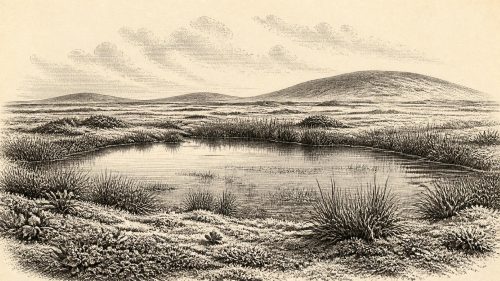
Derryvree’s Sealed Tundra
Archived: 21 September 2026
At around 30,913 BCE, Ireland’s evidence records unstable Ice Age environments rather than identifiable events or communities. Derryvree, County Fermanagh, preserves freshwater organic deposits between glacial tills, dated broadly to 34,950–29,750 BCE, indicating ice-free periglacial wetland with open, treeless vegetation, pools and insects. Cave assemblages, notably Castlepook in Cork, contain remains of mammoth, reindeer, giant deer, predators and cold-adapted mammals, though not necessarily contemporaneous. Crag Cave calcite documents climatic oscillation. A possibly cut-marked reindeer bone suggests, but cannot prove, early human presence. No secure habitation evidence exists; Ireland’s landscape was repeatedly altered, buried and eroded by advancing ice over time.