

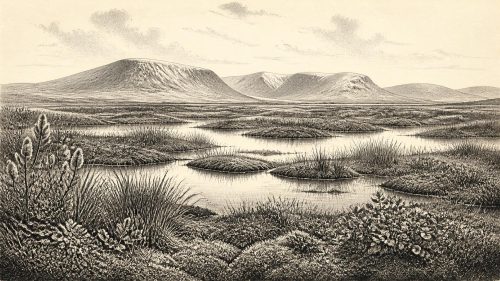
Maguirebridge’s Fossil Bogbean
Archived: 21 September 2026
Around 30,946 BCE, Ireland’s fragmentary record reveals a cold, unstable late-MIS-3 environment rather than identifiable human history. Freshwater deposits beneath a drumlin at Derryvree, County Fermanagh, preserve evidence of locally ice-free, treeless periglacial wetland containing bogbean, dwarf willow, mosses, grasses and aquatic plants. Castlepook Cave, County Cork, yielded remains of mammoth, reindeer, giant deer, lemmings, hyena and other cold-adapted animals, indicating open grazing country. A possibly cut-marked reindeer bone suggests brief human visitation, but does not demonstrate settlement. Advancing and retreating ice shaped conditions, while later glaciers erased much evidence. No communities, farming, dwellings or material culture are securely known.