
Maguirebridge’s Fossil Bogbean30946 BCE
Around 30,946 BCE, Ireland’s fragmentary record reveals a cold, unstable late-MIS-3 environment rather than identifiable human history. Freshwater deposits beneath a drumlin at Derryvree, County Fermanagh, preserve evidence of locally ice-free, treeless periglacial wetland containing bogbean, dwarf willow, mosses, grasses and aquatic plants. Castlepook Cave, County Cork, yielded remains of mammoth, reindeer, giant deer, lemmings, hyena and other cold-adapted animals, indicating open grazing country. A possibly cut-marked reindeer bone suggests brief human visitation, but does not demonstrate settlement. Advancing and retreating ice shaped conditions, while later glaciers erased much evidence. No communities, farming, dwellings or material culture are securely known.
Dateline
30,946 BCE is not a date at which Ireland can be described year by year in the ordinary historical sense. No written record, settlement sequence or securely dated human event permits that precision. The number is a modern calendar convention projected deep into prehistory; it corresponds broadly to a late phase of Marine Isotope Stage 3, during the Midlandian cold stage. The responsible picture is therefore one of ranges, deposits and changing environments. It is a view assembled chiefly from a freshwater bed beneath a drumlin at Derryvree near Maguiresbridge in County Fermanagh, and from animal remains preserved in limestone caves, especially Castlepook Cave near Doneraile in County Cork.
A Date Within a Wider Horizon
Radiocarbon years, calendar years and BCE labels are not interchangeable at this depth of time. The vital Derryvree organic deposit produced a conventional radiocarbon age of 30,500 +1,170/−1,030 years BP, BP meaning before AD 1950. Calibration converts such measurements into a broad calendar-age probability range rather than one secure year; the uncertainty is enlarged by the age of the sample and by the character of the old radiocarbon curve. The date 30,946 BCE should therefore be treated as lying near, rather than exactly within, the environmental world illuminated by Derryvree and other late-MIS-3 evidence. It cannot establish that a particular plant, animal or person was present in that numbered year.
That distinction matters because Ireland’s record is fragmentary. Later glaciers scoured, redeposited and buried much of the landscape. Caves preserve bones, but bones may have been brought in by carnivores, water or sediment movement; open-air surfaces are even less likely to survive. Consequently, the evidence is far stronger for an ice-age environment and its animals than for human communities. It does not support a named people, a polity, a battle, a leader, a religion or a diplomatic order. The appropriate political history for this moment is, bluntly, silence.
Water Beneath a Drumlin
Derryvree is exceptional because roadworks in 1969 cut through a drumlin and exposed freshwater silts and fine sands sealed between two thick tills. In other words, the deposit formed after one episode of glacier activity and before another laid down the material above it. Its preservation offers direct evidence that this part of Fermanagh was locally ice-free long enough for water, sediment, plants and small creatures to accumulate. It does not prove that all Ireland shared the same conditions at precisely the same time, but it is one of the clearest Irish windows onto the cold landscape of this broad period.
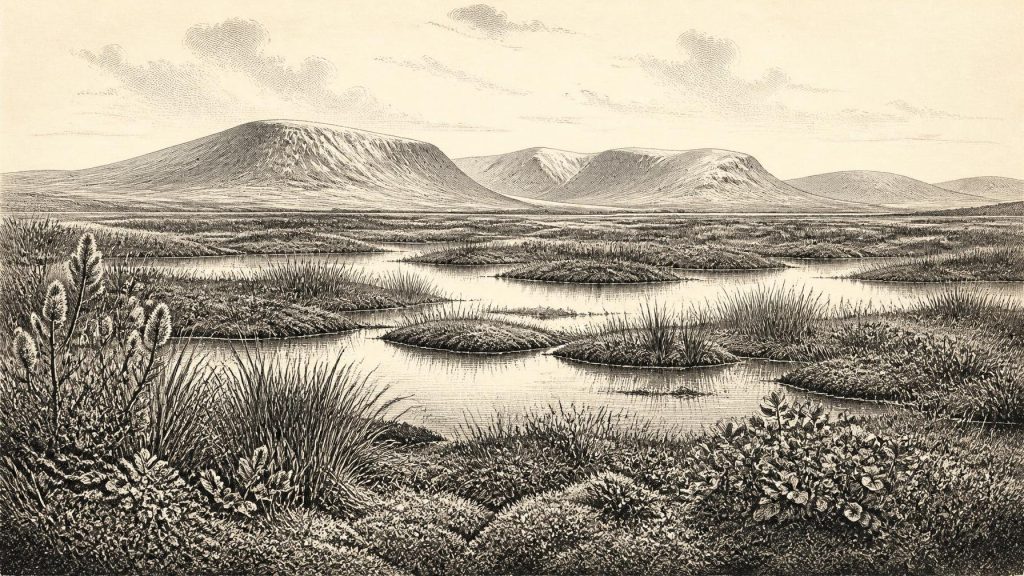
The recovered plant evidence describes an open, treeless periglacial wetland, often termed muskeg: saturated ground with pools, mossy vegetation and seasonally frozen soils. Pollen was poorly preserved, yet grasses, sedges, herbaceous plants and juniper were identified. Plant macrofossils and mosses included bogbean (Menyanthes trifoliata), dwarf willow, mountain-avens, Arctic-alpine clubmoss and aquatic water-milfoil. Together they indicate neither a featureless snow desert nor familiar Irish woodland. Instead, low vegetation occupied damp ground beside shallow, slow-moving or standing fresh water, while drier patches could have been sparse and exposed.
This was a severe but living landscape. Cold winters, frost action and short growing seasons constrained plant cover. Insects and other small faunal remains reinforce the wetland interpretation, while the mixture of aquatic and terrestrial species suggests a patchwork of pools, sedge-rich margins and open tundra beyond. Such evidence is especially valuable because it records what was growing in Ireland itself. It is not merely an inference from climate records in Greenland or from British sites, although those wider North Atlantic archives show that MIS 3 was marked by abrupt climatic oscillations.
An Open Country Fauna
At Castlepook, also known as Mammoth Cave, the evidence takes a different form. Excavation and later study recovered a striking cold-climate fauna: woolly mammoth, reindeer, giant deer, brown bear, wolf, Arctic fox, mountain hare, lemmings and spotted hyena. These animals did not necessarily coexist in one season, or even in one undisturbed deposit. The cave accumulated material over a long period, and modern re-dating has shown that some older determinations needed revision. Nevertheless, the assemblage demonstrates that parts of Ireland supported, at different points before the Last Glacial Maximum, a fauna now unimaginable on the island.
Reindeer and lemmings are particularly important indicators of open, cold habitats; mammoth and giant deer add to the picture of extensive grazing country rather than closed forest. Spotted hyena, represented at Castlepook by bones and a skull, points to a richer predator-scavenger community. A cave was not necessarily anyone’s home: carnivores may have used it as a den or carried in bones, and animals could die in or near its entrances. The fauna therefore tells us much about regional ecology, but less about the exact appearance of a single valley on a single day.
In practical terms, the economy of the landscape was ecological rather than human. Plant growth fed herbivores; herbivores supported predators and scavengers; wetlands supplied specialised plant and insect habitats. Seasonal movement is plausible for grazing animals, especially reindeer, but remains an interpretation, not a mapped migration route. There is no evidence for farming, herding, cereal cultivation, pottery, metalworking, permanent houses or long-distance exchange among people in Ireland at this time. Nor can animal presence alone demonstrate a land route, sea crossing or continuous connection with Britain or continental Europe at any particular moment.
The Human Question
The most provocative object relevant to this era is a reindeer femur from Castlepook reported to bear a deep linear mark consistent with a sharp stone tool used on fresh bone. The bone has been presented publicly as approximately 33,000 years old, raising the possibility of very early human handling or butchery in Ireland. If the mark proves to be a contemporary human cut mark, it would be remarkable evidence for a brief Upper Palaeolithic presence: perhaps a small mobile party processing an animal, whether hunted or scavenged.
But possibility is not settlement history. A radiocarbon age dates the animal bone, not automatically the incision, its maker, the location where the animal died, or the duration of any visit. Castlepook has not produced a securely associated hearth, dwelling floor, burial, tool assemblage or repeated occupation surface of comparable age. Carnivore teeth, sediment abrasion, excavation damage and later disturbance must always be excluded in assessing a marked bone. The sensible conclusion is that late-MIS-3 Ireland may have been visited by people, but sustained human occupation around 30,946 BCE has not been demonstrated.
This caution becomes clearer when set beside firmer later evidence. At Alice and Gwendoline Cave in County Clare, a brown-bear patella with convincing cut marks has calibrated dates of about 12,890–12,678 cal BP, at the beginning of the Younger Dryas. That is much later than the period considered here, but it establishes that the island’s earliest securely evidenced Palaeolithic human activity remains a terminal-Pleistocene question. It should not be retrojected tens of millennia into the Derryvree or Castlepook horizon.
Approaching Greater Ice
The environmental background was unstable. Research on the British–Irish Ice Sheet indicates broad ice growth from about 31,000 to 26,000 years BP, with maximum volume reached much later, around 23,000 BP in one major reconstruction. Ireland around this broad horizon was not simply “under ice”, nor was it safely outside glacial influence. Different regions experienced different conditions, while ice margins, permafrost, meltwater and exposed ground shifted through time. Derryvree’s buried wetland confirms a locally ice-free interval; the tills enclosing it show that this respite belonged to a longer history of glaciation.
Regional change, then, was the central drama. In Fermanagh, freshwater life briefly left a record below later ice-worked ground. In Cork, caves accumulated traces of a cold-adapted animal world. Elsewhere, evidence has been erased, remains undetected or cannot yet be dated closely enough. The future Irish landscape of forests, farms, monuments and kingdoms was not merely absent: the environmental conditions required for it did not yet exist.
For society, culture and learning, the honest record is negative but meaningful. There are no known communities from which to infer households, kinship, language, ritual or artistic traditions. If humans did enter Ireland, their knowledge would have been practical and mobile: reading weather, animals, stone, shelter and seasonal danger. Yet that is a model drawn from wider Upper Palaeolithic Europe, not a fact established by an Irish campsite. Around 30,946 BCE, Ireland’s history is best told through its surviving witnesses: a fossil bogbean seed, a moss bed, a reindeer bone, cave sediments and the advancing shadow of ice.
Primary Sources
- A Middle Midlandian Freshwater Series at Derryvree, Maguiresbridge, County Fermanagh, Northern Ireland
- Palaeoecology
- Figure 6.— The subdivision of the Quaternary Period in Ireland
- Irish Pleistocene Biostratigraphy
- Introduction to the Late Quaternary and Holocene of Northern Ireland
- The Irish Quaternary Fauna Project
- A Reconsideration of the Radiocarbon Dating of the Marine Isotope Stage 3 Fauna from Southern Ireland
- Occurrence of Mammalia Relicts at Site Castlepook Cave
- Spotted Hyena Skull
- Mammoth Cave
- Phylogeographic, Ancient DNA, Fossil and Morphometric Analyses Reveal Ancient and Modern Introductions of a Large Mammal: the Complex Case of Red Deer (Cervus elaphus) in Ireland
- Growth and Retreat of the Last British–Irish Ice Sheet, 31,000 to 15,000 Years Ago: the BRITICE-CHRONO Reconstruction
- The Timing and Magnitude of the British–Irish Ice Sheet Between Marine Isotope Stages 5d and 2
- Trimlines, Blockfields and the Vertical Extent of the Last Ice Sheet in Southern Ireland
- Timing and Pace of Ice-Sheet Withdrawal Across the Marine–Terrestrial Transition West of Ireland During the Last Glaciation
- Sedimentology and Chronology of the Advance and Retreat of the Last British-Irish Ice Sheet on the Continental Shelf West of Ireland
- Pattern and Timing of Retreat of the Last British-Irish Ice Sheet
- First Evidence of a Late Upper Palaeolithic Human Presence in Ireland
- New Insights on the Fauna of Ireland's Younger Dryas and Early Holocene from Alice & Gwendoline Cave
- Revisiting Alice and Gwendoline Cave, Co. Clare: New Light on the 1902 Excavations