Membership is completely free, giving members unlimited access to all available resources, services, features, and benefits without any restrictions or fees.
Welcome back. Sign in to continue enjoying unlimited access to all available resources, services, features, and member benefits at no cost.
Alarm preceded the main outbreak. On 11 February an attempted Fenian raid on Chester Castle in England miscarried. The plan, in which Thomas J. Kelly and Timothy Deasy were involved, aimed to seize arms for use in Ireland. In Kerry, a small disturbance followed soon afterwards. These episodes mattered because they convinced the Dublin Castle administration and ministers in London that a renewed rising was imminent. Parliament therefore prolonged the suspension of habeas corpus in Ireland. This did not suspend all law; rather, it gave the executive exceptional authority to arrest and detain people suspected of conspiring against the Crown without the ordinary safeguards of prompt legal challenge.
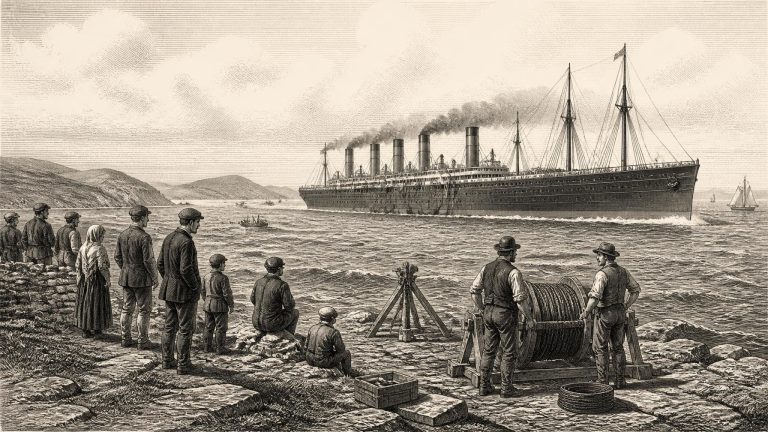
In 1866 Ireland stood at a remarkable intersection of coercion, religious confidence and modern connection. The island was still governed from Westminster through Dublin Castle, and official fears of Fenian conspiracy brought an extraordinary curtailment of civil liberty. Yet the same year supplied striking signs of institutional growth: Paul Cullen became the first Irish cardinal; Alexandra College opened a new path in women’s advanced education; a major Catholic church was dedicated in industrial Belfast; and the Atlantic cable made the remote Kerry coast a gateway for messages between Europe and North America. These were not parts of a single national programme. They belonged to communities with different loyalties, resources and hopes. Together, however, they show an Ireland whose political future was deeply contested while its religious, educational and communications worlds were being remade.
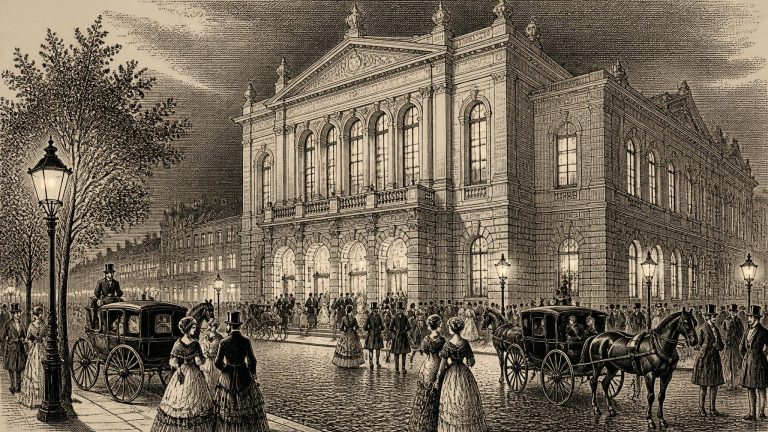
The Dublin International Exhibition of Arts and Manufactures opened on 9 May. The Prince of Wales inaugurated it in an iron-and-glass palace erected on the former Coburg Gardens at Earlsfort Terrace, land made available by the brewer and philanthropist Benjamin Lee Guinness. Its organisers described a purpose larger than trade alone: the building was intended to combine recreation with the improving influence of art. That aspiration belonged to a Victorian confidence in public display, technical progress and civic self-help, but it also had a particular Irish significance. Dublin was asserting its capacity to host an international event on a scale associated with London, Paris and the great industrial cities.
On 1 January 1864, full civil registration of births, deaths and marriages commenced in Ireland. Registration of non-Catholic marriages had existed since 1845, but the new arrangement extended a legal duty to record births and deaths, as well as Roman Catholic marriages. It did not displace parish registers: Catholic clergy continued to create sacramental records of baptism and marriage, while the state compiled its own civil evidence. Nevertheless, the change was important. For families, it meant that birth, death and marriage increasingly became matters documented in standard forms, through local registrars and superintendent registrars, rather than events known chiefly through household, parish and community memory.
The demographic transformation of post-Famine Ireland remained starkly visible. The 1861 census had confirmed that the island’s population had fallen enormously since 1841 through death and migration. In 1863 the outward movement continued on a large scale. Later official figures put emigration from Ireland during that calendar year at 119,788 people, including men, women and children. Departure was not simply an economic statistic: it altered households, removed young adults from villages and towns, and created dense networks of family correspondence, remittances and political contact across the Atlantic.
On 1 January, Edward Harland and Gustav Wilhelm Wolff formally entered partnership in Belfast. Harland, an English engineer and shipbuilder, had taken over the Queen’s Island yard only the year before; Wolff, born in Hamburg and established in Belfast after working in engineering, brought technical ability and commercial connections. The new concern, Harland and Wolff, was still a small enterprise beside the great industrial name it would become. Its significance in 1862 lay not in later-famous vessels but in its position within a growing port economy, where shipbuilding, engineering, linen manufacture, rope-making, warehousing and ocean trade increasingly reshaped the town and drew in labour from across Ulster.
Deasy’s Act was firmly dated: it received royal assent on 28 August 1860. Its central declaration was that landlord and tenant were connected by the express or implied contract between them, rather than by the older language of tenure and service. The Act consolidated a dispersed body of rules governing leases, rents, assignments, notices to quit, ejectment and civil-bill proceedings. It also provided that leases for fixed terms longer than year-to-year tenancies should be made by deed or signed written note. To lawyers and administrators, such regularisation seemed a practical improvement. To many tenants, however, land was not merely a commodity hired at a rent.
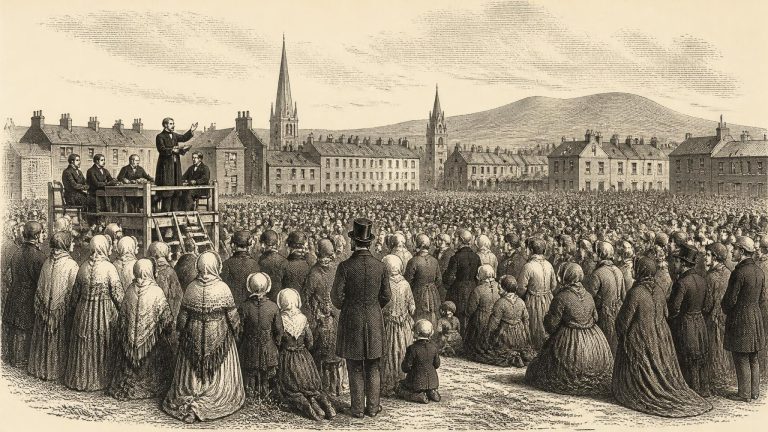
The most conspicuous development within Ireland during 1859 was the Evangelical Protestant revival in Ulster. Its immediate roots lay before the calendar year. Prayer meetings involving young converts had begun at Kells, County Antrim, in late 1857, encouraged by the Presbyterian minister John Hamilton Moore. During 1858 and, especially, 1859, reports of conversions, intense religious feeling, prayer gatherings and crowded services travelled rapidly through Presbyterian networks, newspapers and personal testimony. It was therefore not an event that can responsibly be assigned to one day, but 1859 was unmistakably its year of greatest public visibility.
The best-established political event of the year occurred on St Patrick’s Day, 17 March. James Stephens, a former participant in the Young Ireland rising of 1848, received funding and authority from Irish-American supporters to organise a revolutionary movement in Ireland. That day, he and his associates took an oath directed towards the creation of an independent democratic republic. The body did not at once possess the elaborate membership or nationwide reach associated with later Fenianism, and its early title was not always used consistently. Historians nevertheless treat this moment as the foundation of the Irish Republican Brotherhood.