Membership is completely free, giving members unlimited access to all available resources, services, features, and benefits without any restrictions or fees.
Welcome back. Sign in to continue enjoying unlimited access to all available resources, services, features, and member benefits at no cost.
The United Kingdom general election was held across January and February 1874, with the Irish returns complete by 17 February. The Home Rule League, formed only in late 1873 from the earlier Home Government Association, secured an extraordinary advance. Contemporary and later totals differ slightly: Butt himself spoke of fifty-nine Irish members assenting to the movement’s resolutions, while the usual electoral tally gives the League sixty of Ireland’s 103 seats. The difference reflects the loose character of the alliance and uncertainty over whether particular candidates should be counted as formal Home Rulers, sympathetic Liberals, or independent local figures. What is beyond dispute is the scale of the shift.
The Irish university question had long been inseparable from denominational division. Trinity College Dublin possessed ancient wealth, prestige and a Protestant institutional inheritance. The Queen’s Colleges at Belfast, Cork and Galway, created in the 1840s and linked through the Queen’s University, offered non-denominational instruction. Yet many Catholic bishops and lay leaders regarded the latter arrangement as inadequate, and regarded a Catholic university education under Catholic supervision as essential. The Catholic University, associated above all with John Henry Newman in an earlier phase, did not possess the secure public endowment or degree-granting position its advocates wanted.
The Ballot Act received royal assent on 18 July. Its central principle was simple but far-reaching: an elector marked a ballot paper in private rather than announcing his choice aloud. In Ireland, where elections had often been occasions for deference, intimidation, treating and large public processions, secrecy promised a measure of independence for the voter. It did not make elections fully modern. The electorate was narrow, women could not vote, and candidates and local patrons retained enormous influence. Nor did the Act settle every concern about corruption. But it ended open voting as the normal form of parliamentary choice.
The decisive date was 1 January. Under the Irish Church Act of 1869, the legislative union of the Churches of England and Ireland was dissolved and the Church of Ireland ceased to be established by law. For centuries that church had occupied a privileged legal position despite serving a minority of the island’s people. Its bishops had sat among the Lords Spiritual at Westminster; its ecclesiastical law had legal force; and its property and corporate structures were embedded in the state. The change that took effect in 1871 therefore had a significance beyond theology. It was Gladstone’s attempt to remove a major source of grievance in a country where Roman Catholics were the overwhelming religious majority and Presbyterians constituted another substantial Protestant community.
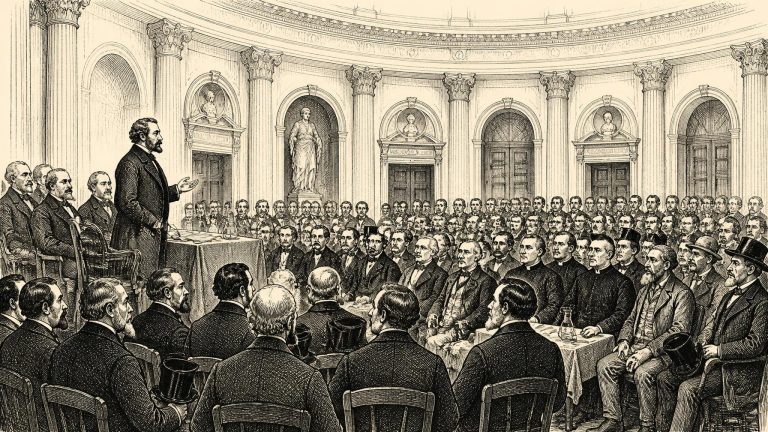
On 19 May, a meeting at Bilton’s Hotel in Dublin established the Home Government Association. Its leading figure was Isaac Butt, a Donegal-born barrister, former Conservative MP and Protestant who had become prominent through his defence of Fenian prisoners and his presidency of the Amnesty Association. The setting and personnel mattered. This was not a clandestine republican organisation, nor simply a revival of Daniel O’Connell’s Repeal movement. Butt sought a constitutional, federal remedy: an Irish legislature to manage domestic affairs while Ireland remained connected to the Crown and empire.
In 1869, Ireland stood at the centre of the first great reforming programme of William Ewart Gladstone’s Liberal government. The year’s defining event was neither an uprising nor an election in Ireland itself, but a Westminster statute with consequences in every parish: the Irish Church Act. Its date of enactment was 26 July 1869. The Act set in motion the separation of the Church of Ireland from the state and from its legal union with the Church of England. Yet it is important to distinguish the Act from its full effect: the Church of Ireland would cease to be established by law on 1 January 1871. Thus 1869 was a year of legislation, preparation and argument rather than an instant remaking of religious life.