

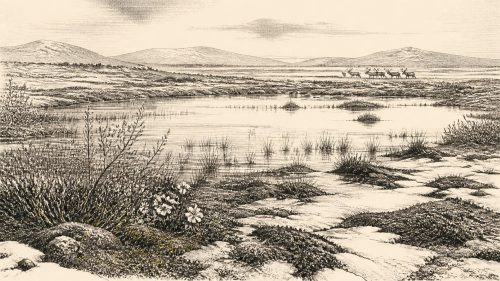
Maguiresbridge Under Permafrost
Archived: 21 September 2026
At 30,947 BCE, Ireland lay within the climatically unstable Late Pleistocene, although no evidence can identify conditions in that exact year. Derryvree, County Fermanagh, preserves freshwater organic sediments between glacial tills, indicating an interval of exposed, periglacial tundra with sedges, grasses, dwarf shrubs, mosses and wetlands before renewed ice advance. Castlepook Cave, County Cork, yielded diverse cold-adapted mammal remains, including mammoth, reindeer and predators, but its disturbed deposits prevent a single-date reconstruction. Ice-sheet growth was underway regionally. A possibly cut-marked reindeer bone suggests, but does not prove, early human visits. Political, social and cultural histories remain unknowable from direct evidence.
