Maguiresbridge Under Permafrost30947 BCE
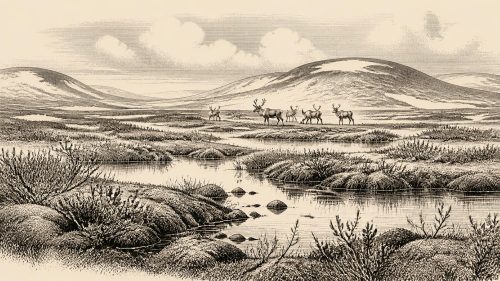
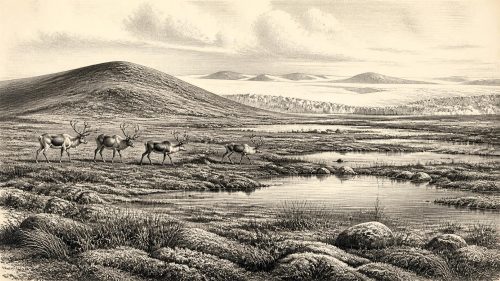
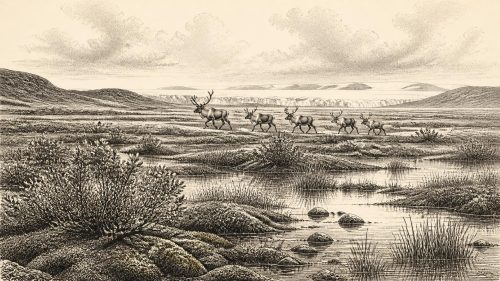
At 30,947 BCE, Ireland lay within the climatically unstable Late Pleistocene, although no evidence can identify conditions in that exact year. Derryvree, County Fermanagh, preserves freshwater organic sediments between glacial tills, indicating an interval of exposed, periglacial tundra with sedges, grasses, dwarf shrubs, mosses and wetlands before renewed ice advance. Castlepook Cave, County Cork, yielded diverse cold-adapted mammal remains, including mammoth, reindeer and predators, but its disturbed deposits prevent a single-date reconstruction. Ice-sheet growth was underway regionally. A possibly cut-marked reindeer bone suggests, but does not prove, early human visits. Political, social and cultural histories remain unknowable from direct evidence.
Dateline
“30,947 BCE” is a modern calendar label, not a date that can be matched to an event in Ireland. At this depth of time, an individual calendar year is beyond archaeological resolution. The label places us roughly 32,900 calendar years before AD 1950, in the later part of the Late Pleistocene and within Marine Isotope Stage 3, a long, climatically unstable phase of the last glacial cycle. Ireland’s evidence is sparse, local and unevenly dated. The responsible history of this moment is therefore not a chronicle of rulers or happenings, but a reconstruction assembled from glacial sediments, fossil plants, animal bones and the changing reliability of radiocarbon measurements.
The closest substantial Irish environmental archive is not necessarily contemporary with this particular numbered year. It is the Derryvree freshwater sequence near Maguiresbridge, County Fermanagh, where roadworks in 1969 exposed silts, fine sands and organic deposits enclosed between two thick sheets of glacial till. The organic material returned a conventional radiocarbon determination of 30,500 +1,170/−1,030 years BP. Calibration and later chronological synthesis place it broadly in the middle-to-later 30th millennium calibrated BP, rather than on a single date. It offers a valuable window onto a cold pre-Last Glacial Maximum Irish environment, but cannot prove that the wetland, its plants or its animals existed in 30,947 BCE itself.
A Landscape Between Ice Advances
Derryvree matters because its structure records change. Till is debris deposited directly by glacier ice: a dense, unsorted mixture of clay, stones and larger fragments. At Derryvree, a lower till was followed by freshwater and organic sediments, then by another till. The simplest reading is that glacier ice had occupied the locality, withdrew or ceased to cover it for a time, and was later replaced by renewed ice. This is not evidence for an entirely ice-free Ireland. It is evidence that at least parts of the northern landscape could, during the wider glacial cycle, contain exposed ground, standing or slow-moving water and living ecosystems between episodes of ice advance.
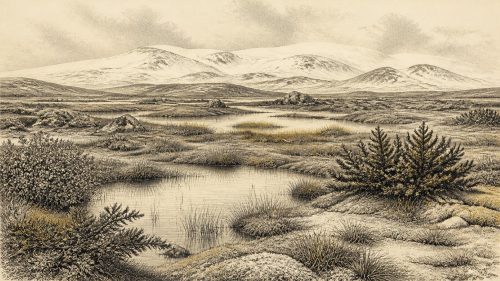
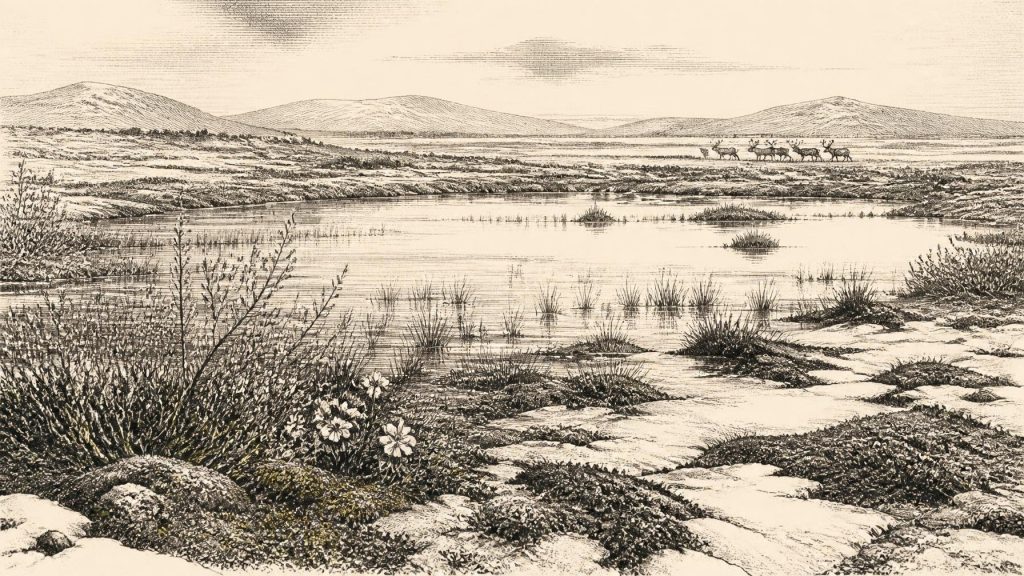
The fossil evidence from the intervening sediments indicates open tundra and a periglacial regime: ground subject to severe seasonal freezing and thawing rather than a forested landscape. Pollen was badly preserved, yet it was dominated by herbaceous plants. Plant macrofossils and mosses add sharper detail. Sedges, grasses, mountain-avens, dwarf willow, juniper and other low-growing plants point towards a treeless mosaic of wet hollows, mossy ground, shallow pools and drier exposed patches. A seed of bogbean, a wetland plant still familiar in Ireland, is especially vivid evidence that freshwater habitats persisted locally despite the cold.
This was not an empty, uniformly white wilderness. In summer, long daylight and meltwater could support a short but productive growing season. In winter, however, frozen ground, wind exposure, limited plant cover and deep seasonal snow would have made conditions exacting. The word “muskeg”, used in descriptions of the Derryvree setting, conveys a moss-rich, waterlogged tundra rather than a peat bog identical to a modern Irish bog. It is an interpretation based on plant, insect and sediment evidence, not a claim that the entire island possessed one unchanging habitat.
Animals in a Fragmentary Record
County Cork provides a complementary, though chronologically complicated, archive. Castlepook Cave, also called Mammoth Cave or Doneraile Cave, near the Awbeg valley, has yielded Ireland’s richest known collection of pre-Last Glacial Maximum mammal remains. Historical excavations recovered bones of woolly mammoth, reindeer, giant deer, brown bear, wolf, Arctic fox, mountain hare, lemmings and spotted hyaena. The combination evokes a cold, open-country fauna very different from modern Ireland, including predators and scavengers now absent from Europe or confined to much warmer regions.
Yet Castlepook is not a census of animals seen together on one day, nor a ready-made reconstruction of 30,947 BCE. Much of the assemblage was excavated in the late nineteenth and early twentieth centuries, when recording standards were inconsistent; deposits had also been disturbed by water, carnivores and earlier digging. Thousands of bones reported from the cave are no longer available for re-examination. The Irish Quaternary Fauna Project used accelerator radiocarbon dating to improve the chronology, while more recent work has shown that some older measurements substantially underestimated the age of specimens. A bone proves that a species reached Ireland; it does not automatically demonstrate that every listed species shared the same place, season or generation.
The cautious conclusion is nevertheless important. During the broader MIS 3 interval, Ireland was repeatedly accessible enough for cold-adapted mammals to colonise it. Their presence implies routes of movement through a markedly altered north-west European geography, but it does not settle the old question of precisely when dry land, ice, sea ice or narrow-water crossings connected Ireland with Britain. Lower global sea levels changed coastlines dramatically, while the form and timing of any usable passage remained dependent on ice, relative sea level and local terrain. There is no warrant for turning this complex palaeogeography into a simple permanent land bridge.
Ice Sheet Build-Up and Regional Change
By around this broad period, the British–Irish Ice Sheet was entering a phase of major growth. Reviews of glacial evidence place its build-up after roughly 35,000–32,000 years ago, with its maximum extent later, approximately 27,000–21,000 years ago. Those ranges are models constructed from many sites, rather than a timetable that can identify conditions in every Irish valley in 30,947 BCE. Still, they explain why the Derryvree sequence is so significant: it preserves a biologically active interval before later ice advanced across or near much of Ireland and scoured, buried or redeposited older evidence.
For people living much later, drumlins, tills, altered drainage and smoothed rock would become conspicuous features of the Irish landscape. At this date, many of the processes that made those landforms were underway or lay ahead. The regional contrast was probably sharp. Uplands, coasts, exposed plateaux, river valleys and lowland basins did not respond alike to advancing ice or thawing ground. Derryvree cannot be projected unchanged onto Cork, Connacht or the east coast; nor can Castlepook’s cave fauna be treated as a map of all Ireland. The strongest lesson is environmental instability, not uniformity.
The Human Question
The human history of Ireland at this depth remains unresolved. A reindeer femur from Castlepook has been reported to bear a deep mark consistent with cutting or chopping by a sharp stone tool, and public accounts have associated the bone with an age of about 33,000 years. If confirmed as deliberate modification of fresh bone, it would be extraordinarily early evidence that people handled an animal in Ireland during the Upper Palaeolithic. It would not, by itself, establish a permanent settlement, a named culture, a local population or continuous occupation.
That distinction is essential. No securely associated hearth, dwelling, stone-tool assemblage, human burial, repeated occupation surface or clearly organised butchery site of comparable age has yet been identified in Ireland. Natural damage, carnivore action, sediment movement and the uncertain histories of old cave collections all require close scrutiny. The Castlepook mark is therefore best treated as a significant research question rather than as proof of a settled community. It is unlike the later, independently dated butchered brown-bear bone from Alice and Gwendoline Cave in County Clare, which provides evidence for human activity at about 12,810–12,590 calibrated BP, near the end of the Pleistocene.
If people did visit Ireland around the wider Castlepook period, they would have been mobile hunter-gatherers whose survival depended on practical knowledge of animals, weather, stone, fuel, shelter and movement through dangerous terrain. That is a reasonable inference from Upper Palaeolithic lifeways elsewhere in north-west Europe. It cannot be promoted to direct Irish evidence. We do not know what language such visitors spoke, whether they came seasonally or briefly, how many there were, or whether they returned. Nor does Ireland preserve art, ornaments, ritual structures or graves from this supposed horizon.
No Politics, But a Material World
There is consequently no evidence for political authority, diplomacy, territorial states, organised warfare or trade in Ireland at this time. To write of chiefs, tribes, alliances or a conflict over hunting grounds would be invention. Even “society” can only be discussed conditionally: small travelling groups may have shared food, skills and seasonal knowledge if people were present, but the Irish record does not reveal their social rules, kinship, beliefs or relationships with other groups.
Religion and learning are equally silent in the direct evidence. The Derryvree sediments preserve neither ritual nor memory; Castlepook’s bones preserve neither mythology nor language. Their value lies elsewhere. They demonstrate that Ice Age Ireland was part of a wider ecological world in which plant communities, large herbivores, carnivores and advancing ice repeatedly reshaped the possibilities for life. The economy visible in the evidence is an ecological one: plants colonising wet ground, herbivores exploiting open vegetation, predators and scavengers moving through the same landscapes, and—only possibly—humans making brief use of animal resources.
A Date Without an Event
The most truthful account of 30,947 BCE is therefore a history of limits as well as discoveries. Ireland was not yet the familiar green, wooded island of later millennia. In places, cold, treeless wetlands and open tundra supported specialised plants and animals; elsewhere, ice and periglacial processes constrained or erased the evidence. Derryvree supplies the clearest local testimony for that world, while Castlepook shows that remarkable mammals reached the island during the wider interval. Whether people were also present remains an important but unproven possibility. This is not a blank page in Irish history: it is a damaged, deeply buried archive, read cautiously through mud, moss, bone and ice.
Primary Sources
- A Middle Midlandian Freshwater Series at Derryvree, Maguiresbridge, County Fermanagh, Northern Ireland
- Palaeoecology: The Middle Midlandian Palaeoenvironment of South Fermanagh
- The Subdivision of the Quaternary Period in Ireland
- The Irish Quaternary Fauna Project
- A Reconsideration of the Radiocarbon Dating of the Marine Isotope Stage 3 Fauna from Southern Ireland
- Extent and Timing of the Last Glacial Maximum (LGM) in Britain and Ireland: A Review
- Growth and Retreat of the Last British–Irish Ice Sheet, 31,000 to 15,000 Years Ago: the BRITICE-CHRONO Reconstruction
- Exploring Controls of the Early and Stepped Deglaciation on the Western Margin of the British Irish Ice Sheet
- The Exploration of Castlepook Cave, Co. Cork
- Archaeological Heritage of County Cork
- Heritage Artefacts of County Cork
- Castlepook Cave, County Cork: Excavation Report 2022
- Mammoth Cave
- Menyanthes trifoliata: Fossil Record in Fermanagh
- Salix herbacea: Fossil Record in Fermanagh
- Dryas octopetala: Fossil Record in Fermanagh
- First Evidence of a Late Upper Palaeolithic Human Presence in Ireland
- New Insights on the Fauna of Ireland’s Younger Dryas and Early Holocene from Alice & Gwendoline Cave
- Dimensions and Chronology of the Last Ice Sheet in Western Ireland
- Deglaciation, Earth Crustal Behaviour and Sea-Level Changes in the Determination of Insularity: A Perspective from Ireland
- The Problem of a Late Quaternary Landbridge Between Britain and Ireland