Glendalough Raids
At a Glance
Raid Record
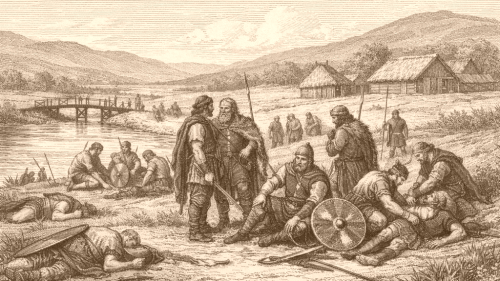
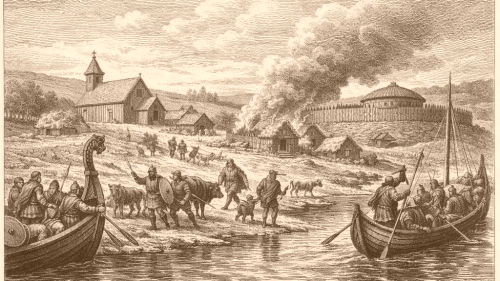
The clearest evidence for the Glendalough raids is the annal entry for 983, which states that Glendalough was plundered by the Foreigners of Dublin. That notice is brief and restrained. It confirms an attack and identifies the assailants in broad political terms, but it gives no casualty list, no description of seized goods, and no explanation for why the valley was targeted. The notice supports the fact of plunder, while leaving the mechanics of the raid uncertain.
The surrounding annal entries place that plundering within a wider pattern of conflict. In 982 the text records the destruction of Kildare by Imar of Waterford, and in 983 it records a battle-rout involving Maelseachnaill and Ímar of Waterford before the Glendalough notice. These entries show a volatile region in which churches and settlements could be struck in quick succession. They do not prove a single campaign against Glendalough, but they do indicate a disturbed political landscape.
Valley Setting
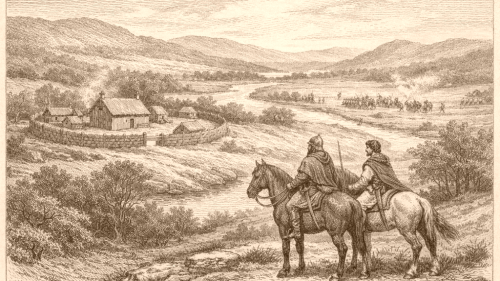
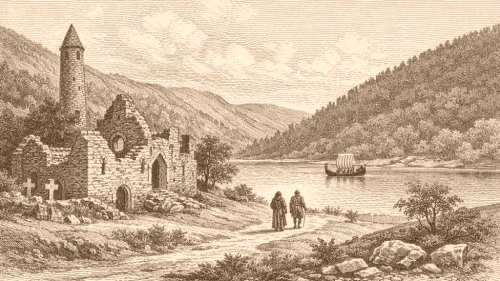
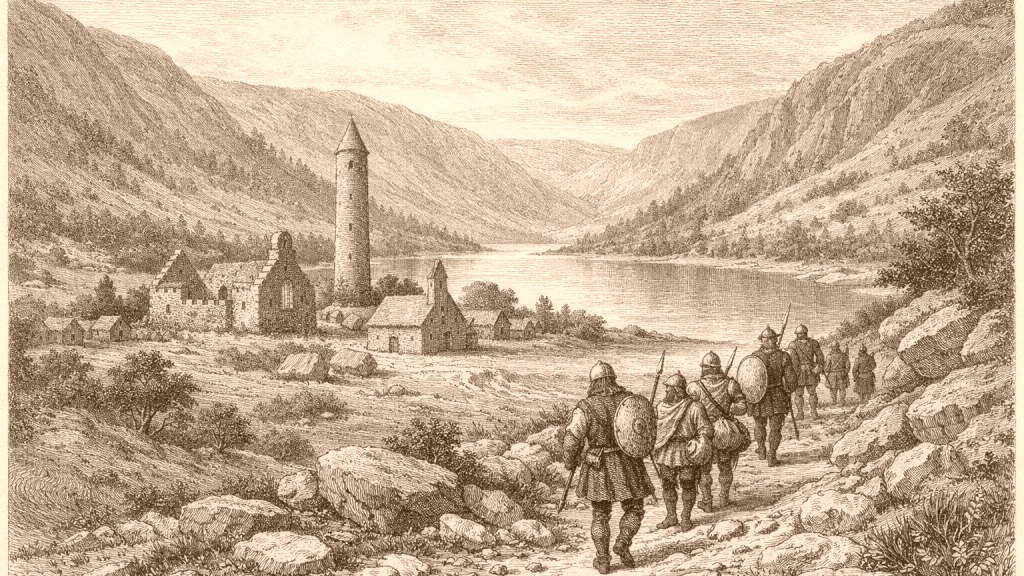
A much later travel narrative helps explain why the valley could be vulnerable. The writer places Glendalough in a thinly inhabited district, with Laragh as the only village across a ten-mile stretch and the mountains described as still more uninhabited. He stresses rocky ground, sparse vegetation, and land used largely for goats. This is nineteenth-century testimony, not medieval description, yet it suggests a landscape difficult to populate densely and easy to move through without leaving much trace.
The same account notes that a military road and barracks were later established through the wilderness, with Laragh barracks standing where three glens meet. That detail belongs to a later state of affairs, but it shows how access into Glendalough could matter strategically. For the medieval raid, this is contextual interpretation only. The later road system does not explain the 983 plundering, yet it reinforces the valley’s exposure and its position within a routeable mountain corridor.
Memory Layers
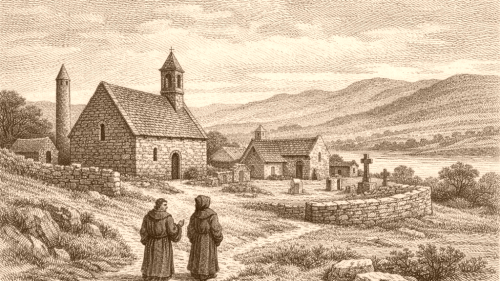
The travel account also preserves Glendalough as a place of ruins, lakes, and remembered sanctity. It describes the Seven Churches, the Round Tower, and the valley as a picturesque scene in which ruins of nature and art stand together. One local guide further claims that a flourishing city once stood there. That claim is presented as local tradition within the narrative, not as independently established fact. The passage is valuable for memory, but not for proving the medieval status of the site.
The same narrative layers literary and royal associations onto the valley through stories, poems, and celebrated visitors. Those details matter because they show how Glendalough gained prestige long after the annal entry was written. Yet prestige is not evidence for safety, and memory is not evidence for defense. The raid remains known through the annal, while the later account mainly shows how the place was imagined and valued in the nineteenth century.
Annal Context
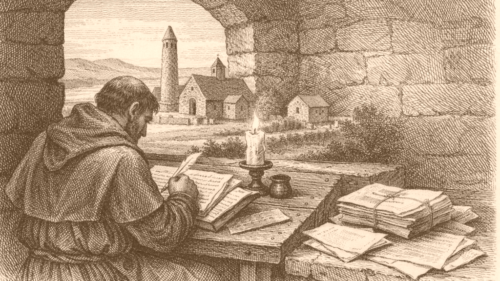
The annals themselves are a mediated textual tradition, and that matters for interpretation. The editorial record for the Annals of Tigernach identifies manuscript sources, an English translation, and a text organized year by year. This does not weaken the Glendalough notice, but it reminds readers that the surviving wording comes through manuscript transmission and modern editing. The raid is historical; the surviving form of the notice is also a textual artifact.
Because the surviving annal entry is so compressed, it should not be expanded beyond what it says. It records plunder, not siege or occupation; it names the Foreigners of Dublin, not a more exact force; and it gives no motive. Any fuller narrative must remain interpretive. The safest conclusion is that Glendalough was important enough to be noted, and vulnerable enough to be raided, even if the scale of the attack cannot be recovered from the brief entry alone.
Historical Limits
The surviving evidence allows a careful but limited reconstruction. In the tenth century, Glendalough appears in a landscape of raiding, rival power, and vulnerable ecclesiastical sites. In the nineteenth century, it appears as a scenic ruin remembered through guide stories and literary associations. Those two kinds of testimony should not be confused. One gives a terse record of plunder; the other shows how later observers invested the valley with romance, memory, and historical wonder.
For the Glendalough raids, the historical answer is therefore narrow but solid. There is explicit evidence for plunder in 983, and contextual evidence for a sparsely settled mountain environment that could shelter both religious memory and insecurity. Beyond that, certainty fades. The raid’s scale, victims, and immediate consequences are not recoverable from the cited record alone, and any broader narrative about cause or aftermath must remain provisional.
Source Witness
The later description of Glendalough is valuable not because it proves the raid, but because it preserves a sense of the valley’s enduring physical isolation. The writer sees mountains, ruins, lakes, and thin habitation, with the church site standing amid a wild setting. That image is centuries removed from the annal entry, yet it helps explain why the valley could be both memorable and exposed in Irish historical consciousness. It is testimony to landscape, not to the raid itself.
Taken together, the annal and the travel account support a restrained conclusion. Glendalough was raided in the tenth century, but the event survives only as a brief notice embedded in a broader chronicle tradition. Later observers turned the place into a landscape of memory and romantic ruin. The historian can recover the fact of plunder and the setting of vulnerability, while leaving the rest marked by uncertainty.