

Irish Art
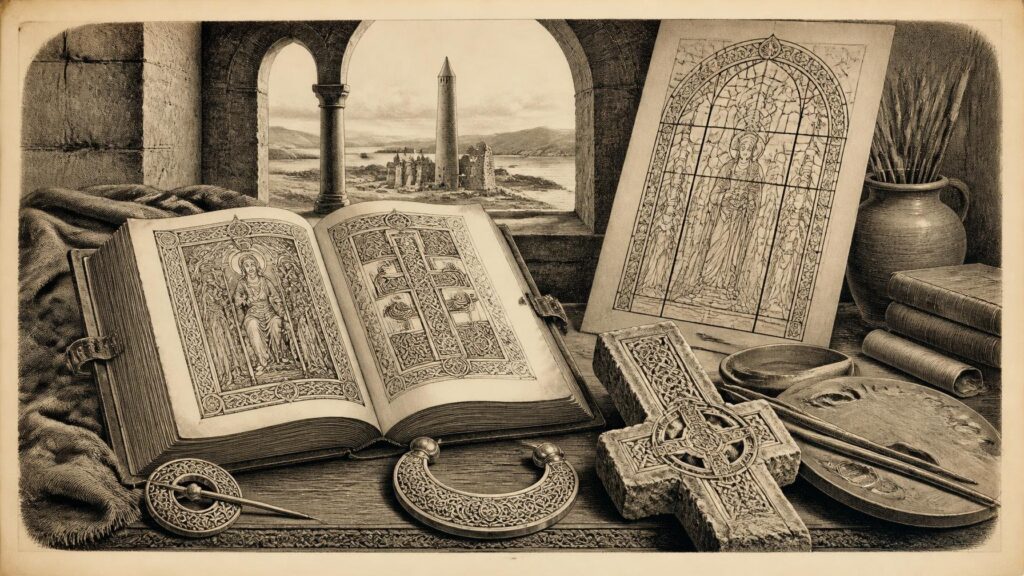
AI generated historical illustration, not a contemporary photograph.
At a Glance
Irish art is not a single style advancing neatly from Celtic ornament to modern painting. It is the long, uneven record of objects, images and buildings made on the island of Ireland, and of Irish makers working elsewhere, under changing conditions of belief, power, trade, migration and patronage. Its history survives unevenly: prehistoric metalwork and carved stone often outlast their makers’ names; medieval manuscripts and church treasures preserve exceptional labour while obscuring ordinary craft; later portraits, landscapes and exhibitions reveal institutions as much as individual genius. To write its history responsibly is therefore to distinguish what objects demonstrably show from what later generations have wished them to mean.
Defining Art
The word “art” can mislead when applied across thousands of years. In modern usage it may suggest autonomous paintings hung in galleries, judged principally by originality or beauty. Much of Ireland’s older visual culture had other purposes. A gold collar could proclaim status; a stone carving could mark a sacred place; a manuscript could make scripture ceremonially present; a chalice could serve the Mass; a portrait might establish family, wealth or political allegiance. Makers often worked within workshop traditions rather than the modern ideal of the isolated artist. Nor did every object now admired as art begin life in that category. The separation between fine art, craft, design and archaeology is itself comparatively recent.
There is also no simple territorial answer to what makes art Irish. Some works were made within the island; some were made by people born in Ireland but trained and employed in London, Paris or elsewhere; some were produced by immigrant artists for Irish patrons; some belong to traditions shared with Britain, western Europe and the Atlantic world. Medieval “Insular” art, for example, was formed through connections among Ireland, Scotland, northern England and continental Europe. Later artists negotiated the realities of the United Kingdom of Great Britain and Ireland, the British Empire, partition, the Irish Free State, Northern Ireland and the Republic. A historical account must preserve these changing settings rather than retrospectively treating the island as culturally sealed.
What may nevertheless be recognised is a recurring interplay between local materials and international contact. Ireland’s gold, stone, wood, wool, glass, paper and later industrial materials were transformed by techniques and ideas that travelled through trade, monastic networks, conquest, colonial administration, art schools and exhibitions. The visual result is often distinctive, but distinctiveness should not be confused with purity. The most compelling works in Irish history frequently arose from encounter: Christian imagery interpreted through existing ornamental habits, European portrait conventions adapted to Irish patrons, continental modernism redirected towards Irish landscape and religious subjects, or international contemporary practice addressing local memory.
Earliest Evidence
The earliest chapter rests principally on archaeological evidence, not written testimony. For prehistoric Ireland, we can identify materials, manufacturing skill, findspots and, sometimes, burial or hoard contexts; we cannot securely recover the thoughts of every maker or owner. It is prudent, therefore, to avoid attaching exact motives to objects whose original social setting has disappeared. The National Museum of Ireland’s archaeological collections preserve a long sequence of artefacts that makes clear that visual sophistication did not await literacy, Christianity or the modern state.
Goldwork is central to this story. Lunulae, torcs, dress fasteners and other ornaments demonstrate remarkable command of hammering, cutting, embossing and decoration. Their thinness, precision and gleaming surfaces suggest both technical expertise and the capacity to command scarce material. Yet labels such as “ritual”, “royal” or “ceremonial” must often remain hypotheses rather than facts. A hoard may have been concealed for safekeeping, deposited as an offering, removed from circulation for political reasons, or left through circumstances now impossible to reconstruct. The objects undeniably show skill and value; their exact meanings are more difficult to prove.
Stone provides another enduring record. Passage tombs and other monuments carry spirals, lozenges, circles and interlocking linear forms. Their survival has encouraged generations to see them as the beginning of an Irish decorative tradition. There is a visual affinity between certain prehistoric designs and much later ornament, but direct continuity over millennia cannot simply be assumed. Motifs can recur because geometric forms are powerful, because later artists studied ancient monuments, or because modern viewers actively connect them. The carvings are evidence of deliberate visual systems; they are not a transparent script whose complete message modern observers can read.
That caution matters because prehistoric art has repeatedly been drawn into national mythmaking. The impressive antiquity of monuments has invited claims about an unbroken native civilisation, often in opposition to later external rule. Such claims reveal much about nineteenth- and twentieth-century politics, but they exceed what the archaeological record can independently establish. The objects deserve attention precisely because they are more than symbols. They are material traces of communities able to organise labour, select striking sites and make images whose visual force still survives even where their original beliefs do not.
Metalwork Mastery
In the centuries before and after Christianity became established, metalworkers developed forms now regularly used to represent early Irish achievement: brooches, hanging bowls, weapons, mounts, shrines and liturgical vessels. The language once commonly called “Celtic” is convenient but imprecise if it implies a homogeneous people or a single timeless artistic culture. Art historians more often describe particular decorative vocabularies, including curvilinear La Tène-derived forms, interlace, animal ornament and geometric pattern. These motifs moved, altered and combined across regions and generations.
The surviving masterpieces are striking partly because they make difficult work appear effortless. A brooch may unite cast elements, pins, bosses, glass, enamel and minute engraved detail. The effect depends on rhythm: spirals lead into curves, creatures dissolve into knots, and tiny compartments reward close looking. Such objects were portable, publicly visible and materially valuable. They could communicate rank at a gathering or make a patron’s resources apparent. It is likely that their visual complexity was socially meaningful, though a modern viewer should resist treating every pattern as coded symbolism.
The later early medieval church transformed the setting in which metalwork was commissioned and preserved. Precious objects could now serve Christian worship, commemorate saints or house relics. This did not mean that earlier artistic habits vanished. Instead, new religious functions met established technical and ornamental knowledge. The result was not a merely decorative “Celtic” overlay upon imported Christianity. It was a creative translation in which the splendour of materials, the power of books and relics, and the prestige of religious communities reinforced one another.
Important survivals include shrines, croziers and celebrated chalices associated with early medieval ecclesiastical culture. Their present condition is often the consequence of later repair, alteration, burial, rediscovery and museum conservation. They should not be imagined as frozen in their first appearance. A treasured object might be reworked over generations, acquiring new components and associations. Its history is therefore both the history of original making and the history of continued care. That long afterlife is one reason why ecclesiastical metalwork occupies such a prominent place in Irish visual memory.
Christian Workshops
Christianity introduced texts, liturgy, new forms of patronage and close relationships with communities beyond Ireland. Monasteries became important centres of learning and production, though it is misleading to picture them as remote, wholly self-sufficient islands of calm. Religious houses were embedded in networks of kinship, landholding, politics and travel. They competed for prestige, received gifts, maintained contacts and were vulnerable to conflict. Art served devotion, but it also made institutional authority visible.
High crosses and other carved monuments demonstrate the public dimension of this visual culture. Their form, scale and placement could organise sacred space and command attention from a distance. Biblical scenes, ornamental panels and crosses appeared together in a medium that could survive weather and changing generations. Interpretation remains difficult where carvings are worn or where modern categories divide “narrative” from “ornament” too sharply. On many monuments, pattern is not marginal decoration but a principal means through which the surface is made active and meaningful.
The familiar story that Ireland preserved European civilisation during a supposedly dark age has great rhetorical appeal, but it is an oversimplification. Irish religious communities unquestionably participated in manuscript culture and missionary connections that extended widely; their intellectual and artistic output was significant. Yet Europe was not simply divided between a luminous Ireland and a fallen continent. Scholarship now places Irish centres within a broad early medieval world of exchange, debate and local variation. The greatness of Irish manuscripts and metalwork does not need an exaggerated civilisational legend in order to be understood.
Equally, the art of this period was not produced only by anonymous monks in a narrow sense. Workshops could involve scribes, painters, parchment preparers, metalworkers, stone carvers and patrons whose individual names are often unknown. The absence of names is a feature of the surviving record, not proof that authorship or skill did not matter. What survives allows us to see collaboration: a manuscript page joins writing, planning, pigments and ornament; a shrine joins skilled metalwork, religious memory and the resources of a community.
Illuminated Pages
Few objects have shaped the public image of Irish art more powerfully than the Book of Kells. The manuscript contains the four Latin Gospels, but its importance is not exhausted by its textual content. Its decorated initials, carpet pages, evangelist imagery and densely animated letterforms make it a major achievement of Insular manuscript art. The Book of Kells is associated in tradition with Colum Cille, yet the manuscript belongs to a later period than the saint’s lifetime. Trinity College Dublin notes that its early recorded history includes a theft from Kells in the early eleventh century, when it was described as the gospel book of Colm Cille.
Its precise place of manufacture remains a scholarly question rather than a point of absolute certainty. The connections between Iona and Kells are important, and the possibility of work begun in one community and completed in another has long been considered. Such uncertainty is not a defect in the history; it is part of the evidence. The manuscript’s later reverence as a relic of Colum Cille tells us much about medieval devotion and institutional memory, whether or not it can establish a direct personal connection to the saint.
The visual language of the Book of Kells is remarkable for the way writing becomes image. Letters expand, contract, twist and grow into inhabited fields of colour and line. Animals, human faces and abstract forms appear at scales demanding sustained attention. It is tempting to call every detail symbolic, but some interpretations are firmer than others. The Gospels, evangelist symbols and Christian subjects provide a clear religious framework. Specific readings of particular beasts, gestures or ornamental structures may be persuasive, but not every meaning can be conclusively recovered. The page rewards both close observation and intellectual humility.
Modern admiration sometimes treats the manuscript as if it were made principally for display in a museum. Its makers worked in a different world. The lavishness of the decoration and the irregularities in the text have encouraged scholars to suggest that it had a special ceremonial or prestige function rather than being designed for routine practical reading. That is an interpretation, not a certainty, but it accords with the book’s exceptional material and visual investment. A gospel book could be a text, a sacred object, a communal treasure and a statement of prestige at once.
Its fame has had consequences. Since the nineteenth century, reproductions, studies, schoolbooks, tourism, design and popular culture have repeatedly turned the Book of Kells into an emblem of Ireland. The process has widened access and inspired makers, but it can also reduce a complex early medieval object to a generic pattern of spirals and knots. The manuscript is most fully appreciated when its extraordinary art is returned to its difficult history of monastic communities, liturgy, loss, preservation and later interpretation.
Viking Encounters
Viking activity altered Irish political and economic life, and its effects on art were neither simply destructive nor straightforwardly assimilative. Raids damaged religious communities and threatened portable treasures, but Scandinavian settlers also established towns and participated in trade networks. Dublin, Waterford, Wexford, Cork and Limerick developed as significant urban centres. Their growth created new settings for craft production, consumption and exchange.
The older narrative of Vikings as enemies of Irish civilisation contains an important element of truth where raids and violence are concerned, but it is incomplete. Archaeology has shown contact, settlement, intermarriage and commercial integration. Art and material culture register these complexities. Imported styles, local responses and hybrid forms make it difficult to divide objects cleanly into “Irish” and “Viking”. Such categories can be useful starting points, but they should not obscure the shared world of craftsmen, traders and patrons.
Urban life also altered the practical conditions of art. A monastery was one kind of centre for making; a trading town was another. Towns brought access to imported materials, customers and patterns of demand different from those of rural religious communities. Craftsmen could make objects for domestic use, trade, display and worship. Although the surviving record favours durable and precious material, it is reasonable to infer that many more everyday objects, painted surfaces, textiles and wooden items once contributed to the appearance of medieval life.
Viking and Hiberno-Norse art has often been absorbed into a broader national story only after its foreignness has been softened. A better historical approach accepts both aspects: Scandinavian settlers introduced cultural connections and practices, while generations living in Ireland became part of the island’s history. The artistic importance lies in the contact zone itself. It shows that Irish visual culture was never an isolated inheritance awaiting later contamination; it was already shaped by movement across the Irish Sea and beyond.
Medieval Patronage
From the twelfth century, political and ecclesiastical changes reshaped the conditions of artistic production. Church reform, the Anglo-Norman invasion, lordship, new religious orders and expanding connections with England and continental Europe all affected buildings, tombs, seals, manuscripts and devotional objects. The period cannot be reduced to a simple replacement of one culture by another. Gaelic lordships persisted, newcomers adapted to local conditions, and patrons commissioned art across linguistic and political boundaries.
Architecture makes this particularly visible. Romanesque and later Gothic forms appeared in churches, monasteries and urban foundations, but imported models were interpreted through available materials, local workmanship and patronal ambition. A church or friary was both a religious place and an assertion of presence in the landscape. Tomb sculpture, heraldry and donor imagery preserved claims about lineage and authority. In such objects, art was inseparable from the social order that paid for it.
The distinction between Gaelic and colonial art is often less stable than later political narratives imply. Patrons could acquire fashions from abroad; craftsmen could move; motifs could be copied between communities. The evidence does not support a picture of two entirely sealed visual worlds. At the same time, power was unequal, and conquest altered landholding, institutions and patronage. To recognise artistic exchange is not to deny domination. It is to acknowledge that art can register unequal encounters without being reducible to one side of them.
Late medieval devotional culture produced objects intended to stimulate prayer, remembrance and intercession. Their later survival was precarious. Reformation, warfare, iconoclasm, changing taste and neglect all affected what remained. Consequently, the modern museum or church treasury is not a complete portrait of medieval Ireland. It is a selective remnant, shaped by accidents of survival and later collecting. What is absent matters alongside what can still be seen.
Reformation Ruptures
The Reformation and subsequent conflicts transformed the visual environment. Religious images and church furnishings became entangled with disputes over doctrine, authority and political loyalty. Some objects were destroyed, concealed, adapted or stripped of their former functions. Others survived because they were valued as precious material, antiquities or family possessions. It is therefore hazardous to describe any later collection as a neutral inheritance from the medieval past.
For much of the early modern period, elite visual culture in Ireland was closely connected to British and European models. Portraiture was especially important. Landowners, administrators, clergy and merchants commissioned images that could record face, costume, property, kinship and status. The painted portrait was not merely a likeness: it was an instrument of representation, often displayed in houses designed to express rank and stability. The sitter’s social power was part of the work’s original meaning.
Landscape, topographical drawing and print likewise expanded the visual ordering of the island. Maps, estate views and architectural representations helped proprietors, officials and visitors imagine land as surveyed, owned and improved. Such images may be aesthetically valuable, but they also belong to histories of plantation, dispossession and administration. A picturesque prospect can conceal labour, poverty and conflict beyond its frame. Reading it historically requires attention to both visual form and the social relations that made its production possible.
There were always makers outside elite patronage, including craftspeople in wood, metal, textile, ceramics and print. Their names are less frequently recorded, and their work was often considered utilitarian rather than worthy of preservation. The archival bias is itself historical evidence. It tells us whose possessions institutions considered worth cataloguing. Recovering a wider art history means looking beyond the conventional canon without pretending that every lost object can be reconstructed in detail.
Colonial Institutions
The eighteenth and nineteenth centuries saw the formation of institutions that would deeply influence what later generations understood as Irish art. Schools, societies, exhibitions, collectors, publishers and museums created professional pathways and standards of taste. They also operated within a colonial polity in which Dublin was connected to London and the wider empire. Artists could gain training, commissions and audiences through those connections, even as the relationship produced profound inequalities and cultural tensions.
The Royal Hibernian Academy became an important exhibition body, while art education developed through formal schools. These institutions offered instruction and public recognition, but they were not neutral. Admission, patronage and critical approval could favour established genres, social networks and masculine authority. Women artists faced particular restrictions despite producing significant work and organising alternatives. Their visibility depended not only on talent but on access to training, travel, studios, money and exhibition opportunities.
The National Gallery of Ireland was founded in 1854, and its existence helped establish a public framework for collecting, conserving and interpreting art. Its holdings include European art as well as a major Irish collection; that duality is historically instructive. Irish artists did not develop in a vacuum, and an Irish national collection has always involved choices about how local work relates to wider European traditions. The gallery’s archives, like those of other cultural institutions, reveal the mechanisms through which artists and works entered public memory.
Cork offers another important institutional story. Crawford Art Gallery traces its collection to 1819, when casts of Graeco-Roman and Neo-Classical sculpture were presented to the Cork Society of Arts. Cast collections could appear derivative to later observers, but they were central to artistic education. They trained students in drawing, anatomy, proportion and the canons of academic art. The subsequent Cork School of Art helped establish a major centre of art education outside Dublin, reminding us that Ireland’s art history has never been only metropolitan.
National Revival
By the late nineteenth century, debates about cultural identity gave art new political urgency. The Irish cultural revival encouraged artists, writers, designers and patrons to search for forms that might express a distinct national character. Early medieval manuscripts, metalwork, folklore, the Irish language, rural life and heroic legend became rich sources of inspiration. This revival generated important work, but it also selected and simplified the past.
The appeal of ancient ornament was understandable. The Book of Kells and related manuscripts offered intricate visual resources that could be adapted for book design, embroidery, stained glass, posters and architecture. Yet revivalist use often detached motifs from their original religious or historical contexts. A pattern that had once belonged to a manuscript page could become a portable sign of Irishness. This was not necessarily dishonest; artistic traditions survive through reinterpretation. It becomes problematic only when adaptation is presented as direct, unchanged inheritance.
The Arts and Crafts movement had a strong Irish expression. Workshops and cooperatives treated design as a cultural as well as economic activity, seeking to dignify skilled labour and create objects that could answer industrial standardisation. The Yeats sisters, Lily and Elizabeth, were important in this field through embroidery, printing and the Cuala Press. Their contribution demonstrates that the revival was not confined to painting or to male public figures. It depended on forms often dismissed as decorative arts, despite their intellectual, commercial and visual importance.
Sarah Purser occupies a similarly significant position. A successful portraitist, organiser and patron, she helped establish An Túr Gloine in 1903 as a cooperative stained-glass workshop. The enterprise trained and supported Irish artists in a medium that joined religious commission, design, craftsmanship and public architecture. Stained glass allowed revivalist interest in colour, pattern and spiritual subject matter to enter churches and other buildings. It also created professional opportunities in a field where women could be central makers rather than peripheral assistants.
National revival art could idealise a rural, Catholic and Gaelic Ireland, leaving less room for urban, Protestant, unionist, working-class or immigrant experiences. It is therefore best seen as a powerful cultural movement, not as a complete description of the island. Its achievements are real: it renewed interest in design, language, print and historical sources. Its limitations are equally real: it could turn selected traditions into tests of authenticity. The tension between inspiration and exclusion remains one of its legacies.
Women Makers
Women were long present in Irish artistic life, but historical accounts often placed them in supporting roles or treated their work as secondary to that of celebrated male painters. The archival record corrects that distortion, though it cannot erase the structural inequalities women faced. Training abroad required money; professional work required studios and networks; reviewing and collecting were dominated by men; domestic expectations restricted time and mobility. To identify women artists is not a gesture of addition alone. It changes the account of how Irish art was made and sustained.
Sarah Purser’s career illustrates the range of roles an artist might occupy: painter, organiser, patron and member of the National Gallery of Ireland’s board. Her work and influence demonstrate that artistic modernity was shaped through institutions as well as canvases. An Túr Gloine further shows the importance of collective production. The finished window may bear an artist’s name, but its realisation depended upon specialised labour, workshop discipline and commission networks.
Women also expanded painting’s formal and thematic range. Mary Swanzy travelled widely and absorbed elements associated with modern European movements; Mainie Jellett and Evie Hone studied in Paris with André Lhote and Albert Gleizes. Their careers challenge any assumption that Irish art encountered modernism only belatedly or passively. They brought international study into conversation with religious subject matter, landscape, design and local exhibition culture.
Jellett’s Decoration of 1923 is a decisive example. Tempera on wood panel, its abstracted shapes and icon-like format unsettled many contemporary viewers when shown in Dublin. Critical hostility is well documented. The hostility was not simply a failure of taste; it reveals anxieties about what art should be, who could define it and whether abstraction belonged within an Irish public culture. Jellett persevered as painter, lecturer and advocate, later helping to found the Irish Exhibition of Living Art. Her story is one of modernism’s contested arrival, not an effortless national acceptance.
Recovery should not turn women artists into a separate appendix. Their work belongs in every period: manuscript and textile labour, patronage, illustration, print, ceramics, stained glass, painting, teaching and administration. The question is not whether women were present, but why conventional histories made their work less visible. A serious account must attend to the institutions that recorded authorship, assigned value and decided which objects entered collections.
Revolutionary Images
The early twentieth century brought political revolution, war, partition and the formation of new states. Art did not stand apart from these events, but neither did it speak in one voice. Posters, cartoons, memorials, commemorative objects, photographs, pageants and illustrations helped make political identities visible. They could simplify complex events into iconic gestures, martyrs, uniforms, flags and landscapes. Such images became part of how later generations remembered the period.
Painting offered more ambiguous responses. Jack B. Yeats is central here, though his relationship to Irish national life cannot be reduced to political illustration. Born in London, he spent formative years in Sligo, trained in England and worked in illustration before settling permanently in Ireland in 1910. His early work often observed rural and urban life with acute attention to character and incident. In later decades, his oils became freer in colour, gesture and atmosphere, producing scenes that are often emotionally intense without functioning as straightforward historical records.
Yeats’s changing style is important because it resists the demand that national art should be illustrative or folkloric. His later paintings can evoke memory, loneliness, music, movement or collective feeling without fixing a single narrative. Works such as The Singing Horseman demonstrate an imaginative rather than documentary energy. The artist remained alert to hardship and social feeling, yet he also sought heightened emotion and transformation. His art belongs to Irish history not because it supplies a simple national image, but because it enlarges what Irish experience could look like in paint.
Independence did not produce a single official artistic language. State commissions, public buildings, educational structures and international exhibitions all created opportunities, but artists debated the value of tradition, realism, religion and modern experiment. In Northern Ireland, art developed amid a different political framework, shaped by regional institutions, unionist and nationalist identities, industrial cities and connections to Britain. Any history that treats “Irish art” as automatically equivalent to the culture of the southern state will miss this complexity.
Modern Experiments
Modernism in Ireland was often received through argument. The country’s artists travelled, studied abroad, saw reproductions and exhibitions, and engaged with European developments; they did not merely imitate them. The key question was how forms such as cubism, expressionism and abstraction might work amid local expectations that art should preserve landscape, religion, social observation or national heritage.
Mainie Jellett’s career makes this negotiation visible. Her Parisian studies gave her a disciplined understanding of abstraction, but her paintings frequently retained links to sacred imagery and natural form. Decoration is essentially abstract, yet its format and palette can recall an icon of the Madonna and Child. The work therefore unsettles an artificial opposition between modern abstraction and spiritual tradition. It is neither a rejection of Ireland nor a decorative revival of the past; it is an experiment in making form, colour and devotion speak differently.
Evie Hone moved between painting, design and stained glass, producing work that likewise joined modernist structure with religious commission. Her career reminds us that modern art in Ireland was not confined to secular galleries. Churches could become sites of serious twentieth-century art, and stained glass could absorb abstraction, colour theory and monumental design. The division between “fine” and “applied” art is again inadequate to the historical reality.
The Irish Exhibition of Living Art, founded in 1943, provided a vital platform for contemporary work when more established institutions were resistant to innovation. Such exhibitions mattered because artistic change needs public space. A modern style does not become historically significant merely when an artist invents it in a studio; it must be displayed, criticised, bought, discussed or rejected. Hostile reviews, alternative societies and debates about standards are therefore part of the history of the work itself.
Modernism was never the only current. Figurative painting, landscape, portraiture and regional observation continued with great force. Nor should innovation be measured solely by formal abstraction. Artists could renew familiar genres through colour, composition, social subject matter or new approaches to materials. The richer account is plural: Irish art after independence contained competing modernities, overlapping traditions and divergent public audiences.
Regional Visions
The west of Ireland acquired exceptional imaginative authority in twentieth-century art. Its coasts, islands, mountains, weather and rural communities became subjects for painters seeking landscape that could appear both particular and emblematic. Yet the west was never merely a symbolic storehouse. It was inhabited, economically varied and connected to migration, tourism, language politics and state policy. Artworks that present it as timeless must be read alongside these realities.
For some artists, western subjects enabled a search for elemental form and colour. Jellett’s later work on Achill demonstrates how landscape could be transformed through modernist structure rather than copied naturalistically. Her horses and waves are animated through rhythm, curved forms and a controlled palette. The local subject did not require a retreat from international ideas. Instead, foreign training and Irish place could become mutually productive.
Regionalism had other forms. Cork’s artistic institutions, Belfast’s industrial and cultural life, Sligo’s associations with the Yeats family, and smaller towns’ schools, collectors and craft traditions all shaped artistic possibility. A Dublin-centred account is convenient because national institutions are concentrated there, but it does not tell the whole story. Artists worked from rural studios, taught in provincial schools, exhibited in local societies and formed networks across the island and abroad.
The very idea of regional authenticity should be handled carefully. It can honour local experience, but it can also turn communities into scenery for urban consumers. The artist’s viewpoint, the conditions of commission and the intended audience affect how a place is represented. A landscape may record close familiarity, but it may also frame land as picturesque, primitive, modernising or politically symbolic. The historical task is not to dismiss such images, but to see the choices they make.
Public Collections
Museums, libraries and galleries have done more than preserve Irish art: they have defined its public canon. The National Museum of Ireland protects archaeological and decorative collections spanning millennia. Trinity College Dublin safeguards the Book of Kells and related manuscript heritage. The National Gallery of Ireland collects, researches and exhibits Irish and European art. Crawford Art Gallery’s collection and educational history anchor a major visual-art tradition in Cork. Each institution makes material available, but each also reflects historical decisions about acquisition, classification, display and value.
Collections can create the impression that history naturally leads to a sequence of masterpieces. In reality, survival is selective. Precious metal is more likely to be retained than everyday wood; elite portraiture is more likely to be documented than anonymous domestic decoration; a work acquired by a public body may become canonical while an equally important work in private hands remains little known. Conservation protects objects, but it cannot replace the lost contexts of use, sound, movement, touch and ritual.
Digital access has altered the relationship between public and object. High-resolution manuscript images, online catalogues and digitised archives allow wider study than earlier generations could have imagined. They also create new risks: a page or painting may be encountered as a detached image, stripped of scale, material texture and neighbouring works. Digital reproduction is invaluable, but it is not identical to the artefact. It should invite closer historical inquiry rather than substitute for it.
Public institutions are increasingly examining their own histories, including the representation of women, the colonial contexts of collections and the boundaries between art, archaeology and design. This work is not a rejection of tradition. It is an effort to make the tradition more accurate. A national collection gains depth when it acknowledges the exclusions that formed it and seeks evidence for makers, audiences and communities previously neglected.
Living Legacies
Contemporary Irish art cannot be contained by an inherited list of motifs. Artists working today engage with migration, gender, language, ecology, conflict, housing, memory, technology and the unsettled histories of the island. They work in painting, sculpture, film, photography, installation, performance, digital media, socially engaged practice and renewed forms of craft. Their relationship to the past may be affectionate, critical, ironic or deliberately distant.
Nonetheless, the older record remains active. Prehistoric gold and carved stone, manuscript illumination, stained glass and modern abstraction continue to offer materials, forms and questions. The strongest contemporary engagements do not merely repeat a Celtic pattern or revive a national icon. They ask what has been preserved, who has been excluded and how a visual inheritance can be used without becoming folklore. Folklore itself has a place in this history, but it must be named as folklore: a later story or shared belief, not evidence automatically equal to an object’s documented past.
The enduring lesson of Irish art is therefore one of complexity. It has been shaped by makers whose names are lost and artists whose archives are extensive; by local skills and international travel; by religious devotion and commercial exchange; by colonial power and cultural resistance; by private patronage and public institutions. It has given visual form to identities, but it has also unsettled them. To see it historically is to resist both the claim that Ireland possesses one immutable artistic essence and the opposite claim that its art is merely derivative.
Its richest works ask for sustained looking. A spiral on a monument, a knot in a manuscript, a sheen of gold, a face in a portrait, a coloured pane in a church, an abstracted horse against an Atlantic wave: each may be beautiful, but each also carries histories of materials, labour, belief and reception. Irish art is not a decorative supplement to Irish history. It is one of the means by which that history has been made visible, remembered, disputed and imagined.
The article’s distinction between material evidence and later nationalist interpretation is valuable when considering prehistoric carvings and the Book of Kells. Recurring spirals, interlace and motifs can create a persuasive sense of continuity, yet the article cautions that resemblance may reflect later study, reuse or modern desire for connection rather than an unbroken tradition. This raises questions about how national identity is constructed through visual culture, especially when museums and popular design elevate certain objects as symbols. How might curators, teachers and contemporary artists acknowledge these associations while conveying the uncertainties, exchanges and changing meanings that shape Irish art’s history?