
Labour Rights
At a Glance
Labour Claims
Connolly repeatedly treated labour as a subject that history had neglected. In Labour in Irish History he says labour should be central to the record of the past, and he links his purpose to the position of Irish workers, their wrongs, and the lessons drawn from them. He also states that Irish history has often been written from the standpoint of the master class, not workers. That is his declared frame, rather than a neutral summary. [1]
The same opening argument sets labour rights within a longer Irish setting. Connolly says Ireland had long been under English control, that before 1649 much of the country rested on communal or tribal ownership of land, and that the forcible break-up of the clan system shifted the struggle away from that social order. In these excerpts, labour rights are not a separate modern issue; they appear inside a history of land, property, and political power. [1]
Wages Protest
Connolly’s discussion of Grattan’s Parliament gives concrete evidence about labour conditions. He cites a 1794 pamphlet reporting day-labourer wages in County Meath of 6d. in summer and 4d. in winter. He also refers to a 1796 advertisement describing 2,000 people in three streets of St. Catherine’s parish as starving. He uses these details to challenge any simple claim that parliamentary prosperity meant comfort for workers. [2]
The same passage also narrows the limits of parliamentary causation. Connolly says that even if one accepts the capitalistic definition of prosperity, such prosperity was produced only in an infinitesimal degree by Parliament. He then points instead to economic development as the true key. Here the evidence is interpretive but explicit: he is contrasting parliamentary claims with a labour-centred reading of who benefited from apparent growth. [2]
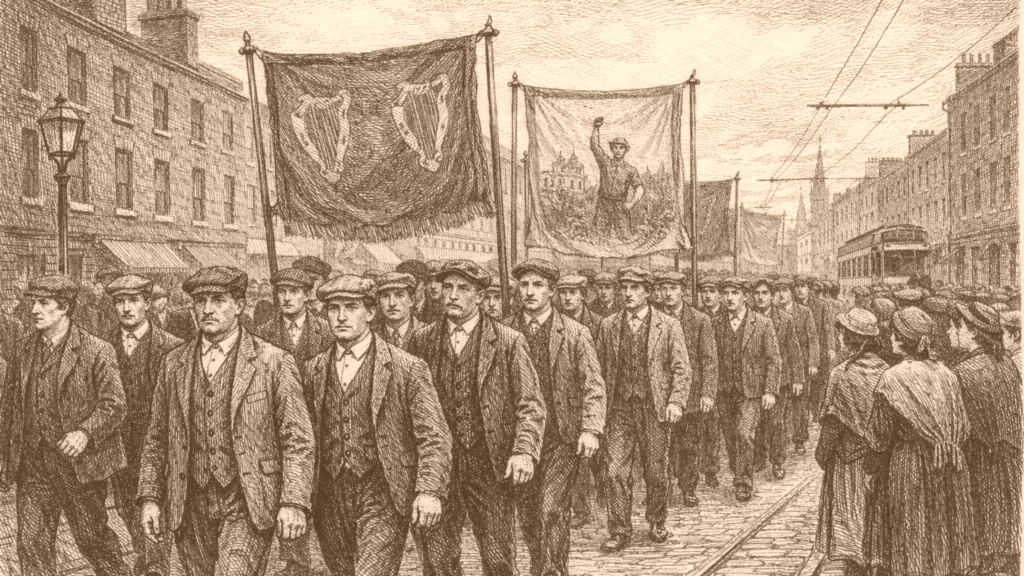
Union Power
Connolly’s account of the Volunteers shows collective organisation before later parliamentary politics. He says the Belfast alarm in 1778 led to a request for military protection, that Dublin Castle replied with only a tiny force, and that people then armed themselves and formed Volunteer corps. He gives a figure of about 80,000 citizen soldiers, financed by private subscriptions, and notes that the Volunteers then turned to reform demands. The sequence is plainly one of mobilisation, organisation, and political pressure. [2]
Later, Connolly says Irish workers and trade unions also showed organisation in the labour sphere. He states that trade guilds existed in Ireland in pre-Reformation days, that they later became exclusively Protestant within the Pale, and that Catholics remained excluded even after emancipation. He then says workmen who were excluded nevertheless organised themselves into trade unions, which dominated the labour world. These are specific institutional claims rather than general praise. [3]
Class Action
Connolly’s 1790s examples place labour conflict alongside wider political unrest. He cites a strike of journeymen tailors in Dublin in January 1792, during which armed tailors attacked strikebreakers and injured them. He also cites organised quay labourers who rescued coal porters from a press-gang by attacking the guard-house and defeating the guard. In these excerpts, labour rights appear as direct, collective action against coercion. [3]
Connolly then connects such action with class consciousness. He says that before political rebellions there was often unrest and discontent among workers, and he presents this as evidence of a link between political and social subjection. The passage does not claim every labour dispute caused rebellion. It does, however, show that he read labour unrest as historically adjacent to rebellion, not isolated from it. [3]
Political Independence
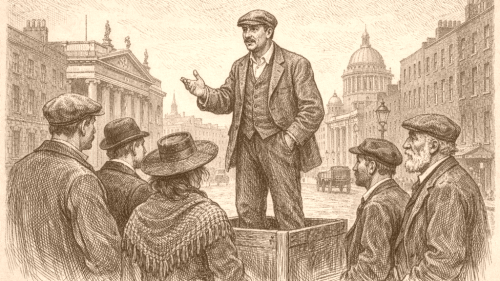
In The Workers’ Republic, Connolly argues that labour should act independently in elections. He says workers formed Labour Electoral Associations after the 1898 reform, sought municipal power from the capitalist class, and rallied on labour rather than party labels. He also states that candidates won across Ireland. This is a description of electoral behaviour, not a claim about an entire political future, but it clearly presents labour rights as bound to independent organisation. [4]
The same passage warns that victory could be weakened by alliance with capitalist factions. Connolly says elected labour men often failed to keep their independence and became attached to capitalist parties. He describes this as a loss of distinct labour politics. The evidence is narrow but clear: he measured labour rights partly by whether workers maintained separate representation rather than subordinating themselves to other interests. [4]
May Day
Connolly’s language in Labour and Easter Week makes the labour movement’s programme explicit. He says its aim in peacetime was to gather into Irish hands, through Irish trade unions, the control of production and distribution. He also insists that the movement never believed freedom would come without fighting for it. In these excerpts, labour rights are framed as control, organisation, and capacity, rather than as a narrow wage question. [5]
He further links labour organisation to docks, shipping, railways, and production. He says the enemy’s power in a conflict would depend on transport control, and he identifies the hopes of Ireland with the rising hopes of labour. The excerpt does not mention May Day by name, and it does not preserve a specific labour-rights manifesto for that day. It does, however, show why a May Day theme fits Connolly’s published argument. [5]
Source References
Hover over a number to see the source. Select it to open the source.

How did James Connolly frame labour rights in relation to Irish political struggle and May Day politics?