
Ireland, 8–14 March 2026: neutrality, security and public memory(c.2020s)
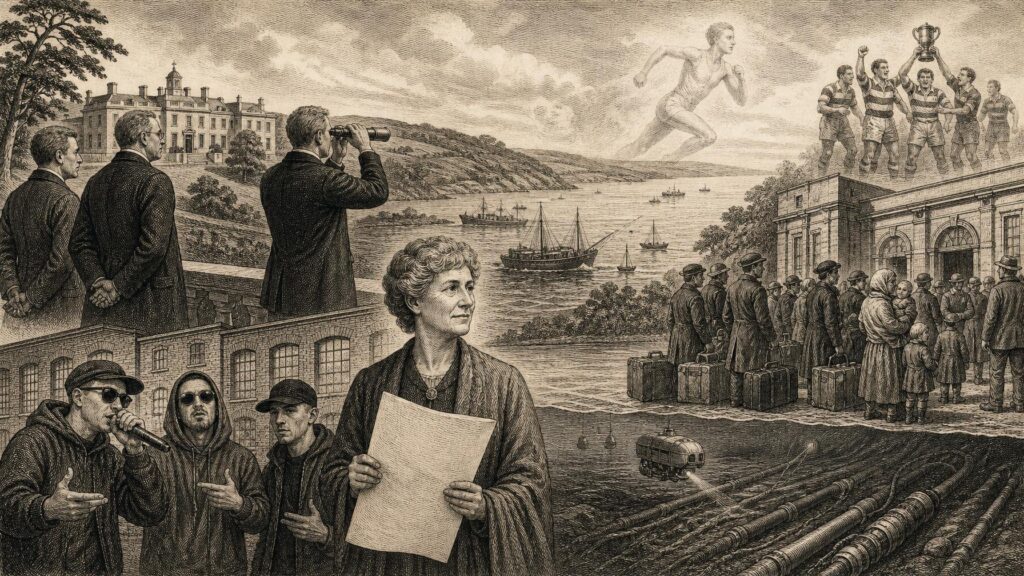
Ireland’s week from 8 to 14 March 2026 was shaped by war abroad and questions of sovereignty at home. President Catherine Connolly’s International Women’s Day appeal to international law tested constitutional boundaries before St Patrick’s diplomacy. In Cork, Micheál Martin and Keir Starmer deepened UK-Irish co-operation on trade, energy and maritime security. The Moriarty saga effectively closed without prosecutions, while IPAS exit letters exposed the housing system’s limits. Ireland mourned Olympic champion Ronnie Delany, celebrated Kneecap’s courtroom victory and watched Andy Farrell’s team claim another Triple Crown, symbols of memory, culture and confidence in public life on the island together.
Dateline
A week when the outside world pressed in
The week from Sunday 8 March to Saturday 14 March 2026 opened with International Women’s Day and closed with Ireland lifting a Triple Crown at the Aviva Stadium. Between those moments lay a dense cluster of developments that said much about the Republic’s anxieties and ambitions: the limits of presidential speech, the revival of structured UK-Irish co-operation, the vulnerability of critical infrastructure, the afterlife of tribunal politics, and the capacity of housing and asylum systems to absorb human need. Northern Ireland, Irish-language culture and sporting memory were also prominent, giving the week a strongly all-island character.
The international setting was unusually severe. The war involving Iran, Israel and the United States had pushed Irish foreign policy, neutrality and energy security from specialist debates into daily political life. In that atmosphere, President Catherine Connolly used her International Women’s Day statement to urge fidelity to the United Nations Charter and Article 29 of Bunreacht na hÉireann, which commits Ireland to peace, international justice and the pacific settlement of disputes. The Áras statement was moral rather than executive, but it was unmistakably political in effect.
Connolly, the Constitution and Irish neutrality
On 9 March the Government responded by stressing that foreign affairs were the responsibility of the Government, not the President. The response was constitutionally conventional, yet historically notable because it signalled a sharper relationship between the new presidency and Government Buildings than had usually been displayed in public. Tánaiste Simon Harris, while emphasising Government authority, also acknowledged Connolly’s right to speak on matters of concern. The exchange became an early test of how an activist president, elected with a strong mandate in 2025, would inhabit a largely ceremonial office during a period of war and great-power instability.
Connolly returned to the same ground at the end of the week through her St Patrick’s Day card, which invoked the UN Charter’s pledge to save future generations from the scourge of war and reproduced the constitutional language on international law. St Patrick’s Day diplomacy traditionally accentuates Irish access in Washington and the value of the US relationship. In March 2026 it also carried unease: Irish leaders were preparing for contact with President Donald Trump while public debate at home focused on the legality and morality of recent military action. The week therefore sharpened an old question in Irish statecraft: how far a small neutral state should go in naming breaches of international law when its economic and diplomatic interests depend on powerful allies.
Fota House and the post-Brexit reset
The practical centre of the week was Cork. On 12 March, Taoiseach Micheál Martin welcomed British prime minister Keir Starmer at Cork City Hall, speaking of geography, history, family, trade and shared responsibility for Northern Ireland. On 13 March the two leaders met at Fota House for the second annual UK-Ireland Summit. The symbolism mattered. After the turbulence of Brexit, the two governments were presenting a relationship of routine, structured co-operation, drawing on the “UK-Ireland 2030” agenda established at the previous year’s Liverpool summit.
The summit’s themes were described as shared prosperity, shared seas and shared ties. They covered investment, research, housing and infrastructure, cultural connection, youth engagement, energy, climate and security. Starmer argued that the volatility of the wider world made good relations between Britain and Ireland more important; Martin framed closer co-ordination as a form of economic security. The meeting was not dramatic in the theatrical sense, but its significance lay in normalisation. Annual summits, ministerial contact and agreed work programmes are precisely the institutional habits that had frayed during the Brexit years.
The summit also produced unease. Protesters gathered in Cork, including critics of both governments’ positions on Gaza and Iran. More substantively, the defence and maritime-security elements raised questions about neutrality. Minister for Defence Helen McEntee said Ireland remained militarily neutral but was not neutral about threats. The renewed defence understanding envisaged more co-operation, including live exercises to test readiness around subsea infrastructure. Supporters saw a pragmatic response to sabotage risks in European waters; critics worried about a gradual alignment with British and wider European security structures without enough democratic debate.
Undersea cables, gas and the new security agenda
By 14 March, Irish Times reporting on Gas Networks Ireland’s submission to the Department of Defence gave concrete form to those concerns. Ireland’s gas network supplied more than 30 per cent of primary energy needs and over 40 per cent of electricity generation, with roughly four-fifths of annual demand coming through subsea interconnectors from Scotland. GNI warned that threats to those interconnectors were a realistic possibility and that a serious outage could take at least six months to repair, create rolling power shortages on low-wind days and impose heavy economic costs.
This was one of the week’s historically important developments because it connected defence policy with ordinary life: heat, light, industry and household bills. Irish neutrality had often been discussed in terms of overseas peacekeeping or alliances; the March 2026 debate centred on cables, pipelines, ports, ships and cyber systems. As Ireland’s maritime area is many times larger than its land mass, the week helped move national-security discussion from abstraction to infrastructure.
The Moriarty saga and the problem of public accountability
Another long historical arc effectively closed on 10–11 March. The Director of Public Prosecutions decided there would be no criminal prosecution of Independent TD Michael Lowry, businessman Denis O’Brien or anyone else arising from the Moriarty tribunal’s final report. The tribunal, established in the 1990s to examine payments to politicians and related matters, had reported in 2011. A Garda and Criminal Assets Bureau investigation followed, but the DPP’s decision ended the prospect of criminal charges from that process.
Legally, the decision illustrated the gap between tribunal findings and criminal proof beyond reasonable doubt. Politically, it revived questions about cost, delay and consequences. The Moriarty tribunal cost tens of millions of euro and occupied public life for decades; yet by March 2026 the criminal-law outcome was nil. Lowry, who has always disputed adverse findings, remained a TD and an influential independent figure. For critics of Irish political culture, the week reinforced a sense that tribunal-era accountability had produced truth of a kind but not closure of the kind many citizens expected.
Housing pressure and the limits of asylum accommodation
On 14 March a different institutional strain came into view. More than 400 families in direct provision centres had received notices from the International Protection Accommodation Service indicating that, because they had refugee status or leave to remain, IPAS accommodation would no longer be available to them from early July. The Dublin Region Homeless Executive had warned of serious pressure on emergency accommodation and asked that such letters to families be paused in 2026. The Department of Justice argued that IPAS could not indefinitely accommodate people who had legal status while new applicants arrived and required accommodation under the State’s obligations.
The dispute showed the collision between three realities: successful protection applicants are no longer asylum seekers; the private rental and social-housing systems cannot easily house them; and the homelessness system is already overstretched. It also highlighted a moral dilemma in public administration. A grant of status should be a moment of security, yet in practice it can begin another period of instability. The issue was historically significant less because of one batch of letters than because it exposed the architecture of a system in which asylum, housing, homelessness and integration policies had not been made to fit together.
Courts, culture and the Irish language
In Belfast on 11 March, Irish-language rap group Kneecap won a major legal reprieve when the High Court in London rejected the Crown Prosecution Service appeal over the quashing of a terrorism charge against Liam Óg Ó hAnnaidh, known as Mo Chara. The case arose from an allegation that he displayed a Hezbollah flag at a London concert in 2024. A lower court had found the proceedings were instituted unlawfully because required consent had not been obtained in time.
The decision was legally technical but culturally resonant. Kneecap have become international symbols of assertive, irreverent Irish-language youth culture, Palestinian solidarity and post-conflict Belfast politics. Their critics view some of their rhetoric and imagery as reckless; supporters see them as victims of an overreaching British state and as evidence of the Irish language’s contemporary force. The celebrations at Conway Mill showed that the case had travelled far beyond one musician and one charge. It became part of a wider argument about language, protest, policing and the boundary between provocation and criminalisation.
Remembering Ronnie Delany and celebrating rugby confidence
The week also brought the death of Ronnie Delany on 11 March at the age of 91. Born in Arklow and raised in Dublin, Delany won the 1,500 metres at the 1956 Melbourne Olympics in an Olympic record time and remains Ireland’s last Olympic gold medallist in athletics. Tributes from Government, Sport Ireland and former athletes underlined his status as a bridge between a poorer mid-century Ireland and a modern sporting nation increasingly confident on the world stage. His victory had given post-war Ireland one of its most enduring images of excellence.
Three days later, Ireland beat Scotland 43–21 in Dublin to secure the Triple Crown, their fourth in five years. France ultimately took the Six Nations title, but Andy Farrell’s side again demonstrated the consistency that has made Irish rugby one of the State’s most visible modern success stories. The juxtaposition was striking: Delany’s solitary Melbourne triumph belonged to an age when Irish global sporting success was rare; the rugby team’s achievement reflected an era of systems, depth and expectation. Together they framed Irish sporting history as both memory and momentum.
What the week revealed
Viewed as a whole, 8–14 March 2026 was a week of thresholds rather than clean endings. Ireland was edging into a more contested security environment while still debating the meaning of neutrality. Its relationship with Britain was being rebuilt through institutions, even as old sensitivities endured. The Moriarty decision closed a prosecutorial door but not the public argument about political standards. IPAS letters turned legal status into a housing question. Kneecap’s courtroom win showed the cultural power of a new Irish-language generation, while Delany’s death and the rugby Triple Crown connected past and present forms of national pride. The week’s central theme was a small state measuring its values against pressure: war, infrastructure risk, housing scarcity, constitutional limits and the long memory of public life.
Primary Sources
- Statement by President Connolly on International Women’s Day 2026
- Power to set foreign policy does not lie with President Connolly, says Government
- President Connolly’s St Patrick’s Day card invokes UN charter on ‘scourge of war’
- Statement between Prime Minister Keir Starmer and Taoiseach Micheál Martin in Cork: 13 March 2026
- Minister O'Brien welcomes shared commitment to decarbonisation at second annual Ireland-UK Summit
- Ireland-UK to enhance defence cooperation in new deal
- Damage to Irish subsea gas pipelines could take ‘six months to fix and lead to power outages’
- No criminal case against Michael Lowry over Moriarty tribunal findings
- DPP decision marks end of decades-long saga that has hung over Michael Lowry and Denis O’Brien
- Hundreds of families told to leave Ipas accommodation despite plea for ‘pause’ over homeless provision
- Court rules no new terror trial for Kneecap's Ó hAnnaidh
- Olympic gold medallist Ronnie Delany dies aged 91
- Sport Ireland Statement on the Passing of Ronnie Delany
- Ireland clinch Triple Crown with victory over Scotland