
Irish Mission635 CE
This article examines the documented 635 mission associated with Aidan, an Irish monk sent from Iona to Lindisfarne at the request of the Northumbrian king Oswald. It separates the Irish monastic background of Aidan and Iona from Ireland itself, and it avoids extending the evidence beyond what is directly attested. The discussion also places Lindisfarne within Northumbria, not Ireland, while noting the later prestige of the site. Because the supplied evidence is uneven, the argument emphasizes what can be proved, where sources overlap, and where later interpretation must remain cautious. The result is a strictly sourced account of early seventh-century connections.
Dateline
Irish Context
The supplied evidence begins with an important distinction: Aidan was Irish, but the mission discussed here did not unfold in Ireland itself. One source describes him as an Irish monk who had studied under St. Senan and then became a monk at Iona about 630, while another identifies him as an Irish monk from the monastery founded by St. Columba on Iona. That matters because the evidence links Aidan’s identity to Irish monastic formation, but the actual setting of the 635 mission was elsewhere. The sources therefore support an Irish connection through person and training, not through the geography of the foundation at Lindisfarne.
The distinction between Ireland and Iona is also visible in the wording of the evidence. Iona is described as an island-monastery off the south-west coast of what is now Scotland, not as part of Ireland. The sources also say that Britain, not Ireland, had belonged to the Roman Empire, which helps explain why the Christian landscape of the islands was already layered and different in each place. For this reason, any account of Aidan’s Irish connections should be careful not to collapse Ireland, Iona, and Northumbria into one undifferentiated Christian world.
Iona Background
Iona is the immediate monastic background for the documented mission. The evidence states that Aidan became a monk at Iona about 630, and that Oswald invited the monks of Iona to send a mission. In the article about Lindisfarne, the wording makes clear that the monks from Iona were the people who came, and that Aidan was chosen from among them to serve as bishop. This is a crucial point: the supplied sources place the mission’s institutional origin in Iona, while the request for it came from Northumbria.
The evidence also suggests that the Iona connection was not merely biographical but communal. One source says Aidan arrived with twelve other monks, while another says he came with twelve other monks and chose to settle on Lindisfarne. That supports the view that this was a monastic group movement rather than the solitary arrival of a bishop. Still, the sources do not preserve the exact internal arrangements of the Iona community before departure, so it is safer to speak of an Iona-trained mission than to speculate about its full organization.
Northumbrian Setting
The location of the mission was Northumbria, not Ireland and not Iona. The Lindisfarne history page states that in 635 Oswald summoned Aidan from Iona to be bishop of his kingdom, and that Oswald granted Aidan and his companions Lindisfarne on which to found a monastery. The same source adds that Lindisfarne lay close to Bamburgh and within the political heart of Northumbria. The evidence therefore places the foundation squarely in the Northumbrian kingdom and ties it to royal authority there.
The evidence also helps define Northumbria more precisely. One source says Northumbria consisted of Deira, centred on York, and Bernicia further north, and that Oswald’s accession in 634 focused power in Bernicia around royal sites such as Bamburgh. That matters because Lindisfarne was not a detached religious colony in an empty landscape; it was placed within a kingdom already organized around kingship and regional power. The article can therefore say that the mission was Irish in personnel, Iona-linked in origin, and Northumbrian in setting.
Mission Account
The exact event documented by the supplied evidence is the 635 summoning of Aidan by Oswald. The Lindisfarne source says that Oswald summoned Aidan from Iona to be bishop of his kingdom, and the Catholic Encyclopedia similarly states that he was selected in 635 as first Bishop of Lindisfarne. Those statements are consistent on the key point: the mission is a datable Northumbrian request answered by an Irish monk from Iona. No supplied source gives reason to move beyond that exact dating, so 635 should remain the fixed anchor for this discussion.
The sources also agree that Aidan’s companions mattered. Lindisfarne history says Oswald granted Aidan and his companions the island, while the Lindisfarne biography says he arrived with twelve other monks. This suggests the mission had a collective religious character from the outset. At the same time, the evidence does not provide a full itinerary from Iona to Lindisfarne, nor does it name every companion, so those details should not be invented in reconstruction.
Monastic Practice
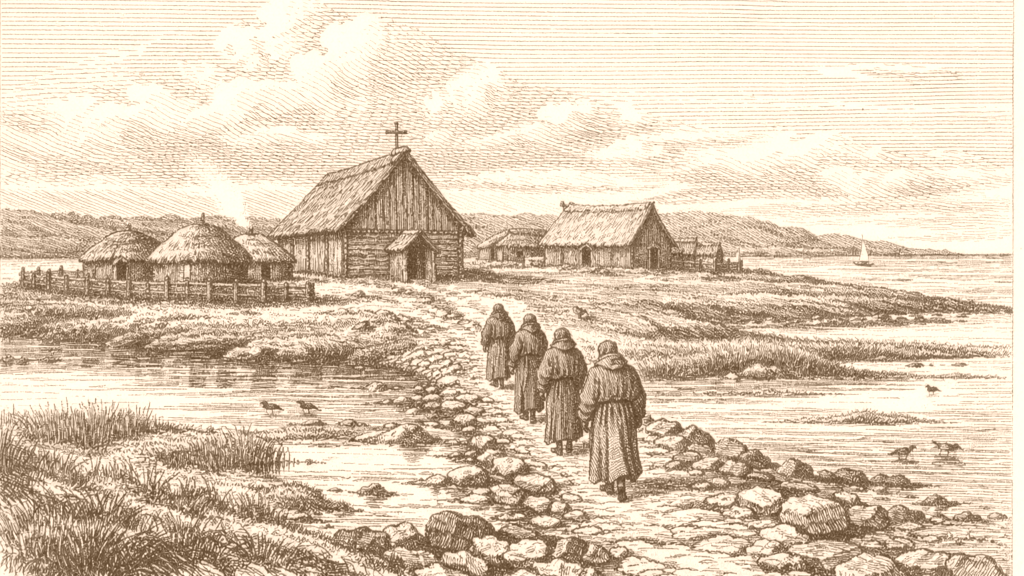
The supplied evidence portrays Lindisfarne as a monastic settlement shaped by Irish practice. One source describes an Irish-type monastery of wooden buildings, including a small church and round dwelling huts, where the monks lived in prayer, study, and austerity. That is useful evidence for the character of the house, but it should not be confused with Ireland itself. The monastery was on Lindisfarne, within Northumbria, even if its religious style drew on Irish monastic models associated with Aidan and Iona.
The same source says the monks went out on mission after learning the English language, and another notes that Oswald had learned Irish in exile. Together, these details explain how a cross-cultural Christian movement could function. Yet the evidence remains limited: it confirms language learning, preaching, and monastic discipline, but it does not preserve a detailed program for daily work or a complete list of early converts. Those broader narratives belong to interpretation rather than directly documented fact.
Learning Tradition
The evidence suggests that teaching was central to the mission’s success. The Lindisfarne biography says Irish monks were keen on Christian education and that Aidan began with twelve boys who would learn by observing and working with older monks. That supports the view that mission and instruction were intertwined. It also shows why the Irish connection mattered: the movement was not only about preaching, but also about building an educated Christian leadership in Northumbria.
Historical Limits
A careful reading also requires noticing where the evidence stops. The supplied texts say Aidan died in 651, and one source gives Oswald’s death in 642, but these dates are not necessary to the central 635 question except as part of the wider chronology of the mission’s later leadership. The evidence also does not establish every stage of Aidan’s early life with certainty. Some details come from biographical tradition, and the article should not present them as equally secure unless the source itself is explicit.
The final historical distinction is therefore conceptual as well as geographic. Ireland supplied part of the ecclesiastical culture and one of the principal actors, Iona provided the monastic base from which Aidan came, and Northumbria provided the kingdom in which the mission was planted. The supplied evidence supports that three-part structure without blending the places together. What can be stated with confidence is the documented 635 summons, Aidan’s Irish monastic identity, his Iona formation, and the Northumbrian setting of Lindisfarne. Beyond that, caution is required.
Conclusion Summary
In sum, the supplied evidence supports a precise statement: in 635 Oswald of Northumbria summoned Aidan, an Irish monk formed at Iona, to become bishop of his kingdom, and granted him Lindisfarne as the site of a monastery. That is the core documented mission. The sources also support a broader but still careful interpretation of Irish influence, since Aidan brought an Irish monastic tradition into Northumbria and worked with companions from the same movement. The evidence does not justify treating Lindisfarne as Irish soil; it was Northumbrian ground shaped by Irish monastic presence.
The proper historical emphasis, then, is on connections rather than conflation. Ireland is present through Aidan’s identity and the wider Irish church tradition; Iona is present as the monastic source of the mission; and Northumbria is present as the kingdom that received and housed the foundation at Lindisfarne. Because the question asks for exact dates and events, the article should remain anchored to 635 and to the summons, leaving later developments aside unless directly supported. That discipline best matches the evidence supplied here.
