

Clements’s Phoenix Lodge
In 1751, Nathaniel Clements became ranger of Phoenix Park and began the lodge later transformed into Áras an Uachtaráin, embodying the Palladian authority of Ireland’s Protestant elite. The shortened legal year, preceding Gregorian reform, altered timekeeping. Architect Richard Castle died, while actor Peg Woffington returned to Dublin’s Theatre Royal, illustrating cultural connections. Debate over Burton’s Bank’s 1733 collapse exposed insecurity. Parliament, dominated by Protestant interests and excluding Catholics, considered revenue, commerce, law, roads and charitable medicine, including Cork Infirmary. These developments reveal a connected Georgian Ireland whose growth, administration and institutions rested upon inequalities of religious, property and political power.
View Record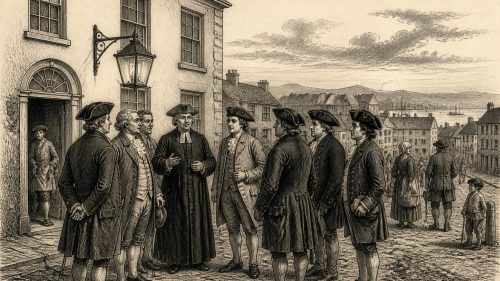
The Missing September
In 1752 Ireland adopted the Gregorian calendar, so Wednesday 2 September was followed by Thursday 14 September, while the civil year now began on 1 January. The reform affected administration, commerce, courts and worship, though no evidence supports later tales of calendar riots. Commissioners for inland navigation were incorporated, signalling ambitions to improve trade despite difficult travel. Dublin gained Ireland’s first purpose-built Methodist chapel; Killaloe and Kilfenora bishoprics were united. Belfast merchants founded the Charitable Society to address poverty amid commercial expansion tied to Atlantic slavery. Under Protestant political dominance, Catholics remained excluded and inequalities persisted deeply across Irish society.
View Record
Boyle’s Surplus and Essex Bridge
In 1753, Ireland’s exchequer surplus provoked a constitutional crisis when the Dublin Commons, led by Speaker Henry Boyle, rejected a debt bill returned from Britain with Crown control over expenditure. The dispute affirmed Commons resistance to executive interference but exposed the limits of parliament under Poynings’ Law, Protestant ascendancy and Westminster’s claimed supremacy; bargaining continued for years. In Dublin, the failing Essex Bridge was dismantled and replacement foundations begun, disrupting traffic while signalling Georgian engineering ambition. Authorities also addressed coal prices, begging, street cleaning and Kildare unrest. George Berkeley died in Oxford, ending an episcopate marked by practical improvement schemes.
View Record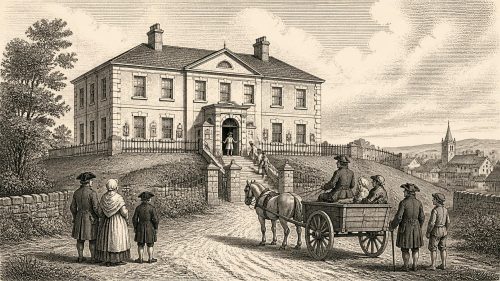
Mahomet, Money and Navan
In 1754, Ireland’s unresolved dispute over public revenue sharpened conflict between the Irish Commons, Dublin Castle and Britain, despite Parliament’s restricted Protestant character. At Dublin’s Smock Alley Theatre, a performance of Mahomet provoked a political riot, damaging the theatre and forcing manager Thomas Sheridan’s departure. Days later, Dillon, Ferrall and Company failed, exposing the fragility of private banking and commercial credit. At Navan, the County of Meath Infirmary, supported by subscription, began providing modest organised care for poor patients. The year also saw notable improvement projects, historical and commercial print, and the death of Irish-language poet Seán Clárach Mac Domhnaill.
View Record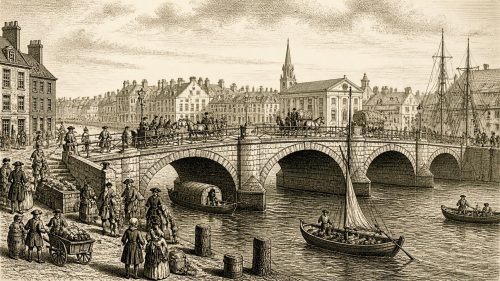
Essex Bridge and Atlantic Waves
In 1755, Ireland remained a Protestant-controlled kingdom constrained by Britain, with Catholics and Presbyterians excluded from political rights. William Cavendish became lord lieutenant as parliament resumed under a narrow electorate. Dublin’s Essex Bridge opened, improving movement across the Liffey, while Luke Gardiner’s death marked his influence on planned urban development. Banking failures exposed fragile commercial credit, despite linen’s importance. Thomas Omer began Shannon navigation works, seeking inland connectivity. Russborough House displayed landed wealth; Moravian activity illustrated religious diversity; and the Irish Artillery Company reflected tensions. Lisbon’s earthquake and tsunami disturbed Irish coasts, damaging Galway’s Spanish Arch and demonstrating Atlantic connections.
View Record
Rocque’s Four Sheets
John Rocque’s four-sheet Exact Survey of Dublin, completed in September 1756, provided an exceptionally detailed record of the capital’s streets, buildings, yards and commercial spaces. Prepared after his 1754 arrival and presented to the Lords Justices, it demonstrated Dublin’s growing administrative and economic importance. The map did not encompass Ireland or alter its entrenched inequalities. Daily life remained shaped by small-scale agriculture, unequal landholding, an expanding linen trade, Catholic disabilities and Protestant landlord power. Nevertheless, 1756 also saw political control shift in Dublin and war with France proclaimed in Ireland, exposing inherited structures to international pressure and closer governmental scrutiny.
View Record
Swift’s Patients, Mosse’s Rotunda
In 1757, Protestant-ruled Ireland remained politically restricted under Poynings’ Law and the penal code, while Dublin witnessed significant institutional beginnings. Lord Lieutenant Bedford’s dispute with John Ponsonby exposed rivalries within the governing Protestant elite, against the background of the Seven Years’ War. Charles O’Conor, John Curry and Thomas Wyse initiated cautious Catholic political organisation, later associated with the Catholic Committee. St Patrick’s Hospital, funded through Jonathan Swift’s bequest, admitted its first patients, while Bartholomew Mosse opened his purpose-built lying-in hospital at Rutland Square. Parliament also authorised the Wide Streets project, initiating statutory urban redevelopment and reshaping access to Dublin Castle.
View Record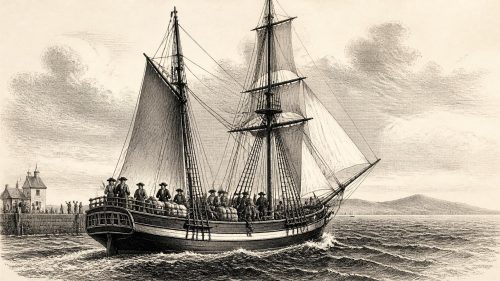
Dublin Trader, Killarney Inns
In 1758, Ireland’s administration relied on proclamations while parliament was repeatedly postponed, revealing tensions over property, livestock and authority. Dublin’s Wide Streets Commissioners became operational, and Grand Canal construction continued, signalling improvement schemes. War shaped fast days and maritime quarantine, while the Dublin Trader wreck killed the Earl of Drogheda, his son and actor Theophilus Cibber. Land reclamation at Ballyconneely and Lucan’s sulphurous spring reflected efforts to exploit landscape. Richard Pococke noted Killarney’s improving inns but Timoleague’s poverty. Mary Shackleton’s birth at Ballitore linked the year to a Quaker chronicler. Records show Ireland reshaped by movement, development, commerce and vulnerability.
View Record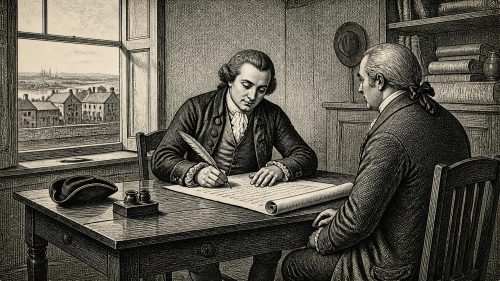
Ponsonby’s Riot, Guinness’s Lease
In 1759, Ireland, a separate but constitutionally restricted kingdom under George II, experienced political unrest and urban change. On 3 December, Dublin crowds invaded Parliament House over a false union rumour, demonstrating Protestant civic patriotism, economic anxiety and expanding popular political engagement. Speaker John Ponsonby helped restore calm, while Henry Flood entered Parliament. Catholics, still excluded from political power, promoted a loyal address to the Crown. Dublin's economy depended on agriculture, linen, trade and regulated industries. Arthur Guinness leased St James's Gate brewery for 9,000 years. Trinity's West Front was completed, and Bartholomew Mosse's maternity hospital survived its founder's death.
View Record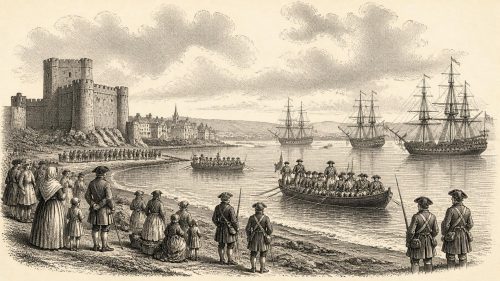
Thurot at Carrickfergus
In February 1760, François Thurot’s French force of about 600 men captured Carrickfergus, requisitioned supplies and threatened Belfast, prompting local defences, negotiations and widespread mobilisation. The raiders departed on 26 February and were defeated two days later off the Isle of Man, where Thurot was killed. The episode exposed Ireland’s coastal vulnerability during the Seven Years’ War. In Dublin, Catholics established a committee to seek cautious relief from penal laws, supported by public debate. George II’s death brought George III’s accession, dissolution of parliament and electoral agitation. Rural insecurity, religious inequality and surviving Gaelic musical traditions also shaped Irish life.
View Record