Yearly Record631 CE
The surviving annalistic notices for 631 CE are brief and uneven. One annal gives only the year heading, while another records the death of Ernaine son of Fiachna and the banishment of Carthach, identified as Mochuda, from Rathain. The Annals of Inisfallen, in its own year entry, names the death of Echaid Buide, the battle of Dún Cethrair, and the slaying of Cáilchíne from Liathmuine. Its bracketed references link the notices to earlier annalistic numbering. No extra event should be added to fill the gap.
Dateline
Yearly Record
For 631 CE, the surviving notices are short and uneven. The Annals of Tigernach preserves only the year heading for T631 in the excerpt here, with no event notice attached in the visible passage. By contrast, the Annals of the Four Masters and the Annals of Inisfallen both supply specific entries for the same year. This makes 631 visible chiefly as a moment of record, not as a year with many securely dated events.
The same material also shows that the year was not recorded in only one way. The Four Masters assigns 631 to the eighth year of Domhnall and then records two notices, while Inisfallen places three notices under its own 631 heading. In both cases, the entries are concise and name particular deaths, a battle, or an expulsion. Nothing in these passages supports adding further events beyond those actually written.
Tigernach Gap
In the Tigernach fragment shown here, the year 631 appears only as a chronological marker: T631.0 gives the year position, but the excerpt does not proceed to a narrative entry for that year before moving on to T632. This is an omission in the displayed passage only. It can be stated securely that the visible Tigernach text provides no event for 631, not that the annal as a whole lacked one elsewhere.
The surrounding Tigernach sequence makes the gap clearer. The preceding year, 630, contains several notices, including battles, a death, the resting of a cleric, a slaying, devastation of Leinster, and a statement that Domhnall son of Aedh rules. Immediately after the 631 heading, the text advances to 632 with another battle entry. The contrast is purely textual: a full year entry in 630, a bare heading in 631, and then fresh material in 632.
Four Masters
The Four Masters gives 631 a compact pair of notices. It states that Ernaine son of Fiachna, chief of Cinel Fearadhaigh, was slain, and that this same Ernaine had killed Maelfithrigh son of Aedh Uairidhnach in the battle of Letherbhe. The passage does not add a date beyond the year heading itself. It therefore supports only those two connected statements and nothing more detailed about the battle.
The same annalistic source also records, under the same year, that Carthach, identified as Mochuda son of Finnall, was banished from Rathain. These are separate notices in the same yearly slot, one martial and one ecclesiastical or institutional in tone. The passage gives no cause for the banishment and no further narrative. Its contribution to 631 is therefore precise but limited to the fact of expulsion.
Inisfallen Entries
Inisfallen offers the fullest set of notices in the evidence here. Under AI631 it records the death of Echaid Buide, son of Aedán, then the battle of Dún Cethrair and the death of Aed son of Cuimíne son of Colgu, and then the slaying of Cáilchíne son of Díma from Liathmuine. The entries are brief and discrete. They identify named people and one battle, but they do not explain causes or outcomes beyond death or slaying.
Inisfallen also attaches bracketed references to these notices, and those references are themselves part of the surviving wording. The death of Echaid Buide is linked to AU 629; the battle of Dún Cethrair is linked to AU 629; and the slaying of Cáilchíne is linked to Tig. and AU 629. Those bracketed links are observable features of the text, but they do not change the year heading under which Inisfallen places the notices.
Named Figures
Across these passages, the named figures attached to 631 are few and specific. Ernaine son of Fiachna appears in the Four Masters, where he is slain and where his earlier killing of Maelfithrigh is also noted. Echaid Buide appears in Inisfallen as a death notice. Carthach, called Mochuda, is said to be banished from Rathain. The evidence identifies persons, not wider groups, and it keeps each notice brief.
The same restraint applies to place names. Letherbhe appears in the Four Masters as the site of the killing connected with Ernaine. Rathain appears as the place from which Carthach is banished. Liathmuine appears in Inisfallen in the slaying of Cáilchíne. Dún Cethrair appears there as the battle site. These toponyms are directly witnessed in the entries, but the passages do not provide descriptions of the places themselves.
Battle Account
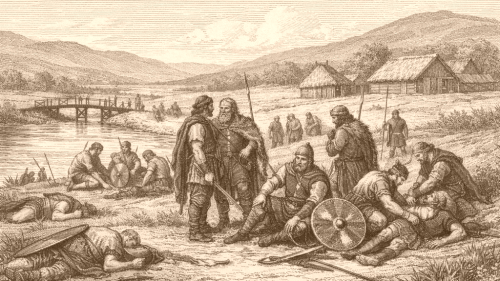
Only one battle is securely dated to 631 in the Inisfallen passage: the battle of Dún Cethrair. The text pairs that battle with the death of Aed son of Cuimíne son of Colgu, but it does not state which side won, who led the fighting, or whether the death occurred in the battle itself. Those stronger claims would go beyond the wording preserved here and should not be supplied from elsewhere.
The Four Masters likewise gives a martial notice for the year, but its wording is different. It says Ernaine son of Fiachna was slain and then relates that he had earlier killed Maelfithrigh son of Aedh Uairidhnach in the battle of Letherbhe. This is a relationship between two events, not a full campaign narrative. It securely dates both items to the same year, while leaving the broader military context unstated.
Cross References
The bracketed references in Inisfallen are part of what can be said about 631. They show that the compiler associated the year 631 notices with earlier annalistic numbering, including AU 629 and Tig. 629. This is a textual comparison visible within the passage itself. It does not permit the further inference that the same events are duplicated in identical form across all annals, only that the linkage is explicitly marked there.
The surviving Tigernach fragment offers a useful contrast without needing any more elaborate argument. Its year 631 heading stands alone in the excerpt, while Inisfallen and the Four Masters preserve named notices for the same year. From these passages alone, the safest conclusion is that 631 survives in an uneven documentary shape: one fragmentary heading, one two-item annal, and one three-item annal with cross-references.
Historical Limit
The evidence for 631 CE is therefore narrow. It securely supports only a small cluster of notices: Ernaine son of Fiachna slain; Carthach banished from Rathain; Echaid Buide dead; the battle of Dún Cethrair; Aed son of Cuimíne dead; and Cáilchíne slain from Liathmuine. No additional event need be added to make the year look fuller. The texts themselves show a sparse record, and that sparseness is part of the historical fact.
What can be written with confidence is limited to the wording of the annals: 631 is a year marked by a few named deaths, one battle, and one expulsion. The texts do not explain causation, alliance, or political consequence in these passages, so such matters should remain unasserted here. The proper historical description is not a reconstructed narrative of the year, but the surviving record of its few securely dated notices.