Comgall’s Passing600 CE
The extant annalistic notices around 600 CE record several deaths, battles, and political killings, but they do not provide a continuous narrative for the year. The entry marked 600 names the deaths of Comgall of Bangor and Uata son of Aed, king of Connacht, and it reports two battles, at Cúil Slemna and Cúil Cóel. The surrounding notices for 599, 601, and 602 show nearby years with similar terse entries. This account separates the securely dated 600 notice from adjacent material and avoids turning silence into conjecture about wider events in Ireland.
Dateline
Year Context
The annalistic sequence places the year 600 between notices for 599 and 601. In the excerpt, the year-marker for 600 is followed by a compact list of events, while the adjacent years carry their own separate lists. That layout supports only a limited claim: the record preserved here assigns the cited deaths and battles to 600, not to the surrounding years. The source gives a dated annal entry rather than a continuous story, so the year must be read as a heading under which separate notices are grouped. [1]
The same excerpted chronology is visible in nearby entries that continue through 601, 602, and beyond. Those lines show that the 600 notice sits within a run of terse annual headings and brief memorial notices, rather than a fuller narrative. On the page itself, the year is expressed by the annal heading and the content under it; nothing in the excerpt explains why these events were selected, or how the compiler ranked them. The safest reading is chronological placement, not explanation. [1]
Annal Record
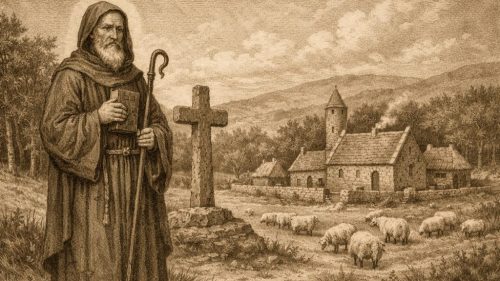
For 600, the most secure facts are Comgall abbot of Bennchor's death and the death of Uata, son of Aod, king of Connacht. The entry also states that Comgall died in his ninety-first year, with a more exact age formula attached to the death notice: "in the 91st year of his age, but in the 50th year and 3rd month and 10th day on the Ides of May rested." No additional circumstances of either death are given in the excerpt, and the two notices are simply placed together under the same year heading. [1]
The same annual notice includes one monastic death and one royal death, and it keeps both within the single year heading. The excerpt does not connect Comgall’s death to Bangor beyond his office, nor does it explain Uata’s death beyond his kingship of Connacht. These are direct statements of death, office, and place in the annalistic list, not broader interpretation. The brevity itself is part of the evidence: the annalist records what happened, but not why, how, or with what consequence. [1]
Kings Deaths
The notice for 600 gives the death of Uata son of Aed, identified as king of Connacht. The surrounding excerpt does not name a killer, a battle in which he fell, or any succession outcome. It is therefore possible to state the death and the title, but not the manner or political consequences from this passage alone. [1]
A nearby entry for 601 records the death of Amalgaidh son of Éanna, king of Munster, and another line in the same year records Fingen son of Aod the Black as king of Munster. These adjacent notices show that the excerpted annals often place royal deaths close together, but they do not make the 600 notice any more specific than it already is. They do, however, show the annalist’s habit of pairing titles with death notices across successive years. [1]
Battle Entries
The 600 entry names two battles: Cúil Slemna and Cúil Cóel. In the first, Colmán Rimid, king of Cenél Eoghain, was the victor and Conall son of Aod son of Ainmire fled. In the second, Fiachaid son of Baetnán was victor and Fiacha son of Deman fled. These are the only battle details securely attached to the year in the excerpt, and they are presented as outcomes rather than as extended battlefield narratives. [1]
Because the annal text gives victory and flight rather than fuller narration, the evidence stops at those outcomes. The excerpt does not identify causes, troop numbers, or the wider setting of either battle. It also does not state whether the two battles were related, simultaneous, or separated by time within 600. The record therefore supports a narrow historical statement: two named engagements, each with a victor and a loser, are attached to the same annal year. [1]
Chronology Notes
The year heading for 600 appears in a modern online presentation of the Annals of Tigernach, while a separate catalogue record identifies The Annals of Clonmacnoise as a printed English translation published in 1896 by Conell Mageoghagan and edited by Denis Murphy. These records show that the annalistic tradition survives in different editorial forms, but they do not alter the content of the 600 annal entry itself. The Clonmacnoise catalogue also identifies the work as an annals-based chronology for Ireland to 1603, which is relevant background only. [1] [4]
A Cambridge chapter on the original chronology of the Irish chronicles and another article on the chronology of St Patrick indicate that chronology remains a distinct scholarly topic. Their titles are the only details visible here, so the safe claim is limited: the year 600 belongs to a broader chronological discussion, but the excerpted annal line still stands as the specific evidence for this entry. The article titles support the point that chronology is a field of study; they do not supply independent detail about the year 600 itself. [2] [3] [1]
Source Limits
The excerpted record for 600 is brief and uneven. It preserves a small set of deaths and battles, but it does not fill every gap that a modern reader might want to close. On the page provided, no further explanation follows the 600 notice, and later or earlier entries cannot be used to invent missing detail for the same year. That limitation matters because annalistic entries often compress years of activity into a few lines, leaving interpretation dependent on what is explicitly said. [1]
What can be stated with confidence is therefore modest: in 600 the annal lists Comgall of Bangor’s death, Uata of Connacht’s death, and the battles of Cúil Slemna and Cúil Cóel with named victors and losers. Anything beyond those statements, including motives, sequence within the year, or wider consequences, remains unsupported by the excerpted text and should be left unasserted. The value of the entry lies in precisely this restraint: it anchors a few events to a year, but it does not narrate the politics around them. [1]
Source References
Hover over a number to see the source. Select it to open the source.