Saint Comgall
Saint Comgall of Bangor is remembered as an early Irish monastic founder associated with Bangor, in what is now County Down. The surviving evidence in the supplied sources places him in the sixth and early seventh centuries and links him especially with the monastery of Bangor, his death or repose being recorded in the annals. Because the evidence comes through annalistic notices, later saintly texts, and modern summaries, it is best to keep to what the sources directly support: Comgall was a monk, abbot, and founder remembered in connection with Bangor and with a wider network of Irish ecclesiastical memory.
Dateline
Saint Comgall of Bangor is remembered as an early Irish monastic founder associated with Bangor, in what is now County Down. The surviving evidence in the supplied sources places him in the sixth and early seventh centuries and links him especially with the monastery of Bangor, his death or repose being recorded in the annals. Because the evidence comes through annalistic notices, later saintly texts, and modern summaries, it is best to keep to what the sources directly support: Comgall was a monk, abbot, and founder remembered in connection with Bangor and with a wider network of Irish ecclesiastical memory.
Life Dates
The clearest date evidence in the supplied material is that Comgall was born in either 516 or 520. One source also gives the year of his death as 602, with the Annals of Ulster preserving the notice “Repose of Comgall of Bennchor” under that year. A different annalistic note in the same source set records “repose of Comgall” in 601 as well, showing that the surviving chronological tradition is not entirely uniform. The safest summary is that Comgall lived in the sixth century and died around 601 or 602. The sources do not provide secure contemporary detail about his childhood, family life, or early training, so those matters should not be expanded beyond the evidence.
Bangor Founding
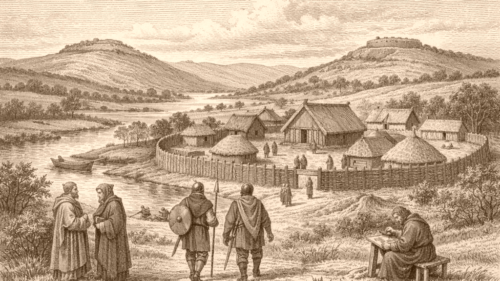
According to the supplied sources, Comgall founded the monastery of Bangor in 555. Another local heritage source states that he established Bangor Abbey in 558 AD. These dates differ slightly, so the article should simply note that the foundation is placed in the middle of the sixth century. Bangor soon became one of the most influential monasteries in Ireland, and the evidence given here specifically says that nearly all the early abbots appear in the Annals of Ulster and the early Irish martyrologies. That is a strong indication of the monastery’s place in ecclesiastical memory, but it is better to avoid broader claims about its full social or cultural influence unless they are directly supported.
The supplied evidence also says that Bangor was particularly associated with the Dál nAraide. It had links with other places as well, including Scotland, Leinster, and Derry. One source mentions that Mael Ruba, an abbot of Bangor, established the monastery of Applecross in 673, while other named links include Ard Crema in County Wexford and Camus. These references show that Bangor’s connections were not only local, but the article should stay close to the specific links attested in the sources rather than generalizing about a broad mission or empire of influence.
Comgall Memory
Comgall appears several times in Adomnán’s Life of Columba. The source list identifies passages at VC 1.49, III.13, and III.17, including a scene in which Comgall appears with Brendan, Cainnech, Cormac, and Columba on Hinba. This is important evidence for how later hagiography remembered him, but such texts are devotional and literary, not straightforward biography. They do, however, confirm that Comgall was counted among the prominent holy men of the age.
The supplied evidence also says that in Comgall’s own Life he founds a monastery on Tiree, described there as “in regione Heth.” This is another hagiographical tradition that should be presented as tradition, not as an independently verified historical event. The same source says that he is claimed as one of the 12 apostles of Ireland and is equated with the apostle James in later tradition. These titles reflect honor and devotional status rather than a formal historical office, so they should be understood as part of his saintly memory.
Another important witness to his memory is the Antiphonary of Bangor, described in the supplied evidence as one of the earliest known texts from the Irish church and containing hymns in Comgall’s honour. A local heritage source also says that the Antiphonary of Bangor is an ancient Latin manuscript believed to have been written in Bangor in the seventh century. The same source identifies it as older than the Book of Kells and as one of the most precious surviving witnesses to the Irish Church in Ireland. These statements support the importance of Bangor in manuscript tradition, but they do not require additional claims about the size or character of Comgall’s own monastery beyond what the sources actually say.
Later Tradition
The same source set preserves a few further traditional details. The tract on the mothers of saints claims that Comgall’s sister was the mother of Mael Ruba of Applecross. This is a genealogical and hagiographical tradition, and it should be treated cautiously. The evidence also notes that Comgall was associated with the Dál nAraide in genealogical material and that he was especially claimed as their saint. In the martyrological material, his feast day is given as May 10, with several forms of his name preserved, including Comgall of Bangor and Comgall Bennchair.
What can be said securely is therefore limited but meaningful. Comgall was born in the early sixth century, founded Bangor in the middle of that century, was remembered in annals at his death or repose around 601 or 602, and remained present in Irish ecclesiastical memory through martyrologies, hagiography, and the Antiphonary of Bangor. The sources support his standing as a significant monastic figure, while leaving many details of his personal life beyond certain recovery.
Source References
Hover over a number to see the source. Select it to open the source.