Newtownabbey
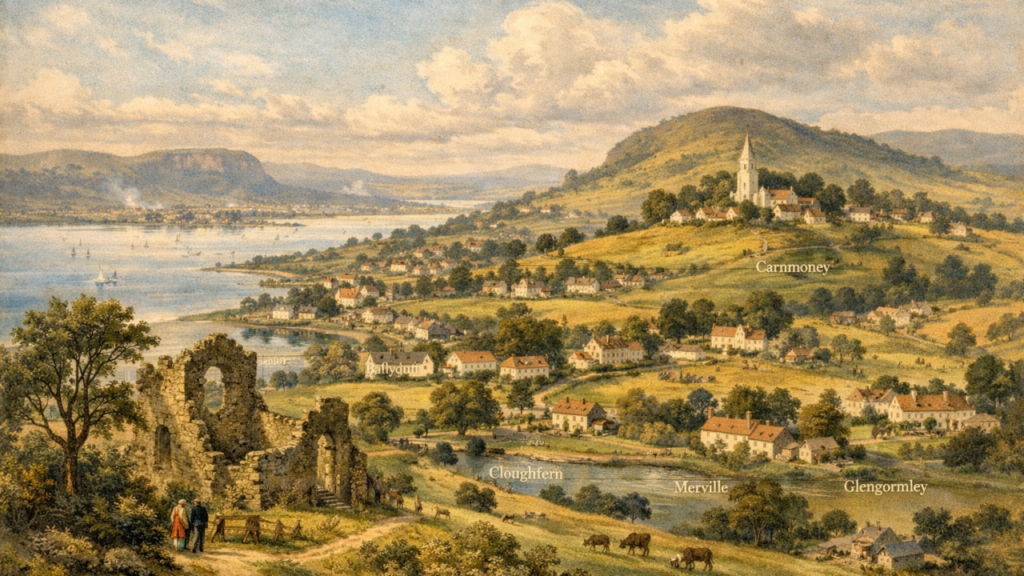
Newtownabbey is a modern settlement-name for the grouped communities north of Belfast, in historical County Antrim 12. The Gazetteer of British Place Names describes it as a large dispersed town surrounding Carnmoney Hill in County Antrim, while Logainm places the settlement within county Aontroim/Antrim and the civil-parish framework of Carnmoney/Carn Monaidh 12. The historical record also shows that Newtownabbey was treated as a place-name worthy of specialist study by the late twentieth century: Irish History Online indexes an article titled “Some place-names of Newtownabbey” in the Carrickfergus & District Historical Journal (1988), confirming that the settlement-name and its local components were already established subjects of local historical and onomastic research 3.
Dateline
Historical identity
Newtownabbey is a modern settlement-name for the grouped communities north of Belfast, in historical County Antrim 12. The Gazetteer of British Place Names describes it as a large dispersed town surrounding Carnmoney Hill in County Antrim, while Logainm places the settlement within county Aontroim/Antrim and the civil-parish framework of Carnmoney/Carn Monaidh 12.
The historical record also shows that Newtownabbey was treated as a place-name worthy of specialist study by the late twentieth century: Irish History Online indexes an article titled “Some place-names of Newtownabbey” in the Carrickfergus & District Historical Journal (1988), confirming that the settlement-name and its local components were already established subjects of local historical and onomastic research 3.
Name forms and variants
For the settlement itself, Logainm records the Irish form Baile na Mainistreach alongside English Newtownabbey 2. The same Logainm hierarchy also records the related local name An Mhainistir Fhionn / Whiteabbey, showing that the wider Newtownabbey area preserved older abbey-linked naming in Irish and English forms 2. This is useful historically because it demonstrates that the present settlement name sits among older ecclesiastical and vernacular place-names rather than replacing them wholesale 23.
In historical county terms, the place belongs to County Antrim; that assignment is explicit in both the modern gazetteer and Logainm’s county field 12. The evidence consulted supports the settlement identity, the historical county, and the recorded Irish-language and variant forms 123.