Cullybackey
Cullybackey is securely identifiable in historical reference works as a village in County Antrim. Samuel Lewis’s Topographical Dictionary of Ireland (1837) describes “CULLYBACKEY” as a village in the parish of Ahoghill, barony of Lower Toome, county of Antrim, noting its situation on the River Maine, about 3 miles from Ballymena, and describing a Presbyterian place of worship and linen manufacture there 1. This confirms both the settlement and its historical county assignment in a nineteenth-century gazetteer. Modern Irish place-name authority also records the settlement under the bilingual form Coill na Baice / Cullybackey, placing it in county Antrim, barony of Toome Lower, and the civil parish of Craigs 2.
Dateline
Historical settlement
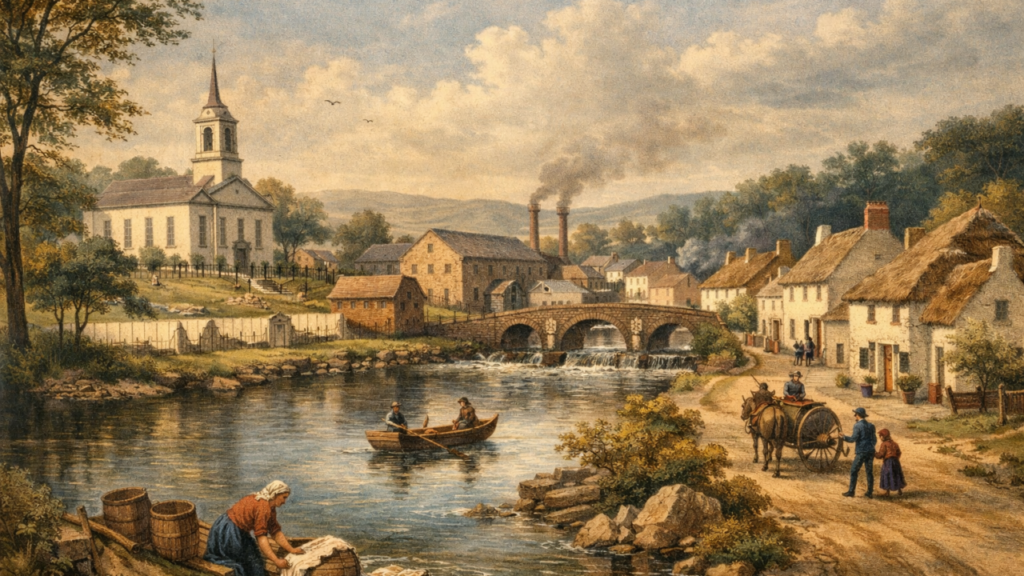
Cullybackey is securely identifiable in historical reference works as a village in County Antrim. Samuel Lewis’s Topographical Dictionary of Ireland (1837) describes “CULLYBACKEY” as a village in the parish of Ahoghill, barony of Lower Toome, county of Antrim, noting its situation on the River Maine, about 3 miles from Ballymena, and describing a Presbyterian place of worship and linen manufacture there 1. This confirms both the settlement and its historical county assignment in a nineteenth-century gazetteer.
Modern Irish place-name authority also records the settlement under the bilingual form Coill na Baice / Cullybackey, placing it in county Antrim, barony of Toome Lower, and the civil parish of Craigs 2. The entry gives the Irish-language form “Coill na Baice” and shows that the place-name is now standardised in Irish with the English form retained as the ordinary name. The same authority also places the townland and population centre under this name, reinforcing that Cullybackey is not merely a loose locality but an established named settlement 2.
Name forms and historical spelling
Historical writing preserves spelling variation. The Vision of Britain gazetteer records earlier usage of “CULLYBACKEY” and the variant “CULLYBACKY” in John Bartholomew’s Gazetteer of the British Isles (1887), alongside Lewis’s 1837 form 3. That evidence shows that the name’s orthography fluctuated in printed nineteenth-century sources, while the core settlement identity remained stable. The Irish-language form now preferred by the place-name authority, Coill na Baice, provides the historical-linguistic context for the English name as it appears in later gazetteers 23.
What the historical record supports
On the evidence consulted, Cullybackey was historically a village in County Antrim, associated with the parish of Ahoghill and Lower Toome in Lewis, and later standardised by Irish-language place-name scholarship as Coill na Baice in the Craigs civil parish 12. The historical references also show that the settlement was recognised for linen manufacture and a Presbyterian congregation, which aligns with its role as a local village in the nineteenth century rather than a larger market town 1.