Start Exploring
Choose a route into Ireland’s past: follow the newest additions, find a particular year or subject, or browse every available period.

Day By Day
Welcome to Emerald Archives, where Ireland’s past awaits discovery. Our homepage brings you the latest additions to our growing collection, from remarkable people and historic places to pivotal events and forgotten traditions. Browse our newest discoveries and follow the archive’s progress day by day.
Deep Research
When you ask, we listen and respond. Enter a question about any aspect of Irish history in our search box (above) to initiate Deep Research. Give us a few moments, and we’ll prepare a detailed, illustrated article with sources and citations to answer your question. Your article becomes a permanent part of Emerald Archives.
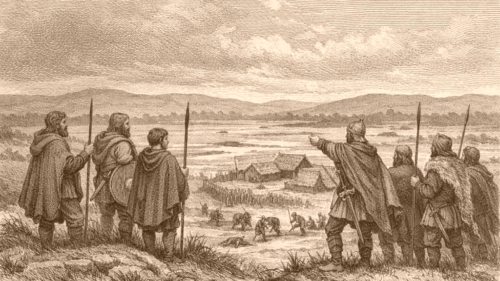
Frémainn Battle
Archived: 20 November 2026
The surviving annalistic notices for this year are sparse and not fully aligned. Ulster places a battle at Fréamu in AD 509 and names Failge Berraide as victor over Fiacha son of Niall. Tigernach records the battle of Fremainn in Meath under a nearby sequence, and Inisfallen places a similar battle of Frémann of Mide under AI508 while naming Rus Failge as victor. The notices show a close cluster of related battle entries, but also clear chronological uncertainty.
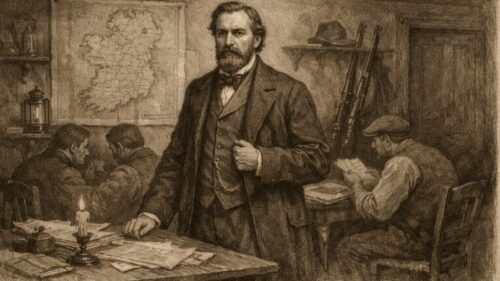
James Stephens, Fenian
Archived: 20 November 2026
James Stephens was born in Kilkenny about 1828, according to one archival description. That same source says he was present at the Rising in Ballingarry, where he was slightly wounded, and that he escaped to France afterwards, meeting John O’Mahony there. It also identifies Stephens as the founder of the Irish Republican Brotherhood, which was founded in Dublin on St Patrick’s Day 1858. The University of Galway archival description similarly says that Stephens returned to Ireland, secured employment as a teacher of French and Italian, and kept up correspondence with nationalists in the United States.
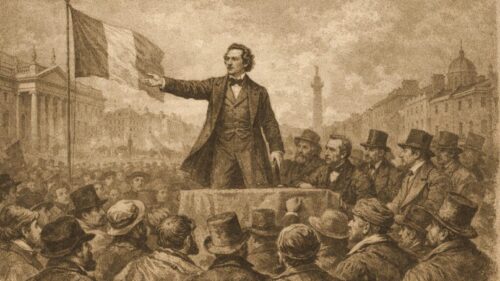
Thomas Meagher
Archived: 20 November 2026
Thomas Francis Meagher was born in Waterford on 3 August 1823. He was educated by the Jesuit fathers at Clongowes and Stonyhurst, and by 1843 had entered public life with a reputation for strong oratorical power. He became a zealous Repealer and joined the Young Ireland party. In the spring of 1848, Meagher and William Smith O’Brien were sent to France as a deputation to congratulate the French people on the establishment of the Republic. On their return, Meagher presented an Irish tricolour flag, green, white, and orange, to the citizens of Dublin.
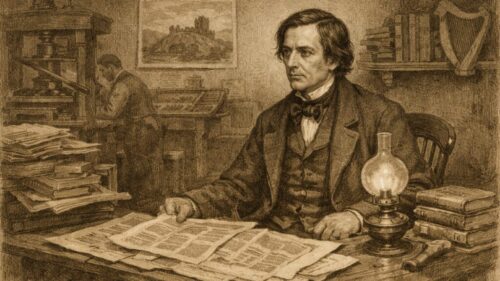
John Mitchel
Archived: 20 November 2026
Early Years John Mitchel was born on 3 November 1815 at the manse, Camnish, near Dungiven, County Londonderry, son of the Presbyterian minister John Mitchel and Mary Haslett. In 1823, when his father became minister of Newry Presbyterian Church, the family settled in Dromalane House. At school in Newry, he met John Martin, who remained a lifelong friend. He graduated from Trinity College, Dublin in 1834. Law And Press In 1840, Mitchel became a lawyer and entered partnership with Samuel Livingstone Frazer in Banbridge, where he ran the branch office. In 1843, he and Martin joined Daniel O’Connell’s Repeal Association.
Bishop Bron
Archived: 20 November 2026
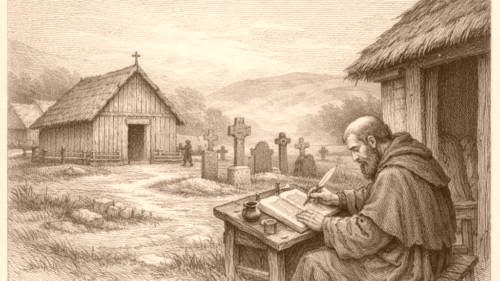
The annals for 511 CE are brief and uneven. Some works record the death of Bishop Bron, while others note the death of Bishop Erc, the birth of Ciarán, and an eclipse of the sun. One Ulster notice even gives an alternative dating for a death, showing that the year’s entries do not always align neatly across the manuscripts.
Thomas Davis
Archived: 20 November 2026
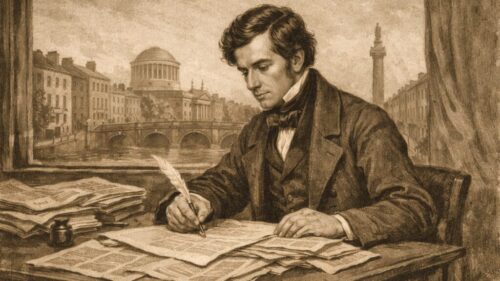
Thomas Davis was an Irish writer and a founding editor of The Nation with Charles Gavan Duffy and John Blake Dillon. He was born on 14 October 1814 in Mallow, County Cork, the fourth and last child of James Davis and an Irish mother. His father, a Welsh surgeon in the Royal Artillery, died in Exeter a month before his birth, en route to serve in the Peninsular War. Davis attended school in Lower Mount Street and then Trinity College, Dublin. He became auditor of the College Historical Society and graduated in 1835 with a degree in Logic.
Druim Dergaige — Druim Dergaighe
Archived: 20 November 2026
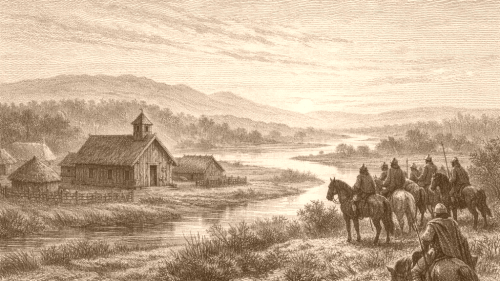
The surviving annals give a sparse and uneven record for 512 CE. Some entries are securely placed under that year, while others appear in nearby years or with cross-references that show dating uncertainty. The best-attested notices concern episcopal deaths, the birth of Ciarán, and the battle of Druim Dergaige, but not every annal places them in the same year.
Maurice O’Connell
Archived: 20 November 2026
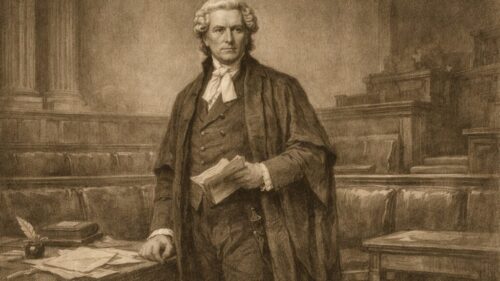
Maurice O'Connell was born on 27 June 1803 and died on 17 June 1853. The parliamentary record identifies him as a barrister or advocate by training and by occupation at the time of his election. He sat as a Liberal and was returned for Tralee in the general election of 10 December 1832. Hansard records his first contribution on 13 April 1831, during his earlier service for Clare. The same parliamentary record shows that he represented Clare from 23 March 1831 to 17 December 1832. His recorded contributions for that period run through 1831 and 1832.
