Cratlagh, Exams and Sunday Doors1878 CE
In 1878, Ireland faced mounting tensions before the Land War. Lord Leitrim, notorious among tenants, was killed with two companions in Donegal, highlighting grievances over eviction and insecure tenure. Agricultural depression, poor harvests, emigration and severe disease increased hardship, though conditions varied regionally. The Public Health (Ireland) Act strengthened sanitary administration amid high mortality. The Intermediate Education Act created examination-based support for secondary schooling, including potential provision for girls. Sunday licensing restrictions reshaped social life, with urban exemptions. Politically, Isaac Butt weakened as Charles Stewart Parnell advanced tenant-rights agitation and contacts associated with the emerging New Departure in Irish politics.
Dateline
A Year of Sharpening Tensions
Ireland in 1878 was not yet in the Land War, and the Irish National Land League had not yet been founded. Yet the year made several of the forces that would soon drive national politics much more visible: the insecurity of tenant farming, the strain of falling agricultural returns, the increasingly assertive politics associated with Charles Stewart Parnell, and demands for social provision shaped by Irish circumstances rather than by Westminster convenience. Two Acts of Parliament passed in August touched ordinary routines directly: one reorganised the terms on which post-primary schooling could be rewarded, while another altered Sunday drinking across most of the island. A third measure recast the machinery of public health. The year also brought a murder in Donegal that became an enduring symbol of landlord–tenant antagonism.
The most dramatic firmly dated event occurred on 2 April. William Sydney Clements, third earl of Leitrim, was ambushed at Cratlagh Wood near Mulroy Bay in north Donegal while travelling towards Carrigart. Leitrim, his clerk John McKim and his driver George Buchanan were killed. The earl had become exceptionally unpopular among tenants on his estates. In March he had sought to evict nearly a hundred tenants at Lifford sessions, an episode that formed the immediate background to the attack. His killing was not an outbreak of a generalised rural rebellion, and it should not be treated as the beginning of the Land War. It was, however, an unusually resonant agrarian homicide: it exposed how disputes over tenure, eviction, authority and dignity could acquire explosive force in a region where many smallholders had little security.
Contemporary reactions themselves reveal the divide. Westminster politicians and the Irish administration stressed the gravity of murder and the necessity of law. Nationalist commentators could condemn the killings while insisting that landlord power and insecure tenure were the conditions from which agrarian violence grew. The alleged attackers were never convicted. Later local memory in Fanad turned the presumed assailants into figures of popular resistance, while Leitrim’s successor, Robert Clements, acquired a much more favourable reputation as a landlord. That contrast mattered. It underlined that the system of landlordism was not experienced uniformly, but that tenants judged it through immediate dealings over rent, improvements, access and eviction.
Farms Under Pressure
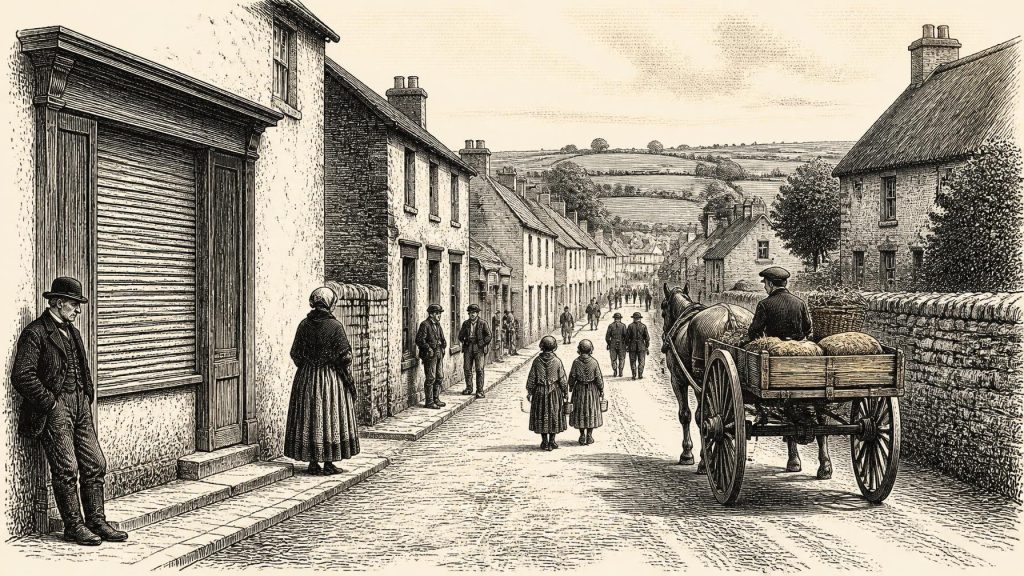
The wider rural position was serious, though 1878 must not be collapsed into the far worse crisis of 1879. International competition had been depressing prices for European agricultural producers from the mid-1870s. Irish commercial farmers faced weaker returns, while smaller occupiers and labourers remained vulnerable to a poor season because cash reserves, credit and alternative employment were limited. Scholarship on the late-1870s crisis identifies poor weather and weak harvests in both 1877 and 1878 as important parts of the deterioration. In the west and north-west, where holdings were often small and the potato remained crucial to household subsistence, a modest setback could rapidly become a food problem.
There were important regional differences. It is misleading to picture all Irish agriculture as equally destitute or all farmers as producing principally for themselves. Cattle, dairying and market crops connected many farms to British urban markets, while ports, railways, fairs and dealers linked rural districts to a larger commercial economy. But the benefits of that economy were uneven. For families dependent on a few acres, potatoes, pigs, seasonal earnings and remittances, the margin between a difficult year and acute hardship was narrow. Agricultural depression also sharpened the political meaning of rent: a payment that might have seemed tolerable in a prosperous market looked very different when sale prices and harvest prospects fell.
The year’s vital statistics convey a country still being reshaped by migration as well as by rural conditions. The Registrar-General estimated Ireland’s mid-year population at 5,351,060. It recorded 134,117 births, 99,629 deaths and 25,284 marriages, alongside 41,124 emigrants. Births and marriages were below the preceding ten-year average, while deaths were above it. Natural increase did not compensate for recorded emigration. These are national totals rather than a direct measure of poverty in any one place, but they show how departure remained a normal, often decisive, feature of family strategy and local life. Young adults leaving for Britain, North America and elsewhere altered the prospects for marriage, inheritance, labour and care within households left behind.
Illness and Sanitation
Public health was another immediate concern. The Registrar-General described 1878 as having the highest recorded death rate since civil registration began in 1864. Respiratory diseases were unusually prevalent; measles caused heavy mortality in many southern districts; and smallpox was notably present in Dublin. Of 873 smallpox deaths recorded across Ireland, 640 were in the Eastern Division, which included Dublin, with the South Dublin Union alone accounting for 432. Such figures are a reminder that nineteenth-century urban life brought dangers quite different from the agrarian anxieties of Donegal or Mayo. Dense housing, contaminated water, inadequate drainage and infectious disease could turn a city or workhouse district into a particularly hazardous environment.
On 8 August the Public Health (Ireland) Act 1878 consolidated and amended Irish sanitary law. It did not suddenly make Irish towns healthy, nor did legislation by itself provide sewers, clean water or effective inspections. What it did provide was a more coherent legal structure for urban and rural sanitary authorities. The Act addressed sewerage and drainage, water supply, nuisances and the ability of the Local Government Board to alter sanitary districts. Its practical effect therefore depended on local ratepayers, boards, officials and the willingness to fund works. Even so, the measure placed matters once treated as private inconveniences — a foul drain, absent privy, unsafe water or overcrowded premises — more firmly within public administration.
Examinations and Opportunity
Education legislation supplied a different kind of state intervention. The Intermediate Education (Ireland) Act received royal assent on 16 August. It established an Intermediate Education Board for Ireland and directed it to promote intermediate secular education through public examinations, student prizes and exhibitions, certificates, and payments to school managers tied to examination results. The formula was deliberately indirect. The state did not undertake to build or run a national network of secondary schools. Instead, it encouraged existing denominational, private and endowed schools to prepare pupils for a common competitive system while leaving control of religious instruction outside the state-funded examination scheme.
The Act’s wording is especially significant on girls’ education. The Board was authorised to make rules for applying the benefits of the system to girls. That was not a promise of equal experience, equal subjects or equal resources, and practical arrangements remained to be made after the Act. Nevertheless, it created a route by which girls as well as boys could enter public examinations and compete for recognised educational rewards. For middle-class and aspiring lower-middle-class households, education could mean access to teaching, clerical work, the civil service, further study or enhanced social standing. For schools, result fees and prizes offered both an incentive and a pressure to organise teaching around examinable performance.
There were costs as well as opportunities in this model. A system rewarding measurable results could encourage narrow preparation, memorisation and rivalry between schools. It also did not erase the financial barriers which kept many children beyond post-primary education, especially where a teenager’s labour was needed at home or on the farm. Yet in 1878 the central development was the creation of the framework itself. Its first examinations belonged to the following year, so it would be anachronistic to describe 1878 as the year in which Ireland’s pupils were already transformed by it. The proper claim is that the rules of future educational competition were set in motion.
Sunday Regulation and Political Reorientation
Also enacted on 16 August was the Sale of Liquors on Sunday (Ireland) Act. It came into operation on 1 October. Across most of Ireland it extended the prohibition on selling intoxicating drink to the whole of Sunday. Dublin’s metropolitan police district and the cities of Cork, Limerick and Waterford, along with Belfast, were treated differently: licensed premises there could operate between two and seven in the afternoon. Exemptions remained for lodgers, packet boats, certain canteens, railway-station sales connected with trains and bona fide travellers. The distinctions mattered because public houses were commercial premises, meeting places and centres of leisure as well as places of drink. The Act illustrates how a moral and social campaign could result in an all-Ireland law that nevertheless preserved special arrangements for the principal urban centres.
In parliamentary nationalism, 1878 was a year of movement rather than final realignment. Isaac Butt still led the Home Rule movement, but his authority was weakening before younger MPs who favoured a more forceful parliamentary posture. Parnell spoke at tenant-defence meetings in Ballinasloe and Tralee during the autumn, supporting familiar demands for fair rent and security of tenure while giving cautious acknowledgement to land purchase. Across the Atlantic, Michael Davitt’s American tour brought him into closer discussion with John Devoy and Clan na Gael. In October Devoy sent a proposal to Parnell advocating co-operation between advanced nationalists and parliamentarians around self-government, land reform and disciplined parliamentary action. The precise extent of Parnell’s acceptance remains disputed; it is safer to see 1878 as a formative stage in contacts later labelled the New Departure, not as the completed birth of a settled alliance.
Thus 1878 closed with no single Irish settlement in sight. The government had legislated on sanitation, schooling and Sunday licensing, but did not resolve the land question. Rural hardship had not yet reached the crisis associated with 1879, but the foundations of that crisis were visible. The killings at Cratlagh, the new examination system, the regulation of public-house hours and the statistical record of illness and emigration all show an Ireland in which questions of authority entered everyday life: in the tenancy agreement, the village school, the city drain, the family’s decision to emigrate and the Sunday door of the local public house.
Primary Sources
- Fifteenth Annual Report of the Registrar-General of Marriages, Births, and Deaths in Ireland, 1878
- Vital Statistics Annual Reports on Marriages, Births and Deaths in Ireland from 1864 to 2000
- Intermediate Education (Ireland) Act, 1878
- Intermediate Education (Ireland) Act, 1878, Section 6
- Public Health (Ireland) Act 1878
- Public Health (Ireland) Act 1878
- Sale of Liquors on Sunday (Ireland) Act 1878
- The Murder of Lord Leitrim
- Crime in Ireland—Resolution
- Clements, William Sydney
- Leitrim Papers
- The Fanad Patriots: Full Authentic Story of the Killing of Lord Leitrim, April, 1878
- Parnell, Charles Stewart
- Devoy, John
- Davitt, Michael
- Isaac Butt and the Home Rule Movement: A Study in Conservative Nationalism
- Agrarian Outrages
- Hunger and Poverty after the Famine: How Old Problems Persisted and New Ones Emerged
- Agricultural History Review, Volume 63
- Farming Since the Famine: General Details
- Intermediate Education (Ireland) Bill—Second Reading
- The Intermediate Education System, 1878–1885
- Irish Sunday Closing Act
- Sale of Intoxicating Liquors (Ireland) Bill