Two Kilometres From Home2020 CE
In 2020, Ireland experienced political realignment, pandemic emergency and Brexit transition. February’s inconclusive election saw Sinn Féin lead first-preference votes, Fianna Fáil win most seats, and caretaker Taoiseach Leo Varadkar govern until Fianna Fáil, Fine Gael and Greens formed an unprecedented coalition under Micheál Martin in June. COVID-19 transformed daily life: closures, lockdowns, the two-kilometre exercise rule, remote work and restricted funerals accompanied 1,928 deaths. Schools adopted remote teaching and calculated Leaving Certificate grades; emergency payments addressed severe job losses amid housing pressure. Northern Ireland restored devolution; Brexit ended in EU-UK trade agreement; Ireland returned to Level 5 awaiting vaccination.
Dateline
In 2020 Ireland entered a year that began with electoral uncertainty and ended in renewed confinement. The COVID-19 pandemic changed the terms of public life with extraordinary speed: schools and churches closed, work and teaching moved into homes, normal mourning and celebration were curtailed, and travel was measured in kilometres from one’s front door. Yet the year was not defined by disease alone. A general election redrew the political map; a coalition between parties once divided by Civil War inheritance took office; devolution returned to Northern Ireland; and Brexit’s transition period ran down towards a new and unsettled economic frontier.
An Election Without A Majority
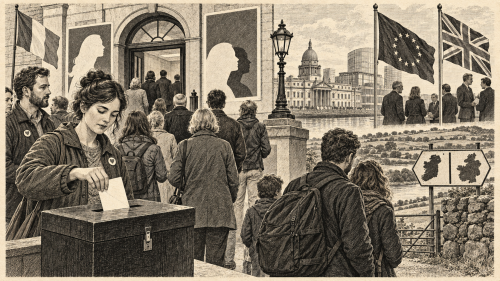
The general election of 8 February produced no commanding winner. Sinn Féin won the largest share of first-preference votes, while Fianna Fáil emerged with the largest number of Dáil seats, narrowly ahead of Fine Gael. The result reflected deep dissatisfaction with housing costs, homelessness and pressures on health services, as well as a striking appetite for political change. It also demonstrated the limits of a campaign: Sinn Féin’s unexpectedly strong vote came despite standing too few candidates to convert all its support into seats.
The 33rd Dáil first met on 20 February, but no viable administration immediately followed. Leo Varadkar remained Taoiseach at the head of a caretaker government when the public-health emergency began. This created an unusual overlap of crises: ministers had to take far-reaching emergency decisions while parties continued difficult negotiations over the shape of the next government. In ordinary circumstances a prolonged interregnum would have dominated the political year. In 2020 it was overshadowed by the pandemic.
On 27 June, after Fianna Fáil, Fine Gael and the Green Party had separately secured their members’ approval for a programme for government, Micheál Martin was nominated Taoiseach and formally appointed by President Michael D. Higgins. It was an important rearrangement of party politics. Fianna Fáil and Fine Gael, whose historic identities had been shaped by opposing sides in the Civil War, entered coalition together for the first time, with the Greens supplying a third partner. The agreement provided for a rotation of the Taoiseach’s office, with Martin to serve first and Varadkar later. Its commitments on housing, health, climate action and economic recovery were necessarily framed by an immediate task: keeping the State functioning through the pandemic.
The Arrival Of COVID-19
Ireland’s first confirmed case of COVID-19 was announced on 29 February. At first, official measures centred on testing, contact tracing and advice about symptoms and travel. The pace of change accelerated during March. On 12 March the government moved to the “delay” phase, announced the first confirmed death, and ordered schools, pre-schools, colleges, museums, galleries and many tourist sites to close. St Patrick’s Day, normally the country’s most public national celebration and a major occasion for the global Irish diaspora, passed without the familiar parades.
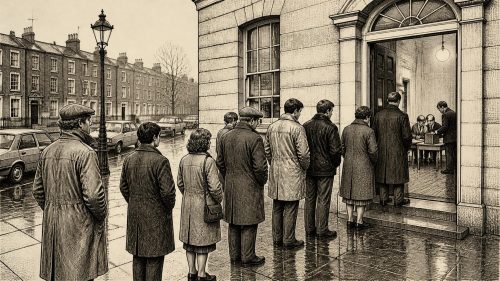
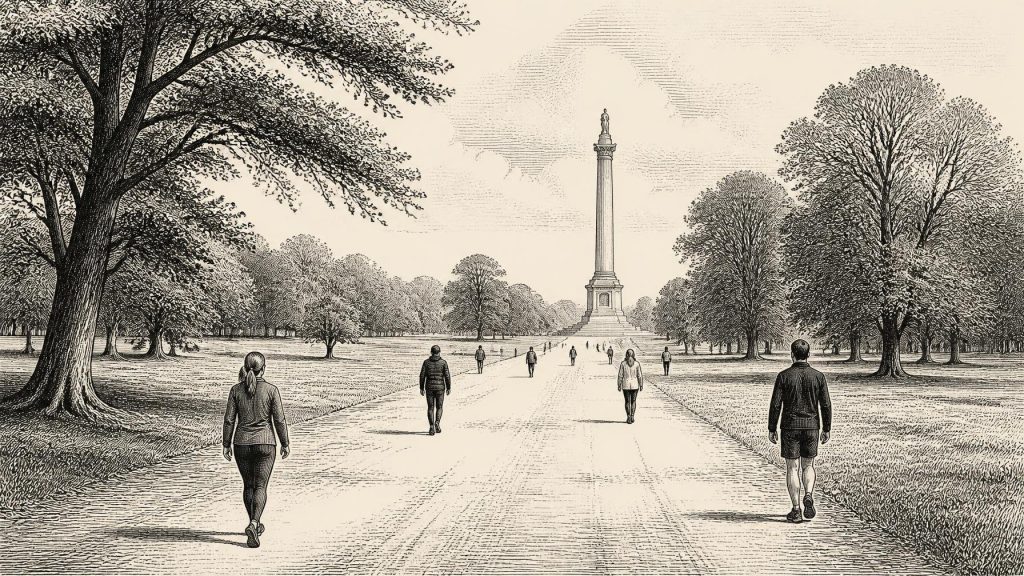
On 27 March the caretaker government imposed the instruction that came to symbolise the first lockdown: stay at home. People could leave for tightly defined essential purposes, including food, medical care, caring responsibilities, essential work, farming and brief exercise within two kilometres of home. Non-essential businesses closed; older and medically vulnerable people were urged to cocoon; and An Garda Síochána subsequently received powers to enforce restrictions. The State had not simply advised social distancing. It had temporarily reshaped movement, commerce and association through emergency law.
The daily routines behind those rules were uneven. Health workers, care staff, shop workers, delivery drivers, farmers and other essential employees continued to travel and face risk. Many office workers encountered mass remote working for the first time. Neighbours organised practical help for people shielding at home, while family contact was often reduced to phone calls, video links and conversations across gates or windows. Funerals were restricted to very small gatherings, making bereavement especially painful. Religious observance moved largely online or into private households, and the absence of public Masses, worship, wakes, concerts and club activity gave the year an unfamiliar quietness.
The public-health burden fell particularly heavily upon older people. Later vital-statistics reporting recorded 1,928 deaths from COVID-19 occurring during 2020, with 79 per cent among people aged seventy-five or over. Such retrospective figures should not obscure what contemporaries knew: daily case, hospital and death reports were closely watched, while uncertainty over testing, transmission and future treatment shaped policy. Protecting residents and staff in nursing homes and other long-term care settings became one of the most difficult and distressing aspects of the emergency.
Closed Classrooms, Altered Lives
Education illustrated both the scale of disruption and the practical limits of an online solution. Schools closed from 13 March after pupils had been told to bring books and materials home. Teachers improvised remote lessons and paper-based work; families had to find space, devices and reliable connections; and existing inequalities in access to technology became more visible. The School Meals Programme continued through adapted local arrangements, recognising that school was also a source of food and support for many children.
For Leaving Certificate students, whose examinations normally mark a decisive passage into higher education, training or work, uncertainty was acute. The written examinations were first postponed in April and then replaced by calculated grades, issued on 7 September. That solution allowed students to progress, but it also provoked serious controversy over predicted marks, standardisation and fairness. Junior Cycle examinations were replaced by school-based assessment. When schools reopened in the autumn with infection-control measures, their return was one of the year’s most important social experiments: an attempt to preserve in-person learning amid wider restrictions.
The State sought to relax the first lockdown gradually. A five-phase roadmap, published on 1 May, envisaged reopening from 18 May in stages. Shops, workplaces and outdoor activity returned unevenly, but every easing was conditional. By August, renewed outbreaks in workplaces, households and sports clubs prompted tighter limits on home visits and gatherings. The pattern of 2020 was therefore not a simple closure followed by recovery, but repeated negotiation between social need, economic survival and infection control.
Work, Welfare And Housing
The economic shock was immediate, especially for hospitality, tourism, retail, arts and personal services. The Pandemic Unemployment Payment and wage-subsidy schemes were designed to preserve income and employment links during enforced closures. They were a conspicuous expansion of emergency State support, though they could not remove anxiety for workers on low or insecure incomes, small businesses and the self-employed. By the end of December, the CSO’s COVID-adjusted measure put unemployment at 19.4 per cent, a figure intended to show the disruption that standard labour-market definitions could miss.
Housing pressure did not disappear because the economy paused. The pre-pandemic shortage of affordable homes remained, while construction interruptions and job losses added fresh uncertainty. The government reintroduced an eviction moratorium during the autumn Level 5 restrictions and adjusted income supports as businesses closed again. The measures offered temporary protection, but also underlined how the pandemic had entered an Ireland already marked by an unresolved housing crisis.
North, South And Brexit
Developments in Northern Ireland were directly relevant to the wider island. In January, the New Decade, New Approach agreement enabled the restoration of the Northern Ireland Assembly and a five-party power-sharing Executive after three years without devolved government. Arlene Foster became First Minister and Michelle O’Neill deputy First Minister. The restored institutions soon faced COVID-19, coordinating public-health decisions in a jurisdiction with its own health service and rules, but linked intimately to the Republic by families, work, travel and an open land border.
Brexit formed the other all-island challenge. The United Kingdom left the European Union on 31 January, but remained within the EU single market and customs union during a transition period ending on 31 December. Throughout 2020 Irish officials, businesses and communities prepared for the consequences. The Protocol on Ireland/Northern Ireland, agreed as part of the Withdrawal Agreement, was designed to avoid a hard border on the island while protecting the EU single market. On 24 December the EU and UK reached their Trade and Cooperation Agreement. It averted tariffs and quotas in much trade, but did not remove the practical changes that Brexit would bring after the year’s end.
Culture In A Constrained Year
Galway’s designation as European Capital of Culture had promised a major international cultural year. Instead, its planned opening event was cancelled because of Storm Ciara in February, and the pandemic soon forced the cancellation or postponement of international travel, live performances and large gatherings. Organisers and artists shifted parts of the programme online, while the European institutions extended Galway’s title period to April 2021. The experience was emblematic: culture persisted through screens, small audiences and altered formats, but performers, venues and cultural workers bore severe losses.
By December, a brief Christmas easing had given way to sharply rising concern. On 30 December the government announced a return to full Level 5 restrictions. Ireland ended 2020 awaiting vaccination, managing exhaustion as well as infection, and facing a new trading relationship with Britain. The two-kilometre rule of spring had passed, but its memory captured the year’s central fact: the most intimate spaces of home, family and neighbourhood had become the front line of national history.
Primary Sources
- General Election – 8 February 2020
- 33rd Dáil Election – February 2020 – Election Results
- Nomination of Taoiseach (Resumed) – Dáil Éireann, 27 June 2020
- President Higgins Presents Taoiseach With Seal Of Office
- Statement by the Taoiseach Announcing New Government Ministers
- Updates on COVID-19 (Coronavirus) from January – March 2020
- Statement by the Taoiseach on Measures to Tackle Covid-19
- Covid-19 – Statement from the Department of Education and Skills
- Taoiseach Urges Ireland to Stay at Home to Combat COVID-19
- Minister for Health Simon Harris Signs Regulations to Give An Garda Síochána the Power to Enforce COVID-19 Restrictions
- Government Publishes Roadmap to Ease COVID-19 Restrictions and Reopen Ireland’s Society and Economy
- Statement on the Introduction of New Measures to Limit the Spread of COVID-19
- Ireland Placed on Level 5 of the Plan for Living with COVID-19
- Ireland Placed on Full Level 5 Restrictions of the Plan for Living with COVID-19
- Leaving Certificate 2020: Information and Resources
- COVID-19 Information and Guidance Issued to Schools
- Labour Force Survey (LFS) Quarter 4 2020
- Deaths 2020: Vital Statistics Annual Report 2020
- New Decade, New Approach
- New Executive Can Rebuild Confidence in Politics
- Brexit Negotiations Timeline
- Annual Report 2020