

Tyrconnell’s New Charters1687 CE
In 1687 Richard Talbot, earl of Tyrconnell, became Ireland’s lord deputy and reshaped government under James II. Although instructed not to remove Protestants solely for religion or overturn land settlements, he promoted Catholics to judicial, administrative, military and local offices. New sheriffs and judges challenged Protestant dominance and intensified fears over legal security. Through charter surrenders and renewals, municipal corporations were reorganised to expand Catholic influence and prepare a favourable parliament. James’s Declaration of Liberty of Conscience widened religious freedoms, though Anglican suspicion persisted. Trade continued, while army recruitment increased. By year’s end, Catholic hopes and Protestant anxieties transformed politics.
Dateline
In 1687, the most consequential change in Ireland was not a battle, a rebellion or a statute passed in parliament. It was the installation of Richard Talbot, earl of Tyrconnell, as lord deputy, and the rapid recasting of offices through which government reached towns, counties, courts and regiments. For Irish Catholics, especially among the landed and professional classes, the year offered an extraordinary opening after decades in which power had been concentrated in Protestant hands. For many Protestants, it brought an alarming sense that the protections secured after the Cromwellian and Restoration settlements could no longer be relied upon.
This was a change within the composite monarchy of James II, king of England and Ireland and James VII of Scotland. Yet Ireland was not simply receiving orders from London. Tyrconnell, a Catholic Old English soldier and courtier with long experience of Irish Catholic claims, had his own network, priorities and understanding of the kingdom’s unresolved problems. The administration he led in 1687 was therefore both a royal project and an Irish political intervention.
From Appointment to Authority
Tyrconnell’s appointment as lord deputy was recorded on 8 January 1687, replacing the Protestant lord lieutenant, Henry Hyde, second earl of Clarendon. He was sworn into office in February. The distinction mattered: Tyrconnell held the practical powers of chief governor but the deliberately lesser title of lord deputy signalled James II’s caution. The king wanted Catholic advancement, but did not wish to provoke Protestant subjects unnecessarily or to commit himself immediately to a wholesale revision of the land settlement.
That restraint was real on paper. James instructed Tyrconnell not to dismiss Protestants simply because of their religion and resisted an immediate statutory undoing of the Acts of Settlement and Explanation, which had confirmed much land in Protestant ownership after the wars of the mid-seventeenth century. In practice, however, the composition of government changed quickly. The question was not merely who possessed estates; it was who could sit on juries, serve as sheriff, command soldiers, hold a corporation office, dispense justice or shape the membership of a future parliament.
The first months of Tyrconnell’s deputyship thus carried a powerful symbolic charge. A Catholic chief governor now presided in Dublin Castle, while Catholics entered senior offices from which they had long been largely excluded. Sir Charles Porter, the Protestant lord chancellor, was removed early in the year. Sir Alexander Fitton, an English lawyer who had become Catholic, was appointed lord chancellor and privy councillor. In April Sir Stephen Rice, a leading Catholic lawyer from County Limerick, became chief baron of the exchequer. Such changes did not make the entire administration Catholic at once: by the summer Protestants still predominated among the revenue commissioners. But they made clear which direction power was travelling.
Courts, Sheriffs and Local Power
The remodelling of justice was among the most immediate practical developments. A sheriff was not a remote dignitary. Sheriffs managed elections, executed writs, summoned juries and handled important aspects of county administration. Their selection for the year 1687 therefore mattered greatly to landowners, tenants, merchants and litigants. The appointment of Catholics to sheriffalties offered Catholic gentry access to local authority and gave Protestant elites reason to fear that old networks of influence were weakening.
Thomas Nugent’s promotion illustrates the same process. Already a judge of king’s bench, he became lord chief justice in October 1687. His advancement was welcomed by those seeking a Catholic presence at the summit of the law, though contemporaries across confessional lines could doubt his ability. The significant fact is not that every judge or official was replaced, but that the old presumption of an exclusively Protestant judiciary had been broken.
Evidence for daily consequences must be handled with care. A later Protestant account claimed that, under the new sheriffs and magistrates, Protestant creditors could scarcely obtain debts by execution. It is valuable testimony to fear and resentment, but it was written amid the Williamite conflict and cannot simply be treated as a neutral description of every court in Ireland. What can responsibly be said is that governmental appointments made legal security a subject of urgent confessional anxiety. In 1687, a dispute over a debt, a lease or a borough privilege could seem inseparable from the larger question of who now governed the kingdom.
The Charters Campaign
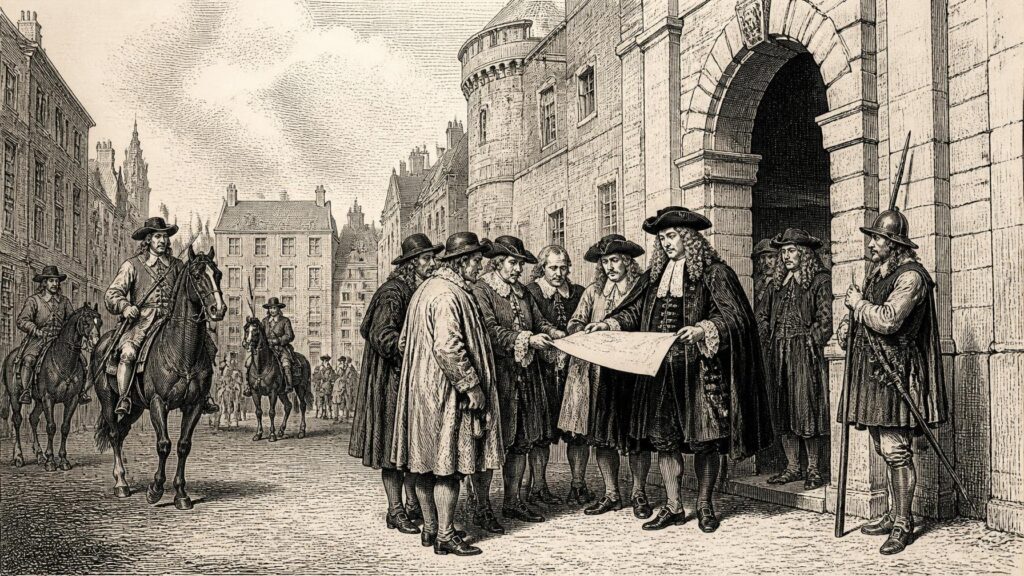
The most far-reaching political work of the year concerned municipal corporations. Chartered towns such as Dublin, Limerick, Cork and smaller boroughs controlled local offices and, crucially, returned members to the Irish House of Commons. Their governing bodies had generally been dominated by Protestant interests. Tyrconnell’s administration used quo warranto proceedings and negotiated surrenders of charters to bring these corporations under review. The method had precedents under Charles II and James II, but its Irish purpose in 1687 was unmistakable: Catholic participation in urban government was to be enlarged, and a future parliament was to be made more favourable to the king’s policies.
On 24 September James II issued a royal letter directing the renewal of corporation charters. New charters enabled the lord deputy to name initial officers and burgesses, after which corporations would continue through their own electoral mechanisms. They also included clauses that strengthened royal control. For supporters, this was a correction of a political order that had excluded the Catholic majority from borough power. For opponents, it was the Crown’s manipulation of civic liberties to manufacture obedient parliamentary constituencies.
The change can be seen at local level. The surviving minutes of Gowran in County Kilkenny record a formal surrender of the borough’s charter and liberties on 3 May 1687. A replacement charter does not appear to have been granted there, reminding us that the process was uneven and incomplete. Limerick, by contrast, received a new charter in 1687, and Stephen Rice was listed among its Catholic burgesses. These were not abstract constitutional adjustments. They affected who wore civic gowns, kept municipal records, regulated markets, administered town property and spoke for a community at elections.
Religion and the Limits of Toleration
Religion gave these administrative changes their deepest meaning. James II’s Declaration for Liberty of Conscience, dated 4 April 1687, suspended penal measures against nonconformity and promoted a broad royal policy of toleration. A Dublin reprint of the declaration was issued that year, demonstrating its circulation in Ireland. Its language of liberty could appeal to Catholics and Protestant dissenters alike, both of whom had suffered disabilities under regimes that privileged the established Church of Ireland.
Yet toleration did not mean equality free from suspicion. James’s use of royal dispensing power alarmed many Anglicans, who saw it not simply as relief for consciences but as a means of bypassing law and parliament. Nor did 1687 transfer Church of Ireland lands or end the established church. The question of church property remained politically explosive precisely because it was left unresolved. Catholic worship and clerical organisation could operate more openly than before, while Catholic laymen received striking access to office; but this was an administrative and political revival, not a settled religious peace.
The Catholic hierarchy recognised the opportunity. In November John Brenan, Catholic archbishop of Cashel, wrote enthusiastically to the Roman Congregation of Propaganda Fide about Tyrconnell’s zeal for religion and his wish to raise Catholic nobility and gentry in public office. His letter conveys the hopes generated by the new regime. It should not, however, obscure divisions among Catholics themselves: Old English families, Gaelic landholders, lawyers, soldiers and clergy did not all have identical ambitions, particularly on the still unsettled matter of confiscated land.
Army, Trade and an Uncertain Future
The army was another instrument of transformation. Catholic recruitment and promotion had begun before Tyrconnell formally became lord deputy, but accelerated during 1687. A more dependable Irish force was useful to James II, who feared opposition in England as well as threats from abroad. In September the king sought 2,500 Irish troops for service in England. The request showed that Ireland’s garrison was being drawn into the wider crisis of the Stuart kingdoms, even before the dramatic events of 1688.
Military change also affected ordinary communities. Garrisons required food, quarters, transport, horses and credit; recruitment connected local gentlemen and their dependants to the state. There is no need to imagine all Ireland under arms in 1687. Rather, the year saw the steady conversion of governmental and military structures into ones more closely associated with Catholic advancement and personal loyalty to James.
Commercial life nevertheless continued across the Irish Sea and beyond it. A surviving pass dated 29 August permitted The Betty of Dublin to make a voyage from Dublin to Lisbon. One vessel cannot stand for the whole economy, but it is a useful, firmly dated sign of an outward-looking port economy linked to Iberian markets. Such trade depended on shipping, customs administration and credit—the very systems whose officials were also being scrutinised and reorganised by the new regime.
By the end of 1687, Ireland had not yet entered the Williamite war. No Irish parliament had met, no general land act had reversed the Restoration settlement, and no island-wide uprising had begun. Those later outcomes must not be read back as if they were already inevitable. But the year had altered expectations. Tyrconnell’s new administration gave Irish Catholics an unprecedented share in public authority, while charters, offices and regiments convinced many Protestants that their position was precarious. In that widening gap between hope and fear lay the unstable political inheritance of 1687.
Primary Sources
- Talbot, Richard
- Fitton, Sir Alexander
- Rice, Sir Stephen
- Nugent, Thomas
- Porter, Sir Charles
- The Irish Parliament of James II
- Part 3 of The Irish Parliament of James II
- Part 4 of The Irish Parliament of James II
- The State of the Protestants of Ireland under the Late King James's Government
- His Majesties (James) Gracious Declaration for Liberty of Conscience: National Library of Ireland Sources catalogue
- The Reign of James II
- Add MS 72885: Papers Concerning Sir William Petty, Tyrconnell and the Irish Land Settlement
- Letters to Richard Talbot, Earl of Tyrconnell, and Other Documents, 1687–1690
- By the Lord Deputy and Council. Tyrconnell
- The Records of the Ancient Borough Towns of the County of Kilkenny
- Ireland Under the Stuarts, Volume 3
- Jacobite Ireland 1685–91: Studies in Irish History
- I. Remembrances, 1671–1714
- A List of Books Printed in Scotland Before 1700
- Annals from 1640 to 1704
- The Journal of John Stevens, Containing a Brief Account of the War in Ireland, 1689–1691
- Talbot, Richard, First Earl of Tyrconnell and Jacobite Duke of Tyrconnell