
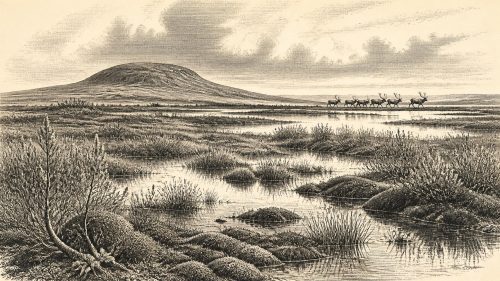
Mammoth Cave and Maguiresbridge
Around 30,387 BCE, Ireland has no recoverable annual history; evidence instead derives from Late Pleistocene sediments, plants and animal bones. At Derryvree, County Fermanagh, freshwater deposits between glacial tills, radiocarbon dated broadly to Marine Isotope Stage 3, indicate ice-free or ice-marginal wetlands with cold-tolerant, treeless vegetation. Castlepook, or Mammoth Cave, County Cork, preserves fauna including mammoth, giant deer, reindeer, bears, wolves, foxes and hyaenas, accumulated over millennia. A marked reindeer femur may indicate human carcass processing, but proves neither settlement nor continuity. Subsequent ice growth transformed and buried these landscapes, leaving a fragmentary record of changing cold-stage environments across Ireland.
View Record
BIRM-166 Organic Mud
30,388 BCE is an approximate modern label for a climatically unstable Marine Isotope Stage 3 interval, not a datable Irish event. At Derryvree, County Fermanagh, organic mud between glacial tills records an ice-free freshwater wetland, later overridden by ice. Its plants and insects indicate treeless, cold, varied habitats shaped by severe periglacial conditions. Growing British–Irish ice remained regionally dynamic, while later glaciation destroyed much evidence. Castlepook Cave’s mixed fauna demonstrates ecological connectivity, and a possibly cut-marked reindeer bone suggests, but cannot prove, fleeting human presence. No settlement or society is established. The record reveals environmental change, cold-adapted animals, and uncertainty.
View Record
Derryvree’s Icebound Pool
Although 30,389 BCE cannot date a specific Irish event, Derryvree, County Fermanagh, preserves freshwater sediments broadly within this period. Deposited between glacial tills, they reveal a local ice-free interval during Marine Isotope Stage 3, with cold periglacial tundra, pools, mosses, sedges, hardy plants and insects. Cave remains from southern Ireland indicate that mammoth, reindeer, giant deer, predators and other animals occupied or reached suitable landscapes during the wider era. A possibly cut-marked Castlepook reindeer bone may suggest brief human activity, but does not prove settlement. Later glaciation buried or destroyed much evidence, making Derryvree an exceptional environmental record for Ireland.
View Record
Derryvree’s Between-Till Silt
30,390 BCE is not a recorded Irish year but a modern label for an unstable later Pleistocene period within Marine Isotope Stage 3. At Derryvree, County Fermanagh, organic freshwater silt between glacial tills indicates an ice-free, cold wetland, though its radiocarbon age cannot provide a calendar date. Mosses, sedges, grasses and aquatic plants supported a sparse tundra ecosystem. Castlepook Cave fauna demonstrates intermittent links to wider cold-climate environments, but its species did not necessarily coexist. Human presence remains unproven: a possibly cut-marked reindeer bone suggests fleeting activity without settlement evidence. Ireland’s history is chiefly environmental: ice, water, plants and animals.
View Record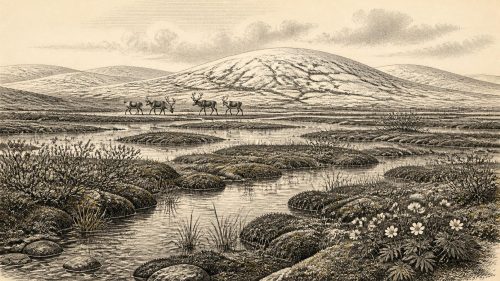
Derryvree’s Frost-Thaw Season
Around 30,391 BCE, Ireland has no year-specific historical record; evidence instead reconstructs a late Pleistocene, pre-Last Glacial Maximum environment. At Derryvree, County Fermanagh, freshwater silts between glacial tills indicate an ice-free interlude of cold, seasonal periglacial wetland, with mosses, herbs, shallow pools and dwarf willow. The deposits are broadly dated, not precise annual evidence. Castlepook Cave, County Cork, preserves remains of mammoth, reindeer, giant deer and predators, demonstrating intermittent cold-adapted fauna, not a single community. A cut-marked reindeer femur may indicate brief human activity, but cannot prove settlement. Growing ice sheets soon transformed this unstable landscape during later glacial expansion.
View Record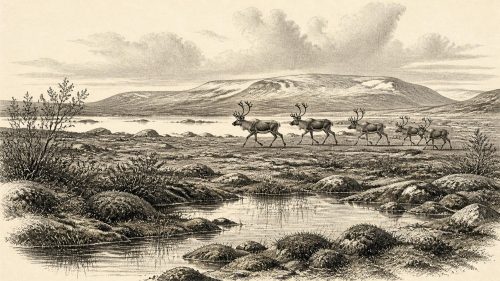
Castlepook’s Uncertain Cutmark
Labelled 30,392 BCE, this period cannot be reconstructed as a precise Irish year. Derryvree, County Fermanagh, preserves freshwater deposits between glacial tills, dated broadly to 34,950–29,750 BCE, indicating treeless wetlands with hardy plants during an ice-free interval. Castlepook Cave, County Cork, contains a long, mixed assemblage of Ice Age fauna, including mammoth, reindeer, giant deer, bear and hyaena. A marked reindeer bone may indicate stone-tool carcass processing, but disturbed contexts and absent associated artefacts leave human presence unproven. Together, the sites reveal variable cold landscapes, shifting ice and animal movement, while supporting only the possibility of brief seasonal human visits.
View Record
BIRM-166’s Sedge Pools
30,393 BCE is not a recoverable Irish historical year but falls within the climatically unstable Late Pleistocene. At Derryvree, County Fermanagh, BIRM-166 dates freshwater organic deposits between glacial tills, indicating a cold, treeless wetland of sedges, dwarf shrubs, aquatic plants and insects during an ice-free interval. Comparable northern sites show regional variation rather than uniform conditions. Castlepook Cave preserves remains of mammoth, reindeer, giant deer, predators and other cold-adapted fauna, accumulated across changing periods. A possibly tool-marked reindeer bone suggests unconfirmed early human activity. Evidence supports environmental reconstruction, not settlements, events, or island-wide conclusions from a nominal calendar date alone.
View Record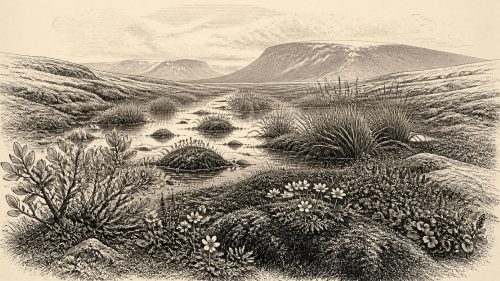
Menyanthes in the Drumlin
Around 30,394 BCE, Ireland lay within the Middle Midlandian, part of Marine Isotope Stage 3. At Derryvree, County Fermanagh, freshwater silts and organic deposits formed between glacial tills, recording an ice-free interval before later ice buried the wetland. Radiocarbon evidence places it broadly near 33,500 calibrated years before present, not precisely in the nominated year. Fossils of bogbean, water-milfoil, mosses, sedges and hardy herbs indicate cold, open, treeless wetland and shallow pools. Ireland was environmentally varied, with shifting ice, exposed ground and caves. Castlepook fauna includes mammoth, reindeer and predators; possible butchery marks suggest only an unproven early human visit.
View Record
Derryvree Between Tills
About 30,395 BCE, Ireland cannot be described through a precise historical year, but Derryvree, County Fermanagh, preserves evidence within a broad calibrated range. Freshwater silts and organic deposits, sealed between glacial tills, show a temporary ice-free wetland during the Late Pleistocene. Plant, insect and small-animal remains indicate treeless, cold, tundra-like mosaics of ponds, mosses, sedges and sparse herbs. Advancing ice was not yet at its maximum, and conditions varied regionally. Southern cave faunas demonstrate glacial animals, although mixed deposits resist exact dating. A possibly cut-marked reindeer bone from Castlepook may indicate fleeting human activity, not settled occupation or social history.
View Record
The Doneraile Reindeer Question
Around 30,396 BCE Ireland lay within the Late Pleistocene, approaching glaciation but not necessarily wholly ice-covered. Evidence from Derryvree sediments indicates cold treeless wetlands with tundra vegetation and freshwater habitats. Castlepook Cave preserves remains of a Marine Isotope Stage 3 fauna including reindeer mammoth giant deer and predators. A marked reindeer femur may record stone-tool use and intermittent human presence but requires confirmation. Cave deposits and radiocarbon dates cannot establish occupation at a specific year or prove settlement. No secure evidence exists for villages political societies or enduring Palaeolithic communities. Climatic instability and ice expansion shaped landscapes and erased evidence.
View Record