

Hacketstown and White Pence1545 CE
In 1545, Ireland experienced interconnected local conflicts, Tudor military demands, scarcity and religious complexity. Cathaoir MacMurrough Kavanagh defeated rivals near Hacketstown, while An Calbhach O’Donnell strengthened his position through dynastic violence in Tír Chonaill. Elsewhere, disputes involving Sligo, Moylurg and O’Rourke reflected fractured lordship. Henry VIII ordered Irish troops for Scotland under Ormond, exposing rivalry between Ormond and Lord Deputy St Leger. Annals recorded severe dearth and costly bread in Connacht and Meath amid debased currency. Papal appointment in Killala, changes at Christ Church, and the death of scholar Piers Ó Muirgheasa demonstrate enduring ecclesiastical and learned traditions across Ireland.
Dateline
In 1545, Ireland was drawn at once into local struggles, an English king’s war in Scotland, a severe food shortage recorded in Connacht and Meath, and competing claims to religious authority. None of these developments made the island politically uniform. Tudor government was strongest in and around Dublin and depended elsewhere on bargains with magnates; Gaelic lordships retained their own dynastic priorities, armed followings and systems of obligation. Yet the year’s surviving records show how closely local affairs could be tied to wider seas, markets and jurisdictions.
The evidence must be handled carefully. The Annals of the Four Masters, compiled in the seventeenth century from earlier material, assigns several events to 1545; Tudor state correspondence offers firmer dates for the Scottish expedition; and later scholarly reconstructions help identify the people and places concerned. The result is not a single national story, but a connected set of Irish experiences.
A Battle Near Hacketstown
One important Leinster encounter took place near Hacketstown, on the Carlow–Wicklow border. Cathaoir mac Airt MacMurrough Kavanagh defeated his dynastic rival Gerald mac Cathaoir Kavanagh of Garryhill and the O’Byrnes of Glenmalure. No day or month can responsibly be assigned, but the battle belongs securely to 1545. A terse Latin chronicle claims that a hundred O’Byrnes and other men of Idough fell, with as many on the opposing side. Such figures should be treated cautiously: casualty totals in partisan annals commonly magnify the scale of a victory. The fact of a pitched battle and Cathaoir’s success are much firmer.
The victory mattered because Cathaoir had not yet obtained the MacMurrough overlordship. He was a leading captain of the Sliocht Diarmada Laimhdeirg, one branch of the wider dynasty traditionally associated with the kingship of Leinster. The Dublin administration had encouraged him to adopt English legal and social forms, while he used royal favour to strengthen his own position within a divided kindred. Hacketstown demonstrated military superiority, but it did not settle the succession: the senior MacMurrough, Muircheartach mac Airt Buidhe, remained alive until 1547.
For the O’Byrnes, defeat did not mean disappearance. Their Glenmalure homeland, protected by wooded valleys and mountain ground, offered a defensible base beyond easy reach of officials or neighbouring lords. By late 1545, O’Byrne leaders were again extracting protection payments from English settlements around the Leinster foothills. The sequence captures an enduring feature of warfare in the region: a battlefield reverse could alter prestige and alliances, but terrain, cattle, local intelligence and the capacity to withdraw into upland country limited any victor’s control.
Division in Tír Chonaill
Ulster’s politics were equally unsettled. In 1545 An Calbhach Ó Domhnaill, eldest son and designated heir of Manus Ó Domhnaill, defeated members of his father’s generation at Coill na gCuirdín, identified with Killygordon near Castlefinn. Donnchadh Cairbreach Ó Domhnaill, Manus’s brother, was killed. The Four Masters also records Éigneachán Ó Domhnaill killed by men of An Calbhach, evidence of a violent struggle within rather than between lordships.
This was more than a private family quarrel. Manus had rebuilt O’Donnell influence in Tír Chonaill and northern Connacht, combining military power, written agreements, church patronage and learned culture. His son’s victories in 1544–45 confirmed An Calbhach’s growing independent authority, but also made the question of succession more dangerous. In this period an heir was not merely waiting to inherit a fixed state: he accumulated allies, hostages, followers and territorial claims during his father’s lifetime. The death of Donnchadh Cairbreach weakened one possible counterweight, while leaving the relationship between Manus and his formidable eldest son increasingly fraught.
The annals also note the killing of Tadhg Óg Ó Conchobair Sligigh by men from Moylurg, alongside conflict involving O’Rourke and the lord of Sligo. These notices should not be inflated into an island-wide war. They do, however, show a north-western political landscape in which control of castles, passes, livestock and client territories remained disputed, and where firearms had entered the vocabulary of violence: one annalistic killing at Sligo was attributed to a shot from a gun.
Soldiers for Scotland
Ireland’s connection with the conflict between Henry VIII and Scotland became unusually visible in the autumn. On 5 September, the English privy council instructed the Irish government to raise 2,000 men to serve under James Butler, ninth earl of Ormond, alongside Matthew Stewart, earl of Lennox. They were intended to support the king’s Scottish policy after the death of James V and during the war later known as the Rough Wooing. The same correspondence stated that money was being coined for Ireland, a reminder that military mobilisation and finance travelled together.
Recruiting proved difficult. Sir Anthony St Leger, the lord deputy, wrote from Kilmainham on 10 October that he hoped to ship the men within a fortnight and complained of the poor quality of their arms. By 14 November, the deputy and council reported that the Irish force under Ormond had advanced to join Lennox. Ormond wrote from Skerries on 15 November that he would sail the next day; a report of 19 November said Lennox and Ormond had departed with a fair wind for Dumbarton. A later annalistic account gives the contingent as 3,000 Irishmen and judges that it achieved nothing memorable. The contemporary administrative correspondence supports a planned force of 2,000, while the later verdict usefully conveys its lack of a celebrated military outcome.
For those recruited, the expedition meant transport by sea, provisioning, unfamiliar command structures and exposure to a conflict beyond Ireland. It also reveals the practical value of Irish military manpower to Henry VIII. Kern and other troops were not simply peripheral auxiliaries: the crown expected Irish captains and magnates to provide soldiers for a campaign across the North Channel. That expectation gave Ormond a conspicuous royal role, even as it sharpened the distrust between him and St Leger.
Ormond, St Leger and Government
The quarrel between Ormond and St Leger became acute in autumn 1545. Ormond suspected that his Scottish commission was designed to remove him from Ireland, perhaps permanently. Behind the suspicion lay a larger contest over authority. Ormond, lord treasurer and the kingdom’s most powerful Anglo-Irish magnate, had accumulated offices, lands and influence after the collapse of Kildare power. St Leger’s administration sought agreements with Gaelic and Anglo-Irish lords but feared the emergence of another magnate able to dominate government.
The dispute should not be mistaken for a straightforward contest between an English official and an Irish lord. Both men were loyal servants of Henry VIII; both operated through personal connections, landholding and military service; and both relied on Irish intermediaries. Their rivalry nevertheless exposed a central problem of Tudor rule: the crown needed powerful local partners to govern, while trying to prevent any partner from becoming indispensable. The eventual summons of the two men to England and their settlement belong chiefly to 1546, not 1545. What can be said for this year is that the Scottish venture brought their mutual suspicion into the open.
Dearth and Debased Money
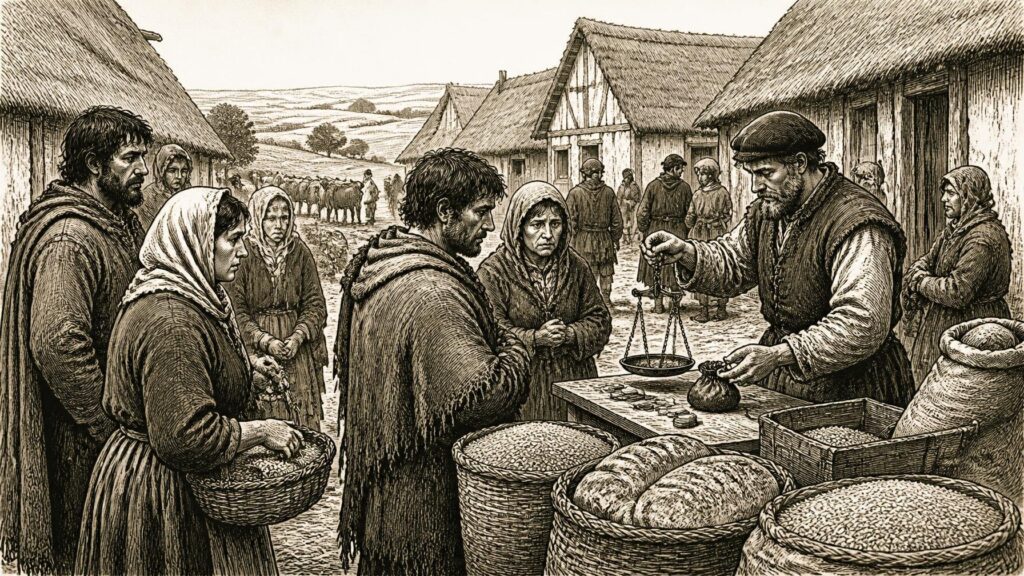
The Four Masters reports “great dearth” in 1545. Its striking measure of hardship was that a cake of bread in Connacht cost sixpence in old money, or six white pence in Meath. The entry does not provide harvest figures, weather observations, duration or a national death toll. It therefore cannot demonstrate a uniform famine across Ireland. It does securely preserve a contemporary tradition of exceptional scarcity and high food prices in two large regions.
The reference to “white pence” is particularly revealing. Numismatists use it as an early notice of low-silver currency circulating in Ireland, though the exact fineness and sequence of Henry VIII’s Irish issues remain subjects of technical debate. On 5 September, government correspondence explicitly said that money was being coined for Ireland. This does not prove that the white pence named by the annal were issued on that day, nor that coinage caused the dearth. But hunger, a weakening currency and wartime expenditure plainly formed a troubling combination for households buying bread, paying rents or supplying soldiers.
Church, Learning and Memory
On 6 November, Pope Paul III provided Réamonn Ó Gallchobhair, usually known as Redmond O’Gallagher, as administrator of Killala with right of succession. O’Gallagher, a nephew of Manus Ó Domhnaill, had not yet reached the normal canonical age for ordination. His appointment was almost certainly enabled by O’Donnell influence in northern Connacht. It is a precisely dated reminder that papal ecclesiastical authority continued to function in Ireland despite Henry VIII’s repudiation of Rome and the crown’s claim to supremacy in the Irish church.
The appointment did not mean that a single confessional settlement operated uniformly in Killala, Dublin or Tír Chonaill. It instead shows overlapping jurisdictions: papal provision, dynastic patronage, diocesan property and Tudor policy could all bear upon one bishopric. In Dublin, the annals report that part of Christ Church Cathedral was dismantled in 1545 and that work uncovered a stone coffin containing a bishop’s body, rings and a chalice. The account’s claim that the vestments remained uncorrupted, interpreted as a sign of sanctity, belongs to devotional storytelling and cannot be verified as described. Even so, it preserves a powerful image of pre-Reformation sacred memory emerging within a cathedral being physically altered.
The same annal records the death of Piers Ó Muirgheasa, praised as a master of schools and lecturer of the men of Ireland. That brief obituary, beside reports of war, dearth and church change, is a useful corrective. Irish learned life endured through teachers, poets, clerics and hereditary scholarly families, even amid political fragmentation. In 1545, power was contested on battlefields and in councils, but it was also sustained—and remembered—through schools, churches, coin and the price of bread.
Primary Sources
- Annals of the Four Masters, Part 5
- Annales Breves Hiberniae
- MacMurrough Kavanagh (MacMurchadha), Cathaoir
- O'Byrne, Seán
- O'Donnell, Manus (Ó Domhnaill, Maghnas)
- O'Donnell (Ó Domhnaill), An Calbhach
- Butler, James
- St Leger, Sir Anthony
- O'Gallagher, Redmond
- O'Neill (Ó Néill), Matthew (Feardorcha)
- O'Connor Faly (Ó Conchobhair Failghe), Brian
- Butler, Richard
- A ‘new departure’ in mid-Tudor Ireland?
- State Papers, Part III
- Calendar of the State Papers Relating to Ireland, 1509–1573
- The Coinages for Ireland of Henry VIII
- Fiants for 36 Hen VIII (1544–1545)
- The Greevances of the Englishe Pale
- Tudor Sovereign
- Extreme Weather, Climate and Natural Disasters in Ireland
- MacMurrough (Mac Murchadha), Murchadh Ballach