Sovereign Voices
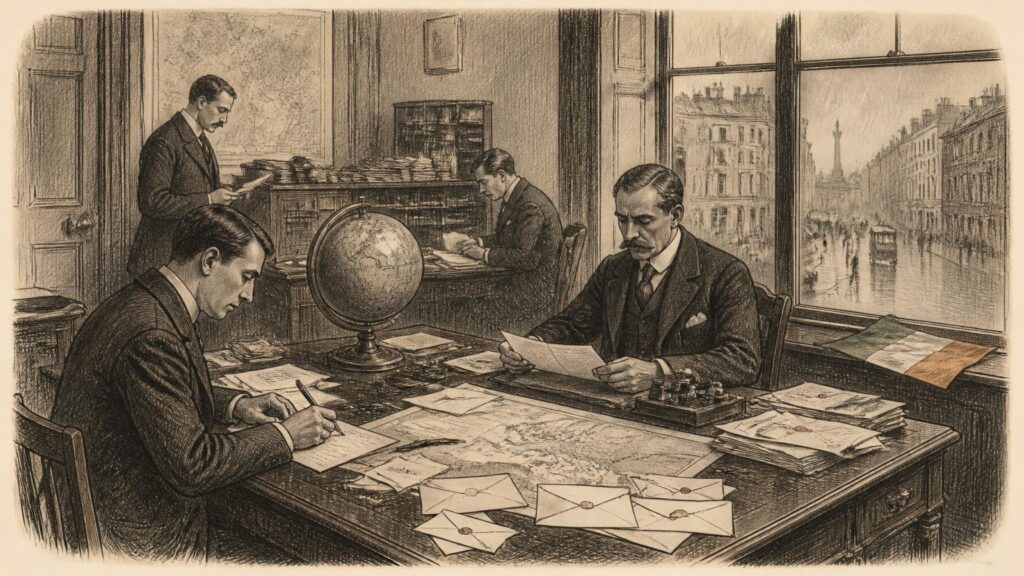
AI generated historical illustration, not a contemporary photograph.
At a Glance
Irish diplomacy was neither an ornamental extension of independence nor a simple story of a small nation finding its voice. It was a practical, contested effort to turn a claim to nationhood into recognised state authority: first amid revolution and civil war, then within the British Commonwealth, and later through multilateral institutions, European integration and painstaking negotiations over Northern Ireland. Its history is best understood as the search for room to act under severe constraints of geography, trade, partition and unequal power.
Irish Diplomacy
“Irish diplomacy” can be used loosely to describe contacts between Irish rulers, churchmen, emigrants and foreign powers over many centuries. Medieval Irish kingdoms made alliances, church reformers travelled widely, and exiles in early modern Europe sought military and political patronage. Those episodes are important parts of Ireland’s international past. They should not, however, be treated as a continuous foreign service stretching backwards from the present state. A modern diplomacy requires institutions able to claim to speak for a polity, sustain representatives abroad, exchange formal recognition and negotiate obligations. In the Irish case, that institutional history begins most clearly with the revolutionary Dáil established in January 1919 and the foreign department created to advance its claim to independence.
This distinction matters because later memory has often simplified the story. Nationalist rhetoric could present Ireland as an ancient nation returning to the family of nations; unionist criticism could depict the Free State as permanently constrained by Britain; and retrospective accounts can make the eventual Republic appear inevitable. Contemporary records show something less tidy. The Irish revolutionary government had a claim, a diaspora and considerable political energy, but no accepted international legal personality. The Irish Free State possessed recognition and treaty-making capacity, but entered the world as a Dominion whose precise constitutional position was disputed. Subsequent governments worked within, and sometimes against, those inherited arrangements.
The evidence for this history is unusually rich. The Documents on Irish Foreign Policy project, created through collaboration between the Department of Foreign Affairs, the Royal Irish Academy and the National Archives, publishes selected official records from 1919 onward. Its records demonstrate that diplomacy was made not only by celebrated leaders but also by secretaries, legal advisers, consuls, code clerks and ministers who translated broad political objectives into cables, memoranda, credentials and draft agreements. The project also warns against a leadership-centred account: many apparent breakthroughs were prepared quietly by officials over years.
Revolutionary representation
On 21 January 1919 the First Dáil assembled in Dublin, adopted a declaration of independence and issued a message to what it termed the free nations of the world. The date is conventionally treated as the beginning of Irish foreign policy because the new assembly attempted to establish a representative relationship with external states while repudiating British authority. It is more accurate to call this the beginning of a putative Irish diplomacy: a diplomatic enterprise pursued by a government whose sovereignty Britain denied and other states did not recognise.
The immediate objective was international recognition of an Irish Republic, particularly at the Paris Peace Conference after the First World War. Irish representatives and supporters tried to persuade the victorious powers that Irish self-determination deserved the same consideration publicly invoked for other peoples. The campaign faced formidable obstacles. Britain was a principal Allied power; the conference was not designed to adjudicate every anti-imperial claim; and American sympathy for Ireland did not necessarily translate into willingness to confront London. Éamon de Valera’s American tour, undertaken from 1919, raised funds and heightened visibility, but did not secure diplomatic recognition. The documentary record preserves the intensity of this campaign without supporting the later legend that recognition was close at hand.
Its importance lay elsewhere. The Dáil’s representatives created habits of external action: issuing propaganda, cultivating journalists and legislators, maintaining contacts in the United States and continental Europe, and treating international law as a field in which Irish claims might be argued. The work was inseparable from the war at home. Representatives abroad had to explain violence, rebut British statements and raise money, while British officials sought to deny the revolutionary administration any standing. Diplomatic advocacy and political communication therefore overlapped. It would be misleading to project today’s professional distinction between diplomacy, public relations and diaspora engagement back onto 1919–21.
The revolutionary service was also constrained by internal uncertainty. Ministers disagreed about priorities, authority and the balance between seeking American support and negotiating with Britain. External representatives could act with imperfect instructions and slow communications. Such difficulties were not uniquely Irish, but they were especially acute for an unrecognised administration operating clandestinely and at war. The first volume of Documents on Irish Foreign Policy, 1919–1922 shows that the service emerged amid these pressures, not as a settled department waiting to be inherited by an independent state.
Treaty Settlement
The Anglo-Irish Treaty signed in London on 6 December 1921 changed the problem. It ended the immediate negotiation between the British government and the Dáil delegation, provided for the Irish Free State as a self-governing Dominion, and required an oath connected with the Crown and Commonwealth. It did not satisfy those who believed that the Republic declared in 1916 and affirmed in 1919 could not be compromised. The Treaty split the revolutionary movement and contributed directly to the Civil War of 1922–23.
Diplomatically, the Treaty was at once an advance and a limitation. It gave the new state a constitutional basis on which to enter international life. Yet it appeared to bind Ireland to a Commonwealth structure in which London expected the Dominions to move in concert with British foreign policy. The ambiguity was not merely theoretical. Who appointed representatives? Could Dublin make treaties independently? Did Irish participation abroad derive from its own status or through the Empire? The Free State’s diplomatic history in the 1920s was largely an argument, conducted through practice as well as law, that these questions should be answered in favour of Irish autonomy.
That argument was not made by proclamation alone. It required a functioning Department of External Affairs, a budget, overseas posts and trained officials. The department retained some personnel from the revolutionary period but was reconstructed as a state institution. Its diplomats had to be economical. A small, poor country could not maintain embassies across the world, and officials knew that the British relationship would remain dominant. This was not a failure of nationalist resolve; it was a material fact. Ireland’s most consequential bilateral relationship was with the neighbouring state that remained its principal market, former imperial ruler and guarantor of the partition settlement.
In this setting, multilateral diplomacy offered disproportionate value. A mission in Geneva could meet representatives from scores of countries at lower cost than a global network of legations. International organisations also supplied a theatre in which Irish ministers could enact and consolidate the equality they sought. The appeal was practical as well as symbolic.
Geneva Personality
The Irish Free State joined the League of Nations on 10 September 1923. W. T. Cosgrave and Desmond FitzGerald led the delegation at Geneva. Membership did not make Ireland independent in a magical sense; the state’s international status had emerged through the Treaty settlement. But it gave public, recurring expression to a central proposition: Ireland sat in an international assembly in its own name. As the historical account of the Free State’s accession observes, Ireland’s Geneva mission offered regular contact with states far beyond the limited range of its early bilateral relations.
The League was also a constitutional testing ground. Britain initially held that the Free State, as a Dominion, should broadly follow imperial policy. Dublin increasingly rejected that view. The registration of the Anglo-Irish Treaty with the League in 1924 mattered because it presented the agreement as an international instrument rather than merely an internal imperial arrangement. This did not erase the Treaty’s obligations or end British influence. It did strengthen the Free State’s case that its relationship with Britain could be addressed in the language of international law.
The history of Ireland at the League of Nations records a gradual change from cautious attendance to more active participation. From the later 1920s, governments signed social and economic conventions, supported codification of international law, and advocated disarmament and collective security. In 1930 Ireland secured election to the League Council for a three-year term. For a state admitted only seven years earlier, this was a significant diplomatic success. It reflected sustained campaigning and the ability to present Ireland as a representative of smaller powers rather than as an adjunct of Britain or France.
There is a temptation to treat this as a golden age of principled idealism. That is partly justified: Irish representatives did repeatedly defend procedures, equality of states and peaceful settlement. Yet the idealism was joined to calculation. League activity differentiated Irish policy from London, built personal networks and enhanced the credibility of a small diplomatic service. Support for international law could be morally serious and strategically useful at the same time. There is no contradiction in that combination.
Geneva also exposed the limits of collective security. The League’s handling of crises, including the Corfu incident in 1923 and later Japanese and Italian aggression, made clear how often great-power interests frustrated its principles. Irish officials did not simply abandon the organisation at the first disappointment. They generally advocated improvement while becoming less confident that the League could protect small states. That experience contributed to, but did not alone create, the later emphasis on neutrality. Neutrality arose from Irish constitutional development, military weakness, the legacy of British rule, public opinion and the strategic realities of a war involving Britain as well as from disillusion with Geneva.
One individual illustrates the connections between national and international service. Seán Lester became Ireland’s permanent representative in Geneva and later served as the League’s final Secretary-General during its wartime dissolution. His career should not be romanticised as proof that Ireland controlled international events. It does demonstrate that the young state’s representatives acquired professional expertise and international standing within a system whose institutional weaknesses they had observed at close hand.
Constitutional Separation
Éamon de Valera’s return to power in 1932 is often presented as a complete break in foreign policy. It was a change in political leadership and constitutional ambition, but it rested on foundations laid by Cumann na nGaedheal. De Valera, who served as both head of government and minister responsible for external affairs for much of the 1930s, used Commonwealth and League forums to advance Irish autonomy. His governments removed the oath of allegiance, reduced the role of the Governor-General and negotiated the 1938 Anglo-Irish Agreements with Britain, which settled the Economic War and returned the Treaty Ports.
These steps had major diplomatic consequences. The ports were important because their retention by Britain had embodied the strategic limitations of Irish sovereignty. Their return shortly before the European war strengthened the practical possibility of staying outside the conflict. The 1937 Constitution, meanwhile, gave the state a new institutional framework, although the constitutional position of the Crown in external relations remained a complicated and contested matter until the Republic of Ireland Act took effect in 1949.
It is important not to impose a false precision on the word “independence”. The Free State was increasingly autonomous well before 1949, while formal links and inherited arrangements survived longer than nationalist celebratory accounts sometimes admit. Statehood developed through accumulated acts: staffing a department, issuing passports, sending envoys, registering treaties, making legal arguments and sustaining distinct positions in international forums. The slow character of this process is exactly what archival diplomacy reveals.
De Valera’s personal prominence could obscure the work of officials such as Joseph Walshe, secretary of the Department of External Affairs from 1938. Civil servants prepared policy, read foreign reports, managed relations with missions abroad and tried to interpret the intentions of stronger states. Their work was necessarily selective. The department was small, resources were restricted, and intelligence depended greatly on reports from London, Geneva, Washington and other capitals. A small state’s diplomacy cannot be measured solely by speeches at assemblies; much of its value lay in obtaining reliable information before decisions had to be made.
Emergency Neutrality
The Second World War, known in Ireland as the Emergency, became the severest test of the state’s external policy. Ireland declared neutrality in September 1939 and maintained it until the war’s end in Europe in 1945. Neutrality was popular, constitutionally resonant and politically useful: entering a British war would have placed grave strain upon a state only recently separated from the United Kingdom and would have intensified the partition question. It was also an assertion that Dublin, rather than London, would decide whether Ireland went to war.
But neutrality did not mean detachment from the conflict. The state faced threats of invasion, shortages, espionage, air and sea warfare around its coast, and intense pressure from Britain and the United States. It shared intelligence in some areas with the Allied side, detained belligerent personnel under rules applied unevenly in practice, and sought to preserve its own security while avoiding commitments that would compromise the public position of neutrality. The government’s choices are still debated by historians because moral, strategic and legal questions do not always yield the same answer.
The documented record does not support either extreme version of the story. Ireland was not secretly an Allied belligerent in all but name; neither was it indifferent to Nazi Germany or insulated from the Allied war effort. Rather, its government tried to protect a vulnerable neutral state whose security was entangled with Britain’s, while maintaining a policy that had domestic legitimacy and international consequences. The closure of the Irish office in Geneva in 1940 and the transfer of representation to neutral Switzerland reflected the altered conditions of wartime diplomacy.
Neutrality acquired an enduring place in Irish political culture, but it should not be treated as a timeless national essence. Before 1939 Irish governments had supported League sanctions and collective-security principles. After 1945 they joined the United Nations and undertook extensive work in multilateral peacekeeping. The more accurate interpretation is that military non-alignment became a favoured instrument of policy under particular historical conditions. It could coexist with economic, political and humanitarian engagement.
Postwar Reputation
Wartime neutrality complicated Ireland’s post-war position. The state was not admitted to the United Nations at its foundation in 1945. This was not a simple punishment with one cause: Cold War division in the Security Council blocked or delayed a range of applications. Nonetheless, Ireland’s wartime policy formed part of the atmosphere in which outsiders assessed it. The state did not become a UN member until 14 December 1955, one of a group of states admitted together after the long membership impasse was broken. The United Nations’ official member-state record gives that date plainly.
The delay illustrates a recurring feature of Irish diplomacy: moral language and national self-understanding were never enough to secure an outcome. Access to international institutions depended on the calculations of larger powers and on the structure of those institutions. Yet Ireland’s eventual admission also showed the value of patient persistence. The state could enter the UN with a body of experience from the League, a professional department and a well-developed belief that small states needed rules and forums through which to be heard.
United Nations
Ireland’s UN membership opened a new chapter rather than restoring the old League world. The organisation’s universal claims were stronger, its security machinery more consequential, and the Cold War more constraining. Irish representatives sought a role compatible with military neutrality and western democratic alignment. This required careful language. Ireland could oppose colonialism, support human rights and contribute to peacekeeping while avoiding formal military alliances.
The Department of Foreign Affairs’ historical publication Ireland: 60 Years at the United Nations places the first General Assembly participation in 1956 in a longer line from the Free State’s appearance at the League. Such institutional continuity is real, although it should not obscure change. The 1950s and 1960s brought decolonisation, the expansion of UN membership and new diplomatic constituencies. Ireland increasingly worked with small and newly independent states, particularly on questions involving peacekeeping, development and international law.
Peacekeeping became a conspicuous element of this role. Irish troops served in UN operations, beginning with the United Nations Operation in the Congo in 1960. The sacrifice and controversy associated with those missions made peacekeeping a powerful public symbol of Ireland’s international identity. But it was not purely altruistic symbolism. Participation provided operational experience, strengthened Ireland’s claim to be an active multilateral member and made visible a form of security contribution that did not require alliance membership. It also exposed Irish personnel to danger and to the ambiguities of mandates negotiated far from the field.
At the same time, governments pursued bilateral representation more systematically. The embassy in London remained exceptionally important. John Dulanty, High Commissioner from 1930 and subsequently the first Irish Ambassador to the Court of St James after the Republic of Ireland Act changed the relationship, personified the importance of sustained contact with Britain. The history of the Irish Embassy in Britain records that transition in 1950. It was a reminder that asserting distinction from Britain did not reduce the need to manage an extraordinarily close relationship.
Washington was another priority. Irish-American public feeling had mattered during the revolutionary struggle, but relations with the United States after independence required more than diaspora politics. Trade, emigration, investment, security questions and cultural links all demanded governmental channels. The appointment of Timothy Smiddy as the first Irish minister to the United States followed diplomatic recognition of the Free State in 1924. Professor Bernadette Whelan’s study of the early decades of Irish diplomacy in America rightly cautions that formal foreign policy belongs to the state after 1922, while recognising the importance of pre-state representative efforts.
European Dependence
European integration transformed the context in which Irish diplomacy operated. In the early decades of independence, economic dependence on Britain had narrowed the state’s options. Protectionist policies did not remove that structural reality. By the late 1950s and early 1960s, economic modernisation and the prospect of British entry into the European Economic Community encouraged a strategic reassessment. Ireland applied to join the EEC in 1961, shortly after Britain’s application. The link was candid: a state whose trade was overwhelmingly connected to Britain could not easily ignore its neighbour’s proposed move into a large common market.
Charles de Gaulle’s vetoes of British accession stalled Ireland’s path as well. This is sometimes presented as evidence that Ireland simply followed Britain. It is truer to say that economic geography sharply constrained independent choice. Irish officials nevertheless used the interval to prepare, analyse the consequences of membership and develop a more European diplomatic outlook. The eventual negotiations after 1970 involved distinct Irish concerns, especially agriculture and regional development. Ireland signed the Treaty of Accession in January 1972, voters endorsed membership in a referendum in May, and the state entered the Communities on 1 January 1973 alongside Denmark and the United Kingdom.
The European Union’s official country history for Ireland confirms the accession date; the detail matters because it marks a decisive institutional shift. Membership did not mean that Ireland escaped interdependence. Rather, it changed its framework. Dublin acquired direct relationships with continental governments and a voice within common institutions, while its economy gradually became less exclusively oriented towards Britain. European policy demanded a much larger and more specialised diplomatic effort, including permanent representation in Brussels, technical negotiation and regular ministerial coordination.
For a small state, the Communities offered both leverage and obligations. Common rules could protect smaller members against arbitrary bilateral pressure, but policy had to be built through compromise. Irish ministers learned to form coalitions, cultivate expertise and use the rotating presidency of the Council. Ireland first held that presidency in 1975. It is tempting to portray this as proof of effortless influence; it was instead evidence that membership gave small states institutional opportunities when they had preparation, credible positions and allies.
European membership also altered the language of sovereignty. The diplomacy of the 1920s had often sought formal demonstrations that Ireland was separate from Britain. By the later twentieth century, governments could exercise influence through shared institutions in which sovereignty was pooled rather than displayed as solitary independence. There was no disappearance of national interest. Agriculture, fisheries, taxation, neutrality, budgetary contributions and treaty change all generated hard bargaining. Yet the means of pursuing Irish interests increasingly involved shaping common decisions before they became fixed.
Partition Diplomacy
No subject more persistently shaped Irish external relations than Northern Ireland. Partition, formalised in the early 1920s, placed a constitutional and emotional question at the centre of relations with Britain. For long periods the issue was managed inadequately or intermittently, partly because the Irish state had little practical power to alter the northern constitutional position and partly because British governments regarded it largely as an internal matter. The border settlement of 1925, which retained the existing boundary after the Boundary Commission crisis, underlined the limits of Dublin’s leverage.
The outbreak of conflict in Northern Ireland from the late 1960s changed this. Irish governments had to protect citizens, respond to public outrage, maintain relations with London and avoid actions that might worsen violence. The challenge was intensified by competing constitutional claims. The 1937 Constitution’s Articles 2 and 3 expressed a territorial claim to the whole island, while unionists feared incorporation into a state they did not consent to join. Diplomacy could not solve these conflicts by wording alone, but wording eventually became crucial in constructing an agreed framework.
Anglo-Irish cooperation developed unevenly. The 1985 Anglo-Irish Agreement gave the Irish government a consultative role in Northern Ireland affairs through the Anglo-Irish Intergovernmental Conference. It provoked fierce unionist opposition and did not end violence. Its historical importance lies less in immediate success than in establishing that London accepted a formal Irish governmental interest in the governance and stability of Northern Ireland. For Dublin, this was an institutional foothold; for London, a means of cooperating with a neighbour whose support mattered to any durable settlement.
The peace process of the 1990s depended on many actors: the British and Irish governments, Northern Ireland parties, civil society, constitutional lawyers, the United States, the European Union and, critically, people directly affected by violence. It is inaccurate to award sole authorship to any one leader or government. Diplomatic work created channels, drafted texts and maintained trust through repeated crisis, but political change also relied on ceasefires, electoral mandates and difficult decisions within republican and loyalist movements.
The Good Friday Agreement, signed on 10 April 1998, was both a multi-party agreement and a British-Irish international agreement. Its structure recognised the legitimacy of differing identities and aspirations; affirmed that Northern Ireland’s constitutional status could change only with majority consent there; established devolved and North–South institutions; and revised the constitutional relationship between the two states. Following referendums north and south, Ireland amended Articles 2 and 3. This was diplomacy at its most consequential: not a declaration that a dispute had vanished, but an agreed set of institutions through which incompatible aspirations could be pursued peacefully.
The Irish government’s official Good Friday Agreement page identifies the signature date and its role in laying foundations for peace. The phrase “foundations” is important. The agreement did not guarantee harmony or resolve every disagreement. Its achievement was to replace the assumption that constitutional conflict must be settled by force with arrangements based on consent, parity of esteem and continuing cooperation.
Statehood Evidence
Irish diplomacy has generated powerful folklore. One version imagines a naturally peaceable island consistently above great-power politics. Another imagines a heroic diplomatic tradition in which eloquence alone repeatedly overcame power. A third reduces Irish policy to dependence, implying that every apparently independent initiative was theatrical. None withstands close attention to the record.
The evidence supports a more demanding conclusion. Irish governments repeatedly used multilateral institutions because they increased access, information and influence for a state with limited resources. They invested heavily in relations with Britain because proximity and interdependence made that unavoidable. They cultivated the United States and the diaspora because those connections could offer political and economic advantages, though never unconditional support. They entered Europe because the old pattern of economic dependence required a new setting. And in the Northern Ireland peace process, they learned that durable progress required reciprocal recognition rather than unilateral constitutional assertion.
Interpretation begins where historians weigh motives. The same action can be described as idealism, self-interest or a mixture of both. Support for collective security at Geneva, peacekeeping at the UN and European cooperation plainly reflected values held by many Irish policymakers. They also served the interests of a small state seeking predictable rules. Similarly, neutrality was a sincere assertion of national agency, but it also reflected military vulnerability and domestic politics. To acknowledge calculation is not to discredit principle; diplomacy normally joins them.
The documentary record also corrects the assumption that all policy was made in public. State papers reveal hesitation, disagreement, preliminary legal advice and private assessments that public speeches conceal. This is why archival publication matters. The National Archives’ annual releases of state records make it possible to revisit decisions after the passage of time, while the Documents on Irish Foreign Policy series gives researchers structured access to selected files. Such material does not eliminate uncertainty: official files preserve the perspective of officials and do not capture every informal conversation or excluded voice. But they offer firmer ground than anecdote.
Sovereign Legacy
The central achievement of Irish diplomacy was not the creation of an unbounded sovereignty; no state possesses that. It was the construction of practical capacity. Between 1919 and the Good Friday Agreement, Irish representatives moved from pleading for recognition to exercising recognised membership in international organisations, negotiating European rules and helping build an intergovernmental framework for peace on the island of Ireland.
That trajectory was neither straight nor inevitable. Revolutionary representatives failed to secure the Republic’s recognition. The Treaty brought statehood but divided the independence movement. League activism enlarged Irish visibility but could not prevent the collapse of collective security. Neutrality asserted autonomy while exposing the state’s vulnerability. UN membership and European integration broadened influence while creating new obligations. The peace process showed the limits of unilateral nationalist language and the possibility of institutional compromise.
Irish diplomacy therefore deserves to be remembered not as a pageant of famous speeches but as a continuing craft: the disciplined use of law, representation, information, relationships and compromise to make a small state’s choices more real. Its most durable lesson is also its least romantic. Independence was not secured once and for all at a single moment. It had to be argued, administered and renegotiated in the world.
Sovereignty Records
The later history of Irish diplomacy is not only a history of agreements reached or institutions joined; it is also a history of how decisions became knowable. That distinction is particularly important for Northern Ireland. Public memory understandably concentrates on leaders, declarations and dramatic moments of breakthrough. Yet the surviving state record directs attention to the less visible labour that made negotiation possible: briefing papers, legal advice, communications between departments, drafts whose wording was revised, and assessments of what another government or party might accept. The National Archives of Ireland notes that records concerning the peace process leading to the Belfast Good Friday Agreement have been released under arrangements that permit access to certain files more than twenty years old. Those files include material from the Departments of the Taoiseach, Foreign Affairs, Justice and the Attorney General’s office, dating between 1992 and 1998. The archive’s account of the releases consequently makes it possible to study Irish and British negotiations as contemporaneous processes rather than as retrospective legend.
This matters because diplomacy is often most consequential before a settlement is signed. A government must identify which principles are indispensable, which formulations can be shared, and which concessions will be understood at home as protection rather than surrender. Such work does not eliminate conflict or distribute credit neatly among participants. It does, however, show that sovereign authority is exercised through interpretation and procedure as well as through public assertion. In the Irish case, the long struggle to speak internationally in the state’s own name was eventually joined by a different challenge: constructing arrangements in which competing identities and constitutional aspirations could be addressed without presuming that one voice alone could settle the island’s future.
The documentary record also guards against an excessively presidential or ministerial history. Documents on Irish Foreign Policy, a collaboration of the Department of Foreign Affairs, the Royal Irish Academy and the National Archives, was established to make important departmental documents accessible and to illuminate the evolution of policy and decisions. Its editorial rationale is revealing. The project does not promise an exhaustive transcript of government; it selects material judged useful or important for understanding how policy developed. Readers must therefore recognise both the value and the limits of the archive. Official documents reveal arguments within the state with exceptional clarity, but they do not automatically encompass the experience of every community affected by those arguments.
Even so, the breadth of the series changes the scale at which Irish diplomacy can be examined. Its published volumes move from the revolutionary years into the Free State, the Commonwealth, the League of Nations, wartime neutrality, the early Cold War and the United Nations era. The online catalogue makes visible a service that was never static: a small department repeatedly adapted its methods to new forums, new risks and new definitions of national interest. The first volume is especially clear that the foreign department and diplomatic service were formed amid political and military conflict, beginning with the First Dáil’s meeting and declaration on 21 January 1919 and extending to the Free State’s official birth on 6 December 1922. Its editorial introduction thus supports a central conclusion of this history: diplomacy was built in conditions of uncertainty, not added after sovereignty had been securely won.
That conclusion also helps explain the durable attraction of multilateral settings. The League of Nations gave a small service contact with representatives of more than fifty states through a single mission in Geneva, while offering a means of distinguishing Ireland’s international position from Britain’s. Ireland’s League experience demonstrates that principle and expediency were intertwined: equality among states was an ideal, but it was also a practical resource for a country with limited diplomatic reach. European membership later supplied another institutional setting for influence; Ireland has been an EU member since 1 January 1973. The EU’s country history records that date, but its larger significance lies in the change of diplomatic method it represents.
Sovereign voices, then, were never simply loud or solitary voices. They were voices made credible by records, representatives, alliances, legal arguments and the capacity to keep negotiating when a final answer remained out of reach. That is the more demanding legacy of Irish diplomacy: not independence as a completed performance, but statecraft as a continuing practice of being heard, answering others and making difficult coexistence possible.