

The Magazine Fort Raid1939 CE
In 1939, Ireland faced both European war and republican militancy. The Government strengthened internal security through the Offences Against the State Act, while air-raid precautions reflected fears of attack. Following Germany’s invasion of Poland, constitutional amendments and the Emergency Powers Act enabled neutral Ireland to regulate security, supplies and communications. Dublin denied belligerents use of its territory and ports, despite British pressure, asserting sovereignty after the Treaty Ports’ return. Northern Ireland entered the war with Britain, underscoring partition’s consequences. Refugee appeals highlighted Nazi persecution. The December IRA raid on Dublin’s Magazine Fort demonstrated that armed challenges to State authority persisted.
Dateline
A State Facing Two Threats
For Ireland, 1939 was the year in which the possibility of another European war became an immediate test of independence. The State was scarcely two years into the life of Bunreacht na hÉireann and still governed by Éamon de Valera’s Fianna Fáil administration. It claimed authority over the whole island in constitutional language, but exercised it only in the twenty-six counties. Northern Ireland remained within the United Kingdom, governed from Stormont. When war came in September, the island therefore entered two sharply different political worlds: one formally neutral, the other at war with Germany.
The crisis did not begin with the German invasion of Poland. During the first half of the year, the Irish Government faced a domestic security problem in the IRA. Its leadership had embarked on a bombing campaign in Britain, often called the S-Plan, intended to pressure the British Government over partition. This strategy did not advance Irish unity. Instead, it made Dublin acutely conscious that clandestine violence, especially violence directed across the Irish Sea, could compromise the State’s security and its international standing at the very moment when a European conflict appeared increasingly likely.
On 14 June, the Oireachtas enacted the Offences Against the State Act. Its scope was formidable: it addressed actions said to undermine public order or the authority of the State, provided mechanisms for suppressing unlawful organisations, and established Special Criminal Courts where the ordinary courts were considered inadequate. The measure was directed principally at republican militancy, but it also revealed a wider principle that would dominate the rest of the year. The State intended to monopolise armed authority, even when the challenge came from people invoking republican language and the unfinished national question.
This was a profound political choice. The Government did not equate national independence with tolerating every act done in its name. For de Valera, uncontrolled IRA action risked giving Britain a reason, or an excuse, to interfere in Irish affairs. The campaign also placed many constitutional nationalists in an awkward position: they opposed partition but rejected the use of bombings and clandestine armies to settle it. Thus, before the international emergency formally began, 1939 had already tightened the relationship between sovereignty, public order and the limits of political dissent.
Preparing for Air War
Fear of aerial attack was tangible well before September. The Air-Raid Precautions Act, enacted on 26 July, empowered local authorities and essential undertakings to make preparations for the protection of people, property and vital services. Its provisions covered shelters, equipment and local schemes, while even the National Gallery of Ireland received statutory authority to move pictures to safety should air attack threaten Dublin. Such clauses give a revealing glimpse of the year’s atmosphere. War had not reached Irish soil, but civic administrators were already expected to plan for damaged streets, interrupted utilities and vulnerable cultural collections.
These preparations belonged to a society that was still substantially rural and agriculturally based. The most recent census, taken in 1936, recorded occupational and household patterns in great detail, including the large numbers of farmers, farm labourers and family members assisting on holdings. Towns and cities mattered, especially Dublin, Cork, Limerick, Waterford and Galway, yet daily life across much of the State remained tied to small farms, local markets and the seasonal rhythm of livestock, tillage and harvest. That made secure supplies, transport and access to imported fuel and fertiliser matters of national concern rather than merely commercial questions.
Ireland’s economic position was also exposed by geography. Britain was the essential market for much Irish agricultural produce and the principal channel through which many imports arrived. The 1938 Anglo-Irish agreements had ended the Economic War and, crucially, transferred the former Treaty Ports to Irish control. That settlement was background rather than an event of 1939, but it was indispensable to the year’s decisions. Had Britain still controlled Cobh, Berehaven and Lough Swilly, Irish neutrality would have been far less credible. The return of the ports gave the Government a practical means of asserting jurisdiction over its coasts and harbours, even as it left Ireland exposed to the disruption of Atlantic trade.
Neutrality Becomes Policy
Germany invaded Poland on 1 September. The following day, 2 September, the First Amendment of the Constitution Act was enacted. It enlarged the constitutional meaning of a “time of war” so that emergency powers could operate during an armed conflict in which the State itself was not a participant, once the Houses of the Oireachtas recognised a national emergency affecting vital interests. This was not an abstract legal adjustment. It was designed to allow a neutral State to defend itself against the political, economic and military consequences of a war fought around it.
On 3 September, the day Britain and France declared war on Germany, the Emergency Powers Act became law. It authorised the Government to make emergency orders for public safety, the preservation of the State, public order and the control of essential supplies and services. In Dáil debate, supporters accepted that the powers sought were exceptional; critics warned that they could weaken normal constitutional safeguards. The tension was real. Neutrality required the State to regulate communications, trade, movement and security in ways unimaginable in ordinary peace, yet the Government had to retain democratic legitimacy while doing so.
The policy itself was not passive isolation. Irish officials worked rapidly to define what neutrality required in practice. A memorandum prepared for the Department of External Affairs at the opening of the crisis stressed that Irish territory and territorial waters could not be used by either belligerent for hostile operations. On 12 September, Dublin communicated restrictions concerning belligerent naval craft. This was a practical assertion of sovereignty: neutrality meant denying facilities to both sides, not simply declining to send an army abroad.
Relations with Britain were necessarily central. The departure of British forces from the Treaty Ports in 1938 had made their possible return politically explosive. Dublin’s refusal to grant Britain naval facilities caused immediate strain, while British fears centred on the Atlantic approaches and the danger of German submarine activity. Yet diplomacy continued. On 22 September the Irish Government agreed to the appointment of Sir John Maffey as the United Kingdom’s diplomatic representative in Dublin. The carefully negotiated form of his appointment mattered: it acknowledged a new direct channel between two governments while reflecting unresolved arguments about Ireland’s constitutional status and partition.
An Island Divided by War
Neutrality did not describe the whole island. Northern Ireland, as part of the United Kingdom, entered the war when Britain did. Belfast’s strategic industries, ports and shipyards acquired new significance, while Stormont and the Northern Ireland administration began adapting to the dangers of air attack. Parliament Buildings at Stormont, conspicuously white in the Belfast landscape, were camouflaged with a dark mixture of tar and cow manure during the war years; the visual transformation began from the same fear that prompted precautions in Dublin. The contrast was striking: the northern state prepared as part of Britain’s war effort, while the southern state prepared to remain outside the conflict.
Partition consequently shaped every calculation in Dublin. De Valera’s Government continued to regard the division of the island as unjust, but it would not surrender control over foreign policy in return for vague promises of unity. Neutrality was therefore both a defensive policy and a declaration that the State would decide for itself whether it fought. It was also widely intelligible to people whose memories of the First World War, the revolutionary period and the civil war remained close. Opposition parties could dispute the extent of emergency powers, but support for keeping the State out of the war was broad at its outset.
The year also brought evidence of Europe’s human catastrophe to Ireland. Between September 1938 and April 1939, Northern Ireland’s Ministry of Commerce received more than 500 letters from Jewish people, mainly in Vienna, seeking opportunities to establish businesses or employment in Northern Ireland after Nazi persecution intensified. These surviving appeals do not by themselves show how every case was decided, but they demonstrate that events on the Continent had reached Irish departments and communities well before the formal outbreak of war. Ireland was not insulated from the refugee crisis, even if its capacity and willingness to offer refuge remained restricted.
Christmas at Phoenix Park
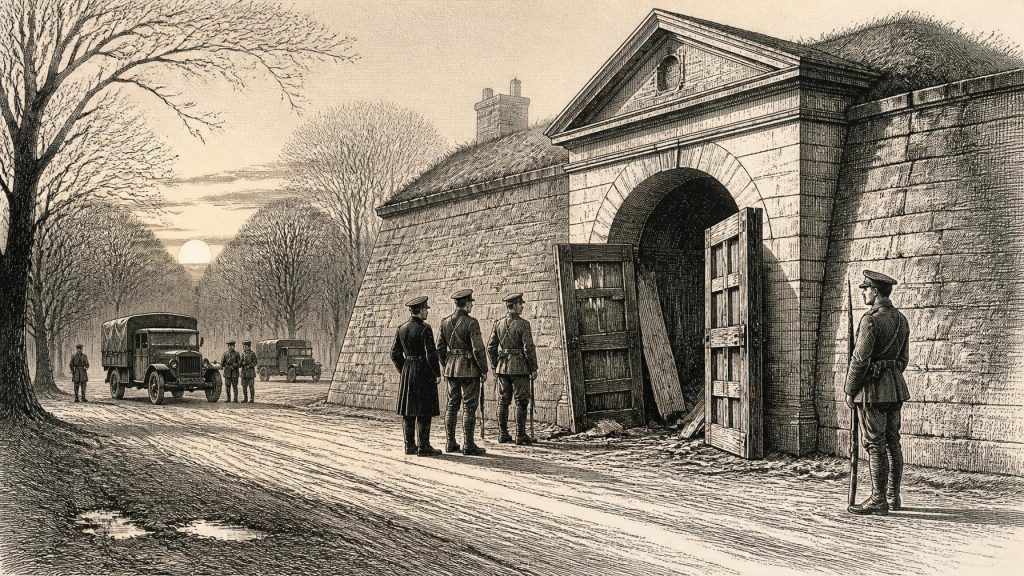
The year ended with a dramatic reminder that neutrality had not settled the internal security question. On the night of 23 December, an IRA party raided the Magazine Fort in the Phoenix Park, Dublin, removing a large quantity of ammunition from the State’s principal ammunition store. The operation was an embarrassment to the authorities and a direct challenge to their claim to control armed force. It also showed why the Government regarded the IRA not as a distant political remnant but as an active danger at a time of international uncertainty.
Nothing in December 1939 made the future course of the war predictable. Shortages, censorship, internment, bomb damage and the far heavier pressures of the Emergency still largely lay ahead. But the essential framework had been created. Ireland had equipped itself legally for an emergency, declared and defended neutrality, begun to manage the consequences for ports, information and supplies, and reaffirmed that armed organisations outside the State would be resisted. The Magazine Fort raid closed the year on an unsettled note: independence had been asserted, but it would require vigilance, restraint and coercive power to preserve it.
Primary Sources
- Emergency Powers Act, 1939
- Offences Against the State Act, 1939
- First Amendment of the Constitution Act, 1939
- Air-Raid Precautions Act, 1939
- Emergency Powers Bill, 1939—Second Stage
- Volume 6: Documents on Irish Foreign Policy, 1939–1941
- Memorandum Entitled ‘Ireland’s Neutrality in Practice’
- Memorandum by Rynne: Emergency Powers
- Memorandum by Sir John Maffey to Anthony Eden
- De Valera, Éamon (‘Dev’)
- Maffey, John Loader
- Walshe, Joseph Patrick
- Boland, Gerald
- Hayes, Stephen
- Census 1936 Volume 1: Population, Area and Valuation of each DED and each Larger Unit of Area
- Census 1936 Volume 2: Occupations
- Census 1936 Volume 8: Irish Language
- Annual Report of the Registrar-General of Marriages, Births, and Deaths in Ireland, 1939
- The Irish Economy in Comparative Perspective
- The Economic History of Ireland Since Independence
- Holocaust Related Records
- Snapshots of History
- CAIN: Chronology of Key Events, 1800 to 1967
- Magazine Fort to Be Restored
- Irish Statute Book: Acts of the Oireachtas, 1939