Playing Ireland
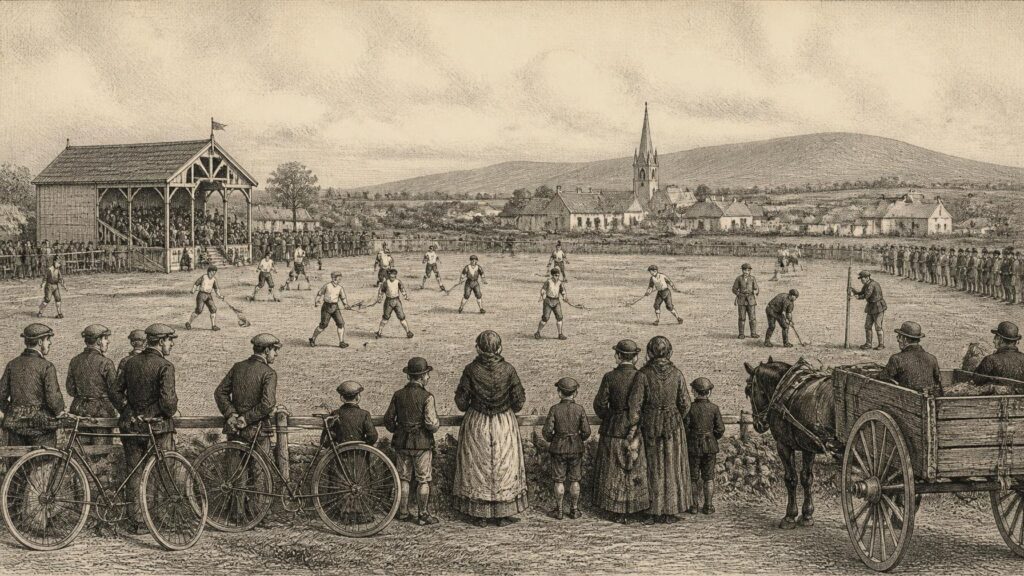
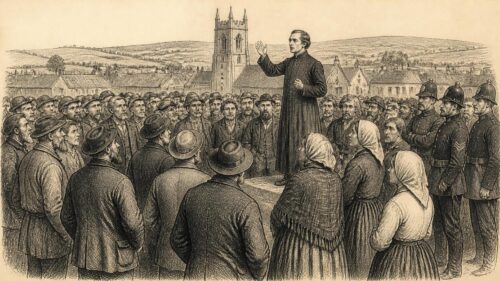
AI generated historical illustration, not a contemporary photograph.
At a Glance
Irish sport has never been merely a diversion from community life. It has been one of the ways communities have been made: through the voluntary club, the parish field, the school team, the workplace side, the railway excursion, the fundraising dance, the county final and the shared recollection of a match. Yet this history is not a simple story of an ancient people expressing an unchanging national character. It is a history of organisations, arguments, exclusions, loyalties and reinventions. Gaelic games became exceptionally influential, but they developed beside rugby, cricket, association football, golf, athletics, rowing, boxing, horse racing and many other pursuits. Each attached itself to particular places and social worlds, while also crossing them.
Sporting associations
The most useful starting point is not a single game but association. Modern Irish sport grew through clubs and governing bodies: groups with committees, subscriptions, rules, fixtures, officers, minutes and, often, a claim to represent a locality. Historians of Irish social life caution against imagining a society without organised leisure before the twentieth century. Clubs and societies had long existed, particularly in towns, among the professional classes and within Protestant civic networks. Across the period from the mid-eighteenth century onwards, associational leisure became a significant means by which people negotiated status, fellowship and identity. Sport was part of that wider voluntary culture, though its reach and social composition differed sharply between regions and games.
In the eighteenth and early nineteenth centuries, recreation could be communal without being regulated by a modern club. Fairs, wakes, market days, patron days and seasonal gatherings offered opportunities for racing, wrestling, stick-and-ball games, dancing and drinking. Such occasions were shaped by custom, but custom was neither fixed nor universally harmonious. Local sport could bring neighbouring districts together, yet it could also provoke disorder, gambling, rivalry and intervention by magistrates or clergy. The documentary record is uneven: official notices frequently preserve conflict more readily than ordinary enjoyment. Consequently, historians should be careful not to infer the normal texture of popular recreation solely from attempts to suppress it.
The familiar claim that hurling or football possesses an uninterrupted, unchanged pedigree from remote antiquity belongs partly to folklore and nationalist rhetoric rather than to secure historical proof. There are early written references to forms of hurling, and the game appears powerfully in Irish literary tradition; the National Inventory notes verifiable references to football in the sixteenth century and earlier, less certain references. But past games varied greatly in rules, numbers, playing space and purpose. The modern codified sports played on marked pitches are not archaeological survivals. They are modern institutions that drew inspiration, vocabulary and prestige from older practices. This distinction does not diminish their cultural importance; it makes their history more intelligible.
By the nineteenth century, industrialisation, urban growth, new transport links, commercial newspapers and expanding education encouraged more formal competition. The spread of standard rules allowed teams from different districts to meet with some expectation of shared procedure. Railways made away fixtures and large sporting gatherings more practical. Newspapers turned local results into public knowledge, recording scorers, controversies, subscriptions and selections while giving communities a language in which to praise their own representatives. Sport thus became both local theatre and a growing communications network.
Class Recreation
No nineteenth-century Irish sporting landscape can be reduced to a neat opposition between native games and imported ones. Cricket, rugby, golf, rowing, athletics and association football all developed substantial Irish constituencies. Their histories reveal differences of class, religion, education, occupation and geography, but none was ever the exclusive possession of one community. Cricket clubs were especially conspicuous in garrison towns and among sections of the Protestant and professional middle classes. Rugby developed through schools, universities and urban clubs; golf expanded through resorts and professional networks; horse racing connected landed patronage, breeding, rural labour and large public gatherings. Association football took particularly strong root in Belfast, later gaining important bases in Dublin, industrial towns and parts of Ulster.
Rugby illustrates the complexity of an all-island sporting structure. The Irish Rugby Football Union was formed in 1879 from earlier unions, with branches in Leinster, Munster and Ulster; Connacht followed in 1885. That institutional geography outlasted political partition. Its durability should not be romanticised as proof that sport naturally overcomes political division. Rather, it demonstrates that organisations with established clubs, fixtures and resources can preserve an all-island framework when members judge it useful or meaningful to do so. Rugby’s social history also includes elite schooling, professional employment, urban sociability and the gradual widening, though never automatic equalisation, of access.
Association football offers a similarly layered history. The Irish Football Association was founded in Belfast on 18 November 1880, following an initiative associated with Cliftonville and other clubs playing Scottish Association rules. Its early institutional base was visibly northern and urban, but its original ambition was to organise the game across Ireland. The formation of the Football Association of Ireland in the early Free State era, and subsequent disputes over international recognition and jurisdiction, show how political change could divide sporting administration. The surviving Football Association of Ireland records held by University College Dublin document correspondence and negotiations concerning recognition, governance and relations with the Irish Football Association from 1922 onwards.
It would be misleading, therefore, to call one set of games wholly Irish and another wholly foreign. All sports are transmitted, adapted and made local. Cricket had Irish players and audiences; soccer became part of working-class urban culture; rugby produced an all-island representative tradition; Gaelic games themselves borrowed heavily from the nineteenth-century world of clubs, championships, printed rules and organised spectatorship. What mattered was not only where a game began, but who controlled access to it, how it was financed, where it was played, and what meanings people attached to participation.
Gaelic revival
The Gaelic Athletic Association was founded at Hayes’s Commercial Hotel in Thurles on 1 November 1884. Its full early title, the Gaelic Athletic Association for the Preservation and Cultivation of National Pastimes, makes clear that it was both a sporting and cultural project. Michael Cusack’s journalism had argued for a body to regulate athletics and revive Irish games; Maurice Davin, an athlete of national reputation, became the first president. The founding meeting asked Archbishop Thomas Croke, Charles Stewart Parnell and Michael Davitt to serve as patrons. These were not incidental associations. They placed the new organisation near the intersecting currents of Catholic public life, constitutional nationalism, land agitation and cultural revival.
The GAA did not create sport among ordinary people from nothing. Its achievement was organisational: it helped standardise rules, affiliate clubs, establish competitions, publicise fixtures and give dispersed local teams a national framework. In doing so it offered many people an accessible route into modern organised sport. The Association’s rapid early expansion was uneven and sometimes fragile, but its club network became a powerful structure through which local loyalties could be expressed. A village team could play under its own name while imagining itself part of a county, province and nation. The club was consequently both intimate and expansive: a place where neighbours collected subscriptions, repaired grounds and selected teams, but also a gateway to public rituals of county representation.
Nationalist interpretation was present from the outset, though it did not operate in exactly the same way everywhere. GAA leaders disagreed politically; branches varied in their proximity to the Irish Parliamentary Party, the Irish Republican Brotherhood, the Gaelic League and later republican organisations. The Association itself experienced factional dispute in its early years. It is more accurate to say that the GAA supplied a field in which nationalism could be practised and argued over than to claim that every member shared a single political creed. Its language of national pastimes nevertheless helped establish Gaelic games as markers of cultural distinction in a country still governed from London.
The Association’s rules and public rhetoric could also define boundaries. Restrictions associated with so-called foreign games became among the most remembered features of its history. Such policies cannot be understood simply as sporting preferences. They reflected a wider late nineteenth- and early twentieth-century effort to cultivate a distinct Irish public culture. Yet they could divide friends, schools and families whose sporting interests were mixed. The historical record demonstrates enthusiasm for Gaelic games, but it also demonstrates that many Irish people continued to play and watch rugby, soccer, cricket, golf and other sports. Irish identity was never governed by a single fixture list.
Hurling became particularly potent in this cultural work because it could be linked to an older literary past. That connection should be expressed cautiously. Mythological associations, including those surrounding Cú Chulainn, have immense cultural force, but mythology is not a match report. UNESCO’s 2018 inscription of hurling, including camogie, on the Representative List of the Intangible Cultural Heritage of Humanity recognised the game’s living social transmission through clubs and schools, its links to identity and wellbeing, and the central labour of volunteer organisations. It did not certify every popular assertion about the precise antiquity of the modern game.
Parish Identity
The enduring strength of Gaelic games lies in the local club. In rural Ireland, the club often overlapped with parish and townland identities, although the boundaries were never entirely tidy. It offered young people a regular meeting place and adults a continuing role as selectors, secretaries, treasurers, groundskeepers, drivers, fundraisers and supporters. Its fixtures divided the year into anticipated stages: league, championship, training, travel and homecoming. In towns and cities, clubs could be based on neighbourhoods, workplaces, schools, political associations or migrants from a particular county. The common thread was voluntary organisation.
This voluntary labour made the club a practical institution of community life. Fields had to be rented, purchased, levelled or drained; jerseys procured; gates staffed; accounts balanced; injured players assisted; transport arranged. The ordinary paperwork of sport, often overlooked beside the drama of a final, records this social infrastructure. Minute books, fixture lists, membership cards, photographs and local newspapers can reveal who held office and who received public recognition. They may reveal less about those whose work was informal: women who prepared food, ran raffles, laundered kit or collected funds; young people who carried equipment; supporters whose contributions were never minuted. A historian must recognise both the archive’s value and its silences.
The club was not invariably harmonious. Selection disputes, rival claims to territory, arguments over eligibility and county-board politics could be as intense as a match. Nor did every resident feel represented by the dominant local club. People who played another sport, belonged to a different religious tradition, lacked money or time, or disliked its social culture could find themselves at the margin. The language of community should therefore be treated analytically, not as an automatic compliment. A club can generate belonging while also drawing a line around those who belong.
Nevertheless, the evidence supports the conclusion that sporting clubs often supplied durable social capital. They created routines of mutual assistance and places where people encountered neighbours across age groups. In periods of emigration, they became particularly important as anchors of continuity. A player leaving a parish carried not merely memories of a game but a set of relationships, stories and obligations. This helps explain why clubs abroad have so often recreated county and parish affiliations, while adapting them to new cities and mixed populations.
Women playing
A history centred only on male clubs would misrepresent Irish community life. Women played sport, organised teams, raised money, administered associations and attended matches throughout the modern period, but their access was constrained by prevailing ideas about femininity, physical exertion, clothing, respectability and public space. Those constraints varied by class, school, religion and locality. They were real, but they did not prevent women from making sporting worlds of their own.
The Camogie Association was founded in 1904, closely connected to the cultural networks of the Gaelic revival. Its early history shows the importance of women’s organisational agency. The first official match after the formation of the national governing body was played in Navan in July 1904 between Dublin clubs Keatings and Cúchulainns. The Association’s official history records the first All-Ireland championship in 1932, when ten counties entered. Camogie players initially competed in restrictive clothing, including gymfrocks, long stockings and long-sleeved blouses, an instructive reminder that participation was often negotiated through contemporary standards of modesty.
Camogie was both analogous to hurling and institutionally distinct from the GAA for much of its history. That distinction mattered. Separate organisations could create opportunities for women while also reflecting the gendered divisions of Irish public life. The development of women’s sport should not be told simply as a slow march toward inclusion by male bodies. Women established clubs, competitions and leadership structures themselves, while confronting unequal resources and visibility. The Camogie Association’s historical material identifies its foundation in 1904 as a significant act of sporting organisation by women in an era when women’s public opportunities were constrained.
Women also played hockey, tennis, golf, swimming, athletics and association football. Their participation cannot be measured solely by national championships because school and workplace sport often provided the first sustained access. In the 1930s, debates over women’s athletics exposed powerful moral and medical anxieties. Critics invoked health, femininity and Catholic social teaching to oppose women competing publicly or alongside men. Yet the very existence of those disputes confirms the presence of female athletes and organisers. Historical evidence from schools, clubs and athletics bodies demonstrates that women continued to find sporting spaces, even where the terms of acceptance were restrictive.
Women’s football has a similarly discontinuous history. Charity fixtures during the First World War attracted attention in Belfast and elsewhere, but a permanent organised game did not emerge at that time. Later generations rebuilt it, particularly from the later twentieth century. The lesson is important: absence from the dominant archive should not be mistaken for absence from play. Women’s sport was repeatedly interrupted by lack of facilities, hostile attitudes, governing structures and limited publicity, but participants and volunteers preserved traditions that later organisations could expand.
Revolutionary fields
Sport and politics were closely connected during the revolutionary decade, but the connection needs precision. The GAA was not a military organisation, and it is inaccurate to treat every club member as a republican activist. Yet GAA clubs offered networks of acquaintances, meeting places and public cultural forms that could overlap with nationalist politics. Some members of the Irish Volunteers, Cumann na mBan and republican organisations were also prominent in Gaelic games. The overlap was meaningful precisely because clubs had become embedded in local life.
Bloody Sunday at Croke Park on 21 November 1920 became the most enduring symbol of that overlap. British forces opened fire during a Dublin–Tipperary football match, killing spectators and players. The event cannot be reduced to a sporting anecdote within the War of Independence: it was a killing in a crowded civilian public space, and its memory has shaped the meaning of Croke Park ever since. Bureau of Military History witness statements preserve testimony concerning the day, including recollections of travel to the match and of fundraising activity associated with the wider republican movement. Such accounts are invaluable primary evidence, but they were recorded later and must be read with attention to memory, perspective and corroboration.
The revolutionary period also reveals sport’s capacity to support different political imaginaries. Irish athletes and administrators debated national representation, flags, anthems and affiliation with international bodies. After partition, jurisdiction became a contested question in several sports. Recent scholarship on the British Empire Games shows that athletic governance was intertwined with diplomacy, state formation and competing conceptions of Irish and Northern Irish identity. It cautions against imagining that political borders simply dictated sporting borders. Some organisations remained all-island; others divided; still others faced international rules that imposed particular definitions of territory and representation.
In the Irish Free State, the promotion of Gaelic games sat within a broader cultural programme that included the Irish language, dance, music and commemoration. That relationship produced powerful public rituals, but it also created tension where citizens maintained plural sporting loyalties. In Northern Ireland, sport could reflect and intensify communal boundaries, particularly in urban settings. Yet neither jurisdiction contained a uniform culture. Individual clubs and players crossed conventional categories; schools and workplaces produced mixed sporting experiences; all-island institutions endured in several games. The historical task is to attend to these variations rather than use sport as shorthand for two fixed populations.
Urban Athletics
Dublin, Belfast, Cork, Limerick, Derry and other towns supplied sporting cultures that were denser and more varied than any single national narrative suggests. Urban clubs benefited from concentrated populations, public transport, newspapers, schools, factories, docks, barracks and commercial recreation. In Belfast, association football acquired exceptional importance, connected to industrial neighbourhoods and a strong local club culture. In Dublin, rugby, soccer, Gaelic games, boxing, athletics and rowing each had distinct social geographies. Cork and Limerick combined strong Gaelic traditions with rugby, soccer, rowing and athletics. These patterns changed over time as employment, housing and migration changed.
Workplace sport deserves particular notice. Railway companies, factories, public services and commercial firms could sponsor teams or provide informal networks from which clubs emerged. Employers sometimes regarded sport as a form of welfare, discipline or corporate identity; workers might value it as companionship, recreation and a route to recognition. Those purposes could overlap, but they were not identical. A works team did not erase class conflict, nor did recreational sociability guarantee equality at work. Still, team sport offered people a way to inhabit collective identities beyond the household and the labour process.
Schools and universities were equally important. They supplied pitches, timetables, coaches and regular competition, while transmitting different sporting cultures to successive generations. Their influence also produced inequalities. Fee-paying schools and universities often had facilities and traditions unavailable elsewhere, reinforcing the social advantages attached to rugby, hockey, rowing or golf. National and vocational schools, religious institutions and local clubs provided other pathways, especially into Gaelic games. The resulting map was not rigid, but it helps explain why particular sports came to be associated with particular educational and class experiences.
Spectatorship enlarged these communities further. A county final, international match or major race could create temporary mass publics, bringing strangers together through travel, song, betting, commentary and post-match debate. Newspapers and radio extended the crowd beyond the ground. The GAA’s later preservation of match footage illustrates how sporting memory has itself become an archival project: its digital archive has assembled broadcasts, match data and related records that allow modern audiences to revisit games once experienced as fleeting events.
Diaspora connections
Migration transformed Irish sport. Emigrants carried games and club practices to Britain, North America, Australia and elsewhere; they also carried county allegiances and expectations of voluntary service. A club abroad could be a place to find employment information, accommodation, friendship and cultural familiarity, as well as a place to train. Diaspora sport was never merely a museum of home. New communities changed the games, brought in players with different backgrounds and created identities that were Irish, local and transnational at once.
Gaelic games became particularly visible in emigrant communities because they could signify a distinctive connection to Ireland. Yet Irish migrants also joined and reshaped the sporting cultures of their new homes through soccer, rugby, boxing, athletics and other pursuits. The history of the diaspora therefore challenges any narrow assumption that Irishness travels through only one game. What travelled more broadly was the habit of club association: committee work, fundraising, social events, representative teams and the language of county loyalty.
Official recognition of the overseas GAA network reflects this continuing role. Government material has described clubs abroad as centres of belonging and heritage, sustained by volunteers. Such language should not conceal practical difficulties, including the cost of facilities, the transient lives of migrants and the challenge of including children with varied connections to Ireland. But it correctly identifies a historical pattern: sport has repeatedly helped communities abroad turn migration into social organisation.
Memory Transformation
Sporting memory is selective. Communities tend to recall dramatic victories, celebrated captains, iconic grounds and moments of collective grief. Defeats, exclusions, financial strain and internal conflict can fade more readily. Museums, anniversaries, hall-of-fame projects and centenary publications preserve valuable evidence, but they also shape the story told about the past. The historian should welcome these sources while asking who chose the objects, which voices were recorded and what was left outside the display case.
Folklore has a place in this history. Stories about heroic local players, legendary long-distance matches or the origin of a club may preserve emotional truths about belonging even when exact details cannot be verified. They should not be discarded contemptuously, nor should they be repeated as established fact without evidence. A responsible account can say that a tradition is remembered locally, distinguish it from documentary proof, and explain why the story matters. In Ireland, where sport is often entwined with family and place, this distinction is especially important.
Modern public policy continues to describe volunteers and local organisations as the backbone of sport. That language has historical depth: clubs have long depended upon unpaid work and local fundraising. At the same time, participation is now shaped by state support, formal safeguarding, commercial sponsorship, broadcast media, changing demographics and greater attention to equality. The Department of Culture, Communications and Sport records both the continuing importance of sporting volunteers and the social benefits attributed to participation. These developments represent change, not a departure from history. They show the old club model being adapted to new expectations.
The central historical conclusion is therefore modest but substantial. Sport has mattered in Irish community life because it has joined the ordinary to the symbolic. A field or court is a physical place requiring labour and money; it is also a stage on which parish, county, class, gender, memory and political identity may be performed. Gaelic games occupy a special position within that history, but they do not exhaust it. Rugby, soccer, cricket, athletics, golf, hockey, rowing, boxing and women’s sports all disclose different Irish communities and different routes into belonging.
To understand Irish sport historically is to see neither an uncomplicated national essence nor a harmless pastime outside politics. It is to see an evolving civic culture: sometimes inclusive, sometimes exclusive; capable of deep solidarity and sharp rivalry; rooted in place yet carried abroad; alive with tradition but repeatedly remade. The lasting significance of the Irish club lies not simply in trophies won, but in its ability to turn voluntary effort, shared time and local attachment into a public community.
National Representation
Sport gave Irish people ways to represent a locality, a province or a parish, but it also raised a harder question: who, exactly, could represent Ireland abroad? This was not settled automatically by geography, nor did the establishment of the Irish Free State make it simple. International federations, organisers and rival domestic associations applied their own rules about territory, affiliation and eligibility. Athletes, administrators and spectators, meanwhile, attached political and cultural meaning to flags, team titles and anthems. The history of Irish representation in sport is therefore not merely a record of results. It is a history of competing claims to authority over a name.
Those claims preceded partition. The study of Ireland and Northern Ireland at the British Empire Games notes that athletics championships described as national were held in Trinity College Park in 1873, while Irish-born athletes competed within imperial and international structures in the late nineteenth and early twentieth centuries. The same research identifies disputes over symbols at international events before independence: athletes could resist the Union flag or anthem even while participating in competitions organised through British institutions. Such episodes show that sporting representation did not begin with a sovereign state. It was already an arena in which people could contest the public meaning of nationality, allegiance and recognition. The Cambridge study of the Empire Games usefully places these arguments within the institutional development of international sport rather than treating them as isolated gestures of patriotism.
The importance of administration is clear in the case of athletics. The National Athletic and Cycling Association, founded in the early 1920s, and the Irish Olympic Council were accepted internationally on an all-island basis. That status, however, was neither uncontested nor permanently secure. According to the Empire Games research, a northern athletics group informally separated from the all-island body in July 1925 and gained affiliation to the Amateur Athletic Association in 1930. International officials could also impose their own political reading on the island: some interpreted the constitutional change after partition to mean that athletes from Northern Ireland were “English.” Irish sporting representatives objected strongly. The issue was not simply where a competitor lived; it concerned which organisation had the right to select, name and present that competitor to the world.
The British Empire Games made such questions unusually visible because their structure linked sport to imperial and dominion status. At the 1934 Games, the N.A.C.A. was invited to nominate athletes, but the hosts required that those athletes come from within the Irish Free State. The Association declined on that basis. Northern Ireland, by contrast, secured separate athletics representation, and its team was formally entered under that title. Yet the same event produced a different arrangement in lawn bowls: an all-island Irish Bowling Association selected from northern clubs, and the side appeared as “Ireland” in contemporary reporting and on the official scoreboard. In 1938, Northern Ireland again appeared among the visiting teams, while “Ireland” again competed in bowls. These differing labels were not minor clerical variations. They demonstrate that representation depended on the particular sport, its governing body, the organisers’ criteria and the practical choices made by administrators. The detailed account of the 1930–38 Games is especially valuable because it follows these differences across athletics, swimming and bowls rather than assuming a single sporting settlement after partition.
This diversity also helps explain why all-island structures could endure in some sports. Rugby’s governing body offers a clear example of institutional continuity built before the political division of the island. The Irish Rugby Football Union records that two earlier unions operated in the 1870s: the Irish Football Union, founded in December 1874, governed clubs in Leinster, Munster and parts of Ulster, while the Northern Football Union of Ireland, founded in January 1875, controlled the Belfast area. Their amalgamation in 1879 produced the IRFU, whose Leinster, Munster and Ulster branches were followed by a Connacht branch in 1885. The modern Union remains the governing body for rugby on the island. The IRFU’s own history thus identifies an organisational sequence that long pre-dated partition. Its survival should not be mistaken for evidence that political difference disappeared at the touchline; rather, it shows how established affiliations, competitions and administrative routines could make an island-wide body durable.
The GAA presents another form of sporting nation-making, though not an identical one. Its early history illustrates how standardisation could turn local play into a broader public project. Before its foundation, clubs and teams might use different rules: the GAA’s historical account recalls a match between the Metropolitans and Killiomor on Easter Monday 1884 that repeatedly stopped because the sides were playing to different rules. Michael Cusack’s subsequent public call for Irish athletics and the meeting held at Hayes’s Commercial Hotel in Thurles on 1 November 1884 helped create an association explicitly devoted to the preservation and cultivation of national pastimes. Maurice Davin was elected president, and Archbishop Thomas Croke, Charles Stewart Parnell and Michael Davitt were invited to become patrons. The GAA’s foundation history makes plain that sporting regulation, cultural purpose and prominent public patronage were intertwined from the beginning.
Yet “national” did not mean that every Irish sporting life was absorbed into one organisation or one political outlook. Rugby retained its island-wide Union; athletics could be organised through competing all-island and Northern Irish bodies; bowls could carry an Irish title in an imperial competition even when selected from northern clubs. Association football, too, developed from an institutional base in Belfast: the Irish Football Association traces its founding to 18 November 1880. The Irish FA’s account of its formation is a reminder that sporting governance grew from particular urban networks and club relationships, not from a pre-written national map. In each case, the word “Ireland” could indicate a sporting jurisdiction, an aspiration, a constitutional claim or a cultural affiliation; these meanings might coincide, but they did not have to.
Women’s sport further complicates any account based solely on state teams or male governing bodies. The Camogie Association was founded in 1904, creating a national framework for a game played by women at a time when public sport was shaped by restrictive expectations around dress and femininity. Its first All-Ireland championship took place in 1932 with ten counties entering, and its early leading centres included Dublin and Cork, where the game flourished in schools and universities. The Camogie Association’s history records both the scale of that inaugural competition and the heavily prescribed clothing in which early players competed. These details matter: representation depended not only on flags and international invitations, but also on who had access to schools, grounds, fixtures, travel and the authority to organise a championship.
The broader lesson is that Irish sport cannot be read as a tidy reflection of constitutional history. Political change shaped sporting administration, but it did not dictate every outcome. Older institutions could outlast new borders; international bodies could press sports into categories that Irish administrators rejected; and different games could produce sharply different answers to the same question of representation. To play for Ireland, Northern Ireland, a province, a county or a club was never only to wear a particular jersey. It was also to enter a contested world of membership, jurisdiction and public identity.