Spring Sovereignty
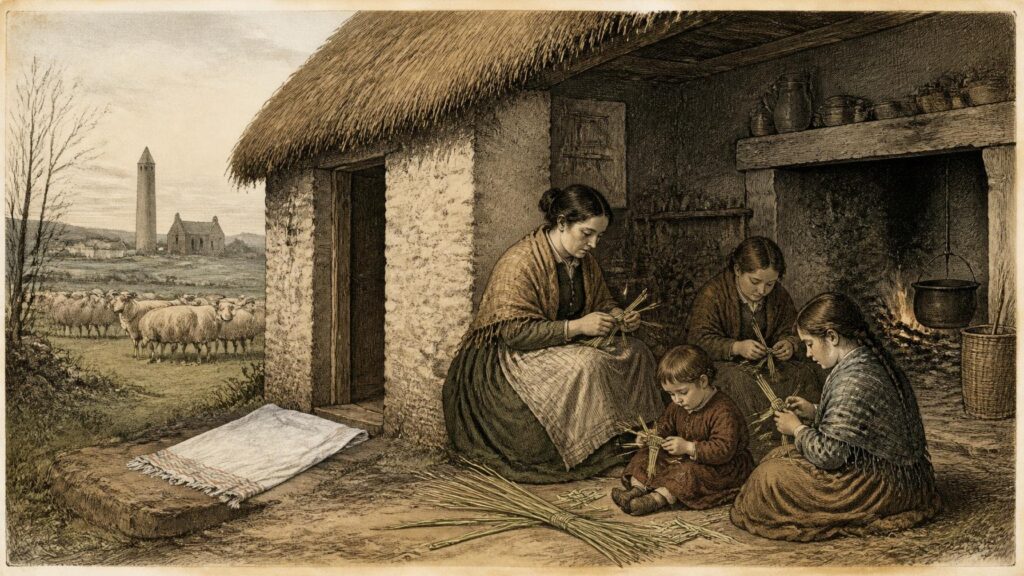
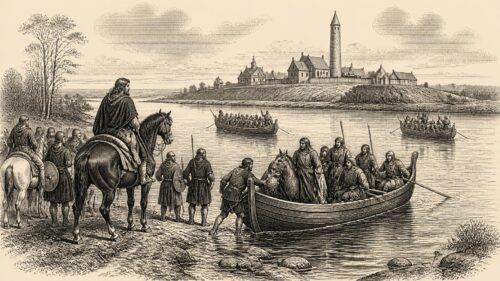
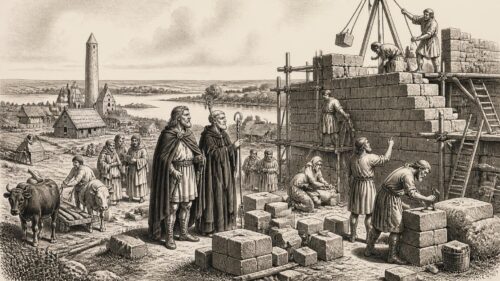
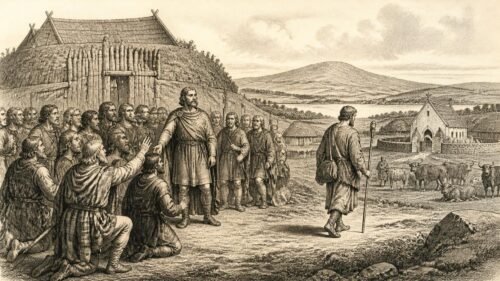
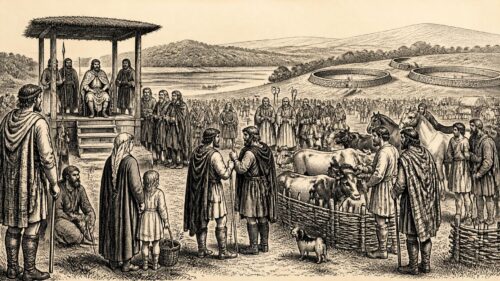
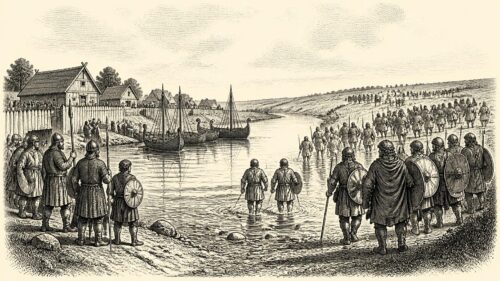
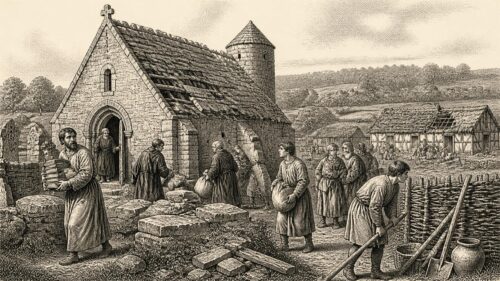
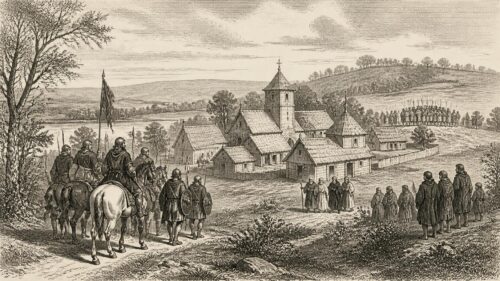
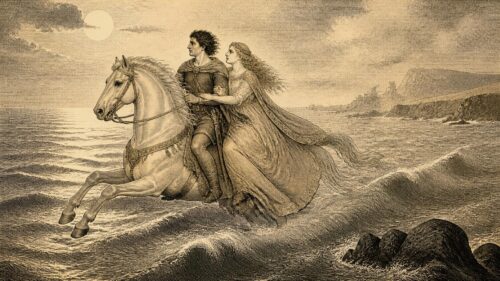
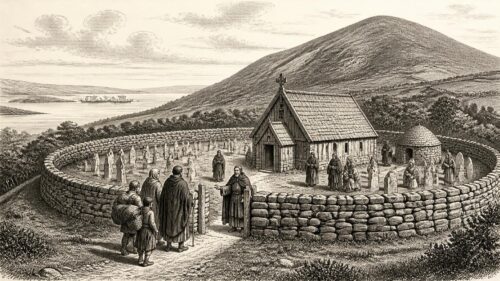
AI generated historical illustration, not a contemporary photograph.
At a Glance
St Brigid and Imbolc stand at a crowded crossing-place in Irish history: early medieval Christianity, vernacular literature, monastic politics, seasonal farming, local custom and modern national commemoration all meet there. Their proximity on 1 February is real and historically important, but it does not permit a simple conclusion that a pagan goddess became a Christian saint. The surviving evidence is later than Brigid’s supposed lifetime, is shaped by religious institutions, and preserves folklore rather than direct testimony from pre-Christian ritual. The task is therefore not to dissolve one Brigid into the other, but to trace how several traditions acquired, exchanged and contested meaning in Ireland.
Historical Problem
“St Brigid and Imbolc” sounds like a single subject, yet it joins together materials of very different dates and kinds. Brigid of Kildare is presented in Christian hagiography as an abbess, miracle-worker and patron of a major ecclesiastical community. Imbolc is the Old Irish name of an early-February seasonal observance, familiar today as one of four supposedly ancient “Celtic” quarter-days. The goddess Brigit appears in medieval Irish literary material. Finally, St Brigid’s Day customs—cross-making, visits by Brigid, bedding for Brigid, blessings of house and livestock, special foods and attention to weather—are recorded largely in much later folklore collections. Each body of evidence has to be judged on its own terms.
That distinction matters because the popular story is unusually smooth. It commonly proposes an ancient goddess of fire, poetry, healing and fertility; a pagan festival called Imbolc; conversion to Christianity; and a Church which recast the goddess as a saint while retaining her feast and symbols. Parts of that picture are plausible as broad cultural interpretation. None of it, however, is a contemporary documentary narrative of conversion. There is no surviving pre-Christian Irish liturgy of Imbolc, no fifth-century biography of Brigid, and no early text plainly stating that the saint was created from a goddess. Medieval and modern sources instead show a long process in which religious figures, seasonal language and domestic practices could be brought into relationship.
The historian’s first rule is chronology. The woman traditionally called Brigid is usually placed in the late fifth and early sixth centuries, but the exact years attached to her birth and death vary across later traditions. The earliest extant Life associated with her, composed by Cogitosus, is normally placed in the later seventh century—well over a century after the saint’s conventional death-date. That Life is invaluable evidence for Kildare and for the ambitions of its cult; it is not a stenographic record of a fifth-century life. The Dictionary of Irish Biography entry on Cogitosus properly emphasises both the text’s early importance and its reflection of Kildare’s circumstances when it was written.
Early Ireland
Brigid belongs to the formative centuries of Irish Christianity, a period whose surviving evidence is impressive but uneven. Latin literacy arrived with Christian institutions; monasteries, churches and learned communities became centres of writing; and Irish-language texts were eventually committed to manuscripts. Yet the written record was neither immediate nor neutral. Annals, genealogies, saints’ Lives and legal texts were copied and reshaped over generations. They serve as evidence for the social worlds that produced them as much as for the remote events they claim to describe.
Within that landscape, saints were not merely pious individuals. They were patrons of churches, protectors of territories, sources of prestige and participants in rivalries between ecclesiastical centres. A saint’s genealogy could link a community to powerful kindreds; miracle stories could articulate claims over land, cattle, tribute, hospitality or authority. Hagiography was devotional literature, but it was also public argument. A saint who subdued kings, secured food, multiplied dairy produce, healed the afflicted and defended dependants could embody both Christian virtue and the worldly prosperity of her church.
Brigid’s central association is with Kildare, Cill Dara, “church of the oak”. By the time Cogitosus wrote, Kildare was a community of exceptional standing. His Life famously describes a large church with separate spaces connected to Brigid and to the bishop Conleth, an arrangement often interpreted as a statement about the joint prestige of the female and male heads of the institution. Modern scholars debate how literally the architectural description should be read, but agree that it conveys the importance Kildare claimed in the seventh century. Carol Neuman de Vegvar’s study of the description cautions that architectural and political meanings must be considered together rather than treating the passage as an uncomplicated building report.
It is tempting to call Kildare Ireland’s first convent, as many later accounts do. That formula is convenient but oversimplified. Early Irish religious communities did not always fit later categories of monastery, convent or parish. What can safely be said is that Brigid’s cult was attached to a major Christian foundation which represented her as an abbess and which acquired lasting influence. Her status as a female saint, coupled with the prominence of Kildare, made her an unusually powerful figure in Irish religious memory.
Saintly Evidence
The earliest substantial written witness is the Vita Sanctae Brigidae of Cogitosus. Its author identifies himself as writing in obedience and presents Brigid as an exemplary servant of God. The work is rich in miracles: food and drink are multiplied; healing occurs; wrongdoers are corrected; animals and natural resources respond to sanctity. Its narrative does not give modern readers what they most want—a secure date of birth, a reliable family biography, or independently corroborated episodes. It gives something else: a seventh-century Kildare community’s literary image of its foundress.
That image is deeply Christian. Cogitosus frames Brigid through biblical echoes, virginity, charity, prayer, miracle and ecclesiastical authority. Claims that the text secretly preserves a goddess beneath a Christian surface therefore require more than the mere presence of fire, cattle, milk or abundance. Such motifs had wide biblical, Mediterranean and medieval Christian resonances, as well as local ones. A miracle involving butter or beer need not be a fossil of pre-Christian worship; it can also express hospitality, household wealth and the saint’s capacity to make God’s providence visible in an agrarian society.
The later anonymous Vita Prima Sanctae Brigidae supplies another early layer of Brigid’s dossier. Its date is debated, with scholarship placing it in the seventh or eighth century, and the relationship between it and Cogitosus remains complex. The British Library’s catalogue for Additional MS 34124 identifies its manuscript as the oldest and best copy of the Vita Prima, while noting that the text survives in numerous copies. Such manuscript survival is itself historical evidence: Brigid’s Life travelled, was recopied and mattered far beyond Kildare.
Neither early Life should be read as simple fabrication. Hagiography often incorporates local memory, place-names, institutional traditions and social assumptions. But neither should it be mined selectively for facts while its miracles are discarded as decorative. Miracles are the genre’s principal language. They tell us how communities expected holiness to act, how writers fashioned authority, and what kinds of insecurity or aspiration mattered: hunger, illness, fertility, justice, property, sexual reputation and protection.
The saint’s biographical core is consequently difficult to recover. A historical Brigid, an early Christian holy woman attached to Kildare, is entirely possible and remains the usual scholarly assumption. The scale and early character of her cult make it unwise to dismiss her as wholly invented. Yet the precise outline of her life remains uncertain. Dates such as 451, 452, 439, 523, 524 and 526 occur in different traditions, rather than forming an agreed chronology. Historical discipline means retaining both propositions: Brigid is not reducible to a literary fantasy, and the surviving narratives cannot provide a modern biography.
Goddess Traditions
The medieval Irish goddess Brigit is most clearly encountered in literary and learned sources rather than in inscriptions, temples or contemporary pagan ritual manuals. In the Lebor Gabála Érenn, the “Book of Invasions”, Brigit is presented as a daughter of the Dagda and associated with poets; the text also links her with healing and smithcraft through her sons. This has encouraged the familiar description of Brigit as a triple goddess of poetry, healing and smithcraft. But the formulation needs care. The medieval passage does not give a straightforward theological handbook from a pre-Christian priesthood. It is preserved in Christian manuscript culture and belongs to a learned synthetic history of Ireland, composed and revised over centuries.
That does not make it worthless. It demonstrates that medieval Irish intellectuals knew and transmitted a divine female figure named Brigit, whose associations overlapped strikingly with later ideas about Saint Brigid. The shared name is indisputable; the shared associations demand explanation. But there are several possible explanations: continuity of traditional material, literary borrowing in either direction, retrospective interpretation by Christian scholars, or a mixture of all three. We cannot observe the supposed moment when one identity became the other.
Older scholarship sometimes treated Irish saints with apparently non-biblical traits as Christianised survivals of pagan deities. This approach could be illuminating, especially where names, places and seasonal practice coincided. It could also flatten medieval Christianity, as though Irish converts merely put saints’ names over unchanged cults. Recent scholarship has instead emphasised that early Irish writers were capable of creative synthesis. A saint’s identity could be emphatically Christian while also being expressed through local landscapes, heroic conventions and inherited categories of power. Lisa Bitel’s influential discussion of the Brigidine tradition describes precisely this sort of literary and institutional construction, rather than offering a simple conversion formula.
Brigid’s gender has made the question especially compelling. In a male-dominated clerical culture, an abbess who blesses, commands, judges, protects and provides abundant food could offer an extraordinary sacred model. Her Lives portray her authority through Christian categories, but they may also draw strength from Irish narrative habits that associated prominent women with sovereignty, land, fertility and hospitality. This is interpretation, not proof of a goddess-cult. It helps explain why Brigid’s saintly persona became so capacious.
Seasonal Language
Imbolc is attested as an Old Irish word and is conventionally associated with 1 February and the beginning of spring. Its etymology is commonly connected with i mbolc, “in the belly”, often understood as a reference to pregnant ewes and the approaching lambing season. The connection is attractive because it matches the agricultural setting of early February in Ireland. Yet even here certainty should not be exaggerated. Historical linguistics can make a strong case for an association with pregnancy and milk, but cannot by itself reconstruct the complete ritual calendar of prehistoric Ireland.
Medieval Irish literature mentions the four seasonal divisions generally rendered Samain, Imbolc, Beltaine and Lugnasad. Modern descriptions often call them Celtic festivals, which is serviceable shorthand if it does not imply that one uniform ceremony was enacted in every Celtic-speaking region for millennia. The surviving texts are medieval Irish; the customs recorded in modern ethnography are much later; between them lie many centuries of religious, political, climatic and economic change.
Imbolc’s position in the year was nevertheless meaningful. It stood near the turning from winter towards spring, a difficult but hopeful agricultural threshold. Stored food was being measured, the weather could still be severe, and livestock were crucial. The prospect of milk, lambs and a lengthening day made early February a natural moment for prayers, predictions, hospitality and protective gestures. These material conditions can explain many seasonal practices without requiring that every practice be a direct survival from a particular pre-Christian ceremony.
The calendar date also makes Brigid an apt saint for this time. Saints’ feasts could gather local meanings around them, and Christian observance did not happen outside the seasonal economy. A feast on 1 February could involve church, household, field, cow byre and weather lore at once. Rather than asking whether the date is “really pagan” or “really Christian”, it is more accurate to recognise that it became a shared chronological hinge. It organised memories and actions in communities for whom no strict separation existed between material survival and sacred protection.
Christian Adaptation
Christianity in Ireland did not simply erase earlier ideas, nor did it preserve them intact. Conversion is better understood as a long and varied process involving new institutions, Latin learning, political patronage, local negotiation and changing habits of worship. The cult of saints was one means by which Christian communities attached holiness to particular people and places. Wells, boundaries, trees, stones and seasonal dates could be incorporated into Christian landscapes without retaining their previous meanings unchanged.
Brigid’s association with fire is frequently offered as decisive evidence of pagan continuity. Kildare’s medieval tradition of a perpetual flame is certainly notable. Gerald of Wales, writing in the late twelfth century, described a fire maintained by Brigid’s nuns and protected from men. His testimony is important but late; it does not prove that the fire was maintained in Brigid’s own lifetime, much less that it continued an Iron Age shrine. It shows that by Gerald’s day Kildare possessed a powerful ritual tradition involving an enclosed fire and female religious custodians.
Fire in Christian symbolism was not foreign or embarrassing. It could signify divine presence, Pentecost, purification, vigil, light and sacred watchfulness. Nor were female communities incapable of creating distinctive practices of their own. The persistence of a Kildare flame is therefore evidence for medieval devotion, not automatic evidence for a pre-Christian cult. The question of whether the practice also drew on local older customs remains open, but it cannot be settled merely by resemblance.
A similar caution applies to holy wells. Brigid’s wells are found across Ireland, and wells remain among the most visible sites attached to her name. Water, healing and pilgrimage have ancient and widespread human histories. Christian well devotion might reuse an older place, establish a newer cult at an attractive spring, or receive a saint’s name through later tradition. Individual sites require local documentary and archaeological investigation. General statements that every Brigid’s well was once a pagan shrine convert possibility into certainty.
Christian adaptation was not necessarily cynical appropriation. Medieval believers did not need to regard a well, a flame or a rush cross as camouflage for something they secretly rejected. They could regard such things as effective material forms of Christian blessing. The historical point is not to police belief as either pure or impure. It is to see how religious cultures make continuity through reinterpretation.
Household Customs
The fullest picture of St Brigid’s Day as lived custom comes from folklore, particularly nineteenth- and twentieth-century accounts and the collecting work associated with the Irish Folklore Commission and the National Folklore Collection. These testimonies are immensely valuable because they record local speech, ritual action and remembered practice. They are not, however, medieval evidence. A custom reported in a schoolchild’s copybook in the 1930s may preserve an old pattern, but it cannot be assigned an ancient date simply because it feels archaic.
One widespread practice was making a St Brigid’s cross, usually from rushes, though straw and other materials could be used. The cross was placed in the house, often near a door, to guard against fire, illness and misfortune. Its form varied: the familiar diamond-centred, four-armed version is not the only pattern. The act was practical and communal as well as devotional. People gathered rushes, taught children the method, worked the material by hand and renewed the protective object annually. The surviving tradition therefore offers a fine example of domestic religion: a blessing made through labour, memory and place.
Another set of customs imagined Brigid as a visiting presence. A ribbon, scarf, cloth or brat Bríde might be left outside overnight to receive her blessing. In some districts a bed or small receptacle was prepared for her, sometimes with food or other tokens. Girls or groups of young people could carry a Brídeog, an effigy representing Brigid, from house to house, receiving gifts and hospitality. These practices were not identical from county to county. Their variety is important: folklore was local performance, not a centrally administered rite.
Accounts also connect the day with food—especially dairy produce, butter, breads and cakes—and with blessing livestock, household tools and crops. Such customs make excellent sense in an agrarian calendar. The household sought protection at the moment when winter scarcity began to yield, imperfectly and unpredictably, to spring possibility. Brigid’s generosity in hagiography and her household presence in folklore meet here, but meeting does not establish direct descent. The saint’s stories may have helped shape the customs; the customs may have helped reshape the saint’s remembered character.
Weather lore was equally persistent. St Brigid’s Day could be used to anticipate the remainder of winter, while the apparent emergence or continued hiding of creatures offered signs. These ideas belong to the widespread human desire to read seasonal transition in natural behaviour. Their resemblance to traditions elsewhere in Europe does not lessen their Irish significance; it does caution against treating them as uniquely or exclusively “Celtic”.
Folkloric Record
The folklore record deserves respect precisely because it is not a museum specimen. People revised customs, omitted elements, added prayers, altered routes, adapted to clerical disapproval and made practices meaningful in changed circumstances. The twentieth-century collector did not enter an untouched pagan past. He or she encountered communities shaped by Catholic devotion, English and Irish language change, emigration, schooling, land reform, mass media and local memory.
The National Folklore Collection’s wider holdings demonstrate the scale of this documentation. Material gathered through the Schools’ Collection of 1937–39, as well as through fieldworkers and voluntary correspondents, preserves many accounts of St Brigid’s Day. Such collections let historians compare regional practice, but they also reveal the mediation involved: a child or informant recalled, a teacher or collector recorded, and an archive classified. The testimony remains historical evidence, but evidence of remembered and performed tradition at the time of recording.
For that reason, phrases such as “the ancient Celtic ritual” should be used sparingly. Folklore may indeed contain very old elements; it rarely supplies a secure date for them. A nineteenth-century or twentieth-century custom can be called traditional, local, devotional, seasonal or vernacular without being falsely pushed back into prehistory. The AskAboutIreland account of calendar customs is useful as an introductory overview, but its suggestion of pagan origins should be read as an interpretative framework, not as direct proof of uninterrupted ritual survival.
Folk custom also complicates the goddess-versus-saint binary. In many recorded practices, the visiting Brigid is plainly a saint who blesses a Christian household. Crosses, prayers and feast-day observance are not disguises. At the same time, the figure may move through domestic space with an intimacy and seasonal force not easily confined to formal church observance. That ambiguity is historically productive. Brigid’s power was strong precisely because she could be saint, protectress, visitor, healer, seasonal sign and local patron at once.
Modern Revivals
Brigid has repeatedly been remade in modern Ireland. Antiquarians, folklorists, poets, nationalists, feminists, religious communities, heritage organisations and environmental campaigners have all found a usable Brigid. Some foreground the Christian abbess of Kildare; some celebrate a pre-Christian goddess; some deliberately hold both identities together. The resulting portrayals tell historians much about modern needs and identities, but they should not be projected uncritically backwards onto early medieval evidence.
The State’s establishment of a public holiday associated with Imbolc and St Brigid’s Day from 2023 is a notable recent chapter. The holiday is observed on the first Monday in February, except when 1 February falls on a Friday, when that Friday is the public holiday. Government statements explicitly linked the day with the beginning of spring, with Brigid, and with recognition of women’s contributions to Irish society. It became the first Irish public holiday named after a woman. This is not an ancient survival; it is a precisely dated modern decision, made in January 2022 and first observed in February 2023.
That modern designation has encouraged a language of recovery: Brigid is said to be returning after suppression, or Imbolc to be restored as a national festival. The language is emotionally powerful but historically imperfect. Brigid’s feast, crosses, wells, pilgrimages and folklore never disappeared altogether, although their forms and prominence altered. What is new is the public holiday’s statutory and national framing, together with its explicit connection to gender, heritage and contemporary cultural programming.
Modern celebration can still be historically responsible. It becomes so when participants acknowledge what is documented, what is inferred and what is imaginative. There is no need to diminish modern ritual by claiming impossible antiquity. A newly created procession, poetry event, feminist commemoration or ecological observance can be meaningful because it speaks to present communities. Its value does not depend on pretending that every detail has been performed unchanged since the Iron Age.
Careful Conclusions
St Brigid and Imbolc are inseparable in the Irish cultural calendar, but their relationship cannot be reduced to a single origin story. The evidence securely supports several conclusions. There was an early and exceptionally influential cult of Brigid of Kildare. Its earliest surviving Lives, written in the seventh century or later, portray a commanding Christian saint and illuminate the ecclesiastical aspirations of Kildare. Medieval Irish learned tradition also preserves a goddess named Brigit. Imbolc was an early-February seasonal term associated with the beginning of spring, and later Irish folklore recorded extensive St Brigid’s Day customs concerned with protection, household welfare, livestock and seasonal renewal.
The evidence does not securely prove that Saint Brigid was invented from the goddess Brigit, that all St Brigid’s Day customs are direct pre-Christian survivals, or that every flame, well and cross associated with Brigid has a pagan origin. Those claims are interpretations, sometimes possible ones, but they exceed the surviving documentation when asserted as fact.
The deeper history is more interesting than the simplified version. Across more than a millennium, Irish communities repeatedly joined a saint’s cult to an early-spring threshold. They told stories of abundance, made crosses, blessed cloths, tended wells, sought protection for homes and animals, and invested a female sacred figure with unusual authority. Medieval scribes, household ritual-makers, folklore collectors and modern organisers did not preserve one unchanging Brigid. They made Brigid meaningful in their own worlds. That continuing work of interpretation is itself the durable historical connection between Brigid and Imbolc.
Source Notes
The article distinguishes between early medieval hagiography, medieval literary tradition, later folklore and present-day commemoration. Dates for Brigid’s life remain uncertain; claims for unbroken continuity from pre-Christian practice are treated as interpretation unless supported by specific evidence. Linked references identify the principal sources used alongside relevant claims.
Sovereign Authority
If spring is understood not only as a point in the farming year but as a season of precarious renewal, Brigid’s authority takes on a sharper historical character. The early narratives do not make her a constitutional ruler, and they do not describe a rite in which she personifies the land. What they do repeatedly imagine is a woman whose holiness changes the terms on which wealth, protection and status are distributed. Cattle, butter, ale, buildings, captives and royal favour move through her hands. That pattern provides a more secure route into the idea of “sovereignty” than the assertion that Brigid must be a surviving land-goddess: sovereignty here is a literary language of command over dependence, generosity and social order.
The point is especially clear in the CELT text of On the Life of St Brigit. Its Brigid is born into conditions marked by bondage and unequal household power. Her mother is a bondwoman; Brigid herself is threatened with sale; and the narrative repeatedly stages confrontations in which an owner or king assumes the right to dispose of people and goods. Yet Brigid’s charity unsettles that assumption. She gives away what male householders identify as their property, directs resources towards poor people, and eventually negotiates freedom for her mother. The story is emphatically Christian in its language of God, baptism, almsgiving and compassion. Nevertheless, it also makes sanctity legible through an ability to redirect wealth away from private possession and towards a protected community.
This is not a small detail in an agrarian setting. A cow in the narrative is not merely a convenient miracle-story prop. It represents food, milk, labour, reproductive capacity and standing. The Life has Brigid give cattle to people in need, while those around her protest that their substance is being dissipated. In another episode, the first butter from her churning is divided with explicit reference to Christ and the apostles before being given to the poor. The author does not present dairy abundance as an autonomous force of nature; it is made a sign of Christian mercy. But the choice of butter, calves and cattle grounds that mercy in the exact materials through which a household might imagine winter survival and spring recovery. Brigid’s abundance is therefore moral before it is seasonal: resources increase because they are used rightly.
That distinction matters for interpreting the familiar modern association of Brigid with fertility. The medieval text certainly gives her power over productive life, but it resists a simple equation between fertility and impersonal natural increase. Her gifts are relational. They feed dependants, relieve sickness, ransom or protect the vulnerable, and establish hospitality. Even when the narrative turns to extraordinary multiplication, it asks readers to see providence and charity rather than a neutral promise that the land will yield. A springtime reading of Brigid can thus be historically persuasive without treating every reference to milk or food as evidence of a pre-Christian cult. Early February may have made such imagery especially resonant; the written Life gives that imagery a specifically Christian ethical direction.
The same narrative gives Brigid an unusual capacity to address kings. In one scene, a king of Leinster recognises that her merit before God exceeds the value placed on her in a proposed sale. In others, she requests freedom, intervenes for captives, or becomes entangled with royal military concerns and succession. These episodes should not be read as a transcript of political events. They are hagiography, built to magnify a saint. Yet hagiography magnifies through recognisable tensions. Kings hold captives, command armed men and control wealth; Brigid can nevertheless demand an answer from them. Her authority is not derived from office in a modern sense. It is presented as a superior access to divine justice, exercised in public situations where worldly hierarchy would normally prevail.
That is one reason the term sovereignty is useful if handled carefully. It need not mean that the text preserves a direct memory of a goddess of kingship. It can name the way the narrative imagines a saintly woman as a decisive presence at the boundary between household and kingdom. Brigid’s power reaches from the dairy and kitchen to the fortress and assembly. The range is striking because it joins domains often treated separately by modern readers: food production, poor relief, kinship, warfare, captivity and ecclesiastical honour. In the Life’s world, these are linked by obligation. A ruler who fails to recognise holy authority, or a householder who hoards what should be shared, risks losing security; the saint restores proper order through prayer, intervention and miracle.
Kildare’s place in that imaginative geography is equally important. The CELT narrative links Brigid’s foundation with the obtaining of building materials and with a declaration concerning Leinster’s kingship. This is not enough to establish an early historical charter granted by Brigid, but it indicates that the author saw her church as inseparable from political landscape and royal legitimacy. The community at Kildare could be represented as more than a secluded religious house: it was a centre whose foundress possessed claims over protection, patronage and public prestige. Such claims fit the larger picture of Cogitosus’s Life. As Carol Neuman de Vegvar’s study of his church description argues, the anomalies of the Kildare church are best considered within seventh-century ecclesiastical politics and a strategy of Roman imitation, rather than being reduced to a straightforward architectural report or dismissed as pure invention.
The survival of Brigid’s Lives also adds a second layer to this authority: the authority of transmission. The British Library catalogue record for Add MS 34124 identifies the manuscript as the oldest and best copy of the Vita Prima Sanctae Brigidae, produced at Benediktbeuern in Bavaria around the middle of the ninth century. It further records that the work survives in twenty-six complete copies and one fragmentary copy. Whatever elements of the tradition first emerged in Ireland, this evidence shows that Brigid’s story was not confined to a single local shrine. It circulated across regions and entered Continental manuscript culture. The saint’s authority was therefore continually renewed by scribes, readers and religious houses that chose to preserve her.
That manuscript history should temper claims of unbroken popular survival while also complicating any picture of Brigid as merely local. A text copied in ninth-century Bavaria is not direct testimony to fifth-century Kildare, but it is powerful testimony to the reach of Brigid’s cult in the early medieval Christian world. The catalogue’s dating of the Vita Prima itself to the seventh or eighth century, and its description of the surviving codex as a later copy, make chronology visible at every stage. Brigid is encountered through layers: a saint’s remembered life, a hagiographer’s composition, a manuscript’s production, later additions, modern cataloguing and present-day digital access. Each layer enlarges the archive while also preventing a naïve return to origins.
The recent scholarly presentation of the two principal Latin Lives makes this layered character explicit. Philip Freeman’s Two Lives of Saint Brigid describes Cogitosus’s Life and the Vita Prima as the most important early sources, both written a century or more after Brigid’s death, and emphasises their value for daily life, women and the spread of Christianity. That description points to the proper scale of the evidence. The Lives are neither transparent biographies nor dispensable fantasies. They are crafted accounts through which later communities made claims about what a holy woman could do: feed people, free captives, correct powerful men, establish a religious centre and safeguard those dependent upon it.
Seen in this light, spring sovereignty is not an inherited theological formula that can be recovered intact from a single goddess, festival or custom. It is a historical reading of how Brigidine narrative joins seasonal resources to moral and political authority. Early spring sharpened attention to milk, livestock, stored food and the hope of renewal. Brigid’s hagiographers transformed such concerns into a drama of Christian largesse, in which abundance was validated by distribution and power by protection. The result is not evidence that Christianity simply concealed an earlier religion. It is evidence that Irish Christian writers could make a female saint extraordinarily authoritative by locating divine power in the materials and obligations of everyday life.