

Distant Witnesses
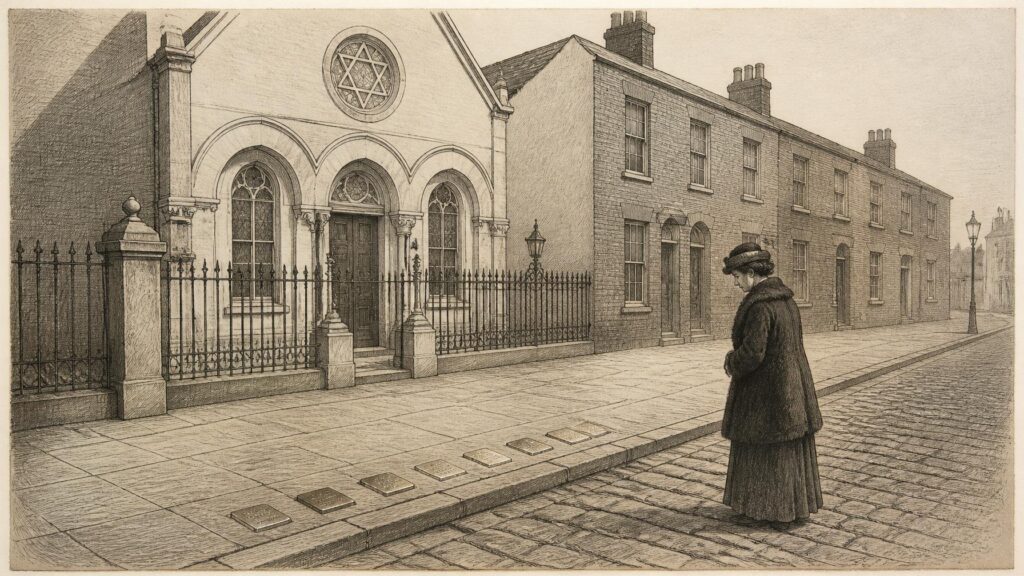
AI generated historical illustration, not a contemporary photograph.
At a Glance
Holocaust remembrance in Ireland is not the history of a country in which the Nazi extermination programme was carried out. It is, rather, the history of how a small neutral state, its Jewish community, refugees, survivors, diplomats, teachers, artists and public institutions came to recognise that geographical distance did not amount to moral detachment. The Irish record contains generosity and courage, particularly in individual lives, but also exclusion, restricted refuge and long silences. Its later commemorative culture has therefore acquired meaning not only by recalling crimes committed elsewhere in Europe, but by confronting the ways Ireland was connected to those crimes and their aftermath.
Historical Distance
The Holocaust was perpetrated by Nazi Germany and its collaborators across Europe between 1933 and 1945, culminating in the systematic murder of six million Jews alongside the persecution and murder of Roma and Sinti people, disabled people, political opponents, homosexual men, Jehovah’s Witnesses and others targeted by the Nazi state. Ireland was neither occupied by Germany nor a battlefield on the scale of continental Europe. From September 1939, the Irish state maintained neutrality during the conflict it termed the Emergency. That political fact has encouraged a durable popular impression that Ireland stood outside the catastrophe. It is understandable, but historically inadequate. Irish people were involved in many capacities: as Jews whose European family networks were destroyed; as citizens caught abroad; as emigrants in Britain’s armed forces; as aid workers; as officials considering refugee applications; as readers of censored newspapers; and, after 1945, as hosts to people who had survived camps, ghettos and displacement.
Remembrance has consequently had to overcome two related distances. The first was physical. Auschwitz, Bergen-Belsen, Ravensbrück and the killing centres of occupied Poland lay far from Dublin, Cork, Belfast or Galway. The second was interpretative. For much of the twentieth century, public memory in the Republic concentrated on revolution, independence, partition and civil conflict. The Second World War fitted uneasily into a national narrative which treated neutrality as both a constitutional necessity and a marker of sovereignty. The Holocaust, an event inseparable from the wider European war but irreducible to it, was still less likely to occupy a central place. This was not a uniquely Irish condition; remembrance developed unevenly across Europe. Yet it helps explain why sustained national commemoration in Ireland arrived comparatively late.
It is important not to convert this point into a story of Irish exceptionalism. Ireland did not simply forget an event that had no domestic relevance. Its small but established Jewish population knew from the beginning that Nazi antisemitism mattered directly. Jewish refugees sought admission. Irish citizens and residents had relatives in places later engulfed by occupation and genocide. Irish humanitarian workers encountered victims on the continent. Moreover, international information about Nazi persecution, although incomplete, contested and constrained by wartime conditions, did reach the country. The historical question is therefore not whether Ireland knew everything, at once, about the machinery of mass murder. No society did. The question is how Irish institutions and individuals responded to persecution, requests for refuge and the testimony that followed liberation.
That distinction also governs responsible remembrance. It is neither accurate to claim that Ireland was a principal participant in the Holocaust nor defensible to portray the state as a wholly detached spectator. The evidence points instead to a peripheral but real relationship: a neutral state with limited power, a restrictive immigration regime, a Jewish minority with transnational ties, individual Irish people who assisted the persecuted, and a post-war society that received some survivors while often treating their arrival as temporary. The later history of commemoration has become a means of making these connections publicly visible.
Jewish Ireland
The modern Jewish community in Ireland was small in number but deeply rooted. Many families had arrived from Lithuania and other parts of the Russian Empire from the late nineteenth century onwards, building congregations, businesses, charities and cultural associations. Dublin’s south inner city, especially the district around the South Circular Road, became widely known as Little Jerusalem. Synagogues, kosher businesses and family networks made the community visible, while Irish Jews also participated in the political, professional and civic life of the new state. The community’s size should not obscure its importance: it possessed close connections with relatives across Britain, continental Europe, Palestine and North America, so events abroad were rarely distant in personal terms.
The 1937 Constitution is significant in this context. Its provisions included an acknowledgement of Jewish congregations among the religious denominations existing within the state. That recognition was unusual enough to acquire later commemorative significance, especially when contrasted with the state’s failure to make refuge readily available to Jews endangered by Nazism. Constitutional language could affirm belonging, but it did not automatically produce a generous refugee policy or eliminate antisemitic assumptions within wider society. Historical assessment must hold both truths together. Jewish citizens had formal standing and created a rich communal life; they also lived in a country where stereotypes, economic suspicion and restrictive official practice could limit solidarity.
The Irish Jewish Museum’s account of the period records that the German Legation in Dublin dismissed its Jewish secretary in 1933, an early local indication of the nature of the Nazi regime. Appeals for admission were made by figures including Isaac Herzog, formerly Chief Rabbi of Ireland, and Robert Briscoe, the Dublin politician and Jewish communal leader. Some refugees did enter before the war, including people who established businesses and factories. But the numbers were small, and entry commonly depended on guarantees, capital, employment prospects or other conditions that were difficult for people fleeing persecution to satisfy. Ireland’s response belonged to a much wider international pattern of states placing immigration restrictions ahead of rescue. That context explains policy; it does not excuse its consequences.
There is no need to invoke folklore or retrospective legend in order to understand the human stakes. Administrative correspondence preserved in the Documents on Irish Foreign Policy series gives unusually direct evidence of official calculation. The records concerning the admission of Jewish children after the war show officials preoccupied with guarantees that the children would ultimately leave Ireland and with who would finance their care. Such documents reveal the difference between humanitarian admission and durable welcome. They also caution against describing every refugee initiative as simple national benevolence. Jewish organisations, individual advocates and voluntary supporters did much of the work, while the state set the terms on which entry was permitted.
Refugee Barriers
Irish policy towards Jewish refugees before and during the war forms an essential part of the history that later commemoration addresses. The state was economically poor, administratively young and anxious about neutrality and security. Those realities mattered to policymakers. Yet the historical record also shows that immigration controls were applied in a manner that made refuge hard to obtain precisely when people needed it most. Officials worried that refugees might become a permanent responsibility, compete for scarce work, create diplomatic complications or threaten security. Such concerns were not peculiar to Ireland, but their repetition across the democratic world had fatal consequences for people seeking escape from Nazi rule.
One should avoid the misleading formulation that Ireland had open doors until war closed them. Immigration was already closely regulated. Permits could be granted in individual cases, and a small number of refugees arrived, but there was no broad rescue scheme comparable to the scale of need. The result was not merely an absence of dramatic action; it was a policy environment in which exceptional admission required exceptional justification. People persecuted because they were Jews were often required to demonstrate resources and usefulness at the very moment when persecution had stripped them of both. This is one reason why Holocaust remembrance in Ireland includes reflection on state decisions as well as sympathy for victims.
The moral language of later ceremonies has sometimes made this history sound settled and uncomplicated. It is not. Historians must distinguish between the documented record, which includes official files and the testimony of communal advocates, and broad claims about what every Irish person thought or knew. There were Irish people who helped refugees, protested prejudice or worked abroad in relief organisations. There were also people who expressed hostility, indifference or fear. The state’s policies cannot be reduced to the prejudices of every citizen, but neither can they be detached from the social climate in which they were made. A responsible public history resists both collective self-exoneration and undifferentiated collective guilt.
The issue of wartime neutrality complicates, but does not cancel, this judgement. Neutrality protected Irish independence in a dangerous moment and was supported by many citizens. It did not oblige Ireland to emulate Nazi persecution, and it did not require the exclusion of people fleeing it. Nor was neutrality a guarantee of insulation from information, pressure or responsibility. The later language of remembrance has gradually recognised this point. When the first official national Holocaust commemoration took place in Dublin in January 2003, Minister for Justice Michael McDowell publicly acknowledged failures by the state and society, including failure to offer refuge and failure to confront the ideas that fed racial hatred. That acknowledgement became a defining moment because it joined commemoration to historical self-examination.
Irish Victims
For years, Ettie Steinberg was generally identified as the sole Irish victim of the Holocaust. Born in Dublin to a Jewish family, she moved to Belgium, married Wojtek Gluck at Greenville Hall Synagogue in Dublin in 1937, and became the mother of Leon. The family was deported from Belgium and murdered at Auschwitz. Her story gives the lie to the idea that the Holocaust had no Irish victims. It also shows why nationality and belonging can be more complicated than a map suggests: Steinberg’s life connected Dublin, Belgium, Jewish migration, marriage, motherhood and Nazi deportation. She was not merely an Irish footnote to an overseas tragedy; she was a person whose Irish origins and communal connections were central to the later work of remembrance.
Research by Holocaust Education Ireland has broadened the known record. The organisation identifies six Irish victims, including Steinberg, her husband and son, and members of the Shishi family. Isaac Shishi was born in Dublin in 1891, when his family briefly lived in the city after arriving from Lithuania. The family returned to Lithuania while Irish relatives remained. Isaac, his wife Chana Garbel and their daughter Sheine were murdered by the Nazis in Vieksniai in 1941. Such cases demonstrate why fixed national categories can obscure historical experience. A person could be Irish-born, linked by citizenship and kinship to Ireland, yet live and die under Nazi occupation elsewhere.
The expansion from one known victim to six is itself instructive. It does not mean the past has changed; it means archives, genealogical work and international Holocaust documentation have made more lives visible. Commemoration should therefore be open to correction. Numbers of victims connected to a particular country may depend on the definition used: birthplace, citizenship, residence, family origin or communal affiliation. The six Stolpersteine installed in Dublin in 2022 were based on the best available identification of Irish victims, not a claim that research has reached its final possible conclusion. Their value lies partly in making a national story more exact while leaving room for further evidence.
Individual Courage
Ireland’s connection to the Holocaust also includes people who acted beyond its borders. The best documented and most widely commemorated example is Mary Elmes of Cork. Elmes worked with humanitarian organisations in Spain and then in France. During the Second World War she assisted refugees and, in the Vichy zone, helped Jewish children escape the danger of deportation. Her work was undertaken amid extreme risk and with considerable personal discretion. Yad Vashem recognised her in 2013 as Righteous Among the Nations, the first Irish person to receive that honour. The Dictionary of Irish Biography and Yad Vashem materials provide the evidential basis for this account; the popular label ‘the Irish Oskar Schindler’ is a journalistic analogy, not an adequate historical description of her distinctive life.
Elmes is important to Irish remembrance not because she offers a comforting national counterweight to every failure, but because her actions establish what one person could do within constrained circumstances. She used relief work, local knowledge and courage to aid children threatened by deportation. Her later recognition, including the naming of a pedestrian bridge in Cork, brought a relatively neglected history into public view. Yet it should not be used to imply that Ireland as a state pursued a policy of rescue. Individual courage and official restriction can coexist in the same national past. Mature commemoration requires both to be remembered without allowing one to erase the other.
Other Irish people were drawn into the European crisis through aid, military service, religious work and resistance. Samuel Beckett, for example, joined the French Resistance and later volunteered with the Irish Red Cross in post-war France. His experience cannot be treated as a simple Holocaust narrative, but it has shaped Irish cultural reflection on occupied Europe and human devastation. The Irish Jewish Museum also records the contribution of Irish Jews to local auxiliary forces and to British services. These histories broaden the field of remembrance. They show that wartime Ireland was not hermetically sealed, even when official policy stressed national separation from the belligerents.
Children Arrive
The most moving post-war Irish episode is the arrival of Jewish child survivors and displaced children at Clonyn Castle near Delvin, County Westmeath. The project emerged from Jewish humanitarian networks associated with Rabbi Solomon Schonfeld and the Chief Rabbi’s Religious Emergency Council. Official files show that permission for one hundred Jewish orphan children was granted in late 1946, but on the clear understanding that their residence would be temporary and that the sponsoring organisation would bear responsibility. The children eventually arrived in 1949, by which point they had already endured war, displacement and lengthy uncertainty. Their stay in Ireland lasted about a year before many moved to the United States, Britain or Israel.
Clonyn Castle has sometimes been retold as a straightforward Irish rescue story. The documentary record makes the reality more complex and, for that reason, more valuable. The project depended upon transnational Jewish initiative, private funds, painstaking negotiation and local voluntary support. The Irish state admitted the children, but only for a limited period and on conditions designed to prevent permanent settlement. The Department of Justice memorandum of April 1948 also records an attempted arson attack at the castle and notes local opposition to the proposal to house Jewish children there. The attack caused limited physical damage, but its existence prevents a sentimental reading of the welcome.
At the same time, testimony and local memory attest to generosity extended to the children once they were in Westmeath. The distinction matters. It is possible to acknowledge affection, care and hospitality without presenting those qualities as proof that the state’s earlier policy was generous. The children came to a rural community far removed from the world of camps and displaced persons centres. For some, Ireland offered a temporary interval of safety, medical recovery, schooling and relative calm. But it was never designed as their lasting home. The story therefore belongs to Holocaust remembrance as both a humanitarian achievement and an illustration of the limits that Ireland placed on refuge.
Survivor Voices
After the war, individual survivors made Ireland their home. Their presence transformed remembrance from an abstract moral imperative into a relationship with neighbours, colleagues, pupils and friends. Holocaust Education Ireland has documented survivors who lived in the country, including Suzi Diamond, Tomi Reichental, Jan Kaminski, Inge Radford, Edith and Zoltan Zinn-Collis, Joe Veselsky and others. Their routes to Ireland differed. Some were among children aided by the Dublin paediatrician Bob Collis after he volunteered at Bergen-Belsen following liberation. Others arrived through marriage, work, family or migration after surviving Nazi persecution in different parts of Europe.
Bob Collis’s work deserves particular notice. Having served with British Red Cross and St John Ambulance medical teams at Bergen-Belsen, he helped care for children who had survived the camp and brought several to Ireland. The subsequent lives of the children were not reducible to their trauma: they attended school, formed families, worked and participated in Irish society. Yet their survival was the basis on which those futures became possible. Remembering them properly means refusing the tendency to treat survivors only as symbols of suffering. They were people with individual histories, preferences and achievements, who chose in different ways whether, when and how to speak publicly about what had happened to them.
Tomi Reichental became perhaps the most familiar survivor voice in Irish schools and public commemorations. Born in what was then Czechoslovakia, he survived imprisonment in the Sered labour camp and Bergen-Belsen, where members of his family were murdered. His decades of testimony in Ireland gave pupils an encounter with a witness whose experience was at once European and local: he lived in the country, spoke in its classrooms and became part of its civic life. His death in May 2026 marked the end of an extraordinary public role. It also sharpened the challenge that every society faces as survivor generations pass away: testimony must be preserved without becoming ritualised, simplified or detached from historical context.
Survivor testimony has particular ethical force, but it is not a substitute for historical method. A testimony is both a personal account and a historical source, to be heard attentively, corroborated where appropriate and situated in its circumstances. Survivors remember events experienced under terror, hunger, bereavement and displacement; variation in detail does not diminish the reality of the Holocaust. In Irish remembrance, the finest educational practice has paired testimony with archival documents, maps, photographs and scholarship. This prevents audiences from treating a survivor as merely an inspirational speaker and instead makes clear the structures of antisemitism, state violence, deportation and collaboration that produced the catastrophe.
Public Recognition
National Holocaust Memorial Day has been held in Ireland since 2003, generally on the Sunday nearest to 27 January, the date on which Auschwitz-Birkenau was liberated in 1945. The annual ceremony developed in the wake of the Stockholm International Forum on the Holocaust, at which states committed themselves to remembrance, education and research. In Ireland it has been organised by Holocaust education bodies with government support, and has drawn political leaders, ambassadors, faith representatives, survivors, descendants, students and members of the public. The ceremony is not simply an imported European observance. It has become an Irish civic occasion because it brings together the country’s own histories of Jewish life, refuge, failure, survival and learning.
Its form has acquired a recognisable solemnity: readings, music, survivor recollections, candle lighting and the Scroll of Names. Such ritual can be powerful, particularly when it names individuals rather than leaving victims within unimaginable totals. It can also risk becoming formulaic if participants assume that repeated words are themselves adequate remembrance. The continuing involvement of survivors, descendants and the Jewish Representative Council has helped anchor the occasion in lived experience. Government participation, meanwhile, makes clear that remembrance is not only a private or communal responsibility. The state that once restricted refuge now publicly accepts a duty to remember the consequences of persecution and exclusion.
McDowell’s 2003 address was consequential precisely because it did more than condemn Nazism. It acknowledged Irish omissions. The statement did not resolve every historical debate about wartime policy, nor did it provide restitution for what could not be repaired. But it set a public standard: commemoration should include examination of the host society’s record. Later speeches have continued to identify antisemitism as the foundation of the Nazi assault on Jews and to warn against Holocaust denial and distortion. The language matters, but it should always be measured against the evidence and against practical commitments to education, security and the protection of Jewish life.
Material Memory
Memorials make remembrance visible in ordinary space. Ireland’s most striking recent example is the installation of six Stolpersteine outside St Catherine’s National School in Dublin 8 on 1 June 2022. These small brass-topped stones, part of the international project initiated by German artist Gunter Demnig, commemorate individuals at places associated with their lives. In Dublin, they honour Ettie Steinberg, Wojtek Gluck, their son Leon, and the Shishi family. Their location in the former Little Jerusalem area links European genocide to a neighbourhood whose streets once sustained Irish Jewish religious and family life.
Stolpersteine are deliberately modest. They do not dominate the cityscape in the manner of a monumental sculpture. A passer-by must notice them, slow down and read. In that sense, they create an encounter rather than a distant spectacle. The stones’ strength is their insistence on names, dates and individual fate. A vast crime is made legible through a child, a mother, a father, a family. Their limitation is equally instructive: no memorial object can contain the full history of persecution or adequately represent every victim. They work best when accompanied by research, guided interpretation and public discussion.
The Irish Jewish Museum in Dublin provides another vital setting for material memory. Housed in the former Walworth Road synagogue, it preserves the social history of Jewish Ireland and displays artefacts connected to the Holocaust and the Second World War. Museums are not neutral storehouses. Decisions about what is collected, displayed and explained influence how visitors understand the past. In the Irish case, the museum’s significance lies partly in refusing to isolate Holocaust history from the longer life of the Jewish community. It situates wartime persecution alongside migration, worship, work, family and civic participation, thereby preventing the reduction of Jewish history to catastrophe alone.
Learning Practices
Education has become one of the principal vehicles of Holocaust remembrance in Ireland. Holocaust Education Ireland, formerly known as the Holocaust Education Trust Ireland, has developed teacher resources, school programmes, memorial booklets, survivor events and the Crocus Project, in which pupils plant yellow crocus bulbs in memory of Jewish children murdered in the Holocaust and other child victims of Nazi persecution. Ireland’s membership of the International Holocaust Remembrance Alliance since December 2011 placed these efforts within an international framework of education, research and commemoration. The Department of Education, curriculum bodies, museums and civil organisations have each contributed to this work.
Curriculum provision has evolved. Junior Cycle History gives students opportunities to examine genocide, including the Holocaust’s causes, course and consequences, while other subjects can address Judaism, human rights, racism and democratic responsibility. These structures matter, but content alone does not guarantee understanding. Holocaust teaching requires chronological clarity: the long history of antisemitism; the Nazi seizure and consolidation of power; exclusionary laws; ghettoisation; deportation; killing centres; collaboration; resistance; liberation and the difficult aftermath. If those elements are blurred into a vague lesson about intolerance, pupils may learn a worthy sentiment while missing the specific historical processes that made genocide possible.
Irish settings offer valuable starting points, provided they are not used to domesticate the event. A class may study Ettie Steinberg, the Clonyn Castle children, Mary Elmes or a survivor who lived locally. These examples can make research concrete. But they should lead outward to the European scale of the genocide, not imply that the principal story happened in Ireland. Similarly, comparisons with other atrocities need care. The Holocaust can be related to wider study of genocide and human rights, but its historical particularities must be retained: the Nazis’ ideological drive to eliminate every Jew within their reach, the bureaucratic and industrial means employed, and the continental scope of the crime.
Recent governmental funding for access to Auschwitz-Birkenau educational programmes and virtual tours signals a continuing public commitment. Such initiatives can be useful, especially when travel is impossible. Yet technology cannot replace rigorous teaching or local dialogue. Images of camps may produce shock, but shock is not knowledge. Students need help to understand what sites were, how people arrived there, who made decisions, how victims responded under coercion, and why post-war societies struggled to listen. The strongest Irish educational work treats remembrance not as an annual emotional exercise but as sustained historical literacy.
Cultural Responses
Irish literature and art have also engaged with the Holocaust, sometimes directly and sometimes through questions of witness, violence, exile and ethical representation. Michael Longley’s poetry is among the most frequently discussed examples. Scholars have examined how his work approaches the Holocaust through elegy, landscape and allusion, while remaining alert to the dangers of appropriation or sentimental identification. Such writing demonstrates that remembrance is not confined to ceremonies or classrooms. It can involve an artist asking how language might register an atrocity that resists ordinary expression.
There are risks in cultural remembrance. A writer may substitute aesthetic beauty for historical understanding, universalise Jewish suffering until antisemitism disappears from view, or use Holocaust imagery as a casual metaphor for unrelated experiences. These risks are not arguments against art. They are arguments for criticism and context. In Ireland, as elsewhere, cultural work is strongest when it acknowledges its distance from the victims’ experience and attends carefully to testimony, scholarship and historical specificity. The question is not whether an Irish artist has the right to address the Holocaust, but how responsibly the address is made.
Public exhibitions have helped create other avenues of connection. Family objects, photographs, testimony and documentary material can bring histories of loss into spaces where visitors encounter them as human lives rather than as statistics. Oliver Sears’s Holocaust awareness work, including exhibitions rooted in family history, is one example of a wider movement in which descendants participate in memory work. Descendant testimony is not identical to survivor testimony, but it has its own legitimate place. It conveys the long afterlife of genocide in families and communities while acknowledging that later generations cannot claim direct experience of events they did not live through.
Memory Debates
Holocaust remembrance is never entirely separate from present politics. That is unavoidable, because it asks what racism, antisemitism, exclusion and state power can do. It is also hazardous, because the Holocaust may be invoked carelessly to settle contemporary arguments. Irish public discussion has at times revealed these tensions sharply, especially when debates over the Middle East, migration, public space or antisemitism have become entangled with claims about memory. Historical commemoration should not demand silence about current injustice. But it must not turn the destruction of European Jewry into an all-purpose analogy stripped of context.
One productive principle is precision. Antisemitism should be named when it occurs; Holocaust denial and distortion should be challenged with evidence; Jewish people should not be treated as responsible for the acts of any government. Equally, remembrance should not be used to prevent legitimate discussion of contemporary politics. These propositions are compatible because they begin with the dignity and safety of people rather than with rhetorical advantage. Ireland’s remembrance institutions have increasingly placed opposition to antisemitism at the centre of their work, while government speeches have acknowledged the continuing vulnerability felt by Jewish communities.
Another principle is humility. No national ceremony, museum display or school lesson can offer final moral absolution. Commemoration may encourage reflection, but it cannot prove that a society has learned the correct lesson forever. The point of remembering Ireland’s restrictive refugee policy is not to claim that present-day dilemmas are identical to the 1930s. They are not. It is to recognise that administrative caution, economic anxiety and cultural prejudice can make distant suffering easy to disregard. The historical parallel lies in the need to examine assumptions, not in mechanically equating distinct events.
Enduring Duties
The most durable achievement of Holocaust remembrance in Ireland has been the gradual replacement of distance with relationship. The Holocaust is now encountered through the names of Irish victims, the stories of people who found temporary or lasting refuge, the testimony of survivors who lived among Irish audiences, the research of historians, the work of Jewish institutions and the physical presence of memorial stones in Dublin streets. This development did not occur automatically. It was advanced by survivors who chose to speak, relatives who preserved records, teachers who made room in the curriculum, voluntary organisations that organised ceremonies, scholars who examined uncomfortable evidence and public bodies that gave recognition and support.
Its unfinished character should be acknowledged. The small size of the Jewish population can make Jewish history seem optional within a broader national story; it is not. The death of survivors makes the careful preservation of testimony increasingly urgent. The discovery of further Irish victims demonstrates the need for continuing archival research. And the persistence of antisemitism, conspiracy theories and Holocaust distortion demonstrates that commemoration cannot be merely ceremonial. A memorial day is most meaningful when it encourages people to learn the history between one ceremony and the next.
Holocaust remembrance in Ireland ultimately asks more than whether citizens can recite a date or attend an annual event. It asks whether a society can remember a European catastrophe without treating it as someone else’s history; whether it can honour courageous individuals without masking institutional failure; and whether it can acknowledge Jewish suffering without reducing Jewish life to suffering. The evidence offers no consoling simple answer. It does, however, show why remembrance matters. In Ireland, as elsewhere, fidelity to the past begins with names, documents, testimony and truthfulness. Its ethical value lies in the continuing willingness to look closely at what people did, what they failed to do, and what responsibility demands now.
