Civic Shelter
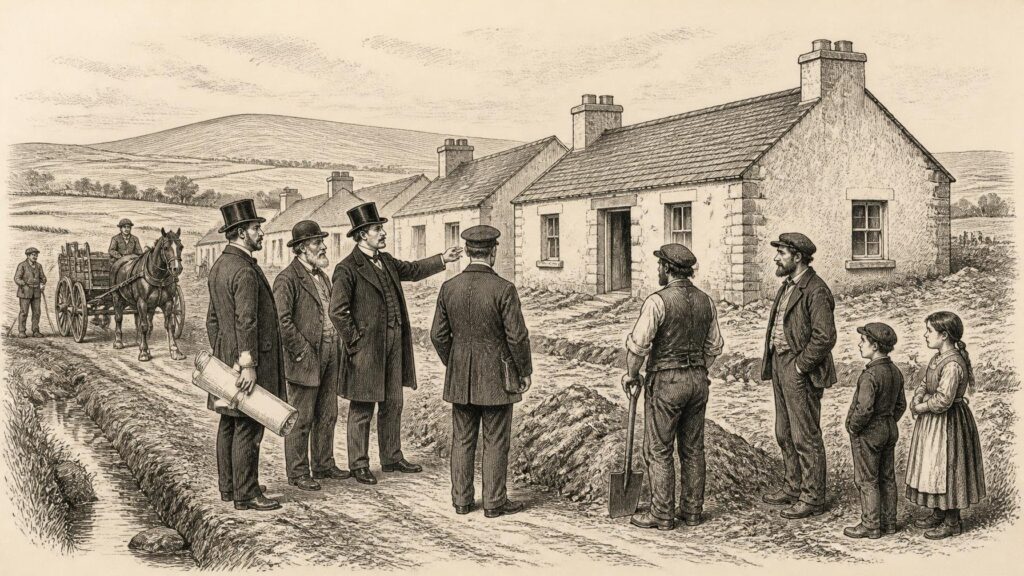
AI generated historical illustration, not a contemporary photograph.
At a Glance
Housing, planning and local government in Ireland developed together because none could be separated from the others. A dwelling required land, roads, water, drainage and finance; its condition raised questions of health and property; its location determined the shape of towns, cities and rural settlements. The institutions that dealt with these matters were never merely technical. They expressed changing ideas about poverty, citizenship, public duty, private ownership and the authority of the State. Ireland’s record is therefore not a simple ascent from slum to suburb, nor a tale in which legislation automatically became lived improvement. It is a history of persistent need, uneven local capacity and recurring argument over who should decide, who should pay and who should benefit.
Urban Necessity
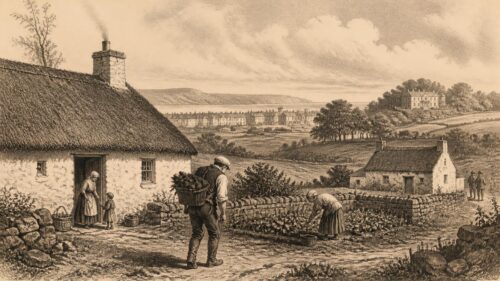
Before the nineteenth century, Irish towns certainly possessed regulation, corporate privilege and occasional improvement schemes, but they did not possess local government in the modern administrative sense. Street maintenance, markets, water supplies and building control were commonly fragmented among municipal corporations, landlords, charitable bodies, vestries, private companies and ad hoc commissioners. The quality of housing depended heavily upon income, tenure and local circumstance. Dublin, Belfast, Cork, Limerick and other centres contained substantial houses as well as courts, lanes and crowded rooms occupied by labouring people, servants, artisans and migrants. Rural housing was equally various: cabins, farmhouses, estate cottages and small town dwellings stood within a landscape shaped by landlordism, agriculture and emigration.
The decades after the Act of Union brought more systematic attempts to govern urban conditions. The Lighting of Towns Act of 1828 enabled towns to adopt arrangements for lighting, cleansing, paving and related improvements. It did not create democratic local government in any broad modern sense: participation and eligibility were tied to property valuation. Yet it supplied a legal route through which local ratepayers could establish commissioners and raise funds for practical urban works. The resulting boards were limited, but their everyday concerns—roads, drains, refuse, wells, lamps and markets—would prove inseparable from the housing question.
That connection deserves emphasis. Poor housing was not understood only as private misfortune. It could contaminate water, obstruct streets, spread disease and impose costs on hospitals, poor relief and employers. At the same time, intervention in housing exposed officials to the force of property rights. A landlord might regard a house as an income-producing asset; an occupier might regard it as an insecure refuge; a sanitary inspector might regard it as a danger; a local board might see a liability to the rates. These positions overlapped but seldom coincided.
The Poor Law system, introduced to Ireland in 1838, sharpened this institutional landscape. Poor Law unions and elected boards of guardians became major local bodies, administering workhouses and relief within defined districts. Their original purpose was not housing policy as later generations would understand it. Nonetheless, the workhouse system made shelter, destitution, sickness and local finance matters of public administration. The catastrophe of the Great Famine exposed the terrible inadequacy of any system that treated accommodation merely as an individual household matter. Workhouses became sites of refuge, discipline, illness and death, while eviction, migration and collapse of small holdings transformed settlement patterns across the island.
It would be misleading to describe the Poor Law as a programme of humane housing provision. Its rules were restrictive, its institutions feared, and its operation during famine has long been subject to grave historical criticism. Yet the system did leave a consequential administrative inheritance: mapped districts, elected or appointed local bodies, rate-based finance, clerks, medical officers and an expectation that public institutions had duties in relation to health and destitution. Later housing and sanitary powers were often placed upon, or exercised through, institutions built within this framework.
Sanitary Reform
In the mid nineteenth century, sanitary reform moved housing nearer to the centre of local administration. Medical knowledge was incomplete, and contemporaries did not agree about the causes of epidemic disease. Nevertheless, cholera, typhus, tuberculosis and other illnesses made the relationship between overcrowding, foul water, deficient drainage and mortality increasingly difficult to ignore. Public health legislation created and widened powers concerning nuisances, water, sewerage, slaughterhouses, lodging houses and insanitary premises. The Public Health (Ireland) Act of 1878 consolidated important elements of this legal field and gave local administration a more recognisable sanitary character.
Sanitary reform was a genuine advance in public responsibility, but it was not socially neutral. Inspection could protect tenants against dangerous neglect; it could also criminalise precarious survival. Closing a dilapidated dwelling without supplying a replacement might remove a hazard while making a family homeless. Demolition could clear a dangerous court but also break neighbourhood networks and push residents into other overcrowded rooms. Such contradictions were not accidental flaws at the edge of policy. They lay at the heart of nineteenth-century housing reform, in Ireland as elsewhere.
Dublin supplied the most notorious examples of urban overcrowding. Its large Georgian houses had, in many districts, been subdivided after the movement of wealthier residents towards new suburbs. By the early twentieth century, contemporaries, journalists, doctors and reformers described appalling conditions in sections of the inner city. The official Dublin housing inquiry of 1913–14 documented overcrowding, poor sanitation and high mortality in tenement districts. Its evidence is especially important because it moves the subject beyond later memory and civic myth: it records what witnesses, officials and investigators identified at the time, even though their language and assumptions belonged to their own era.
Dublin was not the whole Irish story. Belfast was an industrial city with a different economic structure, a large manufacturing workforce and its own severe housing pressures. Provincial towns faced smaller-scale but real difficulties in drainage, water supply, lodging houses and working-class accommodation. In rural districts, the question often concerned the quality, location and tenure of cottages for agricultural labourers rather than urban tenement rooms. A national history must therefore resist treating one city’s experience as a complete substitute for the history of the island.
Public health also made planning imaginable before planning became a distinct statutory discipline. To decide where a sewer should run, how wide a street should be, whether dwellings should front a lane, or where a cemetery, market or hospital should stand was already to shape the future physical order of a place. Such decisions were often piecemeal, reactive and constrained by local money. Still, they established an enduring proposition: the built environment was a legitimate object of collective decision.
Representative Councils
The Local Government (Ireland) Act of 1898 was a watershed because it replaced the governing role of the grand juries with elected county councils and created a new structure of urban and rural district councils. It did not make local democracy complete or remove central oversight, but it shifted substantial authority from an older, property-dominated order towards representative bodies. The reform became operational in 1899. It linked local administration more firmly to electoral politics and created institutions that would become indispensable to the provision of housing, roads, sanitation and public services.
The Act’s importance lay partly in its practical geography. County councils addressed county-wide functions; urban district councils operated in towns; rural district councils inherited and developed responsibilities connected with public health and the Poor Law framework. Different districts possessed sharply unequal resources. A prosperous borough with a substantial rate base, professional staff and an established engineering department could contemplate works impossible for a thinly populated rural district. Local government therefore brought responsibility closer to communities, but it did not make capacity equal.
The politics of rates were decisive. New works required money, and money raised locally could provoke resistance from landlords, shopkeepers, farmers and householders. Ratepayers might welcome a water scheme in principle while opposing its cost; councillors might favour cottages but fear borrowing; administrators might press for sanitary investment while being told that the local economy could not carry it. Arguments over finance were not merely administrative delays. They expressed competing conceptions of fairness: whether property, occupation, landholding, trade or the central Exchequer should bear the cost of social improvement.
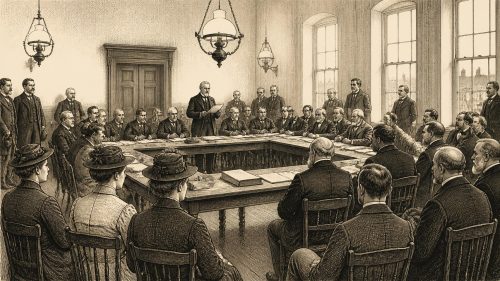
The reform also made local government a training ground for political participation. Councils and boards required public meetings, elections, minutes, estimates, resolutions and negotiation with government departments. In this respect, historians have reasonably interpreted nineteenth-century local institutions as part of the political education that preceded national self-government. That interpretation should not be overstated. Local administration did not automatically produce national unity, and its franchise remained historically restricted. But it created arenas in which questions of roads, rates, housing and public health became arguments about representation itself.
The ordinary archive of local government—the minute book, engineer’s report, tender, valuation list, plan, inspector’s notice or loan application—can appear dry. In fact, it preserves the material texture of public action. It shows that a cottage scheme depended on a site, a road, a water supply, a contractor, a rent, a loan term and a decision about eligibility. It also reveals delay, disagreement and failure. Grand narratives of reform can obscure these small but decisive points at which policy either reached a household or did not.
Rural Cottages
One of the most distinctive features of Irish housing history was the large-scale provision of labourers’ cottages in rural areas. The Labourers (Ireland) Acts, beginning in 1883 and extended repeatedly thereafter, enabled local authorities to provide cottages and plots for agricultural labourers. These measures arose in the context of agrarian conflict, land reform and recognition that rural labourers often lived in exceptionally poor accommodation. They were not simply charitable measures. They were part of a larger reordering of rural society in which housing, land access, labour relations and political allegiance were closely connected.
Under the labourers’ legislation, rural district councils could acquire land, borrow money and build cottages, generally with associated gardens or plots. The attached plot mattered. It gave a household some capacity for food production, small-scale cultivation and domestic independence. It also embodied a moral and economic ideal: a settled, respectable rural family occupying a healthy cottage rather than a labourer dependent upon an employer’s accommodation or a precarious cabin. The ideal could be paternalistic, but the physical result was often transformative for those who obtained a cottage.
Evidence from housing scholarship indicates that Ireland’s pre-independence local-authority output was unusually rural in character. By 1914, local authorities had completed tens of thousands of dwellings under the working-class and labourers’ regimes, with the overwhelming share located in rural areas. This was a striking contrast with Britain, where municipal provision was more urban. The figures should not be treated as proof that rural need had been solved: output totals cannot measure the quality of all dwellings, the size of waiting need, or the households excluded from schemes. They do, however, show that public housing in Ireland did not begin solely with twentieth-century city estates.
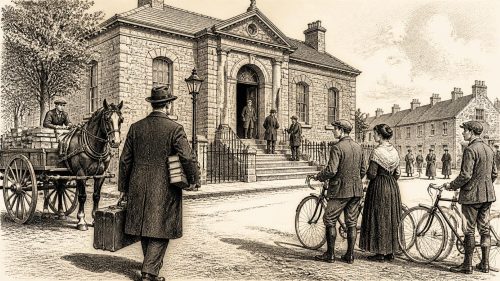
The cottages became visually important in the Irish countryside. Their whitewashed walls, regular forms, gardens and roadside settings acquired a symbolic place in memory. Folklore and nostalgia can make them appear as universal signs of improvement, but the documented record is more complicated. Siting could be contested; rents could be burdensome; some cottages were remote from work; standards varied; and demand exceeded supply. Nonetheless, the labourers’ cottage was a tangible instance in which local government altered the material landscape of ordinary life.
There was also a political logic to rural provision. The land question had made the security of occupation a central Irish issue. Cottages did not resolve land ownership generally, but they addressed the accommodation of a group often excluded from the benefits of tenant purchase. The State and local authorities used loans and subsidies to build a rural housing system alongside wider land reform. It was an early demonstration of how public finance could be mobilised to reshape private domestic life.
Urban Tenements
Urban housing developed under a different legislative and financial regime. The Housing of the Working Classes legislation enabled municipal action, first chiefly in relation to unhealthy areas and later more broadly. Urban authorities could clear unfit dwellings, acquire land and construct replacement housing, although their powers, funds and willingness to act varied. The distinction between urban and rural legislation mattered because it produced different opportunities for different populations. The relatively generous political attention paid to rural labourers did not automatically extend to the inhabitants of congested city tenements.
In Dublin, reformers had long pointed to the paradox of a capital city containing both architectural grandeur and severe domestic deprivation. The 1913 housing inquiry made this contradiction impossible to dismiss as isolated anecdote. It gathered evidence on housing conditions at a time when the city’s tenement problem had become a subject of medical, political and journalistic concern. The inquiry should not be romanticised: official investigations classify people, simplify lives and reflect the authority of those conducting them. Yet its documentary force remains considerable. It showed that overcrowding and insanitary conditions were structural, not merely the consequence of a few irresponsible individuals.
Housing reform also exposed a persistent dilemma of clearance. To remove an unhealthy dwelling was easier than to secure an affordable replacement near existing work, schools, relatives and transport. Clearance programmes could therefore become displacement programmes. This is not an argument against sanitary action; unsafe buildings and overcrowded rooms demanded intervention. It is an argument for judging policy by more than the number of demolished houses or newly laid foundations. The social geography of where people were rehoused mattered as much as the physical quality of the new dwelling.
Municipal authorities faced formidable constraints. They had to borrow, purchase land, prepare plans, obtain approvals and collect rents. They also operated within a political culture in which some feared municipal expenditure, others opposed public competition with private landlords, and still others demanded more rapid action. The case for public housing was strongest where private provision had demonstrably failed, yet the capacity to act was often weakest in precisely those places burdened by poverty and low rateable value.
The urban experience demonstrates why housing cannot be reduced to construction. A house is a unit of shelter, but a district is a social environment. It requires schools, shops, public transport, open space, drainage, lighting, employment access and institutions of care. Early twentieth-century reformers increasingly understood this, even when legislation and local finances allowed only partial responses. Their thinking helped create the bridge from sanitary administration towards comprehensive town planning.
Planning Ideas
Town planning arrived in Ireland through a mixture of international influence, professional expertise and local necessity. By the early twentieth century, planners and architects increasingly argued that cities should not simply respond to development application by application. Streets, industry, housing, parks, transport and expansion should be considered together. The language of planning could promise rationality, beauty, efficiency and public health. It could also carry assumptions about class, family life, traffic, work and social order that deserve critical attention.
The Dublin Town Planning Competition of 1914 provides revealing evidence of this new outlook. Its surviving material, preserved through UCD collections and the Irish Architectural Archive, envisaged the Greater Dublin area rather than only the historic core. The competition did not instantly remake the city; indeed, war and revolution soon disrupted the conditions in which ambitious schemes might have been pursued. But it shows that the idea of planned metropolitan growth was established in Irish professional debate before independence.
Planning should not be imagined as a purely benevolent science. Maps and plans make land appear legible: they separate uses, designate routes, identify sites and project population. Such tools can help protect health, heritage and landscape. They can also privilege the viewpoint of officials and owners over residents whose claims are less easily mapped. A plan may record a clearance area without recording the neighbourly support, informal childcare, credit arrangements or work opportunities that make a district liveable. Historians must therefore read plans alongside testimony, housing records and social evidence.
Irish planning ideas also encountered the particular conditions of the island. Emigration, uneven industrialisation, a dispersed rural population, the centrality of Dublin, the growth of Belfast, land reform and the political partition of 1921 meant that no simple English urban model could be transferred unchanged. In the new Free State, planning and housing would be shaped by a predominantly rural society seeking both national self-definition and practical modernisation. In Northern Ireland, separate institutions developed after partition. This article concentrates on the later Republic’s administrative line while recognising that housing and planning on the island cannot be understood without that wider historical division.
State Formation
The establishment of the Irish Free State in 1922 did not wipe away earlier housing law. Instead, the new State inherited statutes, local bodies, debts, buildings, staff and urgent unmet need. Much of the practical machinery for housing already existed in embryo: local authorities were established providers, the labourers’ legislation had demonstrated an interventionist model, and urban sanitary concerns were well documented. The question was how an independent State, with constrained resources and competing priorities, would use that inheritance.
The early decades saw both continuity and change. Housing measures of the 1920s and 1930s supported local-authority building, private house construction and the clearance or repair of unhealthy housing. The Housing (Miscellaneous Provisions) Act 1931 explicitly connected its provisions to the earlier Housing of the Working Classes, Labourers and Small Dwellings Acquisition legislation. Its language concerning unhealthy and clearance areas demonstrates how strongly public health and urban form remained joined in the legal imagination.
Central government became increasingly significant because local government alone could not meet the cost of large-scale housing. Grants, subsidies, loan arrangements, approvals and standards enabled the State to steer provision, even where councils built and managed the dwellings. This created a durable Irish pattern: housing was locally delivered but centrally financed, legislated for and supervised. The pattern offered capacity and consistency, but it also restricted local autonomy. Councils could identify needs, yet their scope of action remained tied to national policy and available funds.
Interwar and wartime conditions complicated the picture. Economic scarcity, building costs, shortages of materials and political instability restricted what could be achieved. In urban areas, slum clearance remained a central objective; in rural areas, replacement of unfit cottages and provision for scattered populations continued. Housing policy often favoured the family house and owner occupation alongside public rental provision. That duality became a defining feature of twentieth-century Irish housing: public action did not seek only to build municipal estates, but also to facilitate private domestic ownership.
The phrase “housing crisis” is often used loosely in later public debate. Historical care requires more precision. Ireland experienced recurrent shortages, overcrowding and unfit dwellings, but their causes and forms differed by decade and place. A tenement family in 1913 Dublin, a rural labouring household awaiting a cottage, a post-war municipal tenant and a young household seeking a suburban mortgage faced related but not identical problems. The continuity lies less in an unchanging crisis than in the repeated difficulty of aligning need, land, finance, construction and public authority.
Municipal Building
The middle decades of the twentieth century were marked by extensive local-authority house building. Councils produced estates in cities, towns and villages, while county councils continued rural provision. These schemes altered landscapes and life chances. For many tenants, a council house meant indoor water, sanitation, separate bedrooms, a garden, greater security and an escape from overcrowded or decayed accommodation. It would be wrong to minimise this achievement merely because later criticism exposed deficiencies in design, maintenance or location.
At the same time, municipal building was not uniform. Some estates were carefully laid out and well served; others suffered from inadequate amenities, delayed transport links or insufficient employment nearby. The scale of building could place pressure on local services. A new estate needed not only houses but roads, schools, shops, drainage, lighting and recreational facilities. When these arrived late, residents bore the consequences. Planning, in other words, determined whether housing was integrated into a functioning settlement or deposited at its edge.
Dublin’s expansion illustrates this issue particularly clearly. The movement of population from central tenements to new suburban estates changed the physical and social geography of the city. It could reduce overcrowding, but it also displaced households from established inner-city connections. Similar processes occurred, on different scales, in Cork, Limerick, Waterford and other towns. The historical record does not support a single verdict. Residents could experience pride and relief in a new home while also confronting distance, isolation or poor services.
Architectural judgement has also changed. Estates once celebrated as symbols of progress have sometimes been criticised for monotonous layout or segregation; older districts once condemned as obsolete have later been valued for heritage and urban vitality. Such reversals are useful reminders that planning is assessed through changing values. A historian should distinguish contemporary intention from later outcome. A scheme may have been conceived as a humane response to severe need and still have generated long-term difficulties. Conversely, a physically modest development may have supported durable community life.
The introduction of high-rise housing at Ballymun in the 1960s became one of the most prominent examples of ambitious municipal modernism in the Republic. The project sought rapid large-scale provision during a period of acute Dublin housing pressure. Its later difficulties and eventual regeneration have made it emblematic in public memory. Yet Ballymun should not stand for every council estate, nor should retrospective failure erase the housing emergency and planning assumptions from which it emerged. Contemporary film and documentary material, alongside resident testimony, is especially valuable in recovering this complexity.
Administrative Power
Housing policy also reveals a central tension within Irish local government: the relationship between elected councillors and professional administration. Councillors represent electoral areas, adopt budgets and make policy decisions within statutory limits. Engineers, planners, housing officers, managers and later chief executives administer schemes, prepare reports and exercise executive functions. Neither side is dispensable. Democratic representation can articulate local need and public accountability; professional administration can provide continuity, technical knowledge and legal compliance. Conflict arises when either is perceived to dominate the other.
The twentieth century saw substantial centralisation. The old county-manager system, introduced in the 1920s and expanded thereafter, placed executive authority in professional management rather than elected committees. Supporters argued that it protected administration from patronage and parochialism. Critics argued that it weakened local democratic control. Housing allocations, estate management and planning decisions could become especially sensitive because they touched directly upon property, family security and local development.
Centralisation did not mean that local government ceased to matter. Councils remained the bodies closest to the practical consequences of policy. They maintained housing stock, assessed needs, managed tenants, assembled land, delivered infrastructure and determined many planning applications. But their scope was conditioned by national legislation and finance. This is why descriptions of Irish local government as either powerful or powerless are both inadequate. Its powers were real, but bounded; its responsibilities broad, but resources dependent; its democratic role important, but shared with the executive State.
The Local Government Act 2001 consolidated the modern statutory framework for local authorities, while the Local Government Reform Act 2014 further reorganised structures. Official guidance identifies housing and planning among the multi-purpose functions of Ireland’s local authorities and distinguishes policy decisions reserved to elected members from executive functions. This contemporary arrangement is the result of historical layering rather than a wholly new design.
Planning Statutes
Modern statutory planning in the Republic is usually dated from the Local Government (Planning and Development) Act 1963, which came into operation in 1964. It introduced a comprehensive framework under which planning authorities prepared development plans and controlled development through planning permission. Earlier sanitary and improvement powers had undoubtedly shaped land and buildings, but the 1963 legislation made planning a distinct, systematic local-government function. It was designed for a period of expanding roads, industrial development, suburbanisation and changing expectations of public regulation.
The planning system put local authorities in a dual role. They were plan-makers, setting out objectives for land use and development; they were also decision-makers on individual applications. This combination could produce coherence, but it could also generate conflict. A council might seek housing growth yet face objections concerning traffic, services, landscape, heritage or density. It might wish to protect agricultural land while encountering pressure for dispersed one-off dwellings. It might encourage town-centre renewal while confronting vacancy, dereliction and commercial change.
Planning permission became a familiar part of civic life because it translated broad public policy into specific decisions about houses, extensions, estates, shops, industry and infrastructure. The procedure also created opportunities for observation and appeal. Supporters view such participation as an essential protection against arbitrary or damaging development. Critics sometimes see it as a source of delay or uncertainty. Historically, both perspectives reflect a real tension: a democratic planning system must permit scrutiny, but a housing system must also be able to deliver homes and supporting infrastructure in time.
The Planning and Development Act 2000 consolidated earlier planning law and established the framework that continued to shape planning for much of the early twenty-first century. Government guidance describes its wide reach, including development plans, local area plans, planning permission, heritage protection, social housing, appeals and environmental assessment. The breadth of the Act confirms that planning had become a mechanism through which housing, environmental protection, transport, community facilities and economic development were expected to be reconciled.
That expectation is demanding. No plan can itself build a house, finance a water network, train workers or make land affordable. Planning can reserve land, co-ordinate infrastructure, set standards and establish a lawful route for development. It cannot alone overcome every economic constraint. The historical temptation is to blame planning for all shortage, or alternatively to assume that better plans are sufficient remedies. Ireland’s longer record suggests a more cautious conclusion: planning matters greatly, but it operates within wider systems of land ownership, finance, public investment, construction capacity and political choice.
Public Participation
Housing and planning have always generated participation, though its forms have changed. Nineteenth-century ratepayers attended meetings and petitioned commissioners; tenants and reformers gave evidence to inquiries; labourers sought cottages; councillors debated loans and sites; residents’ associations objected to or supported developments; campaigners challenged demolition and dereliction. Participation has never been equally distributed. Those with property, literacy, time, confidence or organisational support have generally found it easier to influence public decisions than those living with insecurity.
The language of consultation can obscure these inequalities. A public notice may be legally sufficient but practically inaccessible. Planning documents can be technical and lengthy. Tenants facing eviction, overcrowding or poor repairs may have little capacity to engage with a distant policy process. Conversely, organised local opposition may preserve valued places, expose poor proposals and compel better design. Historical judgement requires attention not simply to whether participation existed, but to whose voices could be heard and how authorities responded.
Community memory is valuable but requires careful use. Residents’ recollections of an estate, a clearance or a planning dispute can preserve emotional truths absent from official files: fear at a compulsory move, pride in a first indoor bathroom, anger at unfulfilled promises, attachment to a demolished street. Memory can also compress dates, merge events or attach later meanings to earlier decisions. It should neither be dismissed as anecdote nor treated as infallible record. The strongest local history places testimony in conversation with minutes, plans, photographs, census evidence and contemporary reporting.
Folklore has a smaller but real place in the story. Tales of notorious landlords, haunted tenements, miraculous housing allocations or vanished village communities often express shared feelings about authority and home. They can illuminate reputation and popular imagination. They do not, without corroboration, establish exact events. In a subject so bound up with displacement and belonging, the distinction matters. Historical writing should respect memory while making clear where documentary evidence ends and interpretation begins.
Recent Inheritance
The present-day Irish planning and local-government system remains recognisably shaped by this long history. Local authorities prepare development plans, make most planning decisions and retain major responsibilities for housing. Government guidance describes the Planning and Development Act 2000 as the foundation of the established framework, while more recent legislation has been introduced in stages to reform it. The Planning and Development Act 2024 provides for a revised plan-led system, including longer development-plan cycles and changes to the national planning architecture.
These contemporary reforms should be viewed as part of a historical continuum rather than as a complete departure. The enduring questions are familiar. How can housing be supplied at sufficient scale? How can land be serviced and used efficiently? What balance should exist between national targets and local judgement? How can public participation be meaningful without making decision-making incapable of conclusion? How should environmental protection, heritage, transport and climate obligations be reconciled with the immediate need for homes?
There are no easy historical lessons. The labourers’ cottages show that public intervention can alter everyday life on a very large scale. The tenement record shows the human cost of leaving dangerous conditions unresolved. Municipal estates show the possibilities and limits of building at scale. Planning legislation shows that procedures and plans are necessary, yet never sufficient. The centralisation of administration shows the value of technical capacity, but also the democratic cost when residents feel decisions have moved beyond their reach.
The deepest lesson may be that housing is civic infrastructure. It is not only a commodity, an investment or a private aspiration, though it may be all of those to different people. It is the setting in which health, family life, education, work, care and local belonging occur. The history of Irish housing planning and local government is therefore a history of the State and society deciding, repeatedly and imperfectly, what obligations are owed to people where they live.