Contested Learning
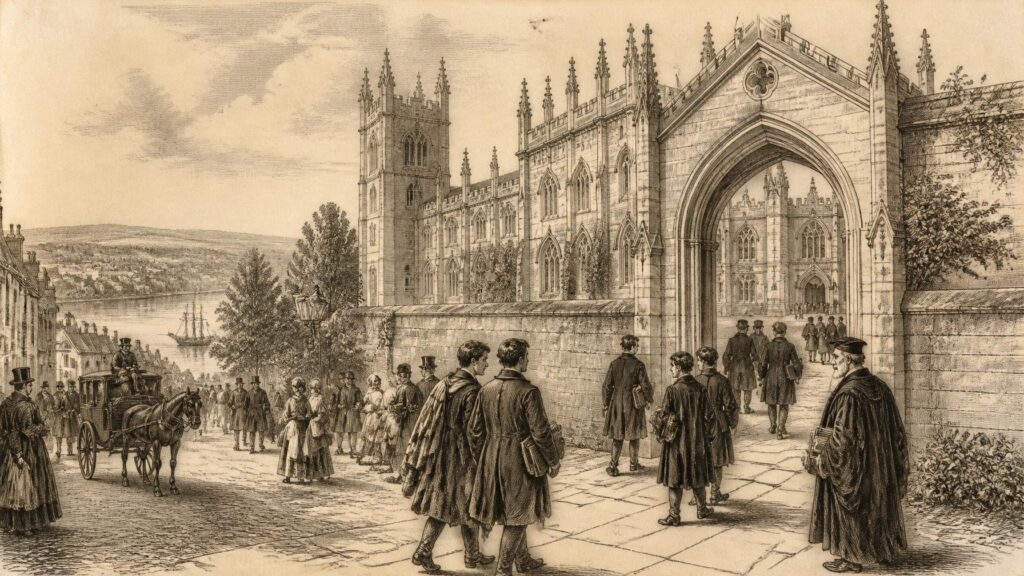
AI generated historical illustration, not a contemporary photograph.
At a Glance
The history of the university in Ireland is not the story of one continuous national institution steadily becoming more inclusive. It is a history of rival foundations, religious disputes, imperial policy, regional ambition, intellectual endeavour and constitutional change. From medieval schools and monastic libraries to Trinity College Dublin, the Queen’s Colleges, the National University of Ireland and Queen’s University Belfast, higher learning repeatedly became a means by which competing authorities sought to define Ireland’s future.
Learning Before
University education, in the strict corporate sense familiar in later European history, was a late arrival in Ireland. Medieval Ireland possessed notable centres of learning, but it did not possess a continuously operating university comparable to Oxford, Cambridge, Paris or Bologna. This distinction matters. The island’s early scholarly reputation is real and important, yet it should not be converted into an anachronistic claim that a medieval Irish university existed where the evidence does not support one.
Early Irish monasteries and ecclesiastical settlements cultivated literacy, manuscript production, scriptural study, Latin learning and intellectual exchange. Armagh, Clonmacnoise, Clonard, Bangor and other religious centres acquired reputations as places in which clerics and students could study. Irish scholars travelled abroad, while continental pupils and churchmen were drawn into Irish networks of learning. The surviving manuscripts, annals, saints’ lives and later traditions testify to a rich learned culture, although they do not offer the institutional evidence required to identify these communities as universities in the medieval legal or organisational sense.
Folklore and patriotic retellings have sometimes described early monastic schools as universities, particularly when emphasising the supposed scale of places such as Clonard or Bangor. Such language can express a legitimate admiration for intellectual achievement, but it obscures differences of structure and purpose. A medieval university was normally a recognised corporate body of masters or scholars, possessed of particular privileges and often authorised to teach and confer degrees. Irish monastic schools were religious communities and educational centres, not universities constituted in that later form.
The Anglo-Norman invasion and the emergence of English lordship introduced further connections with the universities of England. Clerics and administrators from Ireland studied at Oxford and Cambridge, and ecclesiastical careers increasingly depended on mobility within wider British and European networks. The medieval church, rather than a domestic university, supplied much of the framework for advanced learning. Cathedral schools, religious houses and overseas study remained more important than any permanent Irish degree-granting institution.
There were proposals to establish a university in Dublin during the later Middle Ages. Their failure is historically revealing. A university required sustained patronage, money, political security and recognition. In a lordship marked by fluctuating royal authority, warfare and limited resources, those conditions did not align. The absence of a university therefore reflects not a lack of learned people, but the absence of a sufficiently stable and powerful institutional settlement.
The Reformation changed the context decisively. It transformed the relationship between church, crown, property and education. Monastic foundations were dissolved, religious patronage was reordered, and the Tudor state sought to make its authority more effective throughout the island. In this setting, a university in Dublin could serve religious, administrative and political purposes at once. It would educate clergy for the established church, provide trained personnel for government and law, and make a public statement about the cultural authority of the reformed state.
Colonial Foundation
Trinity College Dublin, the sole college of the University of Dublin, was founded by royal charter in 1592. The foundation was connected to a petition by leading Dublin citizens, but it also belonged to the Tudor programme of consolidating English rule in Ireland. Trinity’s own historical materials are unusually direct about this context: the university college emerged while the English state was strengthening control over the kingdom and while Dublin was becoming more fully a capital city.
The college received the site of the former Priory of All Hallows, a religious house dissolved in the sixteenth century. Dublin Corporation granted the property, and the new foundation grew from buildings that had already been reshaped by the Reformation. This was not merely a convenient parcel of land. The location embodied the transfer of ecclesiastical property and authority from pre-Reformation religious life to a Protestant educational institution supported by crown and city.
Elizabeth I’s charter described Trinity as the mother of a university. In practice, the relationship between College and University of Dublin became distinctive. Trinity was the only constituent college, while the University awarded degrees. The arrangement drew on collegiate models associated with Oxford and Cambridge, but it was not a duplicate of either. It was an autonomous corporation governed by provost and fellows, framed by statutes and charters, and intended to teach as well as to confer prestige upon the emerging colonial capital.
The early college was small. Its first physical form was a modest quadrangle, containing accommodation and the essential spaces of a learned community. Finance was a continuing concern. The charter did not magically create a prosperous academic world; income, endowments and benefactions had to be secured. Trinity’s historical records show the importance of land, rents, charitable gifts and crown support in making institutional survival possible. The college was therefore embedded from the outset in the political economy of conquest and settlement as well as in the ideals of learning.
The intended religious function was explicit. Early graduates commonly proceeded towards ordination in the Church of Ireland. The curriculum was grounded in philosophy, theology and the classical learning expected of a Protestant clerical and governing elite. A library was a priority from the beginning. Scholars such as Luke Challoner and James Ussher helped build collections whose growth would become integral to Trinity’s public identity. Books, manuscripts and learned authority were not decorative accompaniments to the new college: they were part of its claim to be a durable institution of European learning.
It would be misleading, however, to reduce Trinity to a simple instrument which never developed beyond its original political purpose. Institutions acquire interests, traditions and intellectual lives that cannot be collapsed into the intentions of founders. Trinity produced scholarship of international consequence and became a place of debate, scientific enquiry and literary activity. Yet its origins remained consequential. Admission, religion, patronage and the distribution of cultural authority were recurrently contested precisely because the college had been founded within a Protestant and colonial settlement.
College Society
During the seventeenth and eighteenth centuries, Trinity gradually established the forms associated with a permanent university college: fellowships, scholarships, statutes, residential routines, examinations and a more secure estate. The political turbulence of the seventeenth century affected every Irish institution. Civil war, Cromwellian conquest, restoration and later revolution disrupted society, reshaped property and created new relationships between state and church. Trinity endured, in part because it was closely associated with the governing Protestant order.
The college’s governing language and traditions reinforced elite character. The provost, fellows and scholars formed the historic corporate core. Foundation Scholarships, rooted in the original charter and later regulations, acquired enormous prestige. Their competitive examinations became a celebrated feature of Trinity life. They rewarded academic distinction but were also part of a system in which access to high learning depended heavily on prior education, social means and cultural familiarity with classical curricula.
In the eighteenth century, Trinity expanded materially and intellectually. Buildings and public spaces gave the college a more imposing physical presence within Dublin. The Old Library, whose Long Room became one of Ireland’s most recognisable scholarly interiors, represented both the accumulation of collections and an institutional confidence. Its library was enriched by legal deposit privileges and by gifts, purchases and the gathering of manuscripts. Such collections made Trinity a repository of cultural memory as well as a teaching body.
The university was also part of the Protestant Ascendancy world. Its graduates entered the established church, law, medicine, administration and the political life of the kingdom. That pattern should not be mistaken for complete intellectual conformity. Individual students and fellows could hold divergent opinions, and academic life contained argument as well as discipline. Nevertheless, Trinity’s social composition, religious tests and association with the established church meant that many Catholics and Presbyterians regarded it as an institution not fully open to them.
By the later eighteenth century Ireland’s educational landscape was changing. The growth of professional life, commerce, scientific enquiry and print culture created pressures for forms of higher education broader than those designed principally for clergy and a governing elite. Dublin institutions outside Trinity contributed to medical, scientific and artistic education. Learned societies and private schools also widened the intellectual environment. The term ‘university’ should not cause these other settings to disappear from view: professional formation often developed through overlapping bodies rather than through one comprehensive university system.
Trinity’s place in Irish public life therefore became paradoxical. It was the island’s principal university institution, yet it was also a symbol of exclusion. It could foster achievements of which Ireland was proud while representing a constitutional and religious order resisted by much of the population. This tension would become sharper after Catholic Emancipation and the growth of organised Catholic political life in the nineteenth century.
Religious Barriers
Religious exclusion is central to the history of Irish universities, but it must be described with care. The formal restrictions affecting Catholics at Trinity changed over time, and legal permission did not automatically equal social equality or practical access. The older system had been designed around the Church of Ireland. As the nineteenth century progressed, Catholic students could enter and take degrees, but the institution’s Protestant character, its curriculum, its residential culture and its governing structures continued to shape perceptions and experience.
Presbyterian concerns were also important. In Ulster, the Presbyterian tradition had strong educational ambitions, and Belfast Academical Institution, founded in 1810, supplied university-style education before the establishment of Queen’s College Belfast. The demand for accessible higher learning was therefore not simply a Catholic campaign against a Protestant university. It involved several religious communities and regions negotiating questions of public funding, denominational influence and intellectual freedom.
The question was sharpened by the relationship between education and political loyalty. Governments in London repeatedly hoped that a non-denominational system might lessen sectarian division by bringing students of different backgrounds into common institutions. Critics, especially among Catholic bishops, believed that supposedly neutral education would place Catholic students at religious disadvantage or detach them from ecclesiastical guidance. The conflict was not only theological. It concerned who had the authority to form future doctors, lawyers, teachers, clerics and public leaders.
The language of ‘mixed education’ could conceal unequal conditions. A college might admit students of different creeds while staffing, ethos, religious instruction and public prestige remained shaped by the preferences of a Protestant state. Conversely, denominational education could offer cultural security and intellectual community while reinforcing separation. Neither side can be understood solely through modern assumptions about secularism. Nineteenth-century Irish debates treated religion as an essential public matter, not a private preference detachable from education.
This context explains the intensity of controversy that followed the creation of the Queen’s Colleges. Their advocates presented them as practical, regional and modern institutions. Their opponents saw them as a state-sponsored challenge to Catholic educational authority. The universities question became one of the great Irish political questions of the century because it joined together religion, representation, finance, social mobility and the future composition of the professional classes.
Regional Colleges
The Colleges (Ireland) Act of 1845 provided for three new colleges, at Belfast, Cork and Galway, intended for ‘the advancement of learning in Ireland’. The colleges were incorporated by royal charters in December of that year and began teaching in 1849. In 1850 they were linked under the degree-awarding Queen’s University of Ireland. The scheme was geographically significant. It ended Dublin’s near monopoly over university-level provision and gave Belfast, Cork and Galway institutions whose buildings, staff and students would help shape regional civic life.
The timing was tragic. The legislation was enacted in the opening year of the Great Famine, at a moment when hunger, eviction, disease, migration and death were devastating much of the island. New colleges could not solve that catastrophe, and it would be wrong to portray them as a generous answer to it. Yet their creation during the famine years exposes the complexity of British policy: investment in educational infrastructure coexisted with a wider imperial administration whose responses to famine remain the subject of grave historical criticism.
Queen’s College Cork opened with 115 students. Its quadrangle, designed by Thomas Newenham Deane and Benjamin Woodward, offered a striking Gothic architectural statement beside the River Lee. The college included arts, law and medicine, and its early staff featured the mathematician George Boole. Cork’s records demonstrate that university life was not simply an urban Dublin story; scientific and professional education became closely linked to the aspirations of a major southern city and its hinterland.
Queen’s College Galway opened with sixty-eight students. Built in local limestone and arranged around a Tudor Gothic quadrangle, it represented the state’s decision to place an institution of advanced learning in the west. Its early struggles were substantial. The college operated in a region profoundly affected by famine, poverty and emigration, and it faced scepticism from critics who doubted either its viability or its religious acceptability. The fact that it survived is important, but survival should not be romanticised as proof that the original scheme had met the needs of western Ireland.
Queen’s College Belfast developed in a different environment. Belfast was becoming an industrial and commercial city, with a strong Presbyterian and mercantile culture. Its campus drew upon the traditions of Belfast Academical Institution, and the later Lanyon Building became a civic landmark. Like its sister colleges, it was non-denominational in formal conception; unlike them, it would after 1908 become an independent university in a city whose political and industrial importance was rapidly increasing.
The Queen’s Colleges are sometimes described as ‘godless colleges’, a phrase associated with Catholic opposition. It captures the polemical force of the controversy but must not be treated as an objective description. Their founders did not imagine learning without morality or religion. Rather, they sought institutions not governed by a single denomination. Catholic critics feared that this arrangement created an education detached from authoritative religious formation. The phrase therefore records an argument, not a settled fact.
For supporters, the colleges promised merit-based advancement. Scholarships, prizes and comparatively modest fees could help students who lacked the wealth required for an elite Dublin education. Their non-residential character also allowed many students to live at home. Such opportunities were real, though unevenly distributed. Schooling before university remained highly unequal, and the social worlds of medicine, law and the civil service continued to favour those with money, connections and cultural capital.
Catholic Alternatives
The Catholic hierarchy’s response to the Queen’s Colleges was the Catholic University of Ireland. It opened in Dublin in 1854, following a long campaign for a university in which Catholic teaching and pastoral authority would be integral rather than supplementary. John Henry Newman, an English convert to Catholicism and leading intellectual of the Oxford Movement, became its first rector. His lectures and writings on university education gave the enterprise an international intellectual significance that exceeded its precarious institutional fortunes.
Newman’s idea of a university emphasised liberal education, the cultivation of intellect and the relationship of different branches of knowledge. He argued that a university should not be reduced to technical training, although he also recognised the importance of professional preparation. His Dublin lectures became foundational texts in the history of higher education. They should nevertheless be read alongside the immediate Irish difficulty: the university lacked secure state recognition and sufficient endowment, while its Catholic supporters expected it to serve needs that intellectual idealism alone could not meet.
The Catholic University began teaching in premises at St Stephen’s Green, later associated with Newman House. Its medical school, established in Cecilia Street, proved especially important. Professional medical education could command practical support and lead to recognised qualifications, even when the university’s broader position was insecure. The contrast between the medical school’s relative success and the university’s difficulties shows how the demand for useful professional education could sustain institutions in ways that abstract plans for a comprehensive university could not.
Newman left Ireland in 1858. The Catholic University continued, but it struggled with finance, governance and the absence of power to award degrees recognised by the state. It would be inaccurate to describe it simply as a failure. It preserved a Catholic university aspiration, educated students, maintained important faculties and created organisational foundations later absorbed into University College Dublin. Yet it did not achieve the fully endowed, autonomous Catholic university envisaged by its founders.
Religious controversy also had a political dimension. Daniel O’Connell’s earlier demand for Catholic educational equality, the influence of bishops, the legacy of Emancipation and the wider movement for Irish self-government all formed the background. The Catholic University asserted that the majority population should not have to choose between higher education and religious principle. Its opponents feared increased clerical control or regarded a sectarian solution as socially divisive. Both arguments involved sincere convictions, but both were also linked to contests over national leadership.
The Catholic University’s history resists easy celebration. Its student numbers and resources were limited; its constitution generated tension; and some of its aspirations were constrained by the very ecclesiastical structures meant to sustain it. Nonetheless, it shifted the terms of debate. After 1854, no durable university settlement in Ireland could ignore Catholic demands for equal status, recognised degrees and institutional influence.
Examination Reform
The University Education (Ireland) Act 1879 created the Royal University of Ireland, which began operating in 1880 and received its charter in 1882. The reform dissolved the earlier Queen’s University in Ireland, although the colleges at Belfast, Cork and Galway continued. The Royal University was principally an examining and degree-awarding body. Students could prepare through different institutions and present themselves for degrees, reducing the dependence of academic recognition upon attendance at one particular college.
This model addressed some of the problems exposed by the Catholic University controversy. It allowed students from Catholic institutions, including the Catholic University’s successors, to seek recognised degrees. It also made higher education more flexible for students educated outside the older university framework. Yet an examining university was not the same as a fully resourced teaching university. It could validate learning, but it could not itself create laboratories, libraries, residences, collegiate communities or the everyday intellectual environment associated with a major university.
One of the Royal University’s most consequential features was its openness to women. At Queen’s College Cork, women were admitted as students in the academic year 1886–87 under the new system. This was a major development, though it should not be presented as complete equality. Women’s admission did not immediately remove barriers of money, family expectation, accommodation, professional discrimination or male institutional culture. It did, however, create legal and educational routes that earlier generations had been denied.
Women’s entry altered the intellectual and professional landscape gradually. They studied arts, sciences and medicine, and some moved into teaching, writing, public service and reform. Their presence challenged assumptions that higher education belonged naturally to men. The history of women in Irish universities cannot be told solely through pioneering individuals; it also concerns the daily negotiations of students who travelled, found lodging, faced social scrutiny and entered classrooms designed without them in mind.
Examination reform also made visible the limits of credential-based equality. A degree could be opened to a wider group, but unequal secondary education still restricted who could plausibly compete. Universities were gateways to professions, and the capacity to reach the gate was shaped by class, gender, region and religion. The later history of access therefore cannot be understood merely by listing admissions reforms. It requires attention to schools, scholarships, family income, language and the geography of opportunity.
National Settlement
The Irish Universities Act 1908 created a new settlement. It established the National University of Ireland and Queen’s University Belfast, and it brought the era of the Royal University to an end in 1909. University College Dublin, University College Cork and University College Galway became constituent colleges of the National University of Ireland. Belfast, meanwhile, became a university in its own right. The reform was a response to decades of criticism, commissions and political argument; it did not erase disagreement, but it provided institutional arrangements durable enough to shape the twentieth century.
For University College Dublin, the settlement joined elements of the Catholic University tradition with recognised university status. Its medical school and academic departments entered a framework in which degrees could carry public authority. The college was initially spread across Dublin premises, notably around St Stephen’s Green and Earlsfort Terrace. These locations placed it in the centre of the city’s intellectual and political life. Students and staff encountered not only lectures and examinations but the ferment of cultural revival, constitutional nationalism and, later, revolutionary politics.
The 1908 settlement also widened formal opportunities for women. Women could enter university colleges as students and staff, and figures such as Mary Hayden, appointed at University College Dublin in 1909, became important academic presences. The formal breakthrough was genuine, but university culture remained heavily male. Women students were often subject to distinctive rules, expectations and surveillance, demonstrating again that statutory equality and everyday experience could diverge.
The National University of Ireland carried an explicit cultural role. Its later stated mission includes promotion of the Irish language and culture, and this was rooted in the national atmosphere in which it emerged. The Gaelic revival gave new importance to Irish-language scholarship, history, folklore, archaeology and literature. Universities became places where the nation could be studied, imagined and debated. Yet cultural nationalism itself was not uniform. Scholars differed over language policy, historical method, the place of Europe and the relationship between scholarship and political commitment.
Trinity remained outside the NUI framework. Its separate status was symbolically important. It was both a historic university and an institution associated in nationalist eyes with the Protestant unionist past. The years around independence did not dissolve this ambiguity. Trinity’s staff and graduates included people of varied political outlooks, while the college itself faced the challenge of adapting to a state increasingly shaped by Catholic and nationalist majorities. Its continued presence ensured that Irish higher education never became entirely organised around a single national model.
Partition Consequences
The partition of Ireland after 1920 gave university history a new constitutional geography. Queen’s University Belfast was situated within Northern Ireland, part of the United Kingdom, while the NUI institutions and Trinity operated within the Irish Free State and later the Republic of Ireland. The island’s earlier interconnected system had already contained regional and religious divisions, but partition made different political jurisdictions a permanent factor in university development.
Queen’s became a leading civic institution in Belfast. Its archives preserve Senate minutes, registers, examination papers, departmental records and materials from student organisations, allowing historians to trace both institutional decisions and aspects of university life. The university trained professionals for Northern Irish society, developed teaching and research, and maintained links with universities in Britain and across the world. It also continued to draw students from beyond its immediate locality, including from what became the Republic.
In the south, the new state inherited universities whose finances, buildings and traditions had been shaped under British rule. Its governments faced competing priorities: national consolidation, school provision, public health, agriculture, infrastructure and fiscal restraint. Universities were valued as sources of trained professionals and cultural authority, but they were not always generously funded. The early decades of independence did not produce a rapid mass expansion of higher education. Access remained limited and socially selective.
The relationship between universities and national identity was often uneasy. Irish language policy, Catholic social influence, civil-service recruitment and debates over academic freedom all touched university life. There was no single ‘Irish university view’. UCD, UCC, Galway, Trinity and Maynooth had different histories, constituencies and institutional cultures. Universities could sustain official ideals, but they could also provide spaces in which those ideals were criticised.
Northern Ireland’s later conflict intensified questions about the public role of Queen’s. The university could not stand wholly apart from the sectarian and political pressures surrounding Belfast, even when its formal purpose was educational. Students and staff lived amid discrimination, civil-rights activism, violence and political division. To say that a university was a place of learning did not make it immune from the society beyond its gates. Its role as a meeting place, employer, landlord, cultural institution and producer of expertise gave it a public importance that could become contentious.
It is tempting to narrate partition as creating two wholly separate educational histories. That is an overstatement. Academic links, personal mobility, professional networks and shared historical inheritances endured. The contrast is nevertheless profound: the twentieth-century university systems north and south evolved within different state structures, funding arrangements and political cultures. Any island-wide account must keep both connection and divergence in view.
Access Expands
The decisive transformation of Irish university education came after the middle of the twentieth century. Economic modernisation, demographic change, expanded secondary schooling, new state policies and international ideas about research and development increased pressure for a larger higher-education sector. University attendance gradually ceased to be an experience confined to a narrow social minority, though inequalities did not disappear.
University College Dublin’s movement to Belfield illustrates the physical scale of this change. The acquisition of Belfield lands began before the great expansion, but the post-war and later twentieth-century development of a large campus answered needs that dispersed city-centre premises could no longer meet. Other institutions expanded their campuses, laboratories, libraries and professional schools. These changes were architectural and administrative, but also social: larger numbers of students required different forms of teaching, accommodation, welfare, transport and representation.
The growth of institutes and colleges beyond the traditional universities altered the wider meaning of higher education. Regional technical colleges, teacher-training institutions, specialist colleges and later technological universities broadened participation and professional preparation. Their histories should not be treated as peripheral to university history. They show that advanced education in Ireland developed through several institutional routes, often responding to regional labour markets and social needs neglected by older universities.
Maynooth provides another example of institutional change. St Patrick’s College, founded in 1795 as a Catholic seminary, was recognised within the NUI structure from 1910 for particular degree purposes. In 1997, the lay faculties were designated as the National University of Ireland, Maynooth, now Maynooth University. This development marked a significant movement from an institution principally associated with clerical formation to a public university with a wider academic mission. It also demonstrates how Irish universities have been remade by reinterpreting inherited institutions rather than only by founding entirely new ones.
Access widened through grants, expanded school completion, new courses and changing expectations, but unevenness persisted. Students from rural areas, working-class communities, minority backgrounds and families without university experience could still encounter financial and cultural barriers. The language of merit could obscure the unequal conditions under which merit was cultivated. Scholarship schemes mattered, yet they could not fully compensate for differences in schooling, housing, transport or family resources.
Student activism became an increasingly visible part of university life. Campaigns addressed fees, accommodation, gender equality, civil rights, war, apartheid, language, sexual politics and institutional governance. Student movements did not speak with one voice, and their most dramatic actions should not be allowed to eclipse ordinary study and sociability. Still, they demonstrate that universities were arenas of citizenship as well as places of instruction. Students learned not only through formal curricula but through societies, newspapers, elections, protest and collective argument.
Legal Renewal
The Universities Act 1997 was a major statutory landmark in the Republic of Ireland. It set out the objects and functions of universities, addressed governance and reconstituted the relationship of constituent institutions to the National University of Ireland. The Act recognised universities as institutions dedicated to the advancement of knowledge, the pursuit of excellence in learning and teaching, the promotion of research and the contribution to cultural, social and economic life.
Its significance was not simply bureaucratic. The Act articulated a modern public understanding of what universities were for. They were to educate students, conduct research, preserve and promote culture, serve communities and maintain links with society. These functions combined older ideals of scholarship with newer expectations about economic development, accountability and wider access. The resulting tensions remain familiar: universities are asked to be independent critics, engines of innovation, professional trainers, cultural custodians and efficient public bodies, sometimes all at once.
The Act also reflected the changing status of the NUI. The constituent colleges that had operated for most of the twentieth century within a federal structure acquired greater institutional autonomy. University College Cork, University College Dublin and University College Galway developed as universities in their own right while retaining connections to the NUI. In later years, names and identities evolved further, most visibly in the adoption of University of Galway. Such changes are more than branding. They express continuing negotiations between local history, national inheritance and international academic presence.
In Northern Ireland, Queen’s remained shaped by United Kingdom legislation and governance, while also operating in a society transformed by the peace process and devolved government. The two jurisdictions did not converge completely, but cross-border research, student mobility and institutional cooperation became increasingly significant. The old image of universities as self-contained national monuments became less persuasive in an era of European programmes, global research networks and transnational student recruitment.
Modern governance reforms have raised questions that echo older debates. Who should govern a university: academics, external members, students, state representatives or some combination? How far should public funding determine priorities? What protections are necessary for academic freedom? What obligations do universities owe to the communities around them? These are contemporary issues, but Irish history shows that university governance has never been purely internal. Charters, statutes, churches, governments, municipalities, donors and students have always claimed a stake.
Historical Meanings
The history of universities in Ireland is best understood as a history of plural institutions rather than a single national ascent. Trinity College Dublin was founded within the Tudor Protestant state and remains inseparable from that origin, even though its later history cannot be reduced to it. The Queen’s Colleges were nineteenth-century experiments in regional, non-denominational education, but they were contested because neutrality itself was politically and religiously charged. The Catholic University articulated an alternative vision, while the NUI and Queen’s University Belfast emerged from a difficult compromise before being separated by partition.
Documented evidence is strongest when it concerns charters, statutes, enrolments, minutes, calendars, buildings and institutional archives. These sources establish dates, legal status and the broad outlines of governance. They do not automatically reveal what university life meant to every student or worker. For that, historians need letters, memoirs, newspapers, student publications, oral testimony and records of societies and campaigns. Such evidence can deepen the picture, but it must be interpreted with attention to whose voices survive and whose do not.
Interpretation is unavoidable. One historian may emphasise universities as instruments of empire and social control; another may stress their role in widening opportunity and cultivating criticism. Both perspectives can be supported by evidence, provided neither becomes exclusive. Universities have indeed served ruling orders, trained elites and reproduced inequalities. They have also given individuals access to knowledge and professions, generated discoveries, preserved archives and enabled dissent. Their history contains both inheritance and challenge.
Folklore has a place too, but not the same place as documentary proof. Stories about ancient Irish ‘universities’, heroic founders, uniquely enlightened campuses or universally harmonious student communities often express institutional pride or communal memory. They can reveal how people wish to remember education. They should not substitute for evidence. The historian’s task is not to ridicule such traditions, but to distinguish commemorative meaning from demonstrable fact.
What endures is the argument over the public purpose of higher learning. Should universities chiefly form citizens, clergy, professionals, researchers or national leaders? Should they preserve tradition or disrupt it? Are they public goods, private advantages, regional anchors or international competitors? Irish history supplies no final answer. It instead shows that every settlement has been provisional, shaped by the religious and political conflicts of its time.
That unsettled quality is precisely why the subject matters. The university in Ireland has never been merely a collection of lecture rooms and degree ceremonies. It has been a field in which authority was claimed, resisted and remade. Its archives preserve the record of institutions; its campuses preserve the material traces of changing ambitions; and its graduates carry university influence into almost every sphere of public life. To study its past is to study how Ireland repeatedly argued about knowledge, belonging and power.