Airwave Nation
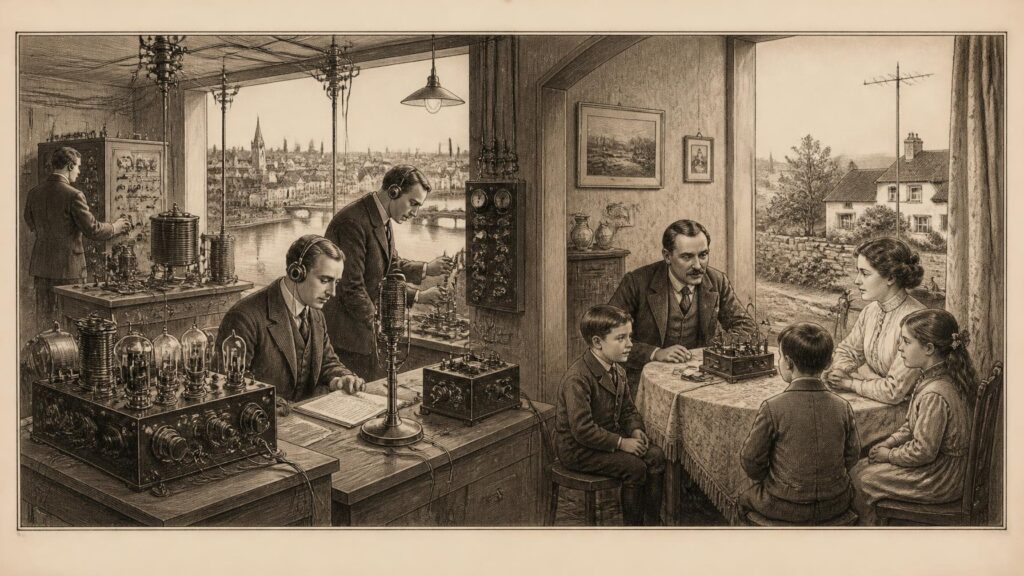
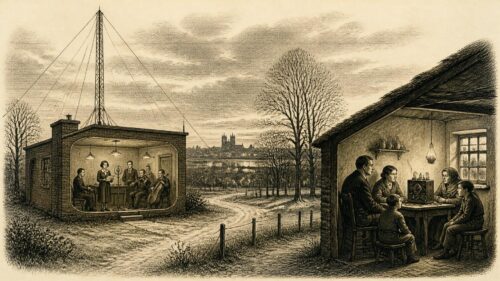
AI generated historical illustration, not a contemporary photograph.
At a Glance
Public broadcasting was one of the institutions through which independent Ireland learned to speak to itself, but it was never simply the voice of the nation. From the first wireless transmissions of 1926 to television, Irish-language services, commercial competition and internet distribution, broadcasting has carried culture and information into domestic life while also revealing persistent arguments about authority, identity, money and freedom. Its history is consequently a history of modern Ireland in miniature: a small state seeking cultural confidence, citizens listening across borders, governments testing the limits of influence, and broadcasters attempting to serve a public that has never been culturally or politically uniform.
Wireless Beginnings
Irish public broadcasting began on 1 January 1926, when station 2RN transmitted from Little Denmark Street in Dublin. The new service was born in the Irish Free State’s unsettled first decade, only a little over three years after the end of the Civil War. Its opening represented more than a technical novelty. Wireless broadcasting offered the young state a means of reaching households beyond Dublin with music, announcements, talks and, in time, a shared schedule of national events. RTÉ’s archival record identifies Douglas Hyde, founder of the Gaelic League and later the first President of Ireland, as the speaker who formally inaugurated the service. The symbolism was unmistakable: modern communications and cultural revival were placed together on the opening night.
The practical scale of the enterprise was modest. 2RN used a Dublin studio and a Phoenix Park transmitter whose early range could not reliably embrace the entire state. Receivers were costly, licences fewer still, and much listening was communal or improvised. A radio set could be a family possession, a public-house attraction or an object around which neighbours gathered. Such conditions matter because later memories sometimes treat radio as though it instantly created a single national conversation. It did not. Reception was uneven, listening habits differed by class and locality, and British and continental stations were already available to many listeners. The Irish service entered a crowded audible world rather than an empty one.
Yet the aim of a national service was clear. The new state had inherited neither a fully formed national broadcast institution nor an uncontested public culture. It confronted the competing attractions of English-language commercial entertainment, British broadcasting, local loyalties and a politically charged debate over what Irish independence ought to mean in everyday life. Radio promised an audience not limited by literacy, library provision or distance from urban theatres. It could circulate traditional music, Irish-language material, religious observance, sport and formal addresses with a speed that print could not equal. These possibilities made broadcasting especially attractive to administrators and cultural advocates, even when the necessary funds and technical resources were scarce.
It would be misleading, however, to describe 2RN as wholly independent in the editorial sense later associated with public-service broadcasting. In its early decades Radio Éireann functioned under the Department of Posts and Telegraphs, within a structure ultimately answerable to government. The distinction between state ownership, state administration and public service was therefore blurred from the outset. That ambiguity became central to later controversies. Irish broadcasting was expected to perform national work, but the question of who could define that work—ministers, civil servants, programme makers or audiences—was never settled once and for all.
National Signals
The extension of transmission capacity helped turn aspiration into a more credible national service. The Athlone transmitter, opened in 1933, greatly enlarged Radio Éireann’s reach. It did not remove every technical limitation, nor did it abolish cross-border listening, but it made the claim to national coverage materially stronger. A service that could be heard in homes across the state could become part of the ordinary rhythm of domestic time: news bulletins, music, weather, devotional items, sporting reports and scheduled entertainment acquired a regular place in daily routines.
Regularity was itself historically important. Broadcasting did not merely deliver programmes; it organised time. Families adjusted meals, conversation and leisure around programmes. Particular voices became familiar without becoming personally known. In rural places, where travel to cinemas or theatres could be difficult, radio widened access to performance and information. In towns, it competed with other amusements while making events elsewhere feel closer. These effects should be understood as interpretation rather than a single measurable outcome. Listeners did not absorb broadcasts identically, and there is no reason to assume passive obedience. They selected, criticised, ignored and discussed what they heard.
Sport was an early demonstration of radio’s distinctive force. RTÉ Archives records that sports announcements appeared in 1926 and identifies Paddy Mehigan’s commentary on the Kilkenny–Galway All-Ireland hurling semi-final of 29 August that year as the first live commentary on a field sport in Europe. Whether listeners experienced it as technological wonder, local partisanship or simple entertainment, live commentary collapsed geographical distance. It also gave national games an enlarged audience and made the broadcast voice part of sporting memory. The connection between Irish broadcasting and the GAA was thus not a later invention; it developed close to the beginning of the service.
Music was equally central. The first broadcast mixed military-band performance, choral music, traditional material and singers. This range reflected necessity as well as policy: live contributors were available, recorded music was technically awkward, and a national schedule needed material capable of appealing to varied listeners. Over time, the service supported musicians, composers and performers while also choosing which forms of culture would receive institutional prestige. That power was significant. To broadcast Irish traditional music, classical performance, drama or popular song was not necessarily to preserve it unchanged; selection, presentation and scheduling shaped how traditions appeared to new audiences.
Language Ambitions
The Irish language occupied a special place in the imagination of the new service. Hyde’s use of Irish and English at the 2RN opening captured the bilingual contradiction of the state’s cultural policy. Irish had constitutional and symbolic importance, while English remained the principal language of most listeners. Broadcasting could make Irish audible in homes far from Gaeltacht areas, offer language learners a recurring resource and signal that the language belonged in modern technology rather than only in schoolbooks or folklore. It could not, by itself, reverse language shift or overcome the social and economic pressures that favoured English.
This limitation is essential. A retrospective story that treats broadcasting as a straightforward instrument of language restoration mistakes aspiration for result. Irish-language programming was often constrained by schedules, budgets, available personnel and audience expectations. As Iarfhlaith Watson has argued in his study of Irish-language broadcasting, language media developed within a broader movement from nation-building ideals towards a more market-conscious modern Ireland. The tension was structural: a broadcaster could be required to promote Irish and national culture while also seeking large audiences and advertising income.
Radio nevertheless created an important platform for Irish-language music, talks, educational output and cultural commentary. It made voices and dialects audible beyond their immediate local communities. It also helped establish the principle that public broadcasting had duties beyond popularity. The later Broadcasting Authority Act 1960 explicitly instructed the new Authority to keep in mind the national aims of restoring Irish and preserving and developing national culture. Such language did not dictate individual programmes, but it made cultural responsibility part of the institution’s legal and political identity.
The language question also exposes a broader feature of Irish public broadcasting. The state’s cultural ambitions were never culturally neutral, even when they were sincerely held. A national service promoted particular ideas of heritage, respectability and belonging. Audiences often welcomed these efforts, but they could also regard them as remote from ordinary taste. The enduring success of entertainment, imported programmes and popular music demonstrates that listeners were not waiting simply to receive official culture. They wanted a service that could inform, reflect and amuse.
Border Reception
Irish broadcasting developed on an island divided politically and connected technically. Signals ignored borders more easily than governments did. In the Republic, many households could receive BBC services and, later, commercial British television. In Northern Ireland, listeners and viewers could encounter services from the south as well as the BBC and Ulster Television. This made the Irish media environment unusually porous. Domestic broadcasters did not possess a secure monopoly over national audiences, and cultural comparison with British services was built into ordinary reception.
That condition affected programming and finance. Irish broadcasters faced the challenge of providing attractive schedules with a far smaller population and revenue base than neighbouring British institutions. Imported programmes were often cheaper than original production, but reliance upon them raised recurring anxieties about cultural dependence. At the same time, British programmes were not simply an external threat. They formed part of the actual media experience of Irish audiences and gave viewers access to genres, stars and news styles that influenced expectations of domestic broadcasting.
Cross-border reception complicates any easy description of broadcasting as a national mirror. It was a meeting place of overlapping publics: Irish citizens, Northern audiences, emigrants, British viewers near the coast, Irish-language communities and people whose strongest attachments were local rather than national. During the Troubles, these overlapping audiences became especially consequential. Coverage of Northern Ireland could be scrutinised in Dublin, Belfast and London simultaneously, with different assumptions about security, representation and legitimacy.
The history of broadcasting on the island must therefore avoid treating the Republic’s public service as the only relevant institution. BBC Northern Ireland and Ulster Television were important elements in the media history of Northern Ireland, just as RTÉ was important to many Northern viewers. Nevertheless, the institutions were not interchangeable. RTÉ emerged from the Free State and later Republic’s legal framework and cultural policy; BBC broadcasting in Northern Ireland belonged to a United Kingdom public-service system. Their signals crossed, but their governing structures and political responsibilities differed.
Television Arrival
Television transformed the scale and visibility of public broadcasting. The Broadcasting Authority Act 1960 moved Radio Éireann from direct departmental administration to a statutory authority and charged it with establishing television. Telefís Éireann began broadcasting on 31 December 1961. The occasion was deliberately ceremonial: President Éamon de Valera, Taoiseach Seán Lemass and the Minister for Posts and Telegraphs addressed viewers. A new visual medium was introduced through the leading offices of the state, confirming television’s perceived national significance.
Television did not create modern Ireland, but it became one of the places in which modernity was performed and contested. It brought images of political leaders, city streets, rural change, international events and domestic entertainment into homes. For some households, the television set was a costly acquisition and a social centre; neighbours watched together, especially in the early years. For others, reception remained difficult or the available programmes limited. The spread of television was gradual, but its cultural effect was profound because it joined sound, image and liveness in a domestic medium.
The new station inherited the mixed remit already visible in radio. It had to entertain sufficiently to win attention, provide information and news, show sport, develop drama and support cultural objectives. Early schedules mixed imported material with Irish production. This was not evidence of failure. Small broadcasters everywhere used acquired programmes. But in Ireland the balance carried particular significance because television was expected both to compete with powerful external services and to represent a distinct society.
Programme history reveals the range of that undertaking. Religious broadcasting, school television, arts programmes, current affairs, rural features, drama and light entertainment all found places in the schedules. The Late Late Show, first broadcast in 1962, eventually became a remarkably durable forum for celebrity, music, social argument and the performance of public disagreement. The Riordans, which began in 1965, placed rural life at the centre of a popular serial drama. Neither programme can be reduced to a sociological document; both were constructed entertainment. Yet their longevity and influence demonstrate that television could make Irish settings, speech and disputes appear as material for popular national viewing rather than merely as local colour.
Screened Society
Television altered public visibility. It allowed audiences to see politicians speaking in their own homes rather than only read their words in newspapers or hear them on radio. It gave performers and presenters a new kind of celebrity. It made regional accents, changing fashions and social differences more immediately noticeable. Such visibility could encourage recognition, but it also imposed standards. Producers and executives decided whose voices were authoritative, which families appeared typical, what subjects were suitable for discussion and how conflict ought to be framed.
The medium’s importance is apparent in debates surrounding religion and social change. Ireland in the 1960s and 1970s was not static, despite later caricatures. Economic development, urbanisation, education, migration and changing generational expectations all altered social life. Television neither caused every change nor merely recorded it. It provided occasions in which changing attitudes could become publicly audible and visible. Interviews, documentaries and discussion programmes sometimes challenged inherited deference; entertainment could normalise new manners and tastes more quietly.
Historians should resist the temptation to read a programme as direct proof that all viewers held the views it expressed. A controversial broadcast tells us reliably that producers judged a subject broadcastable and that an audience could be addressed; it does not automatically measure private opinion. Audience letters, ratings, newspapers, parliamentary debate and oral testimony are needed to reconstruct reception. Even then, the evidence is partial. The surviving archive often privileges production and public controversy over the unrecorded reactions of ordinary viewers.
What can be said securely is that television became a major arena of Irish public life. Its most watched moments—elections, sporting occasions, national ceremonies, crises and entertainment finales—created simultaneous attention on a scale earlier media could rarely achieve. Yet simultaneity did not guarantee agreement. A shared broadcast could intensify disagreement just as easily as it could produce solidarity. This was one reason public broadcasting attracted persistent political interest: it had the capacity to define what was visible, timely and worthy of national discussion.
Editorial Conflict
The most serious test of the relationship between broadcaster and state came during the Troubles. Section 31 of the Broadcasting Authority Act 1960 gave the responsible minister power to issue a written direction preventing RTÉ from broadcasting specified classes of material. In October 1971, Taoiseach Jack Lynch issued a directive targeting material capable of promoting organisations that pursued political objectives through violence. The language was broad and immediately raised questions about reporting, interviews and the distinction between explanation and promotion.
RTÉ Archives records that the wording became the subject of conflict between the Authority and government. In November 1972, RTÉ radio broadcast a report based on journalist Kevin O’Kelly’s interview with Seán Mac Stíofáin of the IRA. The episode led to a confrontation whose consequences included the dismissal of the RTÉ Authority. O’Kelly was later imprisoned for contempt of court after refusing, during Mac Stíofáin’s trial, to identify the interview subject. These events show that broadcasting regulation during the conflict was not an abstract administrative matter. It bore directly on journalistic practice, source protection and the institutional independence of the national broadcaster.
A further directive issued by Conor Cruise O’Brien in 1976 specified organisations whose representatives could not be heard on RTÉ. Supporters regarded restrictions as a necessary response to political violence and propaganda. Critics argued that they impaired public understanding, restricted journalism and allowed government to shape the boundaries of legitimate speech. Both positions were rooted in the conditions of a conflict in which violence, intimidation and propaganda were real. A responsible historical account should not collapse the question into a simple opposition between liberty and censorship without acknowledging that context.
Even so, the effect on broadcasting was substantial. Journalists and producers had to decide how to report organisations, representatives and events without infringing ministerial direction. The distinction between reporting on a person and broadcasting that person’s voice became especially fraught. The controversy surrounding the dismissal of RTÉ journalist Jenny McGeever in 1988 illustrated how operationally consequential the rules remained. Section 31 was repealed in 1994 by Minister Michael D. Higgins. Its history remains a caution against assuming that a public broadcaster is autonomous merely because its remit uses the language of public service.
Public Duties
The statutory authority created in 1960 was intended to give broadcasting a degree of separation from day-to-day departmental control. Its members were appointed within a political system, its money came through public mechanisms and advertising, and ministers retained important powers. Independence was therefore always qualified rather than absolute. The Authority model nonetheless expressed a principle that broadcasting should not operate simply as another civil-service branch. Programme makers, boards and executives could invoke public responsibilities that were wider than immediate government preference.
The 1960 Act’s cultural obligation was later supplemented and reframed. By the time of the Broadcasting Act 2009, RTÉ’s statutory objects included operating national television and sound services with the character of public service, free to air and available, so far as reasonably practicable, to the whole community on the island. The Act also recognised responsibilities for online services, cultural performing groups, archives, emergency information and services for Irish communities abroad. These provisions are evidence of institutional continuity and adaptation: public service was no longer confined to a single national radio station or television channel.
Funding has complicated the ideal throughout the period. Irish public broadcasting has depended upon television licence income while also using commercial revenue. The mixed model has encouraged a recurring argument. Advertising can supply revenue and support costly programming, but it creates pressures to attract audiences attractive to advertisers. Licence funding can support non-commercial obligations, but it invites public and political scrutiny over expenditure, governance and the fairness of the charge. There is no funding mechanism free of influence; each distributes power differently.
Public service also involves more than news. RTÉ has maintained performing groups, notably orchestras and choirs, and has accumulated archives which constitute a major record of twentieth- and twenty-first-century Irish sound and image. These activities do not always command the largest audiences, but they express the broader cultural claim of public broadcasting. Whether every service is adequately funded or perfectly managed is a separate question. The historical point is that Ireland has repeatedly expected its principal public broadcaster to do work that a purely commercial company might not undertake.
Commercial Openings
By the late twentieth century, the single-broadcaster environment had become increasingly difficult to sustain. Audiences had access to more external television, technological change reduced barriers to transmission, and unlicensed pirate stations demonstrated demand for local radio, pop music and formats neglected by established services. Pirate radio was not a single coherent movement: some stations were entrepreneurial, some community-minded, and many operated outside the licensing system. Its importance lay in showing that the public wanted choice and that the national service did not satisfy every musical, local or generational appetite.
Legislative change opened a regulated independent sector. The 1988 broadcasting legislation established a framework for licensed independent radio, and commercial local stations began to alter the soundscape. Their arrival decentralised broadcasting to an extent. Local news, traffic, sport, advertising and presenters could be tailored to particular counties and cities. This did not eliminate concentration of ownership or financial fragility, but it created new sites of local representation and employment.
Television competition followed. TV3 began broadcasting in 1998, adding an Irish commercial television service to an environment already shaped by British channels, cable and satellite. Competition changed scheduling, commissioning and audience measurement. It also weakened any assumption that RTÉ alone could define the visual public sphere. Public broadcasting had to justify itself not by exclusivity but by the quality and distinctiveness of its services: trusted news, cultural work, Irish production, minority provision, children’s material, regional stories and coverage that might be commercially unattractive.
Commercial expansion should not be portrayed as the end of public service. Independent stations can perform civic and cultural functions, while public broadcasters have long used advertising and popular formats. The more useful distinction concerns obligations. A public service remit asks whether a broadcaster must serve audiences and purposes that markets may undervalue. The existence of competition made that question sharper, not obsolete. It also made audience choice a more visible part of broadcasting history: viewers and listeners were not simply citizens to be instructed but consumers with alternatives.
Gaelic Television
The establishment of Teilifís na Gaeilge, later TG4, was a decisive development in the history of Irish-language media. The channel commenced broadcasting on Halloween night, 31 October 1996. Its creation followed decades in which Irish-language output had appeared within broader radio and television schedules, often in marginal slots. A dedicated channel did not solve the wider sociolinguistic difficulties facing Irish, but it changed the institutional status of Irish-language television. Irish could now be the ordinary working medium of a full television service rather than a periodic obligation of an English-dominant schedule.
TG4’s importance lies in both language and form. It commissioned drama, documentaries, children’s programmes, music, sport, current affairs and acquired content, addressing fluent speakers while also inviting learners and bilingual audiences. The channel developed a distinctive presentation style and placed particular emphasis on regional and Gaeltacht production. This helped strengthen an independent production ecology outside Dublin, though such benefits have depended upon funding, commissioning decisions and the survival of small companies rather than arising automatically from the channel’s existence.
The service also demonstrates why cultural broadcasting should not be assessed only through conventional ratings. Audience figures matter, especially where public money is involved, but a minority-language service may have value disproportionate to its share of viewing. It can provide representation, employment, cultural continuity and an archive of speech, place and performance. Such claims require scrutiny, not romantic acceptance. Irish-language television does not preserve a fixed traditional culture; it makes contemporary programming in Irish and therefore participates in change, debate and hybrid identities.
TG4’s later archive work has made this historical role more visible. Its news and current-affairs archive, including material from the channel’s early years, preserves a perspective on local, national and international events mediated through Irish. In 2026 the broadcaster launched Cartlann TG4, expanding public research access to digitised material. Archives are not neutral storehouses: what survives depends on recording formats, rights, cataloguing and resources. But their preservation makes it possible to study how Irish was used not only ceremonially but also in reporting, entertainment and the daily representation of modern life.
Digital Transition
Digital technology changed the meaning of broadcasting without making its earlier history irrelevant. The internet weakened the old relationship between a scheduled programme, a transmission frequency and a domestic receiver. Audiences could watch on demand, listen by stream, encounter clips on social platforms and access material from outside Ireland with ease. This altered habits of attention and made the competition for public time more intense. It also enabled broadcasters to reach diasporic audiences and make historic collections more accessible.
For RTÉ, digital development was incorporated into statutory purpose. The Broadcasting Act 2009 recognised websites and non-linear audiovisual services alongside conventional radio and television. That recognition marked an important conceptual shift: public service could no longer be defined only by broadcasting in the older technical sense. It involved availability, accessibility, reliable information and cultural provision across changing platforms. The principle of serving the public survived, while the channels through which the public was reached multiplied.
Regulation also changed. The 2009 Act created the Broadcasting Authority of Ireland, bringing regulatory functions into a new framework. In March 2023, under the Online Safety and Media Regulation Act 2022, the BAI was dissolved and Coimisiún na Meán assumed its broadcasting functions while taking on wider roles concerning video-on-demand and online safety. This was not merely an institutional renaming. It acknowledged that the media environment in which broadcasters operate includes online platforms, on-demand services and risks that cannot be understood through twentieth-century transmission rules alone.
Digital transition has intensified old problems as well as creating new ones. Public-interest journalism still requires money, editorial protection and skilled staff. Archival preservation remains expensive even when distribution is easy. Cultural material can find new audiences online, but abundance may make it harder for smaller services to be discovered. The historical lesson is that technology does not determine public value. Institutions, funding choices, legal duties and audiences determine whether a new medium broadens democratic and cultural life or merely fragments it.
Archive Futures
The archive is one of public broadcasting’s least glamorous but most consequential inheritances. Early radio recordings, television reports, election broadcasts, sporting commentaries, documentaries and entertainment programmes preserve voices and images that would otherwise disappear. They are evidence of performance, language, official ritual, journalistic practice and changing styles of address. They are also selective. Much early broadcasting was not recorded, recordings were erased or lost, and catalogues reflect institutional priorities. Historians must therefore use surviving footage and sound critically, alongside newspapers, legislation, private papers and oral testimony.
RTÉ Archives has made substantial material available, including items documenting the launch of 2RN, early sports broadcasting, television’s beginnings and the Section 31 controversy. Such resources allow the public to encounter primary evidence directly, although a clip should not be mistaken for a complete historical account. A short excerpt has a production context, a date, an editorial frame and sometimes rights restrictions. It may illuminate how an event was represented without revealing every debate behind the broadcast or every response among audiences.
Public broadcasting’s historical significance cannot be reduced to its best-known personalities or programmes. Its deeper importance lies in its durable role as infrastructure for public speech. It has supplied emergency information, recorded public ceremonies, supported performance, covered elections, reported local and international crises, and created occasions for national amusement. It has also failed, been criticised, faced financial strain and been drawn into political conflict. Those imperfections are part of the history rather than reasons to disregard it.
Modern Ireland has never had one uncontested voice, and its broadcasting history is most useful when it does not pretend otherwise. The wireless service established in 1926 helped a new state communicate with its people. Television expanded the power and reach of that communication. Commercial and community alternatives, Irish-language institutions, cross-border services and digital platforms made the public sphere more plural. The continuing task is not to recover an imaginary age of unified national listening, but to sustain trustworthy, inventive and accountable media in a society whose identities, technologies and arguments remain in motion.
Networked Publics
The migration of broadcasting towards digital distribution has changed the meaning of reach without removing the older importance of transmission. For much of the twentieth century, national coverage meant overcoming distance with transmitters, relay stations and receivers. By the early twenty-first century, programmes could also be accessed through websites, live streams, catch-up players, podcasts and social-media clips. This made Irish material more readily available to emigrants and international audiences, while allowing viewers and listeners to choose programmes outside the fixed timetable that had once structured domestic life. A broadcast no longer disappeared simply because its scheduled hour had passed; it could become an archive item, a shareable excerpt or a resource encountered years later.
The Broadcasting Act 2009 recognised this altered environment by giving RTÉ responsibilities extending beyond conventional radio and television. Its statutory purposes included public-service sound and television services, online services, cultural performing groups and the preservation of archives. The significance of this framework lies in its recognition that public service cannot be defined solely by a transmitter or a channel number. A national broadcaster was expected to make material available through changing technologies, retain records of public life and provide services for audiences on the island as well as Irish communities abroad. These were ambitious obligations for an organisation still required to balance cultural, informational and popular programming.
Digital access has been particularly consequential for minority-language broadcasting. TG4’s player enables Irish-language programmes to circulate beyond the Gaeltacht and beyond Ireland, reducing the dependence of audiences on a particular local signal or broadcast time. That does not make language media independent of its social setting. A programme watched online still requires fluent speakers, writers, performers, producers and an audience willing to make Irish part of ordinary cultural life. Yet digital distribution can connect dispersed viewers who might otherwise have little shared access to contemporary Irish-language television. In this sense, it extends the older ambition of broadcasting: not merely to represent a community, but to help make one visible to itself.
The same technologies have weakened the privileged position once held by any single broadcaster. Irish audiences now move among domestic stations, British services, global streaming platforms, video-sharing sites and audio services that do not fit neatly into the older distinction between broadcaster and publisher. Choice has expanded, but abundance does not automatically produce a more informed public. The competition for attention can reward speed, familiarity and emotional intensity, while locally made journalism, documentary and drama remain costly. Public-service institutions consequently face a renewed version of an old problem: how to justify sustained investment in material whose value may be civic, cultural or archival rather than immediately commercial.
Regulation has had to follow this convergence. Coimisiún na Meán was established on 15 March 2023 under the Online Safety and Media Regulation Act 2022, with responsibilities spanning broadcasting, video-on-demand services, media development and online safety. Its creation marked an important institutional shift. The central questions that once surrounded radio licences, ministerial direction and television schedules now also concern platform power, harmful content, misinformation, children’s access and the discoverability of Irish and European work. These issues are new in form, but they continue the history traced throughout Irish broadcasting: arguments over who speaks, who is heard, what obligations accompany media power, and whether a small society can maintain a public conversation amid powerful external influences.
The airwaves therefore remain a useful historical image, even when much contemporary media no longer travels principally through them. Irish broadcasting began as an effort to create a national service in a crowded field of foreign signals. It now operates in a far more crowded digital environment, where boundaries are less technical than cultural, legal and economic. Its future will depend not on recovering a vanished monopoly, but on sustaining trustworthy information, creative production and meaningful representation for audiences whose identities, languages and habits have always exceeded any single national schedule.