Empty Streets
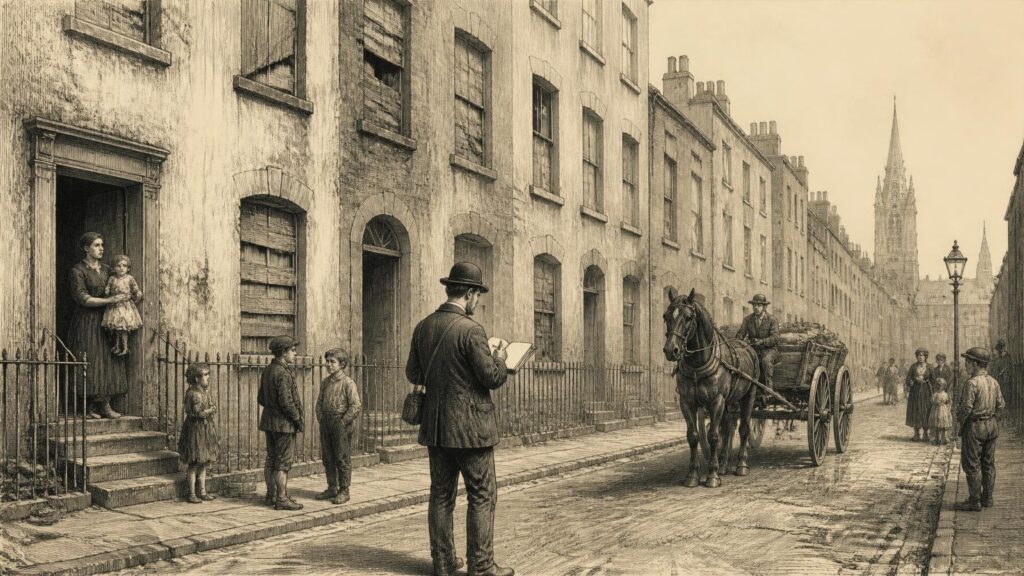
AI generated historical illustration, not a contemporary photograph.
At a Glance
Vacant housing has been one of the most persistent and misunderstood features of Irish urban history. A locked door may suggest waste amid need, but it can also mark bereavement, repair, speculation, seasonal occupation, failed investment, impending demolition or a building caught between public plans and private ownership. In Ireland, arguments about empty homes have repeatedly become arguments about the city itself: who belongs in its centre, who is moved to its edge, what is worth preserving, and whether renewal serves inhabitants before investors.
Urban Absence
“Vacancy” is not a timeless or self-explanatory historical category. In nineteenth-century cities, officials more often described houses as unoccupied, unfit, ruinous, closed, condemned or derelict. A building might be empty because a landlord had withdrawn it from use, because tenants had departed, because a clearance programme was underway, or because an owner expected a more profitable future. Conversely, some of the worst housing in Irish history was not vacant at all. It was excessively occupied. Dublin’s notorious tenements were reminders that apparent density and acute housing need could coexist with abandonment elsewhere in the same city.
The relationship between vacancy and renewal is therefore uneasy. Renewal may bring an empty building back into use, but it can also produce emptiness by clearing a neighbourhood, displacing tenants, delaying construction or holding land for redevelopment. Ireland’s urban history supplies examples of each process. The story begins not with a simple shortage of dwellings, but with the transformation of existing urban fabric: grand eighteenth-century houses subdivided into crowded lodgings, industrial and port districts losing their former purpose, and commercial streets acquiring unused rooms above shops.
Dublin is the central case because its housing crisis was unusually visible, closely investigated and repeatedly used as a national political question. Yet it should not be treated as the whole country. Cork, Limerick, Waterford and Galway had their own overcrowded districts, decaying premises and changing commercial centres. Smaller towns faced a different combination of population loss, shopfront vacancy, inherited buildings and weak demand. The Irish history of vacancy is thus both metropolitan and regional: it concerns the capital’s tenements and docklands, but also the long afterlife of houses, shops and streets in towns whose economic roles altered.
Modern statistics sharpen rather than settle the problem. The Central Statistics Office counted 163,433 vacant dwellings on Census Night, 3 April 2022, excluding holiday homes. That was a lower total than in 2016, but it was a point-in-time measure, not a list of homes immediately available for occupation. Census enumerators could record a dwelling as vacant when it was for sale, to let, under renovation or unoccupied after an owner entered care. Derelict and unfinished properties were treated differently. Historical interpretation requires the same caution: an empty property is evidence of a condition, but not by itself proof of a readily recoverable home.
Georgian Decline
Dublin’s later housing emergency was rooted partly in the city’s earlier success. During the eighteenth century, speculative building created terraces and squares intended for wealthy residents. Their architecture projected confidence, but the social geography that supported it did not remain fixed. The Act of Union of 1800, changing patterns of elite residence, suburban expansion and the gradual movement of prosperous households altered demand for the large city-centre houses. Many were adapted for institutional, commercial or lodging use; others were divided into tenements.
This conversion is often told as a simple tale of aristocratic flight and instant ruin. The reality was slower and more varied. Houses could retain respectable occupants while taking lodgers, be subdivided floor by floor, or move through several forms of use over decades. Nevertheless, the cumulative outcome in parts of north inner Dublin was severe. Large houses designed for a single household became multi-family properties with shared yards, water supplies and sanitary arrangements. The physical shell of Georgian Dublin survived, but its original domestic arrangement did not.
That history matters for vacancy because the same buildings could be simultaneously valuable, unhealthy and economically difficult to repair. An owner might have little incentive to undertake extensive improvement while rental income remained insecure and municipal enforcement was limited. A house could contain occupied rooms but have empty, unusable or dangerous spaces. By the time a property became wholly vacant, its deterioration might be so advanced that ordinary maintenance was no longer enough. The choice presented to public authorities was rarely between a sound empty house and an eager tenant; it was more often between expensive adaptation, piecemeal repair, demolition, or new construction elsewhere.
Such complexity has sometimes disappeared behind romantic images of “old Dublin”. Folklore and family memory rightly preserve attachment to particular streets, courts and houses, but they should not be allowed to soften documented conditions. The 1913 collapses at Church Street, which killed residents, gave brutal visibility to structural danger. The Irish Architectural Archive’s account of the episode and contemporary housing inquiries make clear that the problem was not merely aesthetic decline. It involved overcrowding, sanitation, mortality and the limited capacity of city government to overcome entrenched property conditions.
Reform Demands
By the early twentieth century, reformers had made housing a civic question. Investigations, medical reports, voluntary organisations and municipal debate brought evidence of overcrowding to wider attention. The language of reform was often paternalistic, and it did not always treat tenants as political actors. Even so, it forced public recognition that poor housing was not simply the private misfortune of individual families. It was linked to public health, labour, child welfare and the credibility of urban government.
The scale of the Dublin crisis was disturbing. Scholarly work on the Irish Free State’s urban housing problem notes that, in Dublin excluding Rathmines and Pembroke, 23,655 families lived in one-room tenements in the early interwar period. The figure should be understood as an indicator of extreme crowding, not merely an architectural curiosity. A one-room family dwelling made privacy, illness, domestic labour and childhood profoundly different from the norms imagined in reforming housing policy.
Reform did not arrive as one clean programme. The Housing of the Working Classes legislation, inherited from the United Kingdom, gave local authorities powers connected with unhealthy areas and working-class accommodation. But powers required money, land, administrative capacity and political resolve. Dublin Corporation faced competing demands, while the new Irish state after 1922 confronted wider fiscal and institutional pressures. The early Free State did not inherit an empty canvas. It inherited a city with a longstanding housing crisis, limited resources and an urban form shaped by private subdivision.
Municipal surveys were important because they made need countable. In 1929 the Department of Local Government and Public Health asked urban authorities to assess housing conditions, including unmet need, rehousing required by clearance and replacement of unfit houses. Such surveys did more than collect facts. They framed the policy problem: housing shortage was connected to clearance, and clearance itself created an obligation to rehouse. That principle became central to the next phase of Irish urban change.
State Building
The 1930s brought a more forceful state response. New legislation in 1931 and 1932 improved the financial basis for local-authority house building and slum clearance. Across Ireland, local authorities undertook a substantial building programme. The policy was not simply a humanitarian response, although it answered undeniable suffering. It was also a nation-building project. A young state used housing to demonstrate administrative capacity, improve public health and reshape the everyday surroundings of working-class citizens.
Dublin Corporation’s work combined two approaches that sat uneasily together. It built flats in central clearance areas and houses on expanding suburban estates. The central schemes sought to keep at least some residents close to the city where they worked and where kinship networks were rooted. The suburban developments offered gardens, more space and new streets, but took households farther from established neighbourhoods and, in many cases, from employment. The division between inner-city flats and suburban cottages also carried a social hierarchy. Researchers have argued that this dual policy increased segregation, with the poorest households more often remaining in central flats.
Herbert Simms, Dublin Corporation’s housing architect from 1932 until his death in 1948, became closely associated with the municipal architecture of this period. His work has been celebrated for practical planning and modern domestic standards rather than decorative display. Schemes such as Chancery Place, Pearse House and other inner-city flats gave form to a belief that decent dwellings could be designed within the city, not only beyond it. At the same time, the Corporation’s expanding estates in places such as Crumlin, Cabra, Drimnagh and Donnycarney remade the metropolitan edge.
It would be misleading to describe this as an uncomplicated triumph. Clearance dealt with some dangerous buildings, but it also broke up streets and neighbourhoods. Rents and household eligibility could exclude people whom reformers expected to benefit. The replacement of a condemned tenement did not automatically produce a home suitable or affordable for every former resident. Documentary evidence supports the scale of the effort; it also supports the conclusion that clearance and rehousing were difficult, uneven processes rather than a single humane act completed by demolition.
Clearance Choices
Slum clearance created one of the defining moral questions of Irish urban renewal: should a dangerous district be repaired in situ, comprehensively rebuilt, or emptied while residents were rehoused elsewhere? There was no universal answer. Some structures were beyond economical repair. Others might have been rehabilitated but were caught in systems of fragmented ownership and weak investment. Public authorities had to weigh sanitation, fire risk, cost, density, land values and the wishes of residents, who were never a uniform group.
J. E. Canavan’s 1938 paper, “Slum clearance in Dublin”, is a valuable contemporary source precisely because it avoids treating conditions as an abstraction. It described the widespread but imprecise public awareness of slums and considered the practical difficulty of replacing them. Its terminology belongs to its time and must be read critically, but it records how housing reformers understood the scale and administrative burden of the problem. The Citizens’ Council and other civic bodies likewise pushed housing conditions into public debate.
Vacancy was embedded in this process. A property could be emptied before demolition; a cleared site could remain vacant while funds, plans or contracts were assembled; new units could await allocation. These were not all equivalent. Temporary vacancy caused by a managed rebuilding scheme differs from persistent abandonment, but both could be visible to neighbours as boarded windows and inactive land. The distinction mattered then and matters now, because political rhetoric often treats all visible emptiness as the same failure.
There was also a preservation question. In later decades, some critics would lament the loss of old streets and the destruction of historic fabric. That criticism has force, especially where sound or adaptable buildings were discarded. Yet historical honesty requires resistance to a false choice between preservation and social justice. Many tenants lived in conditions no heritage argument could justify preserving. The lasting lesson is not that clearance was always wrong or always necessary. It is that building conservation, rehabilitation and tenant protection must be considered together, before neglect leaves demolition as the only apparent option.
Suburban Futures
For many Dublin families, municipal suburban housing represented an extraordinary improvement. A house with separate bedrooms, indoor facilities, a small garden and a planned street could transform domestic life. The Corporation’s interwar estates, often designed around open spaces and recognisable house types, gave physical expression to aspirations of health, order and family privacy. Dublin Civic Trust has noted the coherent streetscapes and distinctive planning of these Corporation developments.
But movement to the edge of the city had costs. Distance from central employment increased travel time and expense. New estates needed schools, shops, transport, recreation and social infrastructure, all of which developed unevenly. A household moved from a tenement to a suburban house might gain rooms and light while losing proximity to relatives, casual work and familiar services. Oral memory often captures both feelings at once: pride in a new home and a sense of being removed from the city one knew.
This is an area where folklore must be separated from evidence without dismissing it. Recollections of families being “sent out” to the suburbs are historically meaningful accounts of disruption and adaptation, but they cannot alone establish the scale or sequence of rehousing. Municipal records, plans, housing files and census material are necessary for that. Equally, official statistics cannot fully describe the social loss involved when a street-based network was broken apart. The strongest history places personal testimony beside administrative evidence rather than allowing either to speak alone.
The suburban solution also altered the meaning of the city centre. As population and domestic life moved outward, older central districts could lose purchasing power and political attention. Some were rebuilt with flats; others remained underused or deteriorated. By the later twentieth century, concern about central vacancy would be shaped by this earlier decentralisation. The problem was no longer only how to escape overcrowded inner-city rooms. It was also how to ensure that the historic centre remained a living place rather than a landscape of offices, traffic corridors, vacant upper floors and redevelopment sites.
Modernist Remedies
Postwar housing policy continued the search for scale. The need to replace remaining tenements, meet household formation and accommodate metropolitan growth encouraged larger estates and new forms of construction. In Dublin, the high-rise Ballymun scheme, begun in the 1960s, became the most conspicuous symbol of this moment. It promised modern flats, central heating, lifts and services on a scale that earlier municipal schemes had not attempted.
Ballymun should not be reduced to a simple parable of failure. For early residents, the new flats could be a major improvement on poor-quality dwellings. The estate was built in response to a real housing emergency and to the continuing need to rehouse people from inner-city tenements. However, the later deterioration of buildings, weak maintenance, insufficient local amenities and wider patterns of disadvantage showed the limits of solving housing need through construction alone. A built form cannot compensate indefinitely for inadequate services, employment opportunity, management or resident influence.
The history of flats and towers also changed public attitudes to renewal. Where clearance had once seemed synonymous with progress, demolition of newer public housing later became a contested form of regeneration. Residents could reasonably ask why communities were being displaced again, this time from homes that had themselves been presented as the solution to an earlier crisis. Regeneration plans had to contend with accumulated distrust as well as physical decline.
Elsewhere, low-rise estates faced different difficulties: ageing fabric, underinvestment, changing household needs and stigma attached to particular addresses. Urban renewal was gradually broadened from clearance and new construction to include estate renewal, tenant participation, environmental improvement and social programmes. This shift was incomplete, but it reflected a hard-won understanding: the life of a housing area depends on stewardship after construction. Buildings do not become empty, unpopular or derelict for one reason only; policy decisions made over decades shape their prospects.
Derelict Centre
By the late 1970s and 1980s, Dublin had visible pockets of dereliction, underused land and declining central activity. Deindustrialisation, changes in port activity, suburban retailing, road schemes and outward residential movement all played a part. The problem was not unique to Ireland, but it acquired a particular local form in a capital whose historic fabric, public housing legacy and property market had developed unevenly.
Vacancy above shops became especially significant. Traditional town and city streets often contained accommodation over commercial premises, but changing retail patterns, fire regulations, access difficulties, poor repair and fragmented ownership left many upper storeys unused. Such spaces appeared to offer an obvious housing resource. In practice, conversion could be technically complicated and expensive. Separate entrances, daylight, escape routes, sound insulation, services and financing all mattered. The recurring discovery of “empty rooms over shops” was real, but the persistence of the problem showed that identification was not the same as delivery.
The language of dereliction could also conceal different interests. A developer might see an obsolete site; a conservationist, an adaptable historic structure; a local resident, a dangerous nuisance; a council, a rates problem; a prospective tenant, a lost home. No one description was necessarily false. The challenge was to make public choices transparent: why should a building be retained, adapted, acquired, demolished or left untouched? The history of renewal includes the history of who had authority to answer those questions.
Dublin’s experience helped create a stronger preservation movement. Debate about Georgian buildings, streetscapes and large redevelopment projects demonstrated that urban identity could be destroyed as effectively by indiscriminate modernisation as by neglect. This did not mean that every old building should remain frozen in place. It meant that redevelopment required a fuller account of social value, architectural value and long-term use. A vacant historic building is not automatically an asset, but neither is it merely an obstacle on a development map.
Dockland Renewal
The Urban Renewal Act 1986 marked a major change in the machinery of Irish redevelopment. It established the Custom House Docks Development Authority and gave it powers to acquire, manage and redevelop land in the designated area. The Act’s language was expansive: redevelopment, renewal, infrastructure, environmental improvement and encouragement for people to work, shop and reside there. It addressed a visibly underused former port district, but it also introduced a model in which special designation and incentives could draw private investment into targeted urban land.
The docklands’ later transformation is often presented as decisive evidence that renewal works. In one sense, it plainly did alter the area: former dockland land became a major office, residential and service district, and the inner city gained population and activity. Dublin City Council has described the regeneration of the docklands among the notable achievements associated with the 1986 legislation and later interventions. Yet success cannot be measured solely in buildings completed or capital attracted.
The key historical question is distribution. Who gained employment, housing, public space and lasting security? Who was priced out, and what obligations did development have to surrounding communities? These questions do not invalidate regeneration; they define its social test. Dockland renewal brought infrastructure and investment to land that had become underused, but it also strengthened a wider tendency to understand urban revival through property-led growth. That tendency would shape Irish policy for the next two decades.
Temple Bar offered another, differently scaled example. Rather than comprehensive clearance, its development involved the reuse of an older quarter whose buildings had been threatened by transport plans and long-term uncertainty. Its later cultural and commercial success demonstrated the potential of adaptive reuse, but it also showed how regeneration can turn living districts into spaces dominated by consumption and visitor economies. The lesson is not that cultural renewal is hollow. It is that a district’s public reputation can change more quickly than its capacity to remain affordable and useful to ordinary residents.
Tax Incentives
From the late 1980s, tax-based urban renewal schemes extended beyond the original Dublin focus to designated areas in cities and towns. The intention was understandable. Construction was weak, derelict sites were visible, and local authorities often lacked the capital to undertake comprehensive redevelopment unaided. Incentives were designed to reduce risk and make investment feasible where the market had failed to act.
The policy produced real building activity. The National Building Agency recorded that tax incentives first applied to Dublin inner-city renewal and later reached numerous towns. The Oireachtas banking inquiry similarly described the 1986 scheme as responding to dereliction and population decline in five cities before expansion to many more areas. This is documented evidence of a substantial national policy, not a retrospective invention. It helped modernise some sites and supported construction employment during difficult years.
Its weaknesses were equally documented. Incentives can encourage development because relief is available, rather than because a locality needs a particular kind of housing or commercial space. When designation becomes widespread, scarcity and selectivity weaken. Projects may be viable for tax reasons but poorly aligned with demand, infrastructure or social need. The later banking inquiry judged many property incentives within the broader pattern of pro-cyclical policy that helped intensify Ireland’s property boom.
The issue was not private investment in itself. Historic towns and cities need owners willing to repair buildings, take risks and maintain premises. The problem was the balance of public purpose and private reward. Renewal can create a short-lived construction surge while leaving difficult buildings, marginal streets and low-income residents outside its benefits. It can replace one form of vacancy with another if new units are built without sustainable demand or if speculation values assets more highly than occupation.
Boom Vacancy
The property boom of the late 1990s and 2000s transformed the context. Ireland experienced rapid construction, rising prices and a proliferation of investment-led housing. Some renewal schemes addressed vacant upper floors in targeted streets of Dublin, Cork, Galway, Limerick and Waterford. But the wider development model often treated new supply as inherently beneficial, without sufficient attention to location, tenure, infrastructure or durable demand.
After the financial crash, vacancy acquired a new visibility. Unfinished estates, empty apartments, repossessed homes and stalled construction sites made the contradiction stark: a country could experience housing need while many units stood unused. These were not the same as the decayed tenements of an earlier age. Their causes included credit expansion, speculative investment, planning decisions and the collapse of development finance. Still, the comparison mattered politically. Ireland had again created buildings without guaranteeing that they would become stable homes.
The Central Statistics Office’s Census 2011 analysis identified a sharp increase in vacant dwellings alongside the construction boom from 1996. The pattern was geographically uneven. Rural areas and coastal counties with holiday homes differed from cities; apartments differed from houses; temporary vacancy differed from long-term emptiness. Simplified claims that every vacant dwelling could immediately house a family were never statistically sound. Yet neither was it defensible to treat large stocks of unused housing as irrelevant during an affordability crisis.
The boom also exposed a recurrent blind spot in Irish renewal policy. Governments and markets were better at counting output than at maintaining a long view of use. A house is not only a completed unit. It needs occupants, services, management, affordability and a place within a functioning settlement. When policy rewards the act of development more strongly than long-term occupation, vacancy becomes an expected risk rather than an exceptional failure.
Present Lessons
Recent policy has returned to the language of bringing homes back into use. The Vacant Homes Action Plan for 2023–2026, a refurbishment grant, a Vacant Homes Tax, local vacant-homes officers and urban regeneration funding all reflect an effort to treat existing stock as part of housing supply. The approach is historically significant because it moves away from the assumption that the answer must always be new building on new land. It recognises that vacancy, dereliction, climate concerns and town-centre decline are connected.
Nevertheless, the evidence advises modesty about what vacancy measures can accomplish. The 2022 census count included many dwellings temporarily empty or unavailable for straightforward reuse. The CSO explicitly warns against treating census vacancy as a direct measure of long-term vacant homes. Yet the same census also found that more than 23,000 dwellings had been vacant in 2011, 2016 and 2022, providing a more persuasive indication of persistent non-use. Policy must distinguish between these categories if it is to target public resources honestly.
There is also a difference between vacancy in a pressured city and vacancy in a shrinking or seasonal locality. In Dublin, long-term vacancy may be relatively low as a share of stock, while affordability and homelessness remain severe. In parts of the west, north-west and midlands, vacancy may be more extensive but connected to depopulation, ageing ownership, distance from work, lack of services or the condition of rural buildings. One national slogan cannot resolve these different histories. Local knowledge, enforced standards, acquisition powers, repair finance and viable settlement strategies are all needed.
Historic towns present perhaps the clearest opportunity for a more integrated approach. Their empty upper storeys, old shopfronts, terraces and landmark buildings can support housing and civic life if conservation is joined to practical adaptation. The Heritage Council’s Historic Towns Initiative and the Town Centre First approach reflect this possibility. But reuse must not become a decorative substitute for housing policy. The decisive questions remain familiar: who can afford the renewed home, who controls the building, and will the town retain schools, transport, work and services that make occupation sustainable?
Shared Cities
The long Irish history of vacancy and renewal resists a comforting conclusion. It does not show a steady march from slum to solution. Instead, it shows recurring tensions. Tenement clearance saved people from appalling conditions but could displace communities. Suburban housing expanded domestic space but could weaken central neighbourhoods. Modern flats promised efficiency but required long-term care. Tax incentives activated land but sometimes privileged speculative development. Conservation protected historic fabric but could become evasive if it ignored unsafe living conditions.
The most durable lesson is that housing is not an inert stock of units. It is social infrastructure. Buildings become homes through occupation, security, maintenance, neighbourhood ties and public services. This is why the history of an empty house cannot be read merely from its façade. Behind a boarded window may lie probate, poverty, a failed project, an absent landlord, a family memory, a disputed title, a conservation challenge or an unfulfilled public duty.
Irish cities and towns have repeatedly remade themselves by moving people, capital and buildings across the map. The better moments in that history have treated residents as participants rather than obstacles, preserved what could genuinely be adapted, and accepted public responsibility where the market would not act. The poorer moments have mistaken demolition for renewal, completion for success, or vacancy for a problem that another round of construction alone could cure.
Empty streets are never simply empty. They hold evidence of what a society has neglected, what it has displaced and what it might yet repair. Ireland’s present policies will be judged not only by the number of properties reopened, but by whether renewed places become secure, inhabited and shared cities for the people who need them.
Civic Stewardship
Empty streets are not made empty by buildings alone. They are produced when ownership, planning, maintenance, credit and public responsibility fail to meet at the same moment. Irish policy has increasingly recognised this distinction. The Urban Regeneration and Housing Act 2015 was framed around land in places where housing was needed or renewal was required, seeking to prevent it from lying idle or vacant. Its vacant-sites system was directed at particular kinds of residential and regeneration land, rather than offering a universal definition of every unoccupied house, apartment, shop or ruin. That limitation is instructive. A vacant site, a derelict dwelling and a temporarily unoccupied home may appear similar from the pavement, but they require different evidence and different remedies.
The Census supplies a further warning against easy arithmetic. On 3 April 2022, it recorded 163,433 vacant dwellings, excluding holiday homes. Yet the figure described occupation on one night, not a catalogue of homes ready to be allocated. A dwelling could be empty because it was being sold, let or renovated, or because its usual resident was temporarily absent. Derelict buildings and dwellings under construction were outside that count. The persistence of nearly 48,000 dwellings recorded as vacant in both 2016 and 2022 nevertheless suggests that a substantial longer-term problem existed beneath the changing point-in-time total. Good policy begins by distinguishing the immediately usable from the repairable, the legally encumbered from the neglected, and the genuinely abandoned from the briefly unoccupied.
This is more than a statistical refinement. The older history of Dublin demonstrates the cost of acting too late. Georgian houses were allowed to decline until they became dangerous tenements; later, many were treated as clearance problems. Dockland land was permitted to become underused before special machinery was assembled to remake it. During the boom, construction was rewarded more reliably than lasting occupation. In each case, visible emptiness was the final stage of a longer sequence. By the time shutters, hoardings or broken windows define a street, the underlying difficulties may include probate, fragmented title, absent owners, debt, inadequate services, prohibitive repair costs or uncertainty created by future planning proposals.
The 1998 urban-renewal framework offered a more integrated vocabulary than simple demolition or tax relief. Its area plans could address streetscape, building pattern and shopfronts, while linking relief for construction, refurbishment or conversion to the objectives of a plan. The principle remains valuable: intervention should be judged against an agreed account of a place rather than against the short-term profitability of an individual plot. A town centre needs homes, but it also needs safe access, everyday shops, public space, transport, schools, repair skills and reasons for people to remain after business hours. Reoccupation without such supports can be as fragile as redevelopment without residents.
Historic towns make the point especially clearly. Upper floors, former banks, warehouses, public buildings and long-closed shops may possess considerable potential, yet their age is not itself a solution. Conservation can require specialist work; adaptation must satisfy modern requirements for fire safety, insulation, accessibility and services; and one owner’s building may depend on work to a shared roof, lane or drainage system. The Historic Towns Initiative for 2026 places its emphasis on maintenance, repair, the reuse of historic structures and projects capable of showing a wider path forward. Its approach acknowledges that dereliction is not overcome by a single façade treatment. A successful project must make continued use practical after the initial grant and publicity have passed.
That focus on stewardship offers a different way to read Ireland’s empty streets. The choice is not simply between leaving a building untouched and replacing it wholesale. Repair may be preferable where a structure is sound and adaptable; acquisition or compulsory measures may be justified where long-term neglect damages a community; new construction may be necessary where repair cannot provide safe, decent homes. None of these choices is automatically progressive. Their value depends on whether they increase secure occupation, preserve useful fabric where possible, and avoid displacing those whom renewal is supposed to assist.
The deepest historical lesson is therefore one of timing. Prevention is less dramatic than clearance, but it is usually more humane. Regular maintenance, transparent ownership, enforceable obligations and locally grounded plans can stop a usable building from becoming a ruin and a lived street from becoming a speculative opportunity. Irish cities and towns have repeatedly shown that vacancy is not merely an absence of people. It is an absence of sustained care. Filling buildings matters, but keeping them inhabitable, affordable and connected to their communities is the more durable task.