

Airwave Nation
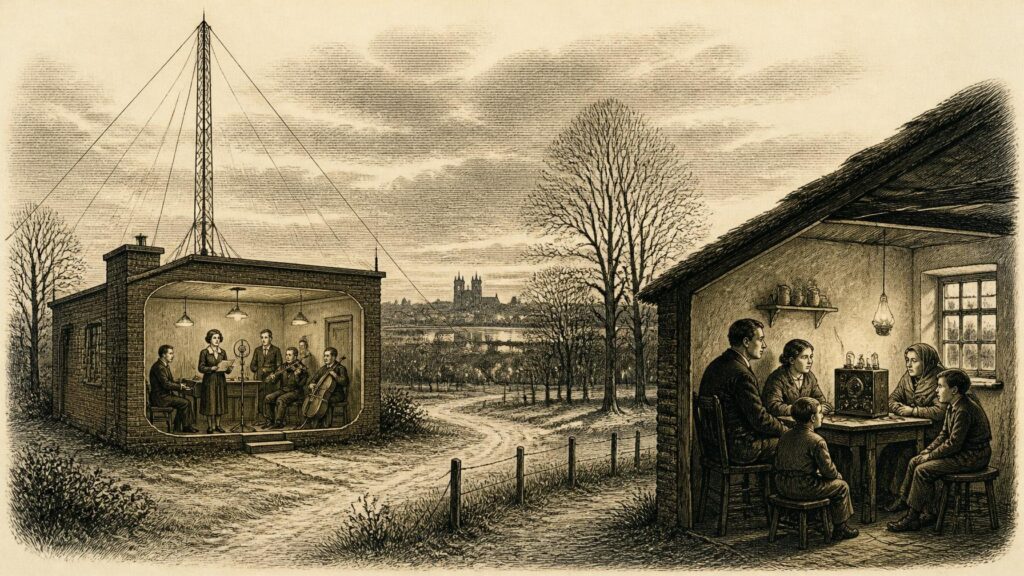
AI generated historical illustration, not a contemporary photograph.
At a Glance
When 2RN began broadcasting from Dublin on 1 January 1926, it gave the young Irish Free State a new instrument of public address. Its centenary is therefore not simply an anniversary in media history. It is an occasion to examine how sound, and later television, helped make a national audience; how that audience remained divided by class, geography, language and politics; and how a broadcaster created by the State gradually acquired a more complicated public identity as Raidió Teilifís Éireann.
Centenary Meaning
The label “RTÉ centenary” needs a little care. RTÉ, in the legal and corporate sense, did not exist in 1926. The service that commenced then was 2RN, a Dublin radio station operated through the Department of Posts and Telegraphs. The statutory Radio Éireann Authority was created by the Broadcasting Authority Act 1960; television began in 1961; and the organisation acquired the name Raidió Teilifís Éireann through later legislation. Yet the institutional lineage is real and continuous enough for the broadcaster to mark 2026 as one hundred years of public broadcasting in Ireland. RTÉ itself describes 2RN as its precursor, identifying the inaugural transmission at 7.45pm on 1 January 1926 as the beginning of that public-service tradition.
That distinction matters because anniversaries tend to compress the past into a reassuring origin story. There was no empty silence before 2RN. Wireless enthusiasts, engineers and amateur operators had already experimented on the island, while Irish listeners could receive stations from Britain and continental Europe. Stephanie Rains’s research argues that 2RN entered, rather than created, a technical and cultural radio world. Its particular novelty was official status: it was the first broadcasting service established by the independent State, and it brought the medium into a project of national administration and cultural definition. Rains’s study is useful precisely because it prevents the centenary from becoming a claim that Irish people first encountered radio in 1926.
Nor should the centenary be treated as proof that broadcasting naturally produced consensus. The history of 2RN, Radio Éireann, Telefís Éireann and RTÉ contains ambitious cultural work, memorable journalism, sport, drama, music and public information. It also contains uneven reception, official influence, restrictive legislation and recurring disputes about funding, taste, impartiality and political speech. The strongest historical account is neither celebratory nor dismissive. It recognises that a national broadcaster can be both an important shared institution and a site where the limits of national belonging become audible.
Wireless Beginnings
The setting was a State only a few years old. The Civil War had ended in 1923; the institutions of the Irish Free State were being assembled; and the Department of Posts and Telegraphs was responsible for an expanding communications system. Radio promised an immediate connection between a central authority and dispersed listeners, but the early service possessed neither the reach nor the resources later implied by the word “national”. Its first premises were modest: studio and office accommodation at 36 Little Denmark Street, Dublin, with a 1.5-kilowatt Marconi transmitter in a hut at McKee Barracks beside the Phoenix Park. The official archival description gives the wavelength as 390 metres.
At 7.45pm on New Year’s Day, Séamus Hughes made the opening announcement in Irish and English: the Dublin Broadcasting Station was calling. Douglas Hyde then formally opened the service. Hyde was a founder of the Gaelic League and would later become Ireland’s first President; his presence joined broadcasting to the cultural revival and to the prestige of Irish-language advocacy. The opening programme included the Army No. 1 Band, singers, musicians and the Palestrina Choir. Later recollections by performers convey nerves, cramped conditions and the novelty of playing to unseen listeners rather than a visible audience. They are valuable testimony, but they are retrospective memories, not a complete account of the event.
The call sign 2RN has acquired an attractive folklore. It has often been explained as a sound-alike for the final words of Thomas Moore’s “Come Back to Erin”. RTÉ’s archive says it was thought to have been inspired by those syllables, while noting that the call sign originated with the British Post Office, then the relevant authority. That phrasing should be preserved. The association is plausible and long repeated, but the archival language stops short of treating it as an uncontested official naming decision. The more certain point is that international wireless regulation still bore the marks of the political and technical arrangements inherited from the pre-independence period.
State Service
2RN began before the main legislative framework governing Irish broadcasting had been enacted. The Wireless Telegraphy Act 1926, passed on 24 December 1926, explicitly authorised the Minister for Posts and Telegraphs to establish, maintain and operate broadcasting stations. It also placed receiving apparatus within a licensing system. In the language of the Act, “broadcast matter” included lectures, speeches, news, reports, advertisements, recitations, drama, music and other sounds approved as suitable for transmission. The breadth of that definition shows that the State conceived broadcasting from the outset as more than technical communication: it was a means of circulating culture, information and public speech.
Control was correspondingly direct. For the first three and a half decades of Irish broadcasting, the radio service remained under ministerial responsibility and its staff were civil servants. This was not an aberration hidden by later autonomy; it was the original constitutional arrangement. The 1926 Act vested the Minister with discretion concerning stations and the material they would transmit. A 1981 Oireachtas committee report later summarised the position bluntly: the 1926 legislation supplied the framework until 1960 and broadcasting services were controlled by the Minister for Posts and Telegraphs.
That arrangement helps explain an enduring tension in Irish broadcasting history. A publicly owned service could claim a duty to serve the whole country rather than a single commercial market. It could make space for education, agriculture, Irish-language material, minority interests and cultural performance. But ownership by the State also made it difficult to draw a clear line between public service and government influence. Later reforms altered the legal machinery, but they did not abolish the argument. Throughout the century, the question has returned in different forms: who pays for broadcasting, who appoints its governors, who defines its public purpose, and how independent can an organisation be when it is charged with representing a nation?
Limited Reach
The phrase “national station” was initially aspirational. A 1.5-kilowatt transmitter in Dublin could not reliably cover all parts of the Free State, and reception depended on equipment that was costly and often difficult to use. Crystal sets were cheaper, but weak signals and rural circumstances frequently made valve receivers necessary. Before rural electrification, batteries required charging and maintenance. The historian of early agricultural broadcasting has noted the sharp imbalance this produced: in mid-1945, an estimated 45 per cent of urban households had wireless sets, compared with 13 per cent of rural households. Such figures caution against imagining the first decades as an equally shared national listening experience.
The early schedule nonetheless indicates what broadcasters hoped radio might do. Music was indispensable because it filled airtime effectively and showcased performers; talks offered instruction and public information; sport supplied event and excitement. In April 1926, 2RN carried talks about the first census conducted under the Free State, explaining why the return mattered and how it should be completed. The surviving listings and announcers’ reports in RTÉ’s archive establish that the new medium was being used for practical civic communication within months of its launch. It was not merely entertainment, though entertainment was essential to attracting listeners.
Sport provided another early demonstration of radio’s ability to turn an event in one place into a collective experience elsewhere. RTÉ’s archival exhibition dates a live commentary by P. D. “Carbery” Mehigan on the 1926 All-Ireland hurling final at Croke Park to 29 August 1926, describing it as the first live commentary on a field game in Europe. The superlative should be treated as the broadcaster’s archival claim rather than as a fact requiring no qualification, but the larger significance is secure. Gaelic games became an enduring part of public-service broadcasting, creating a shared vocabulary of place, rivalry and performance long before television multiplied sport’s visual drama.
Athlone Power
The decisive early expansion came with the high-power transmitter at Athlone. Installed for the 1932 Eucharistic Congress, it operated at 60 kilowatts and was later increased to 100 kilowatts. The Congress was an immense public and religious occasion in interwar Ireland, and the new transmitter enabled 2RN to cover it on a scale impossible from the original Dublin operation. RTÉ’s history describes the transmission as the largest event broadcast during the service’s early years; listeners heard John McCormack at High Mass, while relays carried the event beyond Ireland. More than 30,000 licences had been issued in the Free State by then.
In material terms, Athlone made a stronger claim to national coverage. In symbolic terms, it relocated the transmitter from the capital to a central site and placed Ireland on the radio dial among other European stations. The Irish Architectural Archive describes the building as the country’s first high-power transmitting station and notes that the two 300-foot aerial towers enabled reception at far greater distances. It further records Éamon de Valera’s 1933 description of the station as a bridge between people in Ireland and emigrant Irish people. That image was political rhetoric, but it captures a real aspiration: wireless could make the State’s voice travel across county, sea and diaspora.
The transition was not frictionless. Richard Pine’s detailed history records that when the Dublin transmitter was closed after Athlone’s official opening, crystal-set owners in the capital found the new signal unsatisfactory and 2RN had to be restored. This small episode is historically revealing. “National” infrastructure does not simply replace local infrastructure; it creates new inequalities and practical objections. The station’s changing popular names—2RN, Radio Athlone, and increasingly Radio Éireann—therefore reflected technical as well as institutional development. A stronger transmitter helped make the service more widely heard, but it did not eliminate the importance of particular local conditions.
Cultural Mission
Irish broadcasting was formed amid a strong official interest in language and national culture. The service carried Irish music, Irish-language programmes, religious content, talks and coverage of Gaelic games, alongside imported material and forms shaped by British broadcasting. It would be simplistic to call this merely propaganda, just as it would be inaccurate to treat it as a politically neutral cultural commons. Programming made choices about what sounded representative, respectable or educative. Those choices were intertwined with the cultural ideals of the new State and with the practical challenge of producing enough material for a regular schedule.
Seamus Clandillon, the first station director, is particularly associated with an Irish-language and musical mission. Yet the service had to work with restricted finance, a small staff and limited production capacity. RTÉ’s fiftieth-anniversary retrospective recalled that the early broadcasters tried to provide something for a broad public and struggled with the danger of trying to please too many people too often. That is retrospective interpretation, made in 1976 rather than 1926, but it accurately identifies a structural problem familiar to public broadcasting: a single service must reconcile competing expectations of instruction, entertainment, artistic ambition, commercial appeal and representation.
The cultural mission should not be confused with cultural uniformity. Listeners brought their own tastes, and reception from British stations remained important. Cities, rural districts, Irish-speaking communities, emigrants and households with no wireless set did not experience radio in the same way. Scholarly work on Irish-speaking society argues that the Athlone transmitter made radio a more effective vehicle for the State’s cultural policy, but it also situates that policy amid a much wider European pattern in which broadcasting and nationhood were closely connected. The Irish case was distinctive, not isolated.
Everyday Voices
Radio’s history is often told through directors, legislation and famous announcers. Its social history is also found in domestic routines: a set powered by a wet battery; a family arranging its evening around a match; a farmer listening for information; musicians entering a studio whose audience they could not see. These details are not trivial decoration. They explain why broadcasting became intimate. The voice from a studio entered kitchens, public houses, shops and communal spaces without requiring the listener to travel, purchase a ticket or read a newspaper.
That intimacy had practical consequences. Agricultural broadcasts are a useful example. Departments initially supplied officials to speak on 2RN, but the producers soon discovered that expertise alone did not make successful radio. A speaker had to communicate in a manner suited to listening. The shift towards broadcasters with greater presentational skill is an early indication that radio was developing its own craft. It also shows the service negotiating two identities at once: an arm of public information and a medium that needed to hold attention.
Archival recordings are indispensable for recovering this world, but they need careful handling. Surviving recordings preserve voices, accents and performance styles, yet survival is selective. Much early output was not recorded, and what later generations hear may be shaped by anniversary compilations, curatorial choices and the technical quality of preservation. RTÉ’s archive makes exceptional material publicly accessible, including Hyde’s opening address and later memories of the first night. Such evidence can bring the past close. It cannot, by itself, tell us exactly how every listener understood it.
Television Arrival
The Broadcasting Authority Act 1960 marked a major structural change. It established the Radio Éireann Authority, transferring responsibility for existing radio services from direct departmental control and charging the new authority with establishing television. The legislation’s cultural language was explicit: the authority was to keep in mind the national aims of restoring Irish and preserving and developing national culture. The creation of a statutory corporation did not make the broadcaster wholly detached from the State, but it did replace the older departmental form with a body possessing a distinct legal existence.
Telefís Éireann commenced at 7.00pm on 31 December 1961. President Éamon de Valera made the first address, speaking in Irish and English and expressing both hope and caution about the new medium’s power. The opening programme included a benediction and an address by Cardinal D’Alton, reminders of the prominent public position of the Catholic Church in Ireland at the time. The date, New Year’s Eve, is now one of the familiar landmarks of modern Irish cultural history, but the opening was not a simple rupture. Television inherited radio’s public-service ambitions, staffing traditions and relationship with the State while adding a much more powerful visual medium.
Television changed the meaning of national visibility. Radio had made it possible to hear political leaders, sports commentators, musicians and ordinary contributors. Television made performance, ceremony, urban life and political authority visible in domestic space. It helped establish common reference points, from national occasions to entertainment formats. Yet television also intensified concern about imported culture and commercial pressure. De Valera’s apprehension was not unusual: across Europe, television was greeted as an educational possibility and a possible threat to cultural autonomy. In Ireland, those concerns acquired special force because language revival and cultural distinctiveness had been written into broadcasting’s statutory mission.
Corporate Change
The name RTÉ emerged from this convergence of radio and television. The 1960 Act established Radio Éireann as the authority; the Broadcasting Authority (Amendment) Act 1966 changed the authority’s name to Raidió Teilifís Éireann. The 2009 Broadcasting Act later recast the governing structure as the RTÉ Board while maintaining the corporate continuity of the organisation. These legal details can seem remote from programmes, but they are fundamental to historical accuracy. To say that “RTÉ began in 1926” is useful shorthand only if it is understood as a claim about institutional ancestry, not an assertion that the 1926 station possessed the 1966 name or the later corporation’s exact legal form.
Corporate change also altered expectations. As radio and television grew, RTÉ became not merely a transmitter of centrally produced material but a commissioner, employer, archive-holder, cultural patron and major participant in Ireland’s creative economy. The old assumption that a single national service could cater for a broad population was increasingly tested by changing demographics, greater prosperity, youth culture, international media and demands for regional and linguistic representation. A public broadcaster could no longer define “the audience” as a single homogeneous body, if it ever truly could.
Funding remained a persistent issue. Licence-fee income expressed the idea that broadcasting was a collective public utility, while advertising and commercial revenue brought different imperatives. An Oireachtas report in 1981 noted that government policy under both the 1926 and 1960 frameworks had consistently been that broadcasting should be financially self-supporting. That principle made RTÉ distinctive from a wholly tax-funded department, but it also ensured continuing tension between public obligations and the search for revenue. The tension has survived successive technologies because it concerns governance, not simply transmission.
Censorship Conflict
No centenary account should evade the difficult history of political restriction. Section 31 of the Broadcasting Authority Act 1960 empowered the Minister to direct RTÉ not to broadcast specified matter. During the Troubles, ministerial orders restricted interviews and reports of interviews with spokespeople of particular paramilitary and political organisations. The 1978 order named the IRA, Provisional Sinn Féin, the Ulster Defence Association and organisations proscribed in Northern Ireland under emergency legislation. The wording is preserved in the Oireachtas committee record and should be read as documentary evidence of State policy, not as a neutral editorial decision by broadcasters.
Supporters of the restrictions argued that they were necessary to public order in a period of political violence. Critics, including journalists, argued that they impaired reporting and permitted political authority to shape what the public could hear. The 1981 committee itself recorded journalistic objections while concluding that Section 31 was a necessary contribution to public order. This is a case where historians must distinguish between what an official body concluded at the time and what later readers may judge. The record establishes that the restrictions existed and were defended; it does not end the ethical argument about them.
The episode is central because it reveals the fragility of the phrase “public service”. A broadcaster may be publicly owned, legally chartered and culturally valuable, yet still be constrained in its treatment of urgent political conflict. RTÉ’s later reputation for news and current affairs cannot be understood apart from this inheritance. The history is neither a reason to discard the institution nor a detail to be softened in commemoration. It is evidence that editorial independence requires law, professional practice, public scrutiny and a willingness to remember occasions when those safeguards were inadequate.
Language Service
The Irish language was built into broadcasting’s public purpose long before Raidió na Gaeltachta existed. Early radio used Irish, and the 1960 Act explicitly referred to restoring the language. But intermittent or centrally produced Irish-language broadcasting was not the same as a service rooted in Irish-speaking communities. That distinction lay behind the demand for a dedicated station. Raidió na Gaeltachta began broadcasting from Casla, Connemara, at 3.00pm on Easter Sunday, 2 April 1972. President de Valera’s recorded opening message linked the new service to a much older language-revival aspiration.
The station’s importance was not merely symbolic. It gave Gaeltacht communities a regular platform in their own language, carried local and national material, and connected regions where Irish was spoken in different dialects and circumstances. RTÉ’s later account of the service stresses its origins in public demand and the Gaeltacht civil-rights movement. That is an institutional interpretation, but the historical fact of a separate Irish-language radio service remains significant: it recognised that a national broadcaster’s duty could not be fulfilled solely by adding minority-language items to a predominantly English schedule.
There is a productive tension here. Raidió na Gaeltachta was designed for Gaeltacht listeners, but its audience and cultural significance extended beyond those regions. It was regional and national, local and diasporic, a service defined by language rather than by a single county or city. Its creation complicates any account in which RTÉ simply transmitted culture from Dublin outward. It demonstrates that public broadcasting could also be reorganised when communities argued that central provision did not adequately represent their speech, experience or needs.
Popular Waves
By the 1970s, the older single-service radio model was under pressure from changing listening habits and from the challenge of offshore and pirate broadcasters. RTÉ Radio 2 began broadcasting in May 1979. Its first voice was Brendan Balfe, who introduced Larry Gogan; the first record played was the Boomtown Rats’ “Like Clockwork”. The service was intended to reach a broad audience, including younger listeners, motorists and workers, and it soon became associated with contemporary popular music and new broadcasting personalities. The original Radio Éireann service thereafter became RTÉ Radio 1.
The arrival of Radio 2 was more than a new frequency. It acknowledged that public service could not survive by asking younger audiences to accept a schedule designed around older assumptions of national taste. Its presenters, music and pace represented a shift towards a more informal, commercially alert style. The station was renamed 2FM in 1988 and RTÉ 2FM in 2000, but the underlying question has remained familiar: can a public broadcaster serve popular culture without merely copying commercial competition?
Competition also helped widen the policy debate. The Broadcasting and Wireless Telegraphy Act 1988 prohibited broadcasting in the State unless licensed, reflecting official concern about unlicensed services. Yet the growth of local and commercial radio showed that a national public corporation no longer possessed the same uncontested place in listeners’ lives. Later regulatory developments created a more plural broadcasting landscape. RTÉ remained central, but its authority increasingly depended on the quality and distinctiveness of what it did rather than on scarcity of spectrum alone.
Archive Memory
The centenary has an archival dimension. Broadcasting produces records of voices, events, music, images and vernacular speech that other institutions may not collect in the same form. RTÉ’s archive preserves material from 2RN through later radio and television, allowing listeners and viewers to encounter Hyde’s opening words, early sports commentary, television launches, news reports and the work of performers. Such holdings form part of the historical record of the State, though they remain shaped by the broadcaster’s collecting practices and by copyright, format and preservation constraints.
The University College Dublin archive catalogue for RTÉ radio talk scripts illustrates the scale and complexity of this inheritance. Its administrative history traces the succession from 2RN to Radio Athlone, Radio Éireann, Telefís Éireann and RTÉ, while also showing that institutional history survives in paperwork as well as in sound. Scripts, correspondence, logbooks and production files can reveal intentions that are not audible in surviving broadcasts. Conversely, a recording may show tone, hesitation or performance that a script cannot convey. A reliable history needs both forms of evidence.
Archive material can also generate myths if it is stripped of context. A clip selected for an anniversary may make the past appear inevitable, harmonious or more technically advanced than it was. Historians should ask who made the record, for what purpose, what is missing, and whether later narration has imposed a tidy meaning on a messier event. This is not an argument against commemoration. It is an argument for commemoration that treats recordings as evidence: moving, powerful and incomplete.
Digital Continuity
The most striking change across the century is technological. 2RN began with a small studio, a transmitter and receivers that many households could not afford or operate easily. RTÉ now exists across radio, television, online publishing, streaming, social platforms and digital archives. The Broadcasting Act 2009 framed a modern statutory environment for broadcasting and public-service content, while subsequent media regulation has addressed audiovisual and on-demand services. Technology has expanded distribution, but it has not made the old questions obsolete. It has instead made them more difficult: what counts as a public audience when programmes circulate globally and audiences choose from limitless material?
There is a temptation to describe this as a straight line from weak signals to digital abundance. The historical record suggests a less simple continuity. Every phase brought an apparent solution and a new problem. Athlone extended range but did not guarantee equal reception. Television created common viewing but raised fears about cultural influence. statutory independence reduced direct departmental control but did not extinguish political controversy. Dedicated language broadcasting remedied one form of under-representation while requiring continuing resources and public commitment. Digital distribution preserves material and fragments attention at the same time.
The centenary therefore invites restraint as well as pride. RTÉ’s history cannot be reduced to a story of technical progress, national self-expression or institutional failure. It is the history of an organisation continually asked to serve a public that has never been singular. Its best achievements have come when it recognised that complexity: when it informed without condescension, recorded lives outside the centres of power, made room for Irish and English, regional and national experience, and treated popular culture as part of public life rather than its opposite.
Lasting Questions
What, then, began on 1 January 1926? Documented evidence supports a precise answer. A new Irish radio service, 2RN, went on air from Dublin at 7.45pm, opened by Douglas Hyde and operated within the developing communications apparatus of the Free State. It was not yet RTÉ in name or legal structure; it was not the first manifestation of radio activity in Ireland; and it did not instantly reach or represent every household. But it began an enduring public-broadcasting lineage.
Interpretation takes us further. 2RN supplied an acoustic form to state-building: an official voice, a stage for music and language, and a new means by which public occasions could be experienced beyond their immediate location. Its successors enlarged that role, sometimes admirably and sometimes controversially. Radio and television did not create Irish identity, which was and remains plural, contested and older than either medium. They did, however, help furnish the sounds and images through which many people encountered arguments about Ireland and heard other Irish people speak.
Folklore belongs in the story too, provided it is named as such. The affectionate explanation of 2RN as “to Erin” captures the desire to find national poetry in a technical call sign. The more prosaic evidence of international allocation and Post Office administration complicates it without making it worthless. A century after the first broadcast, that mixture of aspiration and apparatus remains an apt emblem. Irish public broadcasting has always been both: a set of transmitters, statutes, studios and budgets; and an imaginative claim that a dispersed people might, for a while, listen together.
