Protest Traditions
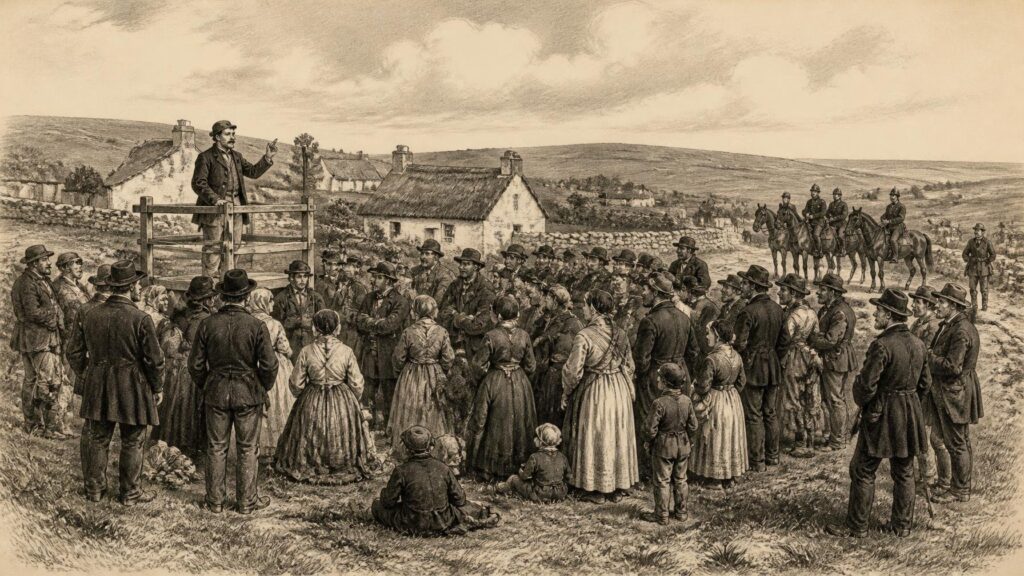
AI generated historical illustration, not a contemporary photograph.
At a Glance
Irish protest has never been one continuous movement with one social base, one objective or one political meaning. It has instead been a changing repertoire through which people with unequal resources made claims: tenants contested rents and evictions, workers resisted employers, women demanded political citizenship, communities challenged discrimination, and campaigners brought questions of bodily autonomy and public provision into the streets and eventually into the ballot box. The record is rich, but it is not simple. Demonstrations could be peaceful and disciplined, clandestine and coercive, locally defensive or nationally transformative. Later memory often compresses those differences.
Public Dissent
“Irish protests” is an expansive subject rather than a single event. It includes petitions and delegations, crowded public meetings, electoral mobilisation, rent strikes, boycotts, picketing, processions, hunger strikes, occupations, road blockades and referendum campaigns. Some actions were openly lawful; others challenged law directly; still others combined respectable public language with intimidation or violence. A historical account must therefore resist two temptations. The first is to make all protest a prelude to independence. The second is to represent every popular action as spontaneous. Irish people repeatedly used inherited customs, institutions, newspapers, churches, unions, voluntary associations and, later, mass media to organise dissent.
The archive itself shapes what can be known. Governments and police generated abundant records when they perceived danger, while newspapers recorded speeches, arrests and spectacular crowds. Those sources can preserve the viewpoint of officials more fully than that of tenants, women, labourers or unemployed people. Pamphlets, private correspondence, organisational minute books, photographs, oral testimony and local studies correct that imbalance, but unevenly. The evidence is strongest for major movements with formal leaders and printed programmes. It is thinner for anonymous rural combinations, informal women’s work, short-lived local protests and acts that left no written trace.
For that reason, this history treats “protest” as a method rather than a moral label. It asks who acted, what they sought, how they organised, and what consequences followed. It also separates documented evidence from interpretation. We can document, for example, that governments prohibited meetings, arrested organisers and altered law under pressure. It is more difficult to prove that one crowd or one campaign alone produced a political change. Folklore has its place as evidence of memory and meaning, but it cannot automatically settle disputed facts about numbers, motives or turning points.
Rural Resistance
Long before the era of modern parties and public relations, rural Ireland contained recurring forms of agrarian resistance. From the eighteenth century into the early twentieth, groups known by names such as Whiteboys, Rightboys, Rockites, Ribbonmen, Terry Alts and Molly Maguires appeared in different districts and circumstances. Their members were not a single organisation marching steadily through history. Names travelled, were revived and were sometimes imposed by magistrates or newspapers. Yet the recurring issues are clear: access to land, rents, tithes, grazing, labour conditions, debt and the survival of smallholders and labourers in a deeply unequal rural economy.
These movements often acted at night, using disguise, warning notices, attacks on property, assaults and threats. Such tactics made individual identification difficult and projected collective authority. They could also be cruel. The historical record offers no warrant for romanticising coercion merely because its targets included landlords, agents, graziers or tithe collectors. At the same time, official descriptions of “outrage” tended to treat rural violence as simple criminality, obscuring the economic conflicts behind it. Historians have consequently debated whether agrarian secret societies should be understood chiefly as communal defence, class conflict, political disaffection, customary regulation or a mixture of all four.
One useful distinction is between a protest movement’s language and its actual local practice. Notices might claim to speak for “the people” or a moral economy of fair dealing, while specific disputes could concern a neighbour’s farm, a labourer’s wage, a disputed grazing right or personal rivalry. The European Social Science History Ireland guide to agrarian protest emphasises both the extraordinary recurrence of such movements and the disagreement among historians about their motives. That caution is essential. Rural resistance expressed real structural hardship, but it did not erase divisions of gender, occupation, locality, religion or property within rural communities.
Constitutional Campaigns
Daniel O’Connell transformed the possibilities of open mass politics. His Catholic Association, established in 1823, made participation affordable through the “Catholic rent”, a small regular subscription. The organisation linked parish-level activity to national leadership, used newspapers and meetings, and made the exclusion of Catholics from parliament a question that could be publicly and repeatedly pressed. The campaign did not create Irish political participation from nothing. It did, however, demonstrate how disciplined organisation, legal pressure and electoral calculation could turn dispersed grievances into a formidable public force.
O’Connell’s successful election for County Clare in 1828 made the constitutional crisis acute, although as a Catholic he could not then take his seat under existing law. Catholic Emancipation followed in 1829. The achievement was qualified by the simultaneous disfranchisement of many poorer voters through a raised property threshold. This was a reminder that constitutional victories could redistribute political power as well as extend it. O’Connell’s politics depended upon great popular mobilisation, but the nineteenth-century franchise remained sharply restricted and was not equivalent to modern democracy.
His later Repeal campaign demonstrated the scale, theatre and discipline of nineteenth-century public protest. The “monster meetings” of 1843, held at sites carrying historical resonance, were carefully staged expressions of support for repealing the Act of Union. Contemporary and later estimates of their attendance can be unreliable, and dramatic figures should not be repeated as if they were precise counts. What is securely established is that the meetings drew exceptionally large crowds and alarmed the British administration. The National Library’s O’Connell collections and the Dictionary of Irish Biography document the organisational importance of these gatherings.
The proposed Clontarf meeting of 8 October 1843 revealed both the strength and constraint of constitutional mass action. The government proclaimed the meeting and deployed military force. O’Connell cancelled it rather than risk bloodshed. Supporters could see prudence and moral authority in that choice; critics could see the limits of a campaign that avoided direct confrontation. Either way, the episode taught an enduring lesson: public assembly is a claim to political legitimacy, but states can regulate, prohibit or militarise the space in which it takes place.
Famine Protest
The Great Famine is sometimes portrayed as a period of stunned passivity. That interpretation is incomplete. Starvation, disease, eviction and migration placed immense limits on collective action, while relief systems and policing structured the choices open to poor people. Yet food protests, attacks on provisions and continuing agrarian activity did occur, especially as prices rose and shortages intensified. James Kelly’s work on food riots stresses that the late 1840s saw an intense period of food protest rather than an absence of popular resistance.
Food riots were not necessarily attempts to overthrow government. In many societies they followed a recognisable logic: crowds challenged dealers, merchants or authorities whom they believed were failing in obligations to provide food at a tolerable price. Actions could involve seizing grain or meal, stopping exports, forcing sales, or demanding supplies. Such episodes were often local and temporary, and the surviving evidence frequently comes from official reports written after the fact. The motivations of every participant cannot be recovered. Nevertheless, they show that famine victims were not merely objects of policy; some asserted claims upon markets, local authorities and the state.
It would be wrong, however, to turn resistance into consolation. Protest did not prevent the catastrophe or offset the profound imbalance of power between impoverished people and government. Famine-era protest also coexisted with desperate competition over work, relief and resources. The idea that a united people either silently endured or uniformly rebelled is a later simplification. The historical reality was a range of survival strategies under conditions that made sustained organisation extraordinarily difficult.
Land Agitation
The Land War of the late nineteenth century joined local hardship to national political organisation more successfully than earlier agrarian movements had done. Bad harvests, falling agricultural prices and insecurity of tenure created a renewed crisis after 1879. The Irish National Land League grew from tenant-right activism in Mayo into a national campaign associated with Michael Davitt, Charles Stewart Parnell and a wide network of local branches. Its principal programme became memorably compressed into demands for fair rent, fixity of tenure and free sale, though the wider aspiration increasingly became occupier ownership.
Public meetings, newspapers, fundraising, tenants’ defence and electoral pressure made the campaign more than a sequence of isolated rural disputes. The language of “land for the people” supplied a powerful moral frame. So did the famous practice later named after Captain Charles Boycott, the Mayo land agent whose social and economic isolation in 1880 supplied a new word to the English language. Boycotting was effective because it depended upon collective compliance: labourers, shopkeepers, neighbours and transport workers had to refuse ordinary dealings. It was non-cooperation, but it could be backed by formidable local pressure.
The Land League’s history therefore cannot be reduced to peaceful persuasion. The period included evictions, emergency legislation, arrests, imprisonment and much violence, including attacks on people and livestock. Government sources often described an undifferentiated conspiracy; nationalist memory sometimes made all rural militancy an expression of liberation. Both accounts conceal complexity. Some tenants and labourers were active, some were reluctant, some suffered from intimidation, and not every landlord or agent occupied the same social position. The National Library’s 1881 Land League pamphlet, addressed “To the people of Ireland”, illustrates the movement’s confrontational political language, while photographs of evictions preserve the visible drama of conflict.
Land legislation changed the terrain. The Land Law (Ireland) Act 1881 introduced courts that could set judicial rents, while subsequent legislation helped transfer land from landlords to occupiers. Those reforms had several causes: parliamentary bargaining, state fear of disorder, economic change and sustained agitation all mattered. It is most accurate to say that protest was indispensable in making land reform unavoidable, rather than claiming that any one tactic achieved it alone. The long-term result was a major transformation of Irish rural property, though it did not solve every problem of rural poverty or land distribution.
Labour Conflict
Urban industrial protest acquired a distinctive form in the early twentieth century, most dramatically in Dublin during the 1913 Lockout. The dispute arose from employers’ resistance to the Irish Transport and General Workers’ Union, led by James Larkin, and from the union’s effort to organise precarious and badly paid workers. William Martin Murphy’s tramway company became a focal point, but the struggle rapidly widened as employers coordinated against the union. Workers were locked out, strikes spread and thousands of families endured deprivation over months.
The Lockout was not simply a contest between two famous men. Its scale rested on tramway workers, dockers, carters, women workers, organisers, families and relief networks. Liberty Hall served as a practical and symbolic centre. The dispute revealed how industrial power was embedded in everyday life: transport, food, rent, childcare and the ability to remain employed. Relief kitchens and solidarity collections were not peripheral humanitarian details; they were essential to sustaining resistance when employers used exclusion from work as their central weapon.
Police conduct became a major political issue. On what became known as “Bloody Sunday”, 31 August 1913, Dublin Metropolitan Police baton-charged crowds in the city centre. The National Archives’ census exhibition records the deterioration in relations between police and sections of the public, including deaths in the wider violence. Accounts differ in emphasis, but the episode became an enduring example of how state policing can alter sympathy during an industrial dispute. Images and newspaper reports gave the conflict an audience well beyond the workplace.
The effort to send some workers’ children temporarily to supporters in Britain produced another revealing conflict. Catholic clerical opposition, fears about religious influence and contested claims about parental authority led to confrontations at stations and ports. This episode complicates the usual picture of a straightforward contest between labour and capital. Religion, family, respectability and nationalism all affected the struggle. By January 1914 the Lockout ended without the decisive union victory that supporters had hoped for, and the union’s membership suffered heavily. Yet its importance was not confined to immediate industrial gains or losses. It entered political memory as a founding episode of Irish labour, urban poverty and civic protest.
Women Mobilise
Women’s protest in Ireland was neither an auxiliary to male nationalism nor a single feminist campaign. It included charitable and labour activity, nationalist activism, anti-war work, trade union organising, demands for suffrage and later campaigns around family law and reproductive rights. The archive has often preserved public male leadership more readily than women’s organising. Nonetheless, the papers of Hanna Sheehy Skeffington and other activists demonstrate sustained, strategic work by women who insisted that political freedom without women’s citizenship was incomplete.
The Irish Women’s Franchise League, founded in 1908 by Hanna Sheehy Skeffington and Margaret Cousins, adopted a more militant approach than earlier constitutional suffrage bodies. In 1912, members broke windows at sites including Dublin Castle, the General Post Office and the Custom House after Irish parliamentary representatives failed to support women’s suffrage. Arrest, imprisonment and hunger strike brought visibility, but also exposed activists to punitive state practices. The National Library’s Sheehy Skeffington papers preserve material evidence of this campaign rather than relying solely on its later commemoration.
Militancy should not obscure other methods. Suffragists lectured, petitioned, published newspapers, organised meetings and forged alliances. Nor were women politically homogeneous. Some prioritised Home Rule, some unionism, some labour, some nationalism and some suffrage before all else. During the 1913 Lockout, women of the Irish Women’s Franchise League worked alongside the Irish Women Workers’ Union in relief efforts. Such cooperation mattered, but it did not dissolve differences of class or political purpose.
The extension of voting rights after the First World War was a major advance, though it was initially unequal. The 1918 settlement enfranchised women on a more limited basis than men, while the 1922 Constitution provided adult suffrage from the age of twenty-one. It is misleading to treat this as a gift bestowed by legislators alone. International change, wartime politics and constitutional reform were all important, but sustained suffrage agitation made exclusion increasingly difficult to defend. The history also cautions against assuming that formal enfranchisement settled women’s equality. Legal, economic and social power remained contested long afterwards.
War Resistance
Not all significant protest in revolutionary Ireland took the form of armed insurrection. The anti-conscription campaign of 1918 was a striking instance of broad, public and largely non-violent mobilisation. When the British government sought to extend compulsory military service to Ireland during the First World War, nationalists, labour organisations, the Catholic hierarchy and women’s groups built an unusual alliance. Demonstrations occurred across the country, and an anti-conscription pledge was widely signed.
The campaign’s strength lay in the way it made conscription a question of collective consent. It linked domestic political grievances to a war in which many Irish people had already served, while insisting that compulsion would be unacceptable. A one-day general strike on 23 April 1918 demonstrated labour’s capacity to halt ordinary activity. Its effectiveness depended not only on workers but on voluntary compliance across towns and rural districts. The strike was an act of political protest, not merely an industrial dispute.
It would be too simple to say that the campaign alone stopped conscription. The war’s changing military and political circumstances mattered, as did British calculations about the practicality of enforcement. Yet the scale of opposition made implementation perilous. The Houses of the Oireachtas’ historical material records both the cross-party committee behind the pledge and support from women’s organisations. The episode became an important precedent for later claims that mass non-cooperation could defeat policies perceived as externally imposed.
Revolutionary Streets
The years from 1916 to 1923 present a difficult boundary problem. The Easter Rising, War of Independence and Civil War involved armed conflict, clandestine organisation and state violence; they cannot simply be assimilated to ordinary protest. Yet public demonstration, prison protest, funerals, strikes and consumer boycotts were integral to the changing political environment. The National Archives’ Decade of Centenaries collections show the breadth of material produced by surveillance, courts martial, compensation claims and administration during these years.
The 1916 Rising itself had limited popular support at its outset and was militarily defeated within a week. Its subsequent political significance was shaped partly by the British authorities’ response, particularly the executions of leaders and the treatment of prisoners. Public opinion did not move in one instant or in one direction, and historians rightly reject tidy conversion stories. Still, the combination of mourning, anger, organisational work and the changing context of war helped create a wider constituency for separatist politics.
Strikes and boycotts offered ways for people who were not combatants to participate in political conflict. Railway workers’ refusal in 1920 to carry British military goods and the wider use of Dáil courts and social ostracism expressed competing claims to authority. Such acts could be framed as civil resistance, but they also operated in an atmosphere where armed coercion existed. Acknowledging that context prevents an overly benign account of “the people” withdrawing consent. Protest and revolutionary power were often entangled.
The Civil War further demonstrates the danger of treating all public mobilisation as democratic expression. Women’s peace initiatives and anti-government demonstrations sought to restrain violence, while both treaty supporters and opponents used public symbolism and pressure. The destruction of the Public Record Office in 1922, during fighting at the Four Courts, was a cultural catastrophe that impoverished the historical archive itself. The decade’s legacy is therefore not only one of national foundation but of contested legitimacy, coercion and irrecoverable loss.
Northern Rights
In Northern Ireland, civil-rights protest emerged from specific grievances concerning housing allocation, local government franchise arrangements, electoral boundaries, employment and policing. It must not be described merely as an import of the United States civil-rights movement, though international imagery and tactics mattered. The Campaign for Social Justice, the Derry Housing Action Committee, the Northern Ireland Civil Rights Association and student activists developed their own response to local structures of inequality and political exclusion.
The Cameron Report recorded the immediate background to the 1968 disturbances, including Austin Currie’s protest against housing allocation in Caledon and the subsequent march from Coalisland to Dungannon. It also documented the Derry march of 5 October 1968. The Royal Ulster Constabulary stopped and baton-charged protesters; filmed images brought the events to a far wider audience. Estimates of crowd size and assessments of responsibility have varied, but there is no serious doubt that the policing of the march became a decisive political event.
The language of civil rights was deliberately broad. NICRA demanded reforms including fairer electoral arrangements, an end to discrimination in housing and employment, and changes to policing. Its supporters included people with different constitutional aspirations, while opponents feared that reform demands concealed a challenge to Northern Ireland’s place in the United Kingdom. The movement’s non-sectarian claims were genuine elements of its public programme, but the surrounding political environment was already profoundly divided. Counter-demonstrations, bans and attacks raised the stakes.
Interpretation remains contentious because later violence transformed the meaning of the early marches. Some accounts overstate the capacity of civil-rights organisers to control events; others treat later conflict as inevitable from the beginning. The Cameron Report itself recognised longstanding social, economic and political tensions while also criticised weaknesses in the organisation and control of particular demonstrations. The more defensible conclusion is that civil-rights protest exposed real inequalities and a crisis of legitimacy, but did so in a setting where sectarian distrust, state force, loyalist mobilisation, republican strategy and British policy made escalation possible rather than predetermined.
Prison Protest
Prison protest has had particular force in modern Irish political history because imprisonment turns the body into the last available site of resistance. Hunger strikes occurred in several periods, including suffrage campaigns, revolutionary imprisonment and the conflict in Northern Ireland. They have attracted intense public emotion precisely because they make state custody, individual agency and mortality visible at once. They should therefore be treated with care rather than as symbols detached from their circumstances.
During the revolutionary period, prisoners protested for political status and against prison conditions. In Northern Ireland after 1969, the withdrawal of special-category status for paramilitary prisoners in 1976 led to the blanket protest, the dirty protest and, ultimately, the 1980 and 1981 hunger strikes. These actions were connected to a wider conflict, not separable humanitarian episodes. The prisoners’ demands, the British government’s refusal to concede political status, family campaigns, electoral interventions and public demonstrations all shaped their impact.
The deaths of ten prisoners in 1981, including Bobby Sands, intensified political mobilisation in Ireland and internationally. Sands’s election as MP for Fermanagh and South Tyrone while on hunger strike was a constitutional event produced by protest conditions. Yet it would be historically irresponsible to present the hunger strikes as producing a single agreed legacy. They deepened support for republican politics in some communities, caused profound grief, and hardened opposition elsewhere. They also remain inseparable from the wider human cost of the Troubles.
Social Campaigns
From the later twentieth century, protest in the Republic increasingly addressed questions that could not be contained within the older language of nation, land or industrial class. Housing, poverty, equality, sexuality, violence against women, Church–state relations, environmental protection and reproductive rights became subjects of public mobilisation. Older methods persisted: marches, petitions, meetings, occupations and lobbying. But campaigners also benefited from new media, professional advocacy organisations and a political system in which constitutional referendums could turn social debate into a national vote.
The marriage-equality referendum of 22 May 2015 illustrates the relationship between street-level campaigning and formal constitutional politics. It originated in a long LGBT rights campaign and followed a Constitutional Convention process. UCD research by David M. Farrell and colleagues stresses the unusual intensity of the campaign and the significance of door-to-door canvassing for turnout. The referendum did not arise from protest alone, but activist networks helped shift public conversation, make personal testimony visible and persuade political institutions to act.
The campaign to repeal the Eighth Amendment similarly combined decades of advocacy, legal argument, public testimony, international attention and marches. The 2018 referendum followed the Citizens’ Assembly and Oireachtas deliberation, but it also reflected a transformation in public willingness to discuss abortion, pregnancy and medical care. To treat the vote as evidence that protest suddenly changed Ireland would be misleading. The campaign’s success rested on long preparation and on the work of people whose experiences had previously been marginalised or silenced.
These campaigns challenge a persistent myth that Irish public protest is chiefly nationalist or male. Their most visible moments were large marches, but their effectiveness depended equally upon patient local organising, support services, storytelling, legal expertise and electoral participation. They also show that protest can seek not only resistance to state power but affirmative changes in law and social recognition.
Water Resistance
The movement against domestic water charges during the middle years of the 2010s demonstrated the continuing importance of local networks and direct public action. The introduction of metering and charges followed the financial crisis and the State’s international assistance programme. For many opponents, the issue represented austerity, unequal burdens and a fear that water might become privatised. The movement organised national demonstrations, local meetings, non-payment campaigns and protests at meter installations.
Its character was contested from the outset. Supporters described an unusually broad grassroots mobilisation that brought people into political activity for the first time. Government representatives and critics warned about intimidation and obstruction at some locations. Both descriptions can be true in part: a large movement can contain peaceful mass participation, disciplined community organising, partisan competition and incidents that breach acceptable protest. Historical judgement should not use isolated confrontations to erase the movement’s scale, nor use its popular support to excuse threatening behaviour.
Parliamentary debates from the period are themselves evidence of the protest’s political impact, although they are not neutral accounts. Deputies referred repeatedly to widespread demonstrations and resistance to meters, while parties argued over the policy’s fiscal and environmental rationale. The eventual suspension and later abolition of charges reflected electoral change, public pressure and decisions taken inside government and parliament. As with the Land War, it is more credible to identify a convergence of protest and political opportunity than to assign causation to one march or one organisation.
Memory Politics
Public protest produces its own archives of memory: songs, banners, photographs, memorial events, family stories and anniversary speeches. These materials matter because they reveal what later generations chose to inherit. They are not always reliable guides to what happened. “Monster meetings” become impossibly vast; leaders become solitary heroes; crowds become unanimous; defeats become victories in disguise. Such stories can sustain identity, but historians must compare them with contemporary evidence and acknowledge uncertainty where the record is incomplete.
The 1913 Lockout is often remembered through Larkin’s rhetoric, the Land War through heroic tenants, and civil-rights marches through iconic television images. Each is indispensable, yet each may obscure women’s labour, internal disagreement, local variation or the costs borne by families. The same process affects contemporary movements. Photographs of a vast demonstration prove that many people assembled; they do not by themselves reveal how many, why each person attended, or how policy changed afterwards.
There is also a danger in presenting a seamless Irish tradition of non-violent popular resistance. Ireland’s history contains disciplined constitutional agitation and principled civil disobedience, but also intimidation, riots, paramilitary violence and state repression. The point is not to equate all forms of conflict. It is to retain moral and analytical distinctions. A boycott, a strike, a banned march, an armed campaign and an attack on an individual may all be described loosely as “protest”, but they are not historically or ethically identical.
Continuing Repertoires
The enduring lesson of Irish protest history is not that crowds invariably prevail. Many campaigns failed, won only partial concessions, or achieved changes that later proved uneven. Protest works through organisation, communication, alliances and timing; it is also constrained by policing, law, economic dependence, sectarian division, institutional access and the willingness of others to join. Its consequences may be immediate, delayed or primarily cultural. A protest can alter what people think is speakable before it alters a statute.
Across the centuries, certain methods recur. Rural communities practised collective refusal; O’Connell mobilised associations and public meetings; Land Leaguers used boycott and electoral pressure; workers used strike and picket; suffragists turned arrest into publicity; civil-rights activists occupied streets and made discrimination visible; recent campaigns joined marches to canvassing and referendum politics. Continuity lies less in a single ideology than in this repeated effort to convert local experience into a public claim.
That is why the history belongs neither to one party nor to one tradition. It contains constitutional nationalists and revolutionaries, unionists and nationalists, workers and tenants, feminists and religious campaigners, civil-rights organisers, community activists and people whose names never entered the record. Their aims conflicted as often as they converged. To preserve that complexity is not to weaken the history of Irish protest. It is to recognise that dissent has been one of the principal means by which Irish society has argued about power, belonging and justice.