Remembering Ashling
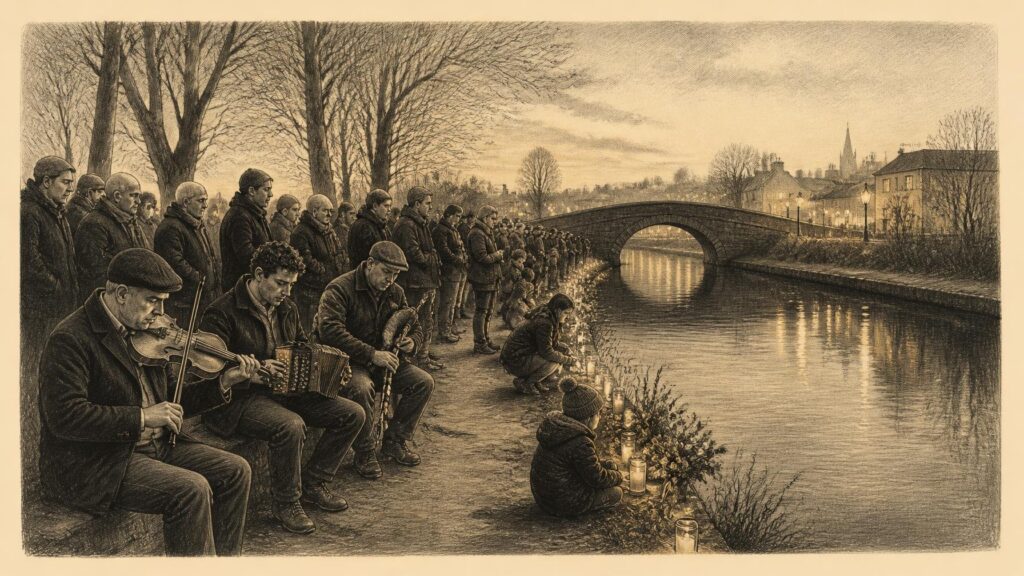
AI generated historical illustration, not a contemporary photograph.
At a Glance
Ashling Murphy’s remembrance belongs to the recent history of Ireland not because public grief can resolve the violence that caused it, but because the ways in which people mourned her reveal much about community, women’s safety, cultural inheritance and the responsibilities attached to national memory. Her death in January 2022 brought an immediate and profound response in Tullamore, across Ireland and among Irish communities abroad. In the years since, vigils, music, walks, school projects, parliamentary discussion and the Ashling Murphy Memorial Fund have created forms of commemoration that seek to preserve the person she was: a young teacher, musician, camogie player, daughter, sister, partner, friend and member of a closely connected Offaly community.
January Loss
On 12 January 2022, Ashling Murphy was killed beside the Grand Canal at Cappincur, near Tullamore in County Offaly. She was twenty-three. The Garda public statement issued six days later identified the location and time of the fatal assault, while subsequent criminal proceedings established the legal responsibility for her murder. In November 2023, Jozef Puška was convicted at the Central Criminal Court and sentenced to life imprisonment. The judicial outcome matters historically because it distinguishes evidence established in court from the understandable but often rapidly circulating speculation that follows a crime of exceptional public attention.
Yet a legal record, indispensable as it is, does not explain the breadth of the response. The loss was felt with particular intensity because Murphy’s life was embedded in ordinary, recognisable institutions of Irish local life. She taught in Scoil Naomh Colmcille, Durrow; she was involved in traditional music; she played camogie; she had family and friends in the Blue Ball, Mountbolus, Kilcormac and Tullamore area. These were not abstract associations adopted after her death. They were the settings in which those who knew her had encountered her abilities, generosity and enthusiasm during her life.
Public accounts from her school, musical community and family remembrance have consistently emphasised these connections. Such testimony should not be treated as a complete biography, and neither should grief turn an individual into an impossible ideal. Nevertheless, it gives a reliable outline of why so many people found ways to mourn through music, sport, teaching and the Irish language. The memorial forms that developed were therefore not merely symbolic responses to a national news event. They grew from pursuits which had been meaningful to Murphy herself.
The date also matters. January 2022 was still marked by the social habits and restrictions of the Covid period, when people had become accustomed to distance, isolation and altered rituals of mourning. Public assembly had resumed but remained shaped by caution. Against that background, the sight of people gathering in parks, on streets, by canal banks, at churches and in community halls carried a particular force. They came not only to express sorrow for a family and town, but to say that the circumstances of Murphy’s death had made many women feel newly visible in their fear, anger and exhaustion.
Local Life
Historical remembrance is strongest when it begins with the ordinary life that a person led, rather than with the event that ended it. Ashling Murphy’s identity in public memory rests partly on the fact that she represented several valued strands of community life at once. She was a newly qualified primary teacher, a committed traditional musician, a participant in sport and a young woman from rural Offaly. Each strand produced its own language of tribute, and together they made her absence palpable across generations.
Teaching was central. In Ireland, the primary teacher has long occupied a distinctive place in local social memory: a professional worker, certainly, but also a figure associated with children, families, school concerts, sport, parish events and the passing on of language and culture. The profession’s importance should not be romanticised; teachers work within demanding systems and diverse communities. Still, the response from pupils, parents and colleagues made clear that Murphy’s vocation was understood as an expression of care and promise. Her funeral included a guard of honour from children connected with her school. This was a deeply affecting public gesture, but it also revealed the difficult reality that a school community had to grieve for its teacher.
Music formed another powerful thread. Murphy played fiddle and concertina, took part in Comhaltas activity, performed and competed, and taught younger musicians. Traditional Irish music is often discussed as heritage, but its everyday existence depends on repeated local practice: lessons, sessions, competitions, family encouragement, branches of Comhaltas, schools and the patient sharing of tunes. It is both a national tradition and a network of personal relationships. When musicians played in her memory, they did not simply select an appropriately Irish sound. They used a form in which Murphy herself had participated.
The same is true of camogie and Gaelic games. In many Irish towns and rural districts, clubs provide a framework through which childhood friendships, voluntary work, seasonal routines and family identity are organised. A jersey or hurley placed among funeral symbols can be read as a conventional emblem, but in this case it also located Murphy in the lived world of team sport. The public remembrance of a young player and teacher drew emotional strength from this recognition: she belonged to particular teams and places, and her life was known in practical detail.
These connections help explain why descriptions of Murphy frequently used words such as talented, kind, lively and generous. Such descriptions are inevitably shaped by bereavement, and historians should acknowledge that mourning produces idealised language. But they are not empty formulae. They were supported by many overlapping circles of acquaintance: family, pupils, colleagues, musicians, fellow players and friends. The historical significance lies less in any single tribute than in the convergence of these independent communities.
Public Mourning
The first days after Murphy’s death saw an extraordinary multiplication of memorial acts. Flowers, candles, handwritten messages, music, walks and silent gatherings appeared in Tullamore and elsewhere. Vigils were held in towns and cities throughout Ireland, while Irish communities in Britain and farther afield also gathered. The scale cannot be measured fully by crowd estimates, photographs or social-media posts. Much remembrance was private: a parent talking to a daughter, a woman reconsidering a familiar route home, a classroom pausing, or a musician playing a tune with friends.
Nevertheless, the visible vigils became important historical evidence of collective feeling. Tullamore Town Park hosted a large gathering on 14 January 2022 in which music, poetry, prayer and silence were interwoven. The choice of form was significant. There was no single authorised language through which Irish people had to grieve. Catholic prayer sat beside secular solidarity; traditional music accompanied political anger; local sorrow became national concern. This mixture reflected the plural character of modern Ireland while retaining recognisable communal rituals.
Music was especially prominent. At the Tullamore vigil, friends played traditional pieces, including music associated with affection, loss and cultural continuity. Elsewhere, musicians gathered in streets, public squares and community venues. The use of live music gave the gatherings a quality different from a purely ceremonial memorial. A tune is repeated but never precisely identical in performance; it permits participation by people who may not have known the deceased personally. For that reason, musical tribute could hold both intimate memory and public solidarity.
Flowers and candles at the canal bank also created what might be called a temporary shrine. Such sites occur after sudden deaths in many societies, but their meanings are variable. They can offer a place to pause when formal institutions feel distant; they can allow strangers to register sympathy; and they can transform an ordinary location into a place of remembrance. The canal path near Tullamore became associated with grief because of what happened there, yet the continuing memorial activity has also attempted to resist allowing the site to be defined only by violence.
Public mourning generated a difficult tension. People wanted to say Murphy’s name, to recognise her family’s loss and to express outrage. At the same time, there was a risk that the attention paid to a single case could reduce her to a symbol. The most durable memorial practices have generally avoided that reduction by foregrounding the activities she loved: children learning music, scholarships supporting education, walks conducted with family involvement, and projects rooted in language, sport and community culture. These do not remove grief, but they refuse to make the manner of death the whole story.
Women Speaking
The public response also became a national conversation about women’s freedom of movement and the burden of precautions that many women describe as routine. In the days after Murphy’s death, women spoke publicly about walking with keys between their fingers, sharing locations, avoiding unlit routes, changing clothing, making calls while travelling, inventing excuses to leave uncomfortable situations and calculating risk in places that men might experience as unremarkable. These accounts did not begin in 2022. What changed was their concentration in a single public moment.
It is important to state the issue carefully. No individual woman’s account can stand as statistical proof of every woman’s experience, and personal safety habits do not determine whether violence will occur. Indeed, one of the central objections made during the public discussion was that attention should not be shifted towards what women ought to do differently. The responsibility for violence rests with perpetrators. The widespread sharing of safety strategies was significant precisely because it illustrated how many women felt compelled to adapt their lives in response to a threat they had not created.
The language of “enough” became common in vigils, placards, speeches and online statements. It was not a detailed programme in itself. Rather, it marked a moral refusal to treat violence against women as inevitable, private or exceptional. In this respect, remembrance of Murphy joined a broader international vocabulary of gender-based violence while remaining distinctly Irish in its locations, institutions and cultural references.
Parliamentary debate recorded this shift with unusual clarity. In January 2022, members of Dáil Éireann and Seanad Éireann expressed condolences to Murphy’s family while discussing women’s safety, domestic abuse, sexual violence, prevention and the behaviour expected of men and boys. Some speakers described how women learn vigilance from a young age; others argued that bystander intervention and education should challenge harassment and misogyny before it becomes more serious harm. These statements should not be mistaken for a unanimous national consensus or for policy results. They do, however, provide a formal record of concerns that had become impossible for political institutions to ignore.
The debate also exposed differences of emphasis. Some called for greater policing, improved lighting or practical safety measures. Others warned that the language of safety could become a way of restricting women rather than changing male behaviour and institutional responses. Some focused on criminal justice; others on housing, refuges, education, social attitudes and support services. These differences were not signs that the public response lacked seriousness. They reflected the fact that violence against women has no single cause and no single remedy.
Historical Context
To place the remembrance of Ashling Murphy in Irish history is not to claim that her death can be neatly explained by the past. History does not provide a simple chain from earlier injustice to one crime. It does, however, show why questions of gender, authority, safety and silence have such depth in Ireland. The State’s history includes the confinement and marginalisation of women and girls in institutions, unequal treatment in law and public culture, and sustained campaigns by women for autonomy, dignity and redress.
Research on historical gendered institutional violence has demonstrated the need to examine not only individual wrongdoing but the systems that made certain harms easier to conceal or normalise. The histories of Magdalene Laundries and Mother and Baby Institutions are not equivalent to contemporary interpersonal violence, nor should they be casually conflated. Their relevance lies elsewhere: they remind us that official respectability has not always protected women, that institutions can fail those in need, and that public language about women’s welfare has often been shaped by power rather than by women’s own voices.
Modern Ireland has changed substantially. Constitutional, legal, social and cultural changes have altered the place of women in public life. Campaigns around reproductive rights, sexual violence, workplace equality and family law have expanded public debate. Yet change is neither complete nor evenly experienced. The memory of Murphy became potent partly because many people recognised a contradiction between an Ireland that presents itself as modern, equal and open, and the continuing reality that women and girls may feel unsafe in homes, workplaces, streets, schools, transport and online spaces.
There is also a history of activism behind the vocabulary used in 2022. Women’s organisations, rape crisis centres, refuges, legal advocates, researchers and survivor groups had worked for decades to name domestic, sexual and gender-based violence as social and political issues rather than private misfortune. Their work created services, collected evidence, challenged myths and pressed governments to act. The public intensity after Murphy’s death did not arise from nowhere; it drew on this longer labour of testimony and organisation.
That longer history cautions against describing January 2022 as a total beginning. It was a watershed for many people, and contemporaries often used that word. But a watershed is not an origin. Ireland already had national strategies, advocacy networks, research projects and legal reforms in development. The event increased urgency and gave public language to experiences that had been insufficiently heard. A responsible historical account must hold both facts together: the moment was transformative in public consciousness, and it was built upon earlier struggle.
Violence Named
The term femicide has increasingly been used in discussion of the killing of women and girls because it directs attention to gendered patterns rather than treating every death as socially identical. In ordinary usage, it refers to the killing of women or girls because they are women or girls, although legal and scholarly definitions vary. Ireland does not have a separate criminal offence labelled femicide. Murder remains murder in Irish criminal law, and the circumstances of individual cases differ profoundly.
For that reason, the term should be used with care. It is not a substitute for evidence about motive in a particular case, and it must never erase the facts established through criminal proceedings. But it can be useful analytically. A 2024 study drawing on homicides referred to the Office of the State Pathologist identified ninety-seven femicides in Ireland between 2012 and 2023 and found that domestic cases comprised a substantial majority. The researchers also stressed that the true scale is obscured by the absence of a dedicated legal definition and complete official statistical framework.
The European Institute for Gender Equality has likewise observed that Ireland’s available data has been shaped by the absence of a specific legal definition and by the division of information across institutions. This does not mean that no information exists. Garda records, court proceedings, health and forensic records, service providers and advocacy organisations all hold different forms of knowledge. It means that assembling a clear national picture is difficult, and that counting alone cannot describe the lived effects on victims, survivors, children, families and communities.
Murphy’s remembrance gave the language of gender-based violence greater public reach. Yet it also highlighted a danger in public discourse: the tendency to divide victims into those whose stories receive national attention and those whose experiences remain less visible. The answer is not to diminish the memory of one young woman. It is to let remembrance widen concern. Public acknowledgement should lead towards attention to all victims and survivors, including those whose cases do not prompt national vigils, whose abuse takes place in private, or whose social position makes them less likely to be believed or heard.
This is one reason that the phrase “violence against women” mattered so much in 2022. It named a broad field of harm without claiming that all circumstances were the same. Domestic abuse, coercive control, sexual violence, stalking, harassment, trafficking, digital abuse and lethal violence require different responses. They may overlap, but no single slogan can replace careful policy, specialist support or survivor-centred justice. Remembrance is valuable when it makes that complexity more visible rather than smoothing it away.
State Response
Within weeks of Murphy’s death, the Government and Oireachtas addressed violence against women in a heightened political atmosphere. The Taoiseach’s Dáil statement in January 2022 described a need for zero tolerance and referred to work then under way on a new whole-of-government strategy. In June 2022, the Government published Zero Tolerance: Ireland’s Third National Strategy on Domestic, Sexual and Gender-Based Violence 2022–2026. Its four pillars were prevention, protection, prosecution and policy co-ordination.
The strategy did not emerge solely as a response to one killing. Its development pre-dated January 2022 and continued earlier national work. That chronology matters because it prevents an inaccurate claim that Murphy’s death simply caused the policy. Still, the national mood following her death was plainly part of the context in which the strategy was received and discussed. The Government presented the plan as a whole-of-society effort, with commitments involving services, education, justice, research, public awareness and administrative co-ordination.
The strategy included plans for increased refuge capacity, a new dedicated agency, improved supports, specialist approaches within the justice system, education on consent and coercive control, and further legislative measures. By later years, implementation plans and progress reports had been published. These are important documentary steps. They show that remembrance can enter the machinery of government through strategy, budget, legislation and oversight.
But documentary action is not the same as achievement. A strategy sets objectives; it does not by itself guarantee accessible services, safer lives or changed attitudes. Historians of policy are alert to the distance that can arise between a national plan and everyday experience. Questions remain about resourcing, regional provision, waiting times, housing, court processes, public understanding, prevention and the capacity of agencies to work together. The proper measure of a zero-tolerance ambition is not only the language of the document, but whether people seeking help can obtain safety, support and justice.
The historical value of the policy response therefore lies in its dual character. It records a public recognition that domestic, sexual and gender-based violence cannot be treated solely as an individual criminal matter. It also creates material by which future citizens can judge the State. Plans, targets and reports make promises visible. In that sense, they belong to the archive of remembrance: they preserve not only grief but an expressed obligation to act.
Memory Work
Memory does not preserve itself. It is made through repetition, selection and care. Annual walks, Masses, gatherings at the canal shrine, school events, music sessions and local fundraising have all helped carry Ashling Murphy’s name beyond the first shock of 2022. Their continuance is significant. The news cycle is brief, whereas bereavement endures. Repeated acts of remembrance make space for family, friends and community members to mark time without pretending that time has solved their loss.
The first anniversary in January 2023 illustrated this process. People walked to the canal-side memorial, brought flowers, prayed and played traditional music. The form was modest compared with the vast national attention of the first days, but modesty was part of its meaning. Commemoration had moved from emergency response into a pattern of local observance. The memorial site became a place where silence, prayer, music and family presence could coexist.
Annual remembrance can nevertheless be emotionally demanding. For close relatives, an anniversary is not an historical date alone; it is a renewed encounter with absence. For local people, it may revive painful memories of the original event and its aftermath. For women who identified with the fear expressed in 2022, commemoration can reopen anger as well as provide solidarity. There is no universally correct form of remembrance. The participation of the Murphy family and local community has been especially important in ensuring that public observance remains respectful rather than extractive.
Social media has complicated this work. Digital platforms enabled rapid solidarity in 2022, spreading information about vigils and allowing people distant from Offaly to express sympathy. They also exposed the risks of misinformation, voyeurism, hostile commentary and the circulation of material that can cause additional pain to those closest to a victim. The history of Murphy’s remembrance will therefore be partly digital, but it cannot be understood only through trending phrases or images. Its more durable record exists in institutions, local practices and sustained relationships.
There is an ethical lesson here for all public memory. To remember Ashling Murphy well is not to endlessly replay trauma or use her name as a shorthand in unrelated arguments. It is to name the injustice honestly, recognise the enduring loss of those who loved her, and support the forms of life that her memory now helps sustain. That requires restraint as well as speech.
Cultural Legacy
The Ashling Murphy Memorial Fund is perhaps the clearest example of remembrance becoming constructive cultural work. Established with the Murphy family and committee involvement, the fund is a registered charity supporting young people in traditional Irish arts, culture and heritage. Its stated objectives include educational and musical scholarships, cultural activities, facilities, language promotion and resources for schools and community settings. These objectives are deliberately connected to the interests that shaped Murphy’s own life.
This approach is historically meaningful because it avoids a narrow model of memorialisation. A monument fixes memory in a particular place and material form. A fund, by contrast, distributes memory through activity. A young person receiving tuition, an instrument, access to a course, a scholarship or a suitable performance space may encounter Murphy’s name as an encouragement to learn and contribute. The memorial becomes active rather than static.
The fund’s support for Gaeltacht scholarships provides a particularly revealing example. The Irish language has a symbolic place in national culture, but it is also a living medium learned, spoken and renewed by young people in particular settings. A scholarship connected to Murphy’s memory links grief to possibility: it enables pupils to spend time in a Gaeltacht environment and to deepen their relationship with the language. This is not an attempt to make loss meaningful in itself. Nothing can do that. It is a decision to invest in what she valued.
Support for schools and traditional arts works in a similar way. Cultural inheritance depends on access. Instruments, lessons, rehearsal rooms, teachers, transport and time are not distributed equally. Small grants and facilities can make participation more possible. In this respect, the fund’s work has a social as well as commemorative value. It acknowledges that heritage is not preserved by sentiment alone; it requires resources and opportunities for the next generation.
Murphy’s legacy in music also resists a simplistic contrast between old and new Ireland. Traditional music can be wrongly imagined as a fixed inheritance from the past. In practice, it is sustained by young performers, digital recordings, schools, competitions, intercultural encounters and changing audiences. To support it in Ashling’s name is to recognise that tradition survives through renewal. The same can be said of Irish language learning, community sport and primary education: all draw on inherited forms while depending on people who make them meaningful now.
Political Uses
Highly visible deaths are often drawn into political argument. That is not automatically improper. Public grief can reveal social failures, and citizens have a right to demand change. However, political use becomes ethically troubling when a person’s memory is separated from evidence, deployed to stigmatise whole communities, or used to advance policies unrelated to the violence being discussed. The remembrance of Ashling Murphy has at times been vulnerable to such pressures.
The criminal case concerned an individual offender, convicted on the evidence presented at trial. It does not justify collective blame directed at migrants, Roma people or any other community. Ireland’s commitment to safety and justice must be compatible with equality before the law and rejection of racism. To turn one woman’s death into an argument for broad prejudice would betray the principles of dignity and solidarity invoked at the vigils held in her name.
This point has historical importance because Ireland’s public culture has often experienced tension between hospitality and exclusion, local belonging and suspicion of outsiders. Contemporary discussions of migration can be heated, especially when crime and security are involved. A responsible account must resist the temptation to make memory serve easy divisions. Violence against women occurs across class, nationality, ethnicity, religion and place. Effective prevention requires evidence, specialist services and cultural change, not scapegoating.
There is an equally important caution on the other side. To reject prejudice is not to insist that people should not speak about fear, anger, sentencing, policing or justice. Bereaved families and communities have every right to seek accountability and to ask whether institutions are adequate. The challenge is to keep that discussion grounded in facts and universal rights. Memory should enlarge public responsibility, not narrow it.
The most persuasive public responses to Murphy’s death were generally those that joined personal remembrance to a broad ethical claim: women should be free to live, travel, work, exercise and participate in public life without fear of violence. That claim does not depend on the identity of a perpetrator, the media visibility of a case or the social standing of a victim. It is a democratic principle.
Community Strength
The remembrance of Ashling Murphy shows the importance of local association in Ireland. Families, schools, sports clubs, music branches, parish networks, voluntary groups and local businesses often provide practical solidarity in moments of crisis. They organise transport, food, fundraising, communications, spaces for gatherings and support for children. Much of this work is not recorded in national archives, yet it forms the infrastructure of communal care.
Such networks are not uniquely Irish, and they should not be idealised. Communities can exclude as well as include; voluntary effort cannot replace properly funded public services. But the response in Offaly demonstrated how dense local connections can support people in grief. The language of community was not an abstract slogan. It referred to people who had taught, played, performed, worked, worshipped and socialised alongside Murphy and her family.
Traditional music offered one of the most visible means of community strength. Its communal character is especially suited to remembrance because it allows different degrees of participation. One person may perform; others may listen, sing, remember or simply be present. A tune can express sorrow without demanding a speech. In a country where public language around emotion has sometimes been cautious or formal, music can carry what cannot easily be said.
Sport performed a related role. Clubs and teams gave young people and adults practical ways to honour Murphy through matches, walks, jerseys, fundraisers and mutual support. These actions mattered not because sport can cure grief, but because it gathers people around shared routines and values. A club field or hall becomes a place where a community can grieve while continuing to care for its members.
In this sense, remembrance has created a living archive. The archive is not only documents held by government or photographs held by newspapers. It includes tunes taught to children, scholarships awarded, names spoken at annual walks and community projects built over time. These forms are less easily catalogued, but they may be more enduring in daily life.
Lasting Questions
What does it mean to say that Ashling Murphy will be remembered? At the simplest level, it means that people continue to speak her name, visit memorial places, attend walks, play music and support projects created in her honour. At a deeper level, it means preserving the balance between person and symbol. She was not only a victim of a crime. She was a particular young woman whose life had family, humour, work, skill, ambition and affection within it. Any commemoration that loses sight of that particularity becomes thinner.
It also means resisting premature narratives of redemption. It is tempting to say that national grief produced change and that change gives tragedy a purpose. This is emotionally understandable but historically unsafe. Public attention can stimulate action; strategies can be launched; funds can support young people; conversations can deepen. None of these outcomes justifies the loss, and none proves that violence against women has been overcome. The task is ongoing.
Evidence supports the view that Murphy’s death became a major moment in Irish public consciousness. The vigils were widespread, the parliamentary response was immediate, the Government’s zero-tolerance strategy entered a new phase later that year, and the Memorial Fund has continued to support culture and education. Interpretation goes further: it suggests that this remembrance has helped reshape how many people speak about women’s safety and the responsibilities of men, communities and the State. That interpretation is plausible, but it should remain open to future evidence.
Folklore will also grow around any figure so deeply mourned. Stories become simplified, details are repeated without verification, and symbolic meaning may eclipse chronology. This is a normal part of collective memory, but it makes careful historical work more necessary. The documentary record should be respected, especially in matters concerning crime and legal responsibility. At the same time, the emotional truth of mourning should not be dismissed merely because it cannot be measured.
Ashling Murphy’s remembrance endures through a combination of sorrow and service. It is present in a canal-side memorial, but also in a child learning a tune, a student travelling to the Gaeltacht, a school receiving cultural support, a community walk and a renewed insistence that women’s freedom and safety are public concerns. These acts cannot restore what was lost. They can, however, ensure that memory is joined to care, culture and a continuing demand for a more just Ireland.