Citizenship Crossroads
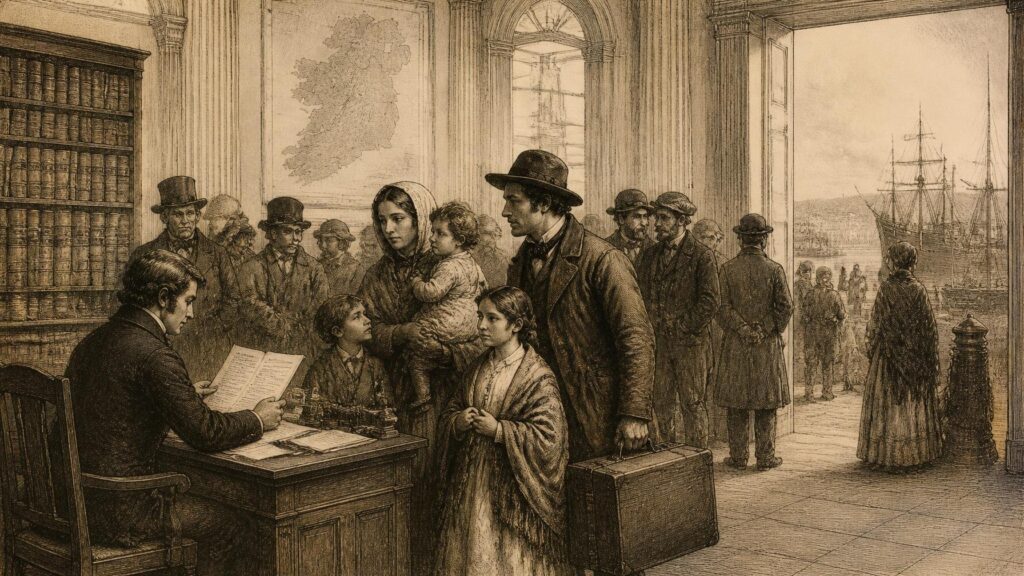
AI generated historical illustration, not a contemporary photograph.
At a Glance
Irish citizenship reform proposed in 2026 belongs to a much longer national argument about membership, belonging and the authority of the State. Its immediate subject is naturalisation, but its historical setting reaches from independence and partition through emigration, constitutional settlement, European integration and Ireland’s transformation into a country of immigration. As of 28 October 2026, the proposed Irish Nationality and Citizenship (Amendment) Bill has not become law. The existing statutory framework therefore remains decisive, while the proposed changes should be understood as a significant but unfinished episode in Irish legal history.
Present Moment
The phrase “Irish citizenship reform 2026” can suggest that a settled new regime already exists. Documentary evidence does not support that description. In September 2026 the Government approved priority drafting of legislation to amend the Irish Nationality and Citizenship Act 1956. A General Scheme was subsequently published and referred for pre-legislative scrutiny. On 1 October 2026, the responsible Minister of State told Dáil Éireann that drafting work was continuing with the Office of Parliamentary Counsel and that publication of a Bill was being progressed as a priority. A General Scheme is an important public legislative document, but it is not a Bill passed by either House of the Oireachtas, and it is not an Act in force.
This distinction matters especially to people who have made their lives in Ireland while building the reckonable residence required for naturalisation. Their position is governed by current law unless and until new provisions are enacted and commenced. It also matters historically. Irish citizenship has repeatedly been altered by political decisions, statutes, constitutional amendments and administrative practice; yet each change has taken place through particular legal forms. Treating a proposal as law erases the deliberation, amendment, opposition and uncertainty that form part of democratic government.
The 2026 proposals concern the route to citizenship by naturalisation. They do not amount to a wholesale rewriting of every route to Irish citizenship. Citizenship by birth, descent and the Foreign Births Register belongs to a related but legally distinct history. This distinction is central. Ireland’s national community has long extended across borders through descent and diaspora, while residence-based naturalisation asks a different question: how, and on what terms, should a person who has made a settled life in the State be admitted as a citizen?
Legal Foundations
Irish citizenship law rests on the Irish Nationality and Citizenship Act 1956, as amended. The Act was enacted after the State had already asserted an independent identity in international affairs, adopted the Constitution of 1937 and formally left the British Commonwealth under the Republic of Ireland Act 1948. The 1956 legislation supplied a comprehensive statutory structure for citizenship in the new republic. It addressed citizenship by birth, descent, marriage, registration and naturalisation, while also engaging with the unresolved constitutional and political fact of partition.
The legislation did not appear in a vacuum. The Irish Free State had inherited a complicated relationship with British subjecthood after 1922. The State needed rules capable of identifying its own citizens, recognising the extensive Irish diaspora, and dealing with a national territory claimed in constitutional language but divided in political reality. Citizenship law therefore became one of the places where sovereignty, family connection and territory met.
In its original form, the 1956 Act reflected assumptions common to mid-century nationality law. It contained provisions shaped by gendered ideas about marriage and family status, including a route by which an alien woman married to an Irish citizen could make a declaration accepting Irish citizenship. Subsequent reform changed this landscape. The history is a reminder that citizenship law does not simply identify an existing people; it also records changing public ideas about equality, kinship and the relationship between individual and State.
Naturalisation under the Act was, and remains, structurally different from citizenship by birth. It is a grant by the State following an application. The statute establishes conditions, but it also gives the Minister a substantial role in deciding whether to grant a certificate. That discretion has been debated for decades because citizenship is both a legal status and a form of political membership. An applicant may satisfy residence requirements and still encounter questions of identity, character, good faith or the public interest.
National Territory
Partition made Irish citizenship unusually sensitive to geography. The 1956 Act addressed persons born in Northern Ireland through provisions framed as temporary pending the reintegration of the national territory. Such language belonged to the constitutional imagination of an earlier State. It also illustrates why Irish nationality cannot be understood solely by looking at the territory administered from Dublin. The island, the border, Northern Ireland and the rights of those born there have remained central to the legal story.
The Good Friday Agreement of 1998 transformed the constitutional context. It recognised the birthright of all people of Northern Ireland to identify and be accepted as Irish or British or both, and to hold both citizenships. The constitutional amendments approved alongside the Agreement replaced the former territorial claim in Articles 2 and 3 with language that recognised the entitlement and birthright of every person born on the island of Ireland to be part of the Irish nation. The revised Article 2 also expressed the Irish nation’s special affinity with people of Irish ancestry living abroad.
That constitutional language is historically significant because it connects citizenship with both place and lineage. It does not, however, settle every statutory question about nationality. The Constitution establishes principles and protections; detailed entitlement is largely determined by legislation. The distinction became particularly consequential in the early twenty-first century, when the rules on citizenship by birth on the island were altered after a referendum.
For historical purposes, it is important not to flatten these developments into a simple story of inclusion or exclusion. The Good Friday Agreement created a rights-based framework responsive to the identities of Northern Ireland. The later citizenship referendum restricted automatic entitlement in particular circumstances. Both episodes concerned the relationship between territory and citizenship, but they arose from different political questions and produced different legal consequences.
Diaspora Connections
Ireland’s citizenship law has always been shaped by emigration. For much of modern Irish history, more people left the island than arrived to settle. The Famine diaspora, later economic migration, political exile and family movement created enduring communities in Britain, North America, Australia, New Zealand, Argentina and elsewhere. Irish governments could not plausibly define the nation only by residence within the State when so many people with Irish family connections lived abroad.
Citizenship by descent is the clearest legal expression of that reality. A person born outside Ireland to a parent born in Ireland is generally an Irish citizen from birth. A person born abroad with a grandparent born in Ireland may in many cases become an Irish citizen through entry in the Foreign Births Register. More remote descent can be legally relevant in limited circumstances, especially where an earlier generation was entered on the Register before the next generation’s birth. These rules are often described in popular conversation as citizenship “through a grandparent”, but the legal position depends on dates, generations and documentary proof.
The overseas dimension of citizenship has carried both symbolic and practical importance. It sustains family connections, offers access to an Irish passport and, by extension, the rights associated with European Union citizenship for those who are citizens of an EU Member State. Yet it also complicates public discussion. A person with an Irish grandparent who has never lived in Ireland may have a statutory path to citizenship, while a long-term resident without Irish ancestry must apply through naturalisation. This is not an accidental inconsistency. It reflects two different historical ideas of membership: descent preserves a transnational national community, while naturalisation marks incorporation through residence and participation.
The 2026 reform proposals do not appear to alter the basic descent structure. Their focus is residence-based naturalisation. Nevertheless, debates about the proposals have often brought the diaspora question into view. Critics and supporters alike ask what Ireland means by connection: inherited family link, birth on the island, a sustained life in the State, marriage, work, civic participation or some combination of these. History provides no single answer, but it shows that Irish law has long recognised more than one route into the national community.
Marriage Changes
Nationality law once treated marriage as a decisive marker of a woman’s civic identity. In Ireland, as elsewhere, older provisions gave special significance to the citizenship of a husband and to a wife’s change of status on marriage. Such rules now appear plainly unequal, but they reveal how citizenship law was once used to organise the family according to assumptions about dependency and male authority.
Reform proceeded gradually. The Irish Nationality and Citizenship Act 1986 altered several aspects of the earlier regime. It removed the automatic acquisition of citizenship by marriage and developed rules that treated marriage less as an automatic transformation of nationality than as a possible basis for an application. This was part of a broader shift in Irish law and public life, in which women’s independent legal personality became more securely recognised.
Under the current framework, the spouse or civil partner of an Irish citizen may apply for naturalisation on more favourable residence terms than most other applicants, provided the statutory conditions are met. The present law has generally required three years of reckonable residence and a continuing marital or civil partnership relationship, alongside residence in the State and the other relevant conditions. This route does not mean that marriage itself confers citizenship. Rather, it permits an application under a distinct statutory provision.
The 2026 General Scheme proposes increasing the qualifying residence period for spouses and civil partners of Irish citizens. The proposal should be seen against the longer movement away from automatic marital citizenship and towards assessed naturalisation. Interpretation differs over the significance of such a change. Supporters may regard it as a consistent application of a more demanding integration standard. Opponents may see it as placing an additional burden on families already embedded in Irish life. The historical evidence establishes the trajectory from automatic status to regulated application; it cannot determine which present policy is preferable.
Migration Transformation
Ireland’s transition from a predominantly emigrant society to a country of sustained immigration changed citizenship from a comparatively specialised legal field into a public question of everyday importance. Economic growth during the late twentieth and early twenty-first centuries brought workers, students, families, refugees and other migrants. Membership of the European Union enabled free movement for EU citizens, while global migration connected Ireland to countries and communities far beyond its traditional emigrant destinations.
This transformation did not erase emigration. Irish people continued to live abroad in large numbers, and return migration remained important. Instead, the country acquired a more complex demographic character: a society with a far-reaching diaspora and a growing population of residents born elsewhere. Citizenship law became one mechanism by which the State responded to that complexity.
Naturalisation figures illustrate the scale of change. In 2024, the Department of Justice stated in a parliamentary answer that 181,233 people had acquired Irish citizenship through naturalisation since 2010. The figure does not tell the whole social story. It does not measure children born to migrant parents, people who remain non-citizen residents, Irish emigrants returning home, or the many citizens whose rights arise by descent. It does, however, show that naturalisation had become a substantial route into Irish citizenship.
The administrative system also changed. Applications became increasingly digital, while e-vetting and other procedural developments were introduced to reduce delays and improve processing. The persistence of parliamentary questions about waiting times shows that efficiency has remained politically important. A citizenship application can affect travel, family planning, employment, security and a person’s sense of belonging. Delays are therefore not merely bureaucratic inconveniences; they can shape the lived experience of residence without full political membership.
Birthright Debate
The most publicly prominent citizenship reform before 2026 was the change to birthright citizenship in 2004. It arose during a period of rapid immigration, intense debate about asylum and changing European legal conditions. Before the reform, the law gave a broad entitlement to citizenship to people born on the island, subject to limited exceptions. The constitutional position was also influenced by the post-1998 wording of Article 2.
On 11 June 2004, voters approved the Twenty-seventh Amendment of the Constitution. The proposal received 1,427,520 votes in favour and 375,695 against. It inserted a provision allowing the Oireachtas to determine by law the citizenship entitlement of a person born on the island who did not have an Irish-citizen parent or a parent entitled to be an Irish citizen. The amendment did not remove citizenship from people already born before its enactment. It changed the constitutional foundation on which future statutory rules could be based.
The Irish Nationality and Citizenship Act 2004 then introduced new conditions for children born on the island from 1 January 2005. In broad terms, a child who did not otherwise have an Irish-citizen parent could be entitled to citizenship where a parent had sufficient reckonable residence in the island during the years before the birth. The current statutory framework specifies a three-year residence requirement within the four years immediately preceding the birth, subject to rules about which periods count.
The referendum remains a contested historical event. Some contemporaries framed it as a necessary correction to a rule they believed was being strategically used. Others regarded it as a restrictive and unnecessary response to migration, adopted amid a charged political climate. Neither characterisation should be presented as neutral fact. The documented fact is that the Constitution and legislation changed. The broader historical interpretation concerns motive, consequence and national self-understanding, and reasonable disagreement remains.
Naturalisation Practice
Naturalisation is the central subject of the 2026 proposals. Under the existing law, the ordinary applicant must generally demonstrate a period of reckonable residence amounting to five years within the eight years before the application, including one year of continuous residence immediately before applying. This is frequently summarised as a “five-year rule”, though the statutory calculation is more precise than that shorthand suggests. Applicants must also satisfy requirements concerning age, character, intention to reside in the State after naturalisation and, save where waived, a declaration of fidelity to the nation and loyalty to the State.
“Reckonable residence” is a technical expression. Not every physical period in Ireland counts for citizenship purposes. The rules distinguish among permissions and statuses, and particular circumstances may require specialist advice. The official system requires applicants to document residence through permissions, records and other evidence. Naturalisation is therefore neither automatic after a number of years nor simply a test of emotional attachment to Ireland.
The Minister’s role is especially important. The statute permits the grant of a certificate of naturalisation when statutory conditions are met, but it does not create a wholly mechanical entitlement in every case. Ministerial discretion has long been defended as necessary for integrity, security and individual assessment. It has also attracted criticism because broad discretion can make decisions seem opaque and difficult to challenge. The tension is not new. Parliamentary material from 2000 recorded the Government’s position that naturalisation applications were considered under statutory criteria but that the Minister held absolute discretion and would not disclose individual reasons.
Modern constitutional and administrative-law expectations have placed greater emphasis on fair procedures and reasoned decision-making than such older formulations might imply. Yet the statute still retains a discretionary structure. The 2026 proposals should therefore not be viewed merely as an increase in the number of years required. They also form part of a longer argument about whether citizenship should be governed chiefly by transparent objective thresholds, individual assessment, or a balance between the two.
Proposed Standards
The 2026 General Scheme proposes a more demanding naturalisation model for ordinary applicants. Its principal elements include an increase in the standard residence requirement from five years to eight years, expressed as two years of continuous residence immediately before application plus six additional years during the preceding ten. It also proposes language and civics requirements, a self-sufficiency condition, revised rules on reckonable residence and changes relating to revocation. The published outline is the best available guide to the proposal, but its heads are not the final wording of an enacted Bill.
The language proposal has attracted particular attention. The stated approach envisages basic proficiency in English, Irish or Irish Sign Language, subject to exemptions that may be prescribed. The inclusion of Irish Sign Language is historically notable because it acknowledges a language community that has often been overlooked in conventional citizenship models. Equally, the proposal’s reference to Irish alongside English raises questions about the symbolic and practical place of the national language in a multilingual State.
A civics test would add another new element. In principle, such a test could ask applicants to demonstrate familiarity with Irish society, democratic institutions, history or public life. At the General Scheme stage, however, essential details remain unsettled: the syllabus, assessment method, language options, cost, accessibility, exemptions and appeal arrangements. These details are not peripheral. They will determine whether a test operates as a reasonable introduction to civic life or as an administrative barrier.
The self-sufficiency proposal is likewise consequential. Government statements have linked it to an intention that applicants should not be in long-term receipt of certain social-protection payments or owe a debt to the State for a defined period. Yet precise thresholds and exceptions are crucial. Illness, disability, caring responsibilities, unstable work, parenthood and economic recession can affect income without proving a lack of attachment or contribution. Historical analysis cannot predict the final scheme, but it can identify the policy choice involved: citizenship would be tied more expressly to a particular understanding of economic independence.
European Context
Government statements have presented the proposed reforms as bringing Ireland closer to approaches used in other European Union Member States. Comparison can be useful, but it requires caution. European citizenship laws differ not only in residence periods but also in colonial histories, language regimes, welfare systems, constitutional structures, dual-citizenship rules and relationships with diaspora populations. A longer qualifying period in one country cannot simply be transplanted into another without regard to those contexts.
Ireland’s position is distinctive in several respects. It combines a strong descent-based citizenship tradition with extensive rights connected to EU membership. It also has the Common Travel Area with the United Kingdom, a unique constitutional relationship with Northern Ireland, and a population whose recent history includes both mass emigration and significant immigration. These features mean that Irish citizenship carries meanings beyond ordinary residence in the State.
European comparison can nevertheless illuminate a political shift. Across many states, policymakers have linked naturalisation to language competence, civic knowledge, residence duration and economic participation. The 2026 proposals place Ireland more visibly within that family of policies. Whether this constitutes ordinary administrative convergence or a deeper remaking of Irish civic identity is an interpretative question. The answer will depend partly on the final legislative text and partly on how officials administer it in practice.
It is also essential to distinguish citizenship from immigration permission. A person may lawfully reside in Ireland without being eligible for naturalisation; another may be eligible to apply but not yet be a citizen. Conversely, an Irish citizen by descent may live entirely abroad. The reform debate is about access to full political membership, not a general rewriting of every immigration status.
Language Questions
Language has long been entangled with Irish nationhood. The revival of Irish was central to cultural nationalism before independence, and the language acquired constitutional recognition after the foundation of the State. Yet the everyday linguistic reality of Ireland has always been more varied than a simple national story suggests. English predominates for most residents, Irish remains a living community language in particular regions and settings, and contemporary immigration has made many additional languages part of Irish social life.
A citizenship language condition therefore raises questions that are historical as well as administrative. If the aim is practical participation, English competence may be treated as a tool for navigating public institutions and employment. If the aim is symbolic incorporation into national culture, Irish may be emphasised. If equality and accessibility are central, Irish Sign Language and well-designed exemptions become vital. Each rationale may support a different test design.
No historical evidence establishes that a language test is inherently inclusive or inherently exclusionary. Its consequences depend on level, cost, preparation opportunities, recognition of disability, availability of tuition and the fairness of assessment. Ireland’s history provides a reason for care: language has been a source of cultural pride and political aspiration, but it has also sometimes been used as a measure of belonging that overlooks the complexity of actual lives.
The same is true of civics. Civic knowledge can help new citizens understand institutions and rights. Yet citizenship ceremonies, local participation, employment, education, family life and community involvement may also demonstrate engagement. A historically grounded policy debate should resist the claim that belonging can be measured perfectly by a test, while acknowledging that democratic citizenship involves more than possession of a passport.
Economic Membership
The proposed self-sufficiency requirement brings an older question into sharp focus: is citizenship primarily a status of equal membership, or should it be conditional on economic independence? The answer has never been straightforward. Modern states finance social protection through taxation and present welfare as part of a civic settlement. At the same time, immigration systems commonly assess sponsors and applicants by reference to income, housing and reliance on public funds.
In Irish history, economic contribution has often been discussed alongside emigration and national development. Migrants abroad sent remittances home, returned with skills or capital, and supported family networks across borders. In more recent decades, migrant workers have been central to sectors of the Irish economy. These facts caution against simplistic distinctions between “contributors” and “dependants”. People can contribute through paid work, unpaid care, taxation, community activity, study and family life at different stages of their lives.
The Government’s case is likely to rest on the view that citizenship should follow a sustained, self-supporting and law-abiding residence. That is a coherent policy position, but it entails difficult boundary decisions. What counts as long-term reliance? How should disability payments be treated? What of workers temporarily unemployed during recession, parents caring for children, or people whose immigration status has restricted their work? The General Scheme cannot answer every issue until its terms are converted into detailed legislation and guidance.
Historical interpretation should remain modest here. It is possible to say that the proposal makes economic status more overtly relevant to naturalisation. It is not possible, at this stage, to say exactly who will be excluded, because the final thresholds and exemptions have not been enacted. Claims that the proposal will inevitably produce a particular outcome should therefore be treated as political prediction rather than settled fact.
Democratic Membership
Citizenship grants rights that extend beyond travel documents. It provides secure membership of the political community, access to full participation in national elections, eligibility for certain public roles and a durable legal bond with the State. For many naturalised citizens, the citizenship ceremony is both a formal legal event and a deeply personal recognition of a life already built in Ireland.
Irish naturalisation ceremonies have helped make this public dimension visible. They present citizenship as an affirmative act of welcome and commitment, rather than solely a bureaucratic conclusion. That symbolism should not obscure the legal realities of application, delay, proof and discretion, but it does show that the State understands naturalisation as more than an administrative convenience.
The 2026 proposals pose a democratic question about the appropriate point at which a settled resident should gain political membership. An eight-year requirement may be regarded as a period sufficient to establish a durable connection. A critic may argue that it delays inclusion for people who work, raise children and participate in communities for years before they can vote in national elections. There is no purely historical formula capable of resolving that dispute. The evidence shows that residence thresholds are political choices, not natural facts.
Irish history also warns against equating national membership with cultural uniformity. The State has included Irish speakers and English speakers, people from different religious traditions, Northern nationalists and unionists, the diaspora, Travellers, immigrants and people with multiple identities. Citizenship law necessarily draws boundaries, but the way it draws them expresses a national vision. The important historical question is not whether boundaries exist; all citizenship laws have them. It is whether they are intelligible, fair, lawful and consistent with the kind of republic Ireland claims to be.
Public Arguments
The public argument around the 2026 proposals has been energetic because naturalisation sits at the intersection of migration, housing, public services, security and identity. Supporters of reform tend to stress integrity, consistency, meaningful connection and alignment with other European states. They may argue that a longer residence period, civic knowledge and financial independence strengthen the value of citizenship and public confidence in the system.
Critics tend to stress the effect on migrants who have already made long-term lives in Ireland, particularly workers, spouses, refugees and families. Civil-society organisations have warned that higher residence requirements and economic conditions may create insecurity and delay equal membership. They have also emphasised that a proposed measure should not be described as current law before it has passed through the Oireachtas.
Both accounts contain identifiable values rather than merely technical disagreements. One places weight on controlled admission to membership; the other places weight on inclusion after established residence. The historical record can clarify prior law, trace institutional change and identify the consequences of earlier reforms. It cannot declare one set of values objectively correct.
Folklore and misinformation have also appeared around Irish citizenship. A common but misleading idea is that anyone with a distant Irish ancestor can automatically obtain a passport. Another is that residence for a stated number of years automatically produces citizenship. Neither is true. Descent claims require specific statutory connections and documentary proof; naturalisation requires an application, statutory eligibility and a ministerial grant. In a period of proposed reform, such distinctions are more important than ever.
Unfinished Future
As of 28 October 2026, Irish citizenship reform remains unfinished. The Government has set out a policy direction and a General Scheme, while the Oireachtas scrutiny and formal legislative process remain to be completed. The present law continues to govern applications unless a new Act is enacted and commenced. People seeking individual advice must rely on official current guidance and, where necessary, qualified legal assistance rather than assumptions based on headlines or proposals.
The historical importance of the episode does not depend on knowing its final outcome. The 2026 proposals reveal how far Irish citizenship has travelled from the conditions of the 1950s. The law now operates in a State shaped by the Good Friday Agreement, European Union membership, a global diaspora, significant inward migration and stronger expectations of equality and administrative fairness. The questions are recognisably old, but the circumstances are new.
Citizenship has never been only a passport or a register entry. It is a legal mechanism for deciding who belongs, a constitutional language of rights, a family inheritance, a political identity and, for many migrants, the culmination of years of residence. Irish history shows that these meanings have changed repeatedly. The proposed reforms may become another major turning point, may be amended substantially, or may not proceed in their present form. Until the Oireachtas decides, certainty should be reserved for the law that exists, and the future should be described as future.