Neutral Industry
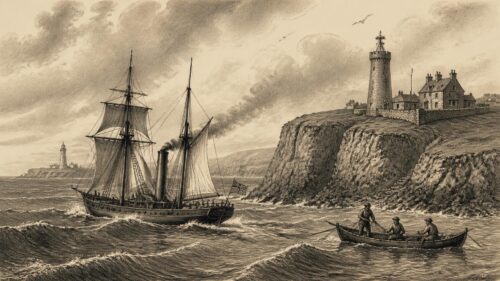
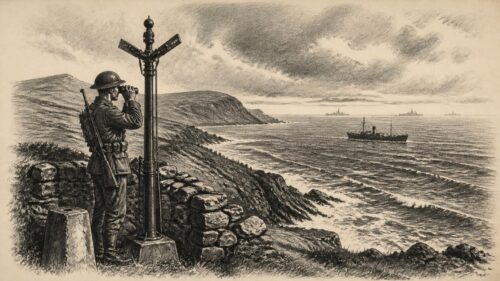
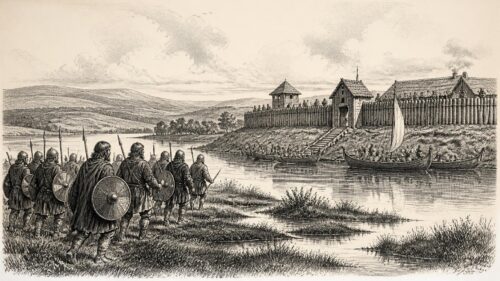
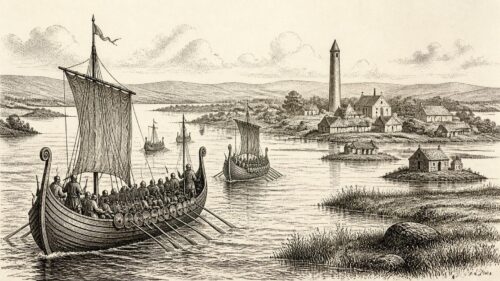
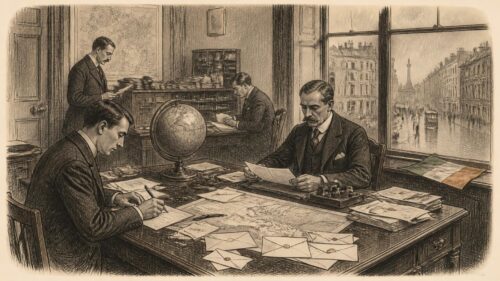
AI generated historical illustration, not a contemporary photograph.
At a Glance
Aughinish Alumina, on the Shannon estuary in County Limerick, is not a military installation and was never conceived as one. Yet its history demonstrates why Irish neutrality cannot be understood only through uniforms, treaties, airports or diplomatic declarations. From its planning in the late twentieth century, the refinery has connected an ostensibly peripheral Irish landscape to mines in West Africa, multinational capital, European smelters, Irish energy policy and, more recently, the political economy of Russia’s war against Ukraine. The resulting controversy is not evidence that Ireland ceased to be neutral. It is evidence that military neutrality and economic detachment are very different things.
Industrial Arrival
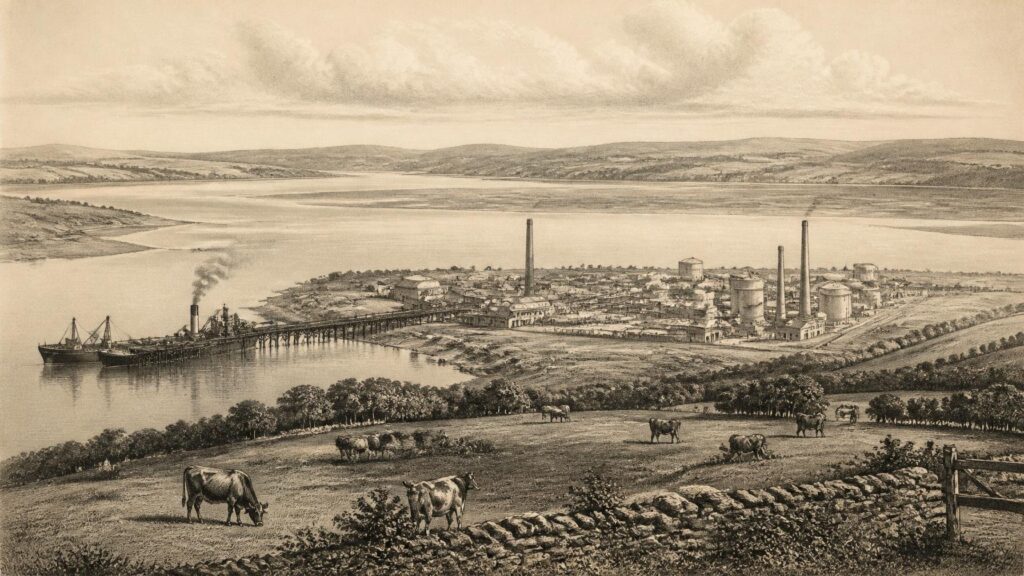
Aughinish is a former island, now effectively a peninsula, on the southern shore of the Shannon estuary west of Limerick city. Before the refinery, it was a place of farms, shore, scattered settlement and deep local history. Its geography nevertheless made it attractive to industrial planners. The estuary offered deep water and a route to the Atlantic; land was available for a large works, residue storage and supporting infrastructure; and west Limerick had long been identified by the Irish State as an area in need of secure employment and industrial investment.
The refinery was conceived during a period when the Republic was attempting to alter its economic position. The protectionist model of the earlier State had given way to a policy that welcomed export industry and foreign capital. The decision to join the European Economic Community in 1973 formed part of that wider turn. Irish officials sought internationally mobile manufacturers, while multinational companies looked for reliable access to European markets, favourable conditions and sites with ports, labour and political support.
Aluminium was one of the strategic materials of the age. Its light weight, resistance to corrosion and usefulness in construction, transport, packaging and electrical systems made it central to modern industrial economies. But aluminium metal is not extracted directly from the ground in a simple local process. Bauxite is refined into alumina, or aluminium oxide, and alumina is then smelted, using immense quantities of electricity, into metal. Each stage can occur in a different country. That division of labour made Ireland a plausible location for a refinery even though it had no commercial bauxite deposits of its own.
The project that became Aughinish was launched in 1971 and repeatedly reshaped by international circumstances. Its promoters initially envisaged a large plant supplying alumina to Alcan’s smelting interests, particularly at Lynemouth in Northumberland. The proposed location had to satisfy demanding practical requirements: a deep-water terminal capable of receiving large ore carriers, sufficient space for the red residue created by refining, access to water and fuel, and a workforce that could be trained for continuous industrial production.
It was, from the beginning, an international undertaking located in Ireland rather than an Irish raw-material industry. Bauxite would travel by sea, principally from Guinea in the early scheme, while the refined alumina would leave by sea for smelters elsewhere. The refinery would add a valuable processing stage to a global chain, but neither the ore at the beginning nor most of the metal at the end would be Irish. This fact is fundamental to its later history. Aughinish’s importance to the State lay in employment, taxation, skills, infrastructure, energy and export earnings; its dependence lay in distant mines, sea transport, world commodity prices and corporate decisions made abroad.
Construction began formally in 1978, after years of discussion, negotiation and delay. The oil crises of the 1970s affected the economics of energy-intensive industry, while volatile aluminium prices affected projected returns. Nonetheless, the Irish authorities continued to support the project. Dr Mauve Carbonell’s research on the refinery describes a formidable package of public assistance: grants, tax arrangements, training support, roads, water provision and housing measures. The plant was promoted as a transformative intervention in a region where outward migration and insecure employment remained living memories rather than remote history.
The scale of the investment helped create the phrase often attached to the project: the largest private industrial investment in the history of the State. Such descriptions require care, because estimates varied over time and depended on how finance and associated works were counted. What is beyond doubt is that Aughinish was exceptional in Irish terms. Its estimated cost rose dramatically between the earliest planning stages and completion. The undertaking brought a highly capitalised, technically specialised industry to a rural estuarine setting and demanded an unusually close relationship between a foreign-led consortium and Irish public bodies.
The first alumina was produced on 4 September 1983. The original partnership included Alcan, Billiton and Anaconda. Its initial designed capacity was roughly 800,000 tonnes of alumina annually. It is tempting to present opening day as an uncomplicated triumph of modernisation, but that would obscure the difficult commercial circumstances. The European aluminium market was weak, and the plant did not immediately achieve the optimistic results associated with its planning. In its first decade Aughinish faced losses, cost pressures and strained industrial relations. The refinery survived not because the original assumptions proved permanently correct, but because its owners, employees and the State adapted it to an unsettled market.
Neutrality Defined
To see why Aughinish could later be drawn into arguments about neutrality, it is necessary first to be precise about what Irish neutrality means. The Republic’s traditional policy is military neutrality. Successive governments have defined it principally through non-membership of military alliances and non-participation in common or mutual defence arrangements. It is not a doctrine of economic self-sufficiency, universal non-cooperation or political silence in international affairs.
The policy took its clearest early form on the eve of the Second World War. During the Emergency, the State sought to remain outside the conflict while defending its own territory and maintaining sovereign control of its decisions. Neutrality acquired great symbolic force because it was associated with the independence of the new State: Ireland would not automatically be drawn into a British war, nor would it take orders from larger powers. That historical inheritance has remained powerful in public life.
Yet the policy was never identical to detachment from the world. Ireland joined the United Nations in 1955, began overseas peacekeeping service in 1958, entered the European Communities in 1973 and later participated in the Partnership for Peace. Governments have consistently argued that such involvement does not amount to joining a military alliance. Official statements also stress that Ireland’s neutrality is neither permanent in the Swiss legal sense nor expressly entrenched in the Constitution. Article 29 affirms devotion to peace, international justice and peaceful settlement, while the Constitution restricts participation in war without the assent of Dáil Éireann. These provisions matter, but they do not create a comprehensive constitutional code of neutrality.
This distinction between a policy and a legal status matters greatly. A neutral state in a particular international armed conflict may have obligations under the law of neutrality. Ireland’s peacetime policy, by contrast, is a political and constitutional practice developed by governments over decades. Its content has been debated in referendums, parliamentary proceedings, election campaigns, anti-war protest and arguments over the use of Shannon Airport. It has often been understood more broadly in popular language than in official definitions.
That broader popular understanding frequently includes a moral aspiration: that Ireland should not facilitate war, should resist great-power blocs, should support disarmament and should offer humanitarian help rather than military assistance. Those values have influenced public arguments, but they do not automatically settle every question involving commerce. Ireland trades with states at war, participates in European sanctions agreed collectively, hosts overseas investment, exports technology and imports materials with complex destinations. A modern trading economy cannot be commercially neutral in the sense of having no economic consequences abroad.
Aughinish therefore exposes a recurring tension rather than a simple contradiction. If neutrality is defined narrowly as military non-alignment, a civilian alumina refinery exporting a lawful commodity does not by itself breach it. If neutrality is understood as an ethical commitment not to contribute materially to warfare, then the destination and eventual use of industrial products become more troubling. The disagreement is genuine because the word neutrality is carrying two different burdens: a formal description of defence policy and a wider claim about national conduct.
Neither interpretation can be dismissed as mere rhetoric. The legal and official definition protects clarity: not every commercial relationship with a belligerent makes a state a combatant. The wider ethical interpretation protects moral seriousness: legal trade can still have consequences that citizens judge unacceptable. The historical task is not to force a false choice between them, but to identify the evidence, the institutions responsible and the limits of what can be inferred from a supply chain.
Global Materials
The Bayer process used at Aughinish makes that supply-chain problem visible. Bauxite is crushed and treated with caustic soda under heat and pressure. The process separates alumina-bearing material from insoluble residue. The alumina is recovered and calcined into a white powder; the residue, often called red mud because of its iron-rich colour, must be managed and stored. Alumina then becomes the feedstock for aluminium smelters, where electrolysis converts it to metal. The refinery is thus neither a mine nor a smelter. It occupies the middle, transformative stage of a far wider industrial system.
Its location on the Shannon was chosen precisely because the system was maritime. Ships could bring bauxite to a dedicated deep-water terminal and remove alumina to European and world markets. The refinery’s physical bulk makes the local consequences conspicuous, but its commercial logic has always been transnational. A tonne of alumina made in Limerick can be sold to a smelter in another jurisdiction; the resulting aluminium can be alloyed, rolled, machined and incorporated into countless civilian or military products in still other places.
This creates an important evidential distinction. Alumina is a basic industrial input, not a finished weapon. It can become part of aircraft, cars, cables, cans, building products and machinery, among many other things. It may also enter production chains capable of serving military manufacturing. The fact that aluminium has military uses does not prove that every tonne of alumina supplied to a country is destined for a weapons factory. Conversely, the civilian character of a commodity does not mean its wartime significance can safely be ignored.
During the Cold War, this complexity was familiar but not usually discussed in relation to Irish neutrality. Ireland was a small, open economy beside the Atlantic, linked commercially to western Europe and North America while outside NATO. Foreign investment was welcomed as a route to employment and development. Aughinish fitted that pattern. It was Canadian-, British-, American- and Dutch-linked capital, international ore and maritime trade brought together by Irish development policy. The refinery’s original purpose was commercial, and there is no sound basis for retroactively describing it as a project of Irish military policy.
There were, however, geopolitical dimensions in the background. Guinea’s bauxite reserves had become important to the international aluminium industry after decolonisation. The global metals trade depended on concessions, ports, shipping contracts, corporate ownership and the politics of resource-producing states. The decision to process Guinean ore in Ireland rather than in Guinea illustrates an older international division of labour in which raw materials often left producer countries while higher-value refining was located elsewhere. That history should be acknowledged without implying that Aughinish alone created it.
For Ireland, the refinery promised a valuable place in European manufacturing. For the multinational companies, it provided capacity close to their smelting and marketing networks. For workers in west Limerick, it offered permanent industrial employment of a kind not readily available locally. Each perspective was real. The project was neither simply an imposed foreign outpost nor simply a national development victory. It was a negotiated bargain, with benefits distributed locally and nationally, while strategic commercial control remained overwhelmingly outside Ireland.
The consequences of that ownership structure became clearer over time. The refinery could be technologically embedded in Limerick, employ local people and depend on Irish public infrastructure, yet still have its output directed according to decisions made within international corporate groups. The State could regulate planning, environment, taxation, employment law and energy connections, but it could not make the plant an autonomous Irish enterprise merely by hosting it. This is one reason the word “Irish” can mislead when applied to products made at Aughinish. The place of production is Ireland; the material chain and ownership are international.
Shannon Transformations
The arrival of the refinery altered a landscape that had already seen many transformations. Archaeological work undertaken before construction in 1974 revealed evidence of earlier settlement and activity. Excavations recorded enclosures, domestic material, quern stones, metalwork and a badly corroded iron bridle bit. Archaeologists interpreted one group of finds as indicating Late Bronze Age occupation, while other features and finds belonged to later periods. Near the industrial complex, investigations also examined the remains of Aughinish Castle and its bawn.
The importance of this archaeology lies not in supplying an invented story of continuous industrial destiny, but in demonstrating the density of human use along the estuary. The evidence permits carefully bounded conclusions. It supports the existence of prehistoric and later activity at specific excavated sites; it does not permit precise dates for every feature or a simple narrative of one community replacing another. The refinery’s construction required the removal, recording or disturbance of a landscape already layered with earlier lives.
The Shannon itself had long connected local communities to wider worlds. Medieval and early modern conflict, commerce and fishing all depended on the estuary. Limerick’s position upstream gave the river military and commercial importance; nineteenth-century batteries at strategic points near the estuary’s mouth testify to the continuing concern with maritime approach. By the twentieth century, Foynes and Shannon became associated with transatlantic aviation, while the estuary also attracted industrial development. Aughinish belonged to this long history of connection, though its scale and chemistry were new.
For local people, the refinery was visible in every sense. Its stacks, conveyors, tanks, jetty and residue area transformed the skyline. It brought construction employment first, then permanent jobs, apprenticeships and a new industrial workforce. It also drew lorries, ships and associated services into an area whose economic rhythms had previously been more agricultural and maritime. Such changes could be welcomed and resisted at once. Families might value a secure wage while fearing pollution, loss of amenity or the erosion of familiar rural life.
That ambivalence is common in Irish industrial history. State agencies often presented major plants as remedies for emigration and regional imbalance. Residents could accept the need for employment while insisting that neither their health nor their land should be treated as expendable. At Aughinish, the tension was especially acute because the industrial process required a large residue-storage area and operated beside an internationally important estuary. Economic development and environmental protection were not abstract policy headings; they were competing claims on the same place.
The refinery also became part of the energy history of the State. Alumina refining consumes considerable heat and electricity. Over time, Aughinish altered its fuel arrangements and invested in a combined heat and power plant. The European Commission’s Joint Research Centre has described the site as having a 160-megawatt combined heat and power facility that supplies steam and power to the refinery and surplus electricity to the Irish grid. This made the plant more deeply connected to national infrastructure than an isolated export factory would have been.
That connection later became politically significant. Arguments about the future of the plant could no longer concern employment alone. They also concerned grid supply, gas demand, industrial competitiveness and the vulnerability of European aluminium chains. These considerations do not remove the need for scrutiny. They explain, however, why governments have tended to view Aughinish not merely as a private employer but as part of an interdependent industrial and energy system.
Environmental Reckoning
Environmental concerns accompanied the project from its earliest public stages. County Limerick councillors raised questions about possible effects on agricultural land and livestock, discharges in wet conditions, water pollution, dust, noise, chimney emissions and the toxicity and accumulation of red mud. Their concerns were not an anachronistic later reaction. They belonged to the original planning story, although the regulatory apparatus available in the 1970s was less developed than the system that emerged after the Environmental Protection Agency was established in the 1990s.
Planning permission came with numerous conditions addressing air and water pollution, spillages, effluent, monitoring and residue. The existence of these conditions should not be mistaken for proof that all risks were solved. It shows that the risks were recognised. In large industrial schemes, assurances from companies and officials often create public confidence at the moment of approval, but the real test lies in decades of operation, maintenance, enforcement and independent investigation.
By the 1980s, complaints emerged concerning bauxite dust and residue. Farmers and residents reported worries about red dust, animals and local environmental conditions. In the 1990s the controversy became more organised. The Askeaton and Ballysteen Animal Health Committee, Greenpeace Ireland and others pressed for investigation. Aughinish disputed claims that it had caused alleged health problems on surrounding farms. The distinction is important: local testimony can establish that people experienced concern, observed changes and demanded answers; it cannot on its own establish medical or environmental causation.
The State-sponsored investigations that followed illustrate the difficulty of environmental evidence. Industrial emissions occur within landscapes affected by weather, soil, farming practice, disease, traffic and other sources of pollution. Establishing causation requires reliable baseline data, sampling, toxicology, veterinary evidence and transparent methods. Communities may reasonably lose trust when these processes are slow or when official conclusions do not match their lived experience. Equally, a historical account should not state that a particular industrial source caused a particular illness unless the evidence supports that claim.
Environmental regulation became more formal when Aughinish came under the Environmental Protection Agency’s licensing system. Licence files, objections and oral-hearing material show the competing pressures clearly. The company argued at different points that additional costs could threaten a refinery operating in a fiercely competitive global market. Objectors argued that economic vulnerability should not justify weaker environmental standards. Regulators had to decide not whether employment mattered, but how environmental conditions could be imposed, monitored and enforced without simply accepting either side’s assertions.
The red residue area has remained central to public concern. Bauxite residue is not a temporary nuisance but a long-term consequence of alumina refining. Its management involves containment, drainage, dust control, monitoring and future obligations extending beyond immediate production cycles. The scale of the site forces an intergenerational question: what duties do present owners and regulators owe to communities and environments long after the commercial decisions that created the residue have passed?
That question has particular relevance to neutrality debates because it reveals a broader pattern. The Irish State has repeatedly accepted global industrial integration in return for local employment and national economic development. The benefits are immediate and measurable: work, income, skills, exports and infrastructure. The costs can be diffuse, delayed and difficult to attribute: altered landscapes, waste management, environmental risk and dependence on decisions made elsewhere. Aughinish is therefore a case study in sovereignty as well as pollution. A state may be politically independent while its choices are constrained by investments and infrastructures it has encouraged.
The refinery’s defenders have often emphasised technological improvement, energy efficiency and regulatory compliance. Its critics have emphasised incidents, contested monitoring and the sheer scale of residue storage. Both positions contain matters that can be checked, but neither should be converted into a folklore of total innocence or total catastrophe. The documentary record supports a history of serious and continuing environmental dispute. It does not support a historian pretending that every allegation has been conclusively proved, nor that regulation has made public concern irrelevant.
Russian Ownership
The ownership history of Aughinish is essential to the neutrality question. Alcan became the sole owner in 1995 after acquiring the interests of its partners. In 1999 it sold the refinery to Glencore, the Swiss commodities group. In 2007, the merger that created United Company Rusal brought Aughinish under the ownership of the Russian aluminium group. The transition was corporate rather than territorial: the works did not move, its workforce did not become Russian, and Irish law did not cease to apply. But the strategic context of its output changed.
For many years this attracted relatively little public attention. Rusal was a major global aluminium producer, and foreign ownership was not unusual in Irish industry. The refinery continued to produce alumina, import bauxite, employ a substantial workforce and supply external markets. Its physical location in Ireland and its reliance on the Shannon ensured that its operations remained locally important even as the corporate headquarters and wider group structure lay elsewhere.
The United States sanctions imposed on Rusal, EN+ and Oleg Deripaska in April 2018 brought the vulnerability of that ownership arrangement into sharp relief. Because Aughinish was controlled within the affected corporate structure, it was caught by the practical effects of American measures. The Irish Government made representations to the United States, arguing that an abrupt disruption would harm workers and a significant industrial operation in Ireland. Temporary licences allowed operations to continue while ownership and governance arrangements were reconfigured sufficiently for the sanctions to be lifted from Rusal and related companies in 2019.
This episode deserves attention because it complicates easy assumptions about national control. Ireland was not responsible for the American sanctions decision, yet a decision taken in Washington could threaten an employer in Limerick. The Irish Government’s response was framed around employment, legitimate commerce and avoiding unintended damage to an Irish-based operation. Critics could see this as accommodation of a Russian-linked company; ministers could describe it as the ordinary duty of a government to protect workers and economic stability. Both interpretations arose from the same material dependence.
The Russian invasion of Ukraine in February 2022 transformed the moral and political atmosphere. Russia’s war was widely condemned by Ireland, which supported Ukraine diplomatically, financially and through European Union sanctions. At the same time, Aughinish remained part of Rusal’s international industrial network. Questions therefore became unavoidable: where did its alumina go, what did its owners control, could exports assist the Russian economy or war effort, and what obligations followed for a neutral member of the European Union?
The language used in these discussions matters. Russian ownership is not the same as proof of wrongdoing by every subsidiary. Ownership by a Russian company does not make a factory an arm of the Russian state. Nor is it sufficient to say that a plant is in Ireland and employs Irish workers, as if those facts exhausted the question. The relevant historical reality is more demanding: Aughinish is an Irish-located refinery integrated into a corporate group with Russian connections, operating in a European sanctions environment and trading in a commodity of strategic industrial significance.
That reality created unusual pressures on workers. Employees did not choose the invasion, the ownership history or the international sanctions architecture. Yet their livelihoods became part of political argument. Appeals to protect jobs should never silence concerns about Ukraine or obscure commercial responsibility. Equally, calls for immediate closure should acknowledge that industrial workers and surrounding communities would carry the consequences. A serious historical account must keep both facts in view.
Sanctions Dilemma
The controversy intensified when investigative reporting in 2026 traced exports of alumina from Aughinish to Rusal smelters in Russia and examined downstream links between aluminium production and companies serving the Russian military-industrial sector. The reporting raised a grave question: whether a product refined in County Limerick could be entering chains that ultimately support weapons used in Russia’s war against Ukraine.
The evidence requires disciplined reading. Trade and customs data can demonstrate shipment routes, volumes, destinations and commercial relationships. Corporate records can identify ownership. Evidence about an aluminium buyer’s business can show that it supplies military manufacturers. But moving from these facts to a claim that a particular consignment of Irish alumina became a particular missile, drone or weapon requires more direct tracing than public trade data ordinarily provide. It would be irresponsible to collapse probability, concern and proof into one assertion.
What can be stated clearly is that alumina exports to Russia were not subject to a general European Union prohibition at the time the issue became public. The European Union had imposed extensive measures on Russia after the full-scale invasion, including restrictions affecting numerous goods, technologies, entities and financial activities. It also moved in 2025 to restrict imports of primary aluminium from Russia. But alumina exported from the European Union to Russia remained outside a blanket export ban. Legality, however, did not settle the political argument.
In June 2026, the Minister for Enterprise told Dáil Éireann that Aughinish and alumina were not then subject to European Union sanctions, while acknowledging the seriousness of reports that alumina could be refined and processed into aluminium for Russian military use. He said his Department was investigating possible sanctions issues and would engage with other State bodies, member states and the company. The parliamentary record is valuable because it captures both sides of the official position: the trade was not automatically unlawful, yet the possible destination and beneficiaries required investigation.
European institutions faced a similar conflict. On one side stood the purpose of sanctions: to constrain Russia’s capacity to wage aggressive war and to avoid making economic resources available to sanctioned persons or entities. On the other stood the dependence of European aluminium producers on reliable alumina supply. Aughinish is Europe’s largest alumina refinery, with annual capacity of more than 1.9 million tonnes according to the European Commission’s Joint Research Centre. Restricting its operation or closing Russian markets without an alternative commercial arrangement could affect workers in Ireland and downstream industry across Europe.
That argument should not be misunderstood as a claim that European industrial inconvenience outweighs Ukrainian lives. Rather, it explains why sanctions are instruments of collective policy rather than simple expressions of moral disapproval. A measure that closes a plant while leaving Russian production supplied from elsewhere may damage European workers without producing the intended strategic result. Conversely, an exemption that keeps trade flowing may weaken the credibility and practical force of sanctions. Policymakers must assess both possibilities, and outsiders are entitled to demand that their reasoning be transparent.
Irish neutrality entered this debate in two ways. First, some critics argued that a neutral state should take a more restrictive approach to trade that might support a belligerent’s military capacity. Second, others argued that neutrality does not require Ireland to act alone outside agreed European sanctions policy, particularly where the commodity concerned is not prohibited and the consequence could be the loss of a major Irish industrial employer. The first argument treats neutrality as a duty of ethical distance. The second treats it as military non-alignment within a rules-based European order.
Neither position is simply a matter of sentiment. Ireland’s membership of the European Union means that trade sanctions are normally designed and adopted collectively. Unilateral national action can be legally and economically complex. At the same time, Ireland is responsible for enforcing applicable sanctions within its jurisdiction and for examining credible evidence of circumvention or prohibited dealings. The question is not whether Ireland has agency; it plainly does. The question is which decisions it can lawfully make alone, which require European agreement, and how far it should press its partners for change.
Public discussion sometimes blurred an additional distinction: sanctions against companies, sanctions against individuals, and restrictions on products are not interchangeable. A designated person may be subject to asset-freeze rules; a company’s ownership and control must then be assessed carefully. A commodity may remain lawful to export even while transactions involving particular end-users are prohibited. An investigation can find insufficient evidence of a direct prohibited supply without resolving every moral question about indirect benefit. Historical writing should preserve these distinctions, not use them to minimise the seriousness of the issue.
The plant’s management has maintained that it operates in compliance with European Union law, sanctions, export controls and trade rules. That is a corporate position, not an independent historical conclusion. Yet it is relevant, because allegations of illegality require evidence tested by competent authorities. Investigative journalists, parliamentarians, campaigners and foreign governments can bring vital information into the public sphere; they do not replace the legal processes that determine whether sanctions were breached.
Evidence Limits
The Aughinish debate has generated a great deal of forceful language. Terms such as “Russian factory”, “war machine”, “neutrality breach” and “economic self-harm” can communicate genuine anxieties, but they can also conceal analytical shortcuts. A historian should separate at least four levels of claim: documented fact, reasonable interpretation, allegation and folklore.
Documented facts include the refinery’s location in County Limerick; its construction between 1978 and 1983; its successive ownership by Alcan, Glencore and Rusal; its role as an alumina producer using imported bauxite; its considerable capacity and energy infrastructure; its long environmental regulatory history; and the existence of substantial exports and official concern about their Russian destination. These points rest on company records, public agencies, parliamentary debate, regulatory documents and established reporting.
A reasonable interpretation is that the refinery embodies a structural tension within Irish economic development. Ireland attracted industrial investment by becoming a dependable place for international capital and trade. This produced employment and technical capacity, but it also bound communities and governments to global systems over which they had limited command. The 2018 sanctions episode and the later Russia controversy are not accidents unrelated to the earlier history; they are later manifestations of the same dependence.
An allegation is the claim that alumina from Aughinish knowingly or directly supplied particular Russian weapons manufacturers. Such a claim demands evidence specific enough to establish the relevant customer, transaction, end-use and knowledge. Public reporting has raised serious concerns about downstream links, and Irish official investigation was warranted. But a historian must not report an allegation as an established fact merely because the possibility is morally alarming.
Folklore, in this context, includes the habit of making the plant stand for everything troubling about modern Ireland: foreign ownership, pollution, compromised neutrality, rural decline, political deference or global capitalism. Such symbolism can illuminate public feeling, but it can also exaggerate the refinery’s singularity. Aughinish did not create Irish neutrality, European sanctions policy, the Russian invasion or the international aluminium industry. It became a focal point because all of those larger forces met there in a particularly visible way.
There is also a methodological limit imposed by corporate opacity. Commodity markets operate through contracts, group companies, traders, shipping agents and changing destinations. Public customs data can be incomplete or revised. Ownership structures can be technically complex. Russian domestic trade information is difficult to verify independently, especially after the invasion and the tightening of information controls. These limitations do not excuse inaction. They mean that public claims should remain proportionate to the available evidence.
The environmental record requires similar caution. There is abundant documentation of complaints, protests, regulatory conditions and disputes. It is supportable to say that Aughinish has been environmentally controversial since planning and that red residue management remains a long-term issue. It is not supportable to attribute every reported illness, animal loss or local environmental change to the refinery without the relevant independent evidence. Respect for affected communities requires taking their testimony seriously; respect for truth requires not turning concern into certainty where the record cannot carry it.
Historical uncertainty is not a weakness in the story. It is part of the story. The difficulty of knowing where a bulk commodity finally ends up, or of proving long-term environmental causation in a changing landscape, reveals the limits of public oversight in global industry. The people of Limerick can see the refinery, its ships and its residue area. They cannot easily see the boardroom decisions, contractual routes and downstream transformations of the product. That asymmetry is a central fact of the modern economy.
Historical Meaning
Aughinish Alumina should therefore be understood as a history of connection rather than contradiction. It does not prove that Irish military neutrality is fictitious. Ireland has remained outside military alliances and has continued to describe its policy in those terms. Nor does the refinery permit a complacent view that neutrality insulates Ireland from war. A globally connected industrial economy can affect conflicts through finance, transport, energy, materials and supply chains even when its armed forces are not belligerents.
The plant’s founding belonged to an era of planned industrial modernisation. Its backers offered regional employment, export capacity and a new industrial future. Those gains were tangible. Generations of workers built skills and livelihoods there, while the refinery became a major presence in the economy of west Limerick. The project also carried environmental burdens and made the locality dependent on markets, owners and materials beyond Ireland. Neither aspect cancels the other.
Its later ownership history sharpened the lesson. Under globalised capitalism, national territory, corporate control and moral responsibility do not align neatly. A refinery can be Irish in place, multinational in operation, Russian-owned in a corporate sense, European in its market role and globally consequential in its material effects. Political debate becomes confused when one of these descriptions is treated as the whole truth.
For students of Irish neutrality, the most useful conclusion is modest. Neutrality is not a shield against entanglement; it is a policy governing military alignment. It may inform ethical choices about trade, arms, diplomacy and sanctions, but it cannot by itself answer every question raised by an industrial commodity. Those questions require evidence about law, ownership, end-use, employment, environmental risk and European obligations.
The controversy also invites a more demanding civic standard. Governments should be clear about the difference between lawful trade and trade that is ethically defensible. Companies operating in sensitive supply chains should provide as much transparency as commercial reality allows. European institutions should explain how exemptions and omissions within sanctions regimes are assessed. Workers should not be treated as collateral in geopolitical arguments, and Ukrainians should not be expected to accept abstract assurances where material links to an aggressor’s industrial base are plausibly alleged.
At Aughinish, the Shannon continues to carry ships bearing the traces of distant mines and distant markets. The refinery is a monument not only to twentieth-century industrial ambition but to the enduring difficulty of separating local prosperity from global consequence. Its history makes one point unavoidable: in a connected world, neutrality is never simply the absence of involvement. It is a continuing argument about what forms of involvement a state is prepared to accept, regulate, resist or change.