Death Herald
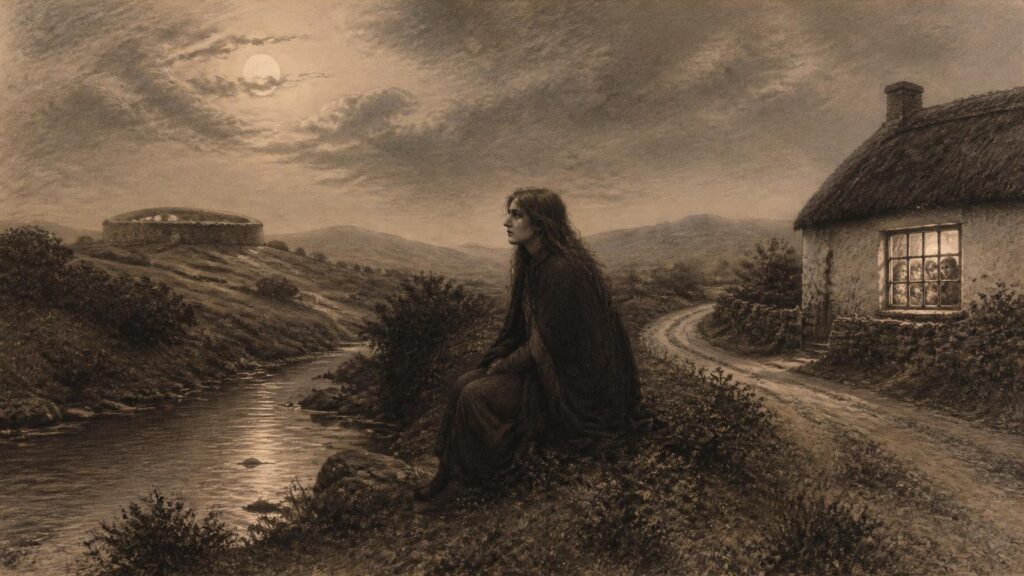
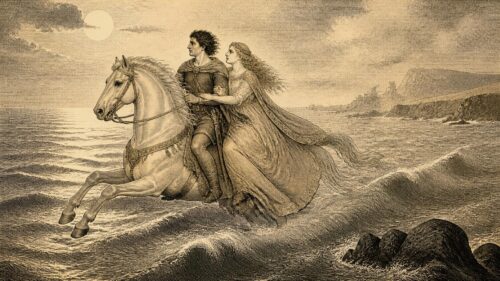
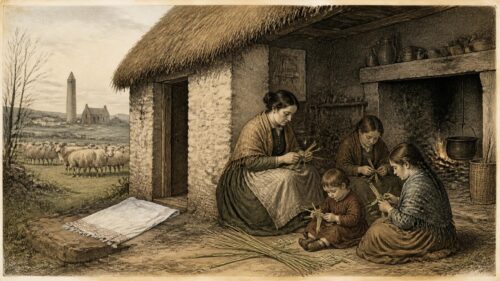
AI generated historical illustration, not a contemporary photograph.
At a Glance
The banshee is among the best known figures associated with Ireland, yet the familiar modern image of a shrieking ghostly woman tells only part of the story. In Irish tradition, the bean sí was principally a supernatural death-messenger: a female being whose lament announced, or accompanied, the death of a person connected to a particular family. Her importance lies not in whether supernatural appearances can be historically verified, but in the unusually rich evidence for the belief itself. Stories, local recollections, manuscripts and printed accounts reveal how Irish communities gave form to grief, lineage, place and mortality.
Irish Origins
The English word “banshee” derives from Irish bean sí, commonly translated as “woman of the sí” or “fairy woman”. The second element, sí, has a wide semantic history. It can refer to a supernatural being, but is also associated with a fairy dwelling, mound or hill. Older spellings such as bean síde and bean sídh appear in historical Irish and in antiquarian English-language writing. The term therefore belongs to the vocabulary through which people described an Otherworld thought to exist alongside the visible landscape.
This does not mean that every part of later banshee lore can safely be projected into remote antiquity. Ireland possesses medieval literary texts containing powerful female figures who lament, foretell death, appear near battle or possess links with the supernatural world. It is tempting to identify each of these with the banshee. Such identifications can be suggestive, but they are interpretations rather than proof of direct continuity. The surviving medieval sources were written down by learned authors in particular literary and religious settings. The detailed family-attached death-messenger known from modern folklore is most securely documented in much later material.
Care with terminology matters. A bean sí was not simply a generic ghost, witch or goddess. Nor was she identical with every fairy woman encountered in Irish story. In the folklore record she was usually solitary, female and connected to death. Her principal action was lamentation: keening, crying, wailing or making a sound understood as grief. The word “banshee” is now often used internationally for a monster that kills with a scream. That popular version has little in common with the Irish tradition, in which the sound ordinarily did not cause death. It signalled a death believed to be near, occurring elsewhere, or already underway.
The traditional figure could be called by other local names. English spellings varied widely because collectors represented Irish sounds differently and because many accounts circulated orally before being written. Some narrators used a name which could be rendered “the little woman”; others spoke simply of a fairy woman, a crying woman or an unnamed presence. The apparent looseness of naming is itself historically useful. It indicates that the belief did not always rest on a single fixed creature with a standard appearance. It was a body of connected local understandings concerning a supernatural mourner.
Irish-language terms also warn against an overly literal translation. The sí was not necessarily a single visible hill. It denoted an Otherworldly order associated with particular places, with the dead, with fairies and with powers outside ordinary human control. A bean sí, in this sense, belonged to a landscape of thresholds. She was heard outside a house, beside water, at a gate, on a road or near a fort; she could cross the boundary between the household and an unseen realm while announcing that a person within the human world was about to cross another boundary.
Written Traces
Historical evidence for banshee traditions comes in several forms, and each must be read differently. Medieval and early modern texts preserve motifs which later readers have linked to the supernatural female mourner. Nineteenth-century travel writing, folklore collections and antiquarian works offer much fuller descriptions, but their authors had their own tastes, assumptions and audiences. Twentieth-century folklore archives record an immense range of local testimony, yet they too reflect the questions collectors asked, the languages used and the circumstances of collection.
Early literary Irish contains scenes in which women lament the dead, predict calamity or move between ordinary and supernatural spheres. In heroic narrative, lamentation is never merely private emotion. It can establish fame, mark kinship, acknowledge political loss and convert a death into communal memory. Such scenes are important background for the later bean sí, but the historian should resist reducing them to a simple origin story. A literary heroine, a battle-prophecy figure and a household death-messenger may share features without being the same traditional being.
By the eighteenth and nineteenth centuries, English-language observers increasingly described the banshee as distinctive to Ireland. Their accounts commonly said that she attached herself to old families, especially families with Gaelic names or ancient local standing, and that she lamented before one of their members died. These writers often treated the tradition as an exotic survival, a picturesque relic or evidence of what they called superstition. Their language can be patronising, but it preserves information about the reputation of the belief and about the social worlds in which the belief was discussed.
Thomas Crofton Croker’s Researches in the South of Ireland, available through University College Cork’s CELT project, is a valuable nineteenth-century witness. Croker described the banshee as a spirit associated with old houses and families, while also reporting a Kerry elegy in which a family banshee laments a knight. His work should not be treated as a transparent transcript of rural speech. He was a literary antiquary who shaped material for readers. Nevertheless, it demonstrates that the family death-messenger was established in print well before the great institutional folklore collections of the twentieth century.
Printed accounts also helped to standardise certain expectations. The banshee became increasingly associated with long hair, white clothing and a mournful cry. Yet the archives show much greater variety than printed illustrations suggest. Some witnesses described an old woman, others a young woman; some saw red, grey, white or dark garments; others heard a cry but saw no person at all. Some reports stressed a comb, others a riverbank, a window or a nearby fairy fort. The repeated claim that there is one canonical appearance is therefore a product of simplification rather than an accurate account of Irish tradition.
There is another reason to distinguish written record from historical event. A report that somebody heard the banshee before a death proves that the report was made and that the story mattered to its teller or audience. It does not establish an independently observable supernatural occurrence. That distinction is not dismissive. Folklore is historical evidence precisely because it records meanings, expectations, relationships and remembered experience. The historian’s task is to understand why an account was credible or memorable in its community, not to certify the literal existence of a supernatural being.
Family Claims
The connection between the bean sí and particular families is one of the tradition’s most striking features. In many accounts, the banshee did not lament indiscriminately for everyone in a district. She “followed” a named family, attended an old house, or mourned those who could claim a particular descent. The language of following did not necessarily imply hostility. More often it expressed attachment, guardianship, inherited association or a longstanding claim upon a household.
Nineteenth-century writers frequently asserted that banshees attended the great Gaelic families, especially those whose surnames began with Ó or Mac. There is some basis for this association in tradition, but the statement has often been exaggerated into a rule. The evidence collected in the twentieth century names many families not fitting that simple formula. It includes local households whose importance was remembered in a parish, as well as families defined by residence, reputation or descent. In some places, the ability to say that one’s people had a banshee could be a mark of standing. In others, it was a troubling hereditary burden.
Stories from the National Folklore Collection’s Schools’ Collection illustrate the local character of the claim. Children writing in the late 1930s recorded lists of families said to be visited, heard or warned by the banshee. A Laois account associated the figure with families including Gannon, Cahill and Ryan. A Cavan account listed Quinn, Sheridan, Smith, Shanahy, Halton, Dillon and Brady. Material from Mayo, Dublin, Kildare and elsewhere offers similar examples. Such lists should not be read as demographic fact. They show, rather, how people mapped supernatural reputation onto the social geography of a community.
The special family connection made the death-messenger a figure of kinship. A death affects an individual, but it also changes a household, redistributes property, alters care arrangements and reshapes local memory. The banshee’s cry made that change audible before it became public. In a society where neighbours watched over one another closely, news of illness or accident could travel quickly. A story that the cry had been heard beforehand retrospectively gave emotional order to an unexpected death. It turned misfortune into an event that had been recognised, mourned and, in some sense, anticipated.
Association with a banished or dispossessed family could add political meaning. Later writers sometimes linked banshee traditions to Gaelic aristocracy and to the destruction or displacement of old families. This interpretation is plausible in particular contexts, especially where a family’s lost status formed part of local memory. It should not, however, be imposed universally. The archive preserves traditions from modest households as well as prominent ones. The bean sí could lend dignity to a family without proving noble ancestry. Her attachment offered a language for antiquity, belonging and remembered distinction.
The family motif could also be socially contested. A person might claim that a banshee cried for their people; a neighbour might doubt it, mock the claim or supply an alternative explanation. Folklore was not accepted uniformly. The Schools’ Collection includes narrators who described believers, sceptics and people who changed their minds after a troubling sound or coincidence. In this respect the banshee tradition reveals a social conversation rather than a unanimous creed. Its force arose partly from the fact that families debated who was entitled to the story and what it meant.
Sound Lament
The banshee was above all an aural presence. Many accounts mention no clear sighting. What people remembered was a cry: low, mournful, piercing, far away, near the window, moving across fields, rising from water or circling a house. English words such as wail, screech, keening and crying capture only part of the range. The sound was often explained by comparison with human lamentation, an animal call, a child’s crying or a woman in grief, yet was distinguished from each by context and consequence.
A traditional account usually linked the cry to a death rather than to a fixed interval before death. Some narrators said it was heard on the night before someone died; others said it came at the moment of death, even when the death occurred far away. Still others said it marked a funeral or catastrophe. This variability is significant. The banshee was less a clockwork predictor than a supernatural interpreter of mortality. Her lament explained why a strange sound, heard at night or in a lonely place, had acquired importance after bad news arrived.
Descriptions of the cry also convey the emotional labour of mourning. It was not simply a warning signal. It was grief already taking audible form. The bean sí lamented because a person was dying; in that sense she performed an act that relatives and neighbours would soon have to perform themselves. This is why comparisons with the human keener are unavoidable, though the two should not be collapsed. The banshee was not merely a spectral professional mourner. She belonged to the Otherworld, while human mourners belonged to the bereaved community. Their resemblance made each intelligible to the other.
Sound carries easily across rural space, especially at night, and its source can be difficult to locate. Wind, water, birds, foxes, dogs and human voices can all produce unsettling noises. Some accounts openly acknowledge natural explanations. A Schools’ Collection story from Raheny tells of a supposed banshee pursued by a sceptical man, who found an owl associated with the fright. The tale does not simply disprove belief; it dramatises the encounter between a rational explanation and a local supernatural interpretation. Such stories show that people could recognise ambiguity without abandoning the wider tradition.
The emotional effect of a cry depended on what listeners already knew. A neighbour may have been ill; a traveller may have been overdue; a family may have feared an accident. When a death followed, the earlier sound could become a meaningful omen. This is a common human process of retrospective pattern-making, but it should not be described crudely as deception. For narrators, the story preserved an experience of dread, grief or astonishment. It linked private sorrow to a wider moral universe in which the dead did not pass unnoticed.
Some reports emphasise that only particular people heard the sound. Relations, neighbours or those with special sensitivity might hear it, while the dying person did not. This selectivity helped reconcile the tradition with ordinary experience: not everyone needed to witness the same event. It also gave value to the witness. To have heard the banshee was to possess an unsettling form of knowledge, often recounted years later as proof that death had announced itself.
Human Keening
The Irish practice of mourning through vocal lament, often called caoineadh in Irish, provides the most important cultural context for understanding the banshee. Keening was a form of expressive mourning performed around the dead and at funerals. It could include cries, praise of the deceased, genealogical reference, religious feeling and improvised verse. Its exact form varied by locality, period and social circumstance. It should not be treated as an unchanging survival from an imagined ancient past.
Human lamentation gave communities a recognised way to acknowledge death publicly. It turned grief into sound, gathered people around the bereaved and articulated the worth of the person who had died. The banshee’s wail resembled this mourning practice in broad emotional terms. She too cried for the dead, or for one about to die. Yet she was exceptional because she lamented before the ordinary human rites began. Her sound came from outside the house, outside the family’s immediate control and often outside ordinary time.
Scholars have rightly warned against simple equations between bean sí and the human keening woman. The banshee did not necessarily recite a human-style lament, nor did every account explicitly compare her sound with a wake. Moreover, keening itself changed under pressures from clerical disapproval, social reform, migration and altered funeral customs. The relationship is best understood as one of cultural analogy. In a society familiar with vocal mourning, a supernatural cry of grief was readily imaginable and emotionally legible.
Accounts of the banshee sometimes make her a benevolent presence. She can be frightening because she announces death, but she is not always hostile. Her lament honours the person concerned and validates the family’s loss. Some traditions even present her as a kindly helper when treated respectfully. This complicates the modern horror image. The central emotion is sorrow, not predation. Fear arose from proximity to death and from the breach between worlds, rather than from an assumption that the bean sí intended harm.
The tradition could nonetheless carry social discipline. Stories in which someone insults, pursues or tries to seize the banshee often end with an injury, a frightening mark or a warning never to interfere again. The comb story is especially widespread. A passer-by finds a comb, takes it home and is later confronted by the banshee demanding its return. The narrative turns an ordinary object into a dangerous point of contact between worlds. It teaches caution at night, respect for the unknown and, perhaps, practical suspicion about objects found on a road.
The distinction between folklore and historical practice remains essential here. Keening is documented in descriptions of Irish funerary life, although those descriptions must also be scrutinised for prejudice. The banshee is documented in belief narratives and reports. Neither kind of evidence demonstrates that an otherworldly mourner objectively appeared. Both demonstrate that death was imagined and managed through culturally powerful forms of sound, gendered expression and communal memory.
Changing Forms
There was never a single uncontested portrait of the banshee. Some narrators described a small, old, bent woman; others a tall young woman of remarkable beauty. Hair might be white, grey, golden, red, brown or black. Clothing might be white, green, red, grey or dark. She could be seated beside a stream, combing her hair, standing at a window, moving through a field, appearing on a road or disappearing into a fort. In many accounts there was no body at all, only sound.
This variety reflects the nature of oral tradition. A local story adapts a conventional figure to the landscape and expectations of its tellers. Long hair and a comb are memorable visual motifs, but their meanings are not fixed. They may evoke femininity, disorder, ritual preparation, dangerous beauty or the vulnerability of a traveller who encounters a stranger after dark. A comb in the road is both a plausible lost object and a useful narrative device: it gives a human character something tangible to take, thereby provoking contact with the supernatural.
Red clothing deserves particular caution. Modern retellings sometimes claim that a red-haired banshee in a red dress represents an ancient goddess, while a white-clad banshee is a later Christian alteration. The evidence does not sustain such neat categories. The folklore record includes numerous colour descriptions, and local variants cannot be reduced to one universal code. Christian ideas undoubtedly shaped Irish folklore over many centuries, but it does not follow that every difference in costume can be assigned to a specific religious period.
The same caution applies to famous mythological comparisons. The Morrígan, Badb and other female figures in medieval Irish literature possess associations with conflict, prophecy, shape-shifting and death. These similarities have encouraged the claim that the banshee is simply a surviving form of one of them. Such a claim is too confident. Folklore can preserve motifs over long periods, but transmission is not a straight line. The historically safer conclusion is that Irish traditions repeatedly imagined female supernatural figures at moments of death, crisis and transition, while the bean sí developed a more particular role as a family death-messenger.
The banshee’s mobility also varies. She may be attached to an ancestral residence, yet heard when family members die elsewhere. This apparent contradiction made sense within a world where kinship endured beyond travel and migration. A family could leave a district, enter military service, emigrate or die abroad, while the story claimed that the home-place registered the loss. Such accounts should not be read as geographical reports. They express a powerful idea that family belonging continued across distance.
Visual variation makes a methodological point. The popular expectation of a white-robed apparition can lead researchers to overlook accounts which use no visual imagery. A witness who heard crying near a house may have held a fully developed belief in the bean sí without ever claiming to see a woman. The tradition was structured by function first: the messenger mourned and announced death. Appearance was secondary, fluid and locally supplied.
Local Landscapes
The banshee belongs to a remarkably specific Irish geography. Folklore accounts place her at house walls, windows, bridges, crossroads, riverbanks, lakeshores, lanes, fields and the edges of settlements. These were not random settings. They were places of movement and uncertainty: points where travellers passed, where households met the outside world, or where the cultivated landscape approached water, waste ground or a reputed fairy place.
Water recurs often in descriptions. A banshee may cry beside a river, sit at a stream or be heard near a lake. Water is naturally associated with sound and distance; it can conceal the source of a cry and magnify it in a quiet landscape. It was also dangerous in practical terms, especially at night. Folklore attached to riverbanks and wells could encode attentiveness to real hazards while also giving the landscape an otherworldly presence. One should not reduce every supernatural account to safety advice, but practical experience and imaginative tradition could coexist.
Fairy forts, mounds and ancient earthworks were another important setting. In local belief, such places could be homes or entrances of the sí. Archaeologically, many are the remains of prehistoric or early medieval settlement and burial landscapes, but folklore gave them additional meanings. The bean sí’s relation to a fort did not prove that she originated in a particular archaeological period. It showed that communities read visible old places as thresholds between present life and an inhabited past.
Roads and crossroads were similarly charged. A road connects households but also brings strangers, news, illness and death. A crossroads offers multiple directions and, in many European traditions, a setting where ordinary boundaries are uncertain. The banshee’s comb story frequently unfolds on a road because the road allows an accidental encounter. It also dramatizes the danger of bringing something unknown across the threshold of one’s home.
Place names could preserve or generate associations with supernatural beings. A field might be known as the banshee’s field, a stream as a place where she cried, or a lane as one travellers avoided after dark. Such names are historical evidence for local memory, though not necessarily for the age of the tradition they record. A place name may be old, recent, translated, renamed or explained by a story created after the name existed. The historian must distinguish between a tradition’s attachment to place and a demonstrable date for that attachment.
The strong localism of the archive is one reason the banshee cannot be adequately understood through a handful of famous literary stories. Each parish account locates the death-messenger among familiar surnames and landmarks. In that setting, the supernatural was not a distant mythology. It was woven into routes taken to school, stories told by grandparents, remembered deaths, local rivers and the inherited map of a neighbourhood.
Archive Evidence
The greatest body of evidence for twentieth-century banshee belief is held by the National Folklore Collection at University College Dublin and made widely accessible through Dúchas.ie. Its Schools’ Collection was compiled between 1937 and 1939, when schoolchildren throughout the twenty-six counties of the Irish Free State wrote down local lore supplied by parents, grandparents, neighbours and teachers. The resulting manuscripts preserve approximately three quarters of a million pages of material, making them indispensable to the social history of Irish oral tradition.
The collection contains hundreds of references to the banshee. Some are brief definitions: she is a fairy woman who cries before a death. Others name local families, describe a sighting, retell a comb legend or explain that a strange nocturnal sound was later understood as an omen. The entries are not all independent testimonies. Children could draw on classroom instruction, popular books, shared local stories or accounts already shaped by previous retelling. Yet this does not diminish their value. It reveals what adults considered worth transmitting to children and what children understood as part of local knowledge.
The archive also makes variation visible. In one district the bean sí is linked to certain surnames; in another she is heard by relatives but not by the household itself; elsewhere she appears as a small woman in a red skirt, a white-clad figure by water or merely an anguished cry. Such variation argues against the idea of a rigidly standard belief. At the same time, the recurrence of core features across distant counties confirms that people recognised a broadly shared Irish death-messenger tradition.
Archival evidence must be handled with ethical and historical care. A child’s transcription may preserve the name of a living person, a family reputation or a story involving death and misfortune. It may include spelling shaped by the child’s schooling rather than the speaker’s pronunciation. It may compress a long performance into a short paragraph. The words on the page are therefore not a direct recording of voice. They are a record of transmission through several people and institutions.
Later collecting complicates any simple narrative of disappearance. Ask About Ireland, drawing upon folklore resources, notes recordings of banshee stories in recent decades, including a 2009 Carlow account which connected the death-messenger with a hospital death. Such material does not show that a medieval belief survived unchanged. It shows that the name and explanatory pattern remained available in modern life. Tradition can adapt to hospitals, roads, migration and new media while retaining older structures of family, warning and lament.
Patricia Lysaght’s major scholarly study, The Banshee: The Irish Supernatural Death-Messenger, remains central because it brought together archival, printed and field evidence, mapped regional patterns and treated the tradition as a serious subject of folkloristic research. Its value lies partly in method. Rather than selecting only picturesque stories, it compares names, sounds, appearances, places, experiencers and family connections. It thereby demonstrates that the banshee is not a decorative fragment of “Celtic myth” but a complex and changing social tradition.
Belief Boundaries
To say that people believed in the banshee requires precision. Belief was rarely an uncomplicated yes or no. A narrator could report what “the old people” said without personally committing to it. Someone might reject fairies generally but remain uneasy about a cry heard before a relative’s death. A sceptic could tell a banshee story for entertainment, while a believer could acknowledge that owls, wind or animals sometimes caused mistaken alarms. Folklore records these shifting positions poorly if they are read only for a simple measure of credulity.
Accounts are often best approached as memorates: narratives of a person’s own unusual experience, or of an experience attributed to a known relative or neighbour. A memorate differs from a wonder tale. Its power derives from proximity: “my grandmother heard it”, “a woman near us saw it”, “it happened at that house”. The story’s claim to truth rests on social trust rather than documentary proof. This is historically important because it shows how authority worked within a community.
Christian belief and fairy tradition were not necessarily opposites in everyday life. Many Irish people could attend church, accept Catholic teaching and also retain stories about fairies, omens and the bean sí. Clergy, reformers and educated commentators sometimes condemned such beliefs as superstition, but condemnation itself indicates their continuing presence. In practice, people often placed supernatural lore within a Christian moral world, invoking God, prayer or blessed objects while narrating encounters with beings outside official doctrine.
Gender is important but should not be overstated. The banshee is female, and her lament resembles forms of women’s mourning, so the tradition naturally raises questions about women’s role in ritual grief and household memory. Yet the archive contains male as well as female narrators and witnesses. Men might hear the cry, encounter the comb, tell the story or interpret a family warning. The bean sí did not simply represent women; she represented an otherworldly form of mourning whose gendered character drew meaning from the social world of women’s work, kinship and lament.
Class and status also shaped the tradition. Antiquarian writers often emphasised noble surnames and ancient houses, turning the banshee into a badge of aristocratic Gaelic lineage. Local evidence is more democratic. Families of limited means could be said to have a banshee, and stories could attach to ordinary cottages as well as great houses. Nonetheless, claims of association might raise a household’s prestige. The death-messenger gave symbolic antiquity to a family whose historical records were otherwise sparse.
Modern readers sometimes ask whether the banshee was “real”. Historical method cannot answer that metaphysical question. It can say that the belief was real in its consequences: it affected fear, storytelling, family reputation and the interpretation of deaths. It can establish that particular stories were written down at particular times and places. It can compare accounts and explain their cultural setting. It cannot transform folklore testimony into physical evidence, nor should it dismiss testimony as worthless because it does not meet that standard.
National Afterlives
During the nineteenth and twentieth centuries, the banshee became a portable emblem of Ireland. Literary writers, artists, emigrant communities and later film, television, comics and games carried the name far beyond its local settings. This process broadened recognition but narrowed meaning. The international banshee is usually a frightening female apparition whose scream is lethal. The Irish bean sí was more often a mourner and announcer of death, attached to a family and defined by lament rather than attack.
National romanticism played a part in this transformation. Collectors and writers searching for a distinctive Irish past presented fairy lore as a cultural inheritance. Their work preserved material that might otherwise have gone unrecorded, but it also selected, edited and sometimes aestheticised it. The banshee could become an emblem of a vanished Gaelic world, a symbol of national sorrow or a picturesque figure for English-speaking readers. These uses are themselves historical evidence of how folklore entered cultural politics.
Migration changed the tradition too. Irish families overseas could retain stories of a banshee heard at home when a relative died abroad, or heard abroad in advance of news from Ireland. Such narratives made kinship stretch across the Atlantic and across the British Isles. They expressed the pain of delayed communication in eras when letters travelled slowly and death could occur far from home. The supernatural messenger solved, imaginatively, a problem of distance: the family bond could announce loss before the post did.
In the contemporary world, the word “banshee” is often detached from Irish language and place. It may name a vehicle, sports team, machine, fictional character or horror trope. That widespread usage is a form of cultural afterlife, but it can obscure the historical tradition. A responsible account should restore the Irish context without insisting that every modern adaptation is illegitimate. Folklore has always changed. The key distinction is between adaptation and description: an invented monster may be artistically effective, but it should not be presented as a faithful summary of recorded Irish belief.
The persistence of the bean sí in heritage writing and popular memory also raises questions of ownership. The tradition belongs neither exclusively to scholarly institutions nor to commercial entertainment. It was preserved by innumerable unnamed tellers, listeners, children, teachers and collectors. Archives make these materials accessible, but access should encourage careful reading rather than extraction of a few dramatic details. The most revealing stories are often not the most sensational; they are the brief local notes that connect a cry, a house, a name and a remembered death.
Historical Meaning
The banshee matters historically because she makes visible a vernacular theory of death. Death was not imagined solely as a medical fact or religious judgement. It was also a disturbance in the web of family, place and memory. The bean sí gave that disturbance a sound. She lamented at the edge of the household before the household itself could fully speak its grief.
Her association with selected families expresses the importance of descent and belonging in Irish local life. Her changing appearance shows the flexibility of oral tradition. Her relation to keening reveals how human mourning shaped the imagination of supernatural mourning. Her presence near rivers, roads, forts and windows places death at physical and social thresholds. Her later transformation into an international horror figure demonstrates how readily folklore can lose its local complexity when it becomes a commodity.
Documented evidence supports the existence of a widespread and enduring Irish tradition concerning a female supernatural death-messenger called bean sí or banshee. It supports regional diversity, associations with families, reports of crying or keening, and a continuing capacity for adaptation. It does not support a single fixed image, a provable pagan genealogy, a universal connection only with aristocratic Gaelic names, or the claim that every strange cry was regarded as supernatural. Those stronger assertions belong to later simplification, speculation or the imaginative freedom of modern retelling.
The historical achievement of the folklore record is not that it settles the supernatural. It preserves ordinary people’s efforts to address the most ordinary and devastating fact of life. In stories of the bean sí, death was anticipated by a mourner who was neither wholly stranger nor wholly kin, neither living woman nor abstract omen. Her cry made bereavement communal before it was public, and made a family’s loss part of the remembered life of its place.