Connolly Remembered
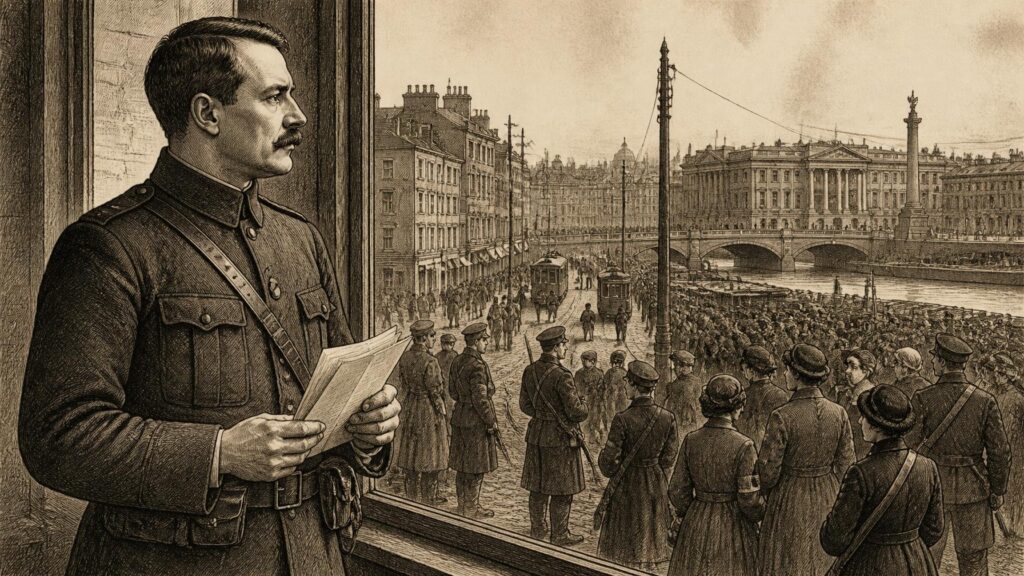
AI generated historical illustration, not a contemporary photograph.
At a Glance
James Connolly was one of the most formidable and disputed figures in modern Irish history: an Edinburgh-born child of Irish migrants, a self-educated socialist, trade-union organiser, republican propagandist, military commander and, after his execution in 1916, an enduring political symbol. His importance lies not simply in his part in the Easter Rising, but in his attempt to make social equality inseparable from national freedom. That attempt did not produce the workers’ republic he envisaged, yet it permanently altered the language through which Irish independence, labour and citizenship could be argued.
Edinburgh Origins
James Connolly was born on 5 June 1868 in the Cowgate district of Edinburgh, one of the city’s poorest quarters. His parents, John Connolly and Mary McGinn, were Irish Catholic migrants, probably with roots in County Monaghan, and their family belonged to the large Irish community whose labour helped sustain Victorian Scotland while whose lives were often marked by insecure work, overcrowding and poor health. The detail matters. Connolly was neither born in Ireland nor raised in the rural Ireland that nationalist mythology often presented as timeless and homogeneous. He came from an urban, migrant, working-class world within the United Kingdom, and his Irish identity was formed amid the inequalities of industrial capitalism and imperial rule.
His childhood was materially harsh. He left school young, worked in a succession of poorly paid jobs and acquired much of his education independently. Later admirers sometimes turned this self-education into a simple tale of exceptional genius. The documented reality is more useful: Connolly read seriously and persistently, developed a powerful command of political prose, and learned to connect immediate working-class grievances to broad arguments about history and power. That intellectual achievement was extraordinary, but it was not solitary. It emerged from the associational culture of late nineteenth-century socialism: meetings, pamphlets, libraries, newspapers, trade societies and arguments conducted in public halls.
As a teenager he joined the British Army. The exact circumstances surrounding his enlistment and departure have generated some uncertainty, partly because Connolly later gave limited and occasionally inconsistent accounts of his early life. What is secure is that he spent several years stationed in Ireland, principally in Dublin, and that his service brought him into direct contact with the country whose political future would define his adult life. He married Lillie Reynolds, a Protestant woman from County Wicklow, in Scotland in 1890. Their marriage and family life complicate any crude representation of Connolly as motivated by a narrow religious nationalism. His household crossed inherited confessional boundaries, while his mature politics condemned sectarian division as a weapon used against working people.
Connolly returned to Edinburgh after leaving the army and became active in socialist circles. In this period he encountered Marxist ideas, labour organisation and the arguments of British and Scottish radicals. He was not merely importing a ready-made doctrine into Ireland. From the beginning, he asked how socialism might address a society shaped by conquest, land conflict, religious division, emigration and the constitutional relationship with Britain. The distinctive character of his later politics lay in this effort to interpret Irish nationality through class, and class through the unfinished history of Ireland.
Socialist Formation
Connolly’s early socialism was practical as well as theoretical. He worked with organisations that sought the political representation of labour, the extension of democratic rights and the collective ownership or control of economic life. His convictions hardened in an age when industrial workers possessed few protections and when the franchise excluded many of those whose work sustained urban economies. He came to regard capitalism not as a regrettable feature of society but as a system based on the appropriation of workers’ labour by employers, landlords and financiers.
He also became convinced that nationalism without social transformation would leave the essential structures of exploitation intact. In later writing he made this point with deliberate sharpness, asking what value political freedom had if landlords and capitalists remained free to command housing, wages and employment. Such language was polemical, intended to provoke nationalist audiences accustomed to placing constitutional questions first. Yet the underlying argument was consistent: a change of flag or parliament would not automatically transform the lives of people living in Dublin tenements, working irregularly on the docks, or labouring in insecure industries.
That position did not mean Connolly rejected national independence as irrelevant. Rather, he increasingly argued that the Irish working class needed both political self-government and social ownership. The relationship between those aims changed across his life, and historians rightly resist reading his later revolutionary choices back into his earliest years. In the 1890s he was building a socialist movement before he was planning an insurrection. His early activity was directed towards organisation, propaganda, elections and education; violence was not the central instrument of his programme.
His developing political style was already conspicuous. Connolly wrote with compression, irony and moral force. He disliked deference to respectable authority and distrusted constitutional leaders whom he believed treated workers as electoral foot soldiers. He could be intellectually generous towards historical radicalism while merciless towards contemporary opponents. This made him an effective journalist and speaker, but it also gave his political writing a tendency to divide actors into sharply opposed camps. That tendency later contributed to both the clarity and the limitations of his analysis.
Dublin Arrival
In 1896 Connolly moved with his family to Dublin to become paid organiser and secretary of the Dublin Socialist Club. The move was decisive. Dublin was then a city of striking contrasts: administrative and commercial importance stood beside appalling housing conditions, pervasive casual employment and high mortality in the poorest districts. Connolly founded the Irish Socialist Republican Party, a small body with ambitions far larger than its immediate membership, and edited its newspaper, The Workers’ Republic. The paper became his principal platform for joining social questions to the cause of Irish national self-determination.
The party’s name announced a synthesis. Connolly did not see socialism as an imported doctrine that had to be set against Irish nationality; nor did he accept that national liberation could be entrusted to property-owning patriots. He called for an Irish republic in which economic power would be reorganised in the interests of those who worked. His argument was not that every Irish person shared the same material interest merely by virtue of nationality. On the contrary, he argued that Irish employers, landlords and financiers could exploit Irish workers no less effectively than British ones.
The organisation remained small and under-resourced. Connolly’s own economic situation was often precarious, and political work was constrained by the demands of supporting a growing family. It would be misleading to picture him as commanding a mass socialist movement in late Victorian Dublin. He did not. The importance of the Irish Socialist Republican Party was intellectual and organisational rather than numerical. It supplied a language, a newspaper and a cadre through which a specifically Irish socialist republican tradition could be articulated.
During these years Connolly also began the historical work that would later become central to his reputation. He looked backwards to the United Irishmen, the land struggle, the Fenians and earlier forms of communal organisation, seeking a genealogy for the claim that Irish freedom ought to belong to the people who laboured. His historical interpretation was purposeful rather than detached. It treated the past as political ammunition. Modern readers should therefore distinguish between Connolly’s importance as a historical thinker and the reliability of every historical assertion he made. His work remains illuminating, but it was written to persuade and mobilise.
Atlantic Years
In 1903 Connolly travelled to the United States on a lecture tour and in 1904 his family joined him there. The American years were not an exile from Irish politics but an expansion of the world in which he pursued them. Irish nationalism, American socialism, industrial unionism and radical journalism overlapped in cities such as New York, where migrant communities maintained dense political networks. Connolly encountered a labour movement operating on a far larger industrial scale than Ireland’s, as well as the sharp racial, ethnic and occupational divisions that complicated appeals to working-class unity.
He was involved with the Socialist Labor Party and later associated with the Industrial Workers of the World, while founding the Irish Socialist Federation in New York and editing The Harp. His affiliations shifted, sometimes amid bitter disputes characteristic of American socialist politics. These experiences made him more committed to industrial unionism: the organisation of workers across crafts and occupations into powerful bodies capable of confronting employers. The ideal often associated with this approach was ‘one big union’, a united industrial force rather than a fragmented collection of skilled trades.
Connolly’s American career was neither uninterrupted success nor mere political apprenticeship. He struggled financially, took ordinary employment, debated rivals and experienced organisational setbacks. It nevertheless sharpened his view that unions should be instruments of social transformation rather than narrowly defensive associations. It also reinforced his conviction that Irish independence had international dimensions. Ireland’s position, in his view, could not be separated from British imperial power or from the global circulation of Irish migrants, capital and political ideas.
Two major works associated with his return period demonstrate the reach of this intellectual development. Labour in Irish History, published in 1910, argued that labouring people had repeatedly been neglected or betrayed by the dominant political forces in Ireland. Labour, Nationality and Religion set out his case that socialism, national self-determination and freedom of conscience could be reconciled. These were not neutral textbooks. Connolly wrote as a partisan socialist, and his historical reconstruction often elevated class conflict into the principal explanation for diverse events. But his insistence that Irish history be read from below, through those who worked, rented, migrated and fought, made a lasting intervention.
Belfast Organiser
Connolly returned to Ireland in 1910, initially becoming organiser in Belfast for the Irish Transport and General Workers’ Union. The city presented a severe test of his politics. Belfast was industrially more developed than Dublin, especially through linen, engineering and shipbuilding, but was also divided by religion, residential geography and competing national allegiances. Connolly believed that class organisation could overcome those divisions. He opposed unionism as a political structure linked to privilege and imperial power, but he also tried to address Protestant workers as workers rather than treating them simply as enemies of Irish freedom.
That effort was principled and difficult. Connolly recognised that working people in Ulster had real fears about Home Rule and that sectarian loyalties were deeply embedded. Yet he tended to believe that economic solidarity could, if properly organised, weaken communal antagonism. His writing on proposed partition was especially uncompromising. He considered the division of Ireland an act that would intensify sectarianism and make collective working-class politics more difficult. Subsequent history gives his warning considerable force, though it does not prove that he had identified a viable political route through the conflict.
His Belfast work helped enlarge his trade-union experience, but the period did not produce a stable cross-community labour alliance. That failure should not be attributed to one man or one movement. Employers, churches, political organisations, housing patterns and the wider crisis over Home Rule all shaped the situation. Still, it reveals a continuing tension in Connolly’s political thought: he could identify the economic interests shared by Protestant and Catholic workers, yet he underestimated at times the independent force of national and religious identity.
In 1911 he moved into a more prominent role within the Irish Transport and General Workers’ Union, founded by James Larkin. The union’s growth offered Connolly something his earlier political organisations lacked: a mass membership rooted in workplaces. It also brought him into a partnership with Larkin that was productive, dramatic and ultimately troubled. Both men believed that workers needed militancy and organisation; their temperaments and methods, however, differed significantly.
Dublin Lockout
The Dublin Lockout of 1913 placed Connolly at the centre of a major confrontation between organised labour and employers. The dispute began when William Martin Murphy, a prominent employer and owner of the Irish Independent, moved against workers connected with Larkin’s union. It grew into a prolonged lockout involving tens of thousands of workers and their families. Employers sought to defeat the union by refusing employment to those who would not renounce it. Workers faced hunger, eviction, police violence and the exhaustion that accompanies a long industrial struggle without adequate resources.
Connolly was Larkin’s deputy and an important organiser, writer and speaker throughout the crisis. The lockout did not arise simply from abstract ideological conflict. It concerned the employer’s right to determine conditions and the union’s right to organise workers who were often casual, poorly paid and insecure. Connolly’s journalism made the moral stakes explicit, portraying the confrontation as evidence that Irish capitalism could be as coercive as any external oppressor. In this sense the dispute strengthened his belief that national rhetoric which ignored class power was hollow.
The struggle also exposed the limits of solidarity. British trade union support was substantial in important respects, including relief for Dublin families, but the British Trades Union Congress declined to support a sympathetic strike on the scale Larkin and Connolly desired. The workers returned under immense pressure, and the employers had prevented the union from securing the decisive victory it sought. To call the lockout an uncomplicated defeat, however, is inadequate. It enlarged the public presence of organised labour, deepened political consciousness among many participants and created institutions and loyalties that shaped the revolutionary years ahead.
It was during the lockout that the Irish Citizen Army emerged. Formed in 1913 to protect workers from police attacks and to provide discipline and solidarity, it was initially a defensive force rather than an army designed for national rebellion. Connolly played an important part in its development, alongside figures including Larkin and Captain Jack White. Its members drilled, marched and wore uniforms, but its social character was unusual in the Irish political landscape: it arose from a labour dispute and admitted women. The Citizen Army’s later place in the Rising should not obscure those origins.
The lockout also intensified Connolly’s public profile. He became identified with the city’s poor not merely as an analyst of their condition but as an organiser who remained engaged during a punishing conflict. His rhetoric could be severe, and his hostility towards Murphy and the employing class was unmistakable. Yet the lasting importance of 1913 lies in the connection it forged between labour militancy and wider ideas of Irish freedom. By 1914, Connolly had stronger organisational resources, a more recognisable public voice and a body of trained activists around Liberty Hall.
Citizen Army
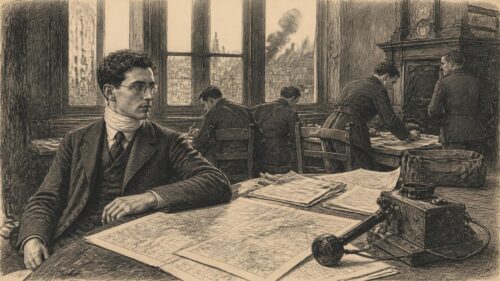
After Larkin left for the United States in late 1914, Connolly became acting general secretary of the Irish Transport and General Workers’ Union and assumed a leading role in the Irish Citizen Army. Larkin’s absence did not make Connolly his simple successor. The union faced financial and organisational strain after the lockout, while the outbreak of the First World War transformed the political environment. Nevertheless, Liberty Hall became the institutional centre of Connolly’s work: a trade-union headquarters, a newspaper office, a venue for political education and, increasingly, a military base.
The Citizen Army was small compared with the mass armies fighting in Europe and smaller than the Irish Volunteers. Estimates of those who mobilised at Easter 1916 generally place its active contingent at roughly a few hundred. Its historical significance is therefore not numerical. It represented a rare attempt to bind armed republicanism to a programme of labour emancipation, and it provided Connolly with a disciplined organisation whose loyalty was personal, political and practical.
Women held a more visible place in the Citizen Army than in many contemporary military formations. Constance Markievicz, Helena Molony and others performed organisational, medical, communications and combat roles. The Citizen Army’s constitution declared that women should be admitted on equal terms with men, an aspiration that did not erase the gendered assumptions of its time but was nevertheless notable. Connolly’s support for women’s political equality was genuine and repeatedly expressed. He saw no coherent democratic programme in denying women political rights while demanding freedom for the nation.
There is a temptation to imagine the Citizen Army as uniformly socialist, egalitarian and strategically coherent. The evidence suggests a more complicated body: committed members, limited weapons, imperfect training and a mixture of political motives. It was not a mass revolutionary army waiting to seize the state. But it gave Connolly a means through which the experience of industrial conflict could be translated into republican action. This transformation would become increasingly pronounced as war continued.
War Opposition
The outbreak of the First World War in August 1914 was a decisive rupture. Connolly opposed the war and condemned recruitment into the British armed forces. His opposition arose from socialist internationalism, anti-imperialism and the specific position of Ireland under British rule. He regarded the European conflict as an imperial war in which workers were being asked to kill one another for the interests of ruling classes and states. In Ireland, he believed, wartime appeals to loyalty threatened to subordinate labour and national demands to the British war effort.
His anti-war stance separated him from Irish Parliamentary Party leader John Redmond, who encouraged the Irish Volunteers to support Britain and the Allies. It also placed Connolly within a wider European crisis for socialism. Many socialist parties that had pledged international solidarity supported their own governments once war began. Connolly treated this as a profound betrayal. Yet his own response was not simply pacifist. He increasingly came to believe that armed rebellion in Ireland could be justified as resistance to imperial rule and as a blow against the political order that sustained the war.
During 1914 and 1915 Connolly’s newspaper, now titled The Workers’ Republic, became more militant. He attacked recruitment and warned that a settlement of the Home Rule question might leave Irish workers subordinated to employers and imperial interests alike. He was especially alarmed by proposals that contemplated excluding Ulster from a Home Rule settlement. His opposition to partition was rooted in both nationalism and class politics: he feared the institutionalisation of sectarian division and the weakening of all-Ireland labour organisation.
His language became increasingly insurrectionary. Here historians debate motive and timing. Some have emphasised his fear that the Citizen Army would be disarmed or suppressed if it did not act. Others stress the influence of wartime revolutionary expectation, the frustrations left by the lockout and his long-held conviction that constitutional nationalism could not deliver real emancipation. The evidence supports a combination rather than a single explanation. Connolly was not converted overnight from trade unionist to rebel; nor was Easter Week the inevitable conclusion of everything he had written. It was a decision shaped by an exceptional wartime crisis.
Revolutionary Convergence
By late 1915 Connolly’s militancy alarmed the Irish Republican Brotherhood, the secret organisation whose leaders were preparing an insurrection. The precise sequence of contacts is not wholly transparent, but by January 1916 Connolly and the Brotherhood’s military leadership had reached an understanding. He was co-opted onto the Military Council responsible for planning the Rising. This agreement joined organisations with different traditions: the Irish Volunteers, linked to militant nationalism; the Irish Republican Brotherhood, a secret revolutionary network; and the Citizen Army, rooted in the labour movement.
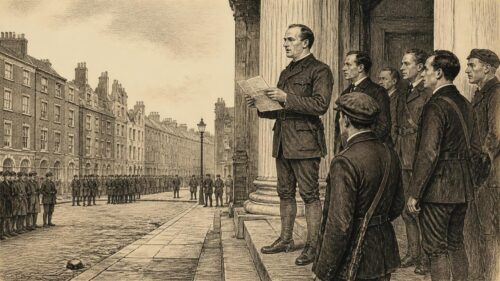
The alliance was consequential but not seamless. Connolly’s long-term objective remained a socialist republic, while many of his new collaborators did not share a developed socialist programme. The Proclamation of the Irish Republic, read outside the General Post Office on Easter Monday, addressed itself to Irishmen and Irishwomen, promised equal rights and equal opportunities to all citizens, and invoked the nation’s ownership by its people. Connolly is widely understood to have influenced its social and egalitarian language. However, no surviving draft permits every phrase to be assigned confidently to an individual author. The careful conclusion is that the document reflected a collective process in which Connolly’s presence mattered greatly.
His decision to join the planned rising has often been treated as paradoxical because he had criticised isolated conspiratorial action in earlier years. The paradox is real. Connolly had argued that political freedom without working-class power was inadequate and that labour required mass organisation. Yet he now allied himself with a secret revolutionary council preparing a rising that could not, by itself, establish socialism. His later defenders regard this as a realistic recognition that British rule had to be broken before democratic social transformation could advance. Critics argue that it subordinated labour politics to a nationalist military venture. Both readings identify a genuine tension in his final strategy.
Connolly apparently hoped that the Rising would have international reverberations and would make Ireland’s claim impossible to ignore. German assistance was expected by the republican planners, though its failure and the countermanding order issued by Eoin MacNeill gravely disrupted mobilisation. The Rising that began on 24 April 1916 was therefore far smaller and more geographically limited than its organisers had intended. Connolly proceeded despite those weaknesses, a choice that was courageous in one sense and militarily hazardous in another.
Easter Command
During Easter Week Connolly served as Commandant General of the Dublin Division of the Army of the Irish Republic and as vice-president of the Provisional Government. He was based in the General Post Office alongside Patrick Pearse and other leaders. Pearse was commander-in-chief, but testimony and later accounts consistently place Connolly in a central operational role. His previous army experience, Citizen Army command and practical aptitude made him one of the Rising’s principal military figures.
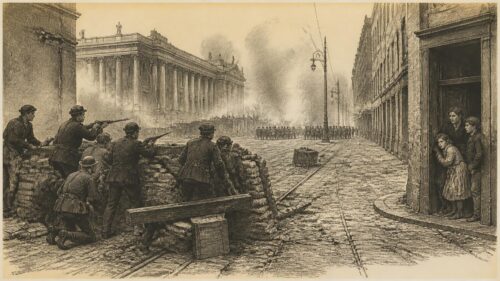
The GPO headquarters was strategically and symbolically important, but it was exposed. British forces initially struggled to respond to the multiple rebel positions, yet their superiority in numbers, artillery and weapons steadily asserted itself. The centre of Dublin suffered extensive damage, and civilians endured the danger of crossfire, shelling and fire. Any account that presents Easter Week only as heroic pageantry obscures this suffering. The Rising was an armed rebellion in a densely populated city, and its consequences were borne by combatants and non-combatants alike.
Connolly was wounded on Thursday, 27 April, receiving a serious injury to his ankle; accounts also refer to shoulder wounds. He remained involved in command after being carried inside the GPO. The headquarters became untenable as artillery and fire destroyed the building. On Saturday, 29 April, Pearse ordered a general surrender in an effort to prevent further civilian deaths. Connolly, incapacitated by injury, accepted the decision. The surrender ended organised resistance in Dublin, though its political consequences were only beginning.
The Rising did not immediately command popular approval. Contemporary reactions were diverse and could include anger, grief, confusion and hostility, particularly in a city devastated by fighting and facing wartime hardship. The subsequent executions changed the atmosphere. British military authorities executed fifteen leaders between 3 and 12 May. The sequence, the secrecy of court martial proceedings and the continued executions after public unease had begun to grow helped convert many participants into martyrs. Connolly’s execution was especially potent because he was badly wounded and unable to stand.
Trial Execution
Connolly was tried by court martial after the surrender. The surviving official record establishes that he was sentenced to death and that the sentence was confirmed within the military system established under martial law. The proceedings were swift and did not resemble a civilian trial with public hearings, a jury or the ordinary protections associated with peacetime justice. His physical condition was grave. Contemporary and later testimony agree that he was taken to Kilmainham Gaol on a stretcher and executed there on 12 May 1916.
The familiar image of Connolly being tied to a chair, or seated on a box, before a firing squad has become one of the most powerful scenes in Irish historical memory. The central fact is beyond dispute: he was executed while severely wounded and unable to stand. Some precise details of posture and arrangement vary among accounts, which were often recollected later and shaped by the emotional force of the event. The image should therefore be treated with care, not rejected. It conveys the brutality of executing a badly injured prisoner, but historians should avoid claiming certainty about every visual detail where the evidence differs.
He was the last of the Rising leaders executed. His body was buried in the military cemetery at Arbour Hill with those of the other executed leaders. Lillie Connolly was left widowed with surviving children, including his son Roddy, who had taken part in the Rising. The private cost of the rebellion is sometimes eclipsed by public commemoration. Connolly’s family had already experienced years of poverty, political disruption and separation; the aftermath of 1916 added bereavement to that burden.
The execution made Connolly a national figure on a scale that his lifetime activism had not achieved. It also encouraged simplification. Republican memory could celebrate him as a martyr for Irish freedom; labour memory could claim him as the champion of the workers; socialist traditions could elevate him into an Irish Marxist exemplar. Each image contains part of the truth, but none is sufficient alone. Connolly’s power as a symbol came partly from the fact that different movements could adopt him while disagreeing about what, precisely, he had meant.
Political Thought
Connolly’s thought is best understood not as a closed system but as a sustained argument about labour, nation and power. He believed that the people who produced wealth should control the social conditions under which they lived. He opposed landlordism, capitalism and imperial domination because he considered each a form of rule exercised over the many by the few. For him, an Irish republic worthy of the name required economic democracy, not merely national separation.
Labour in Irish History is his most influential historical work. It advances a strong thesis: that the aspirations of Irish freedom were repeatedly diverted, compromised or betrayed by propertied interests, while the working class carried forward the most democratic possibilities in the national tradition. The book was innovative in insisting that economic relations belonged at the centre of Irish historical interpretation. It was also selective and teleological. Connolly often read earlier movements as stages in a story culminating in socialist republicanism. His account can flatten differences among historical actors and overstate continuity between Gaelic communal structures, eighteenth-century radicalism and modern socialism.
That criticism does not diminish the work’s importance. Connolly challenged historical narratives that treated elite politics, constitutional manoeuvre and military leaders as the only subjects worthy of attention. He directed readers towards artisans, labourers, tenants, women, migrants and the urban poor. In doing so, he helped establish questions that later historians of labour and society would pursue with greater archival range and methodological caution.
His approach to religion was equally distinctive. Though raised Catholic, he opposed clerical domination of politics and defended freedom of conscience. He rejected the idea that Irish national identity should be defined by Catholicism. This position was essential to his effort to reach Protestant workers in Belfast and elsewhere. It also brought him into conflict with clerical critics who regarded socialism as hostile to religion and social order. Connolly could be sharply anti-clerical, but he did not make atheism a condition of socialist commitment.
Women’s equality was another substantive part of his public politics. He supported women’s suffrage and argued that a movement which excluded women could not claim to represent human freedom. The Citizen Army’s formal admission of women reflected this conviction. Yet, as with most radicals of his era, his practice and language remained shaped by the gender assumptions around him. His significance lies not in having escaped his period altogether, but in having placed women’s citizenship inside the democratic claim of the republic.
Contested Memory
Connolly’s memory has never belonged to one tradition. In the years after independence, official commemoration often incorporated him into a national pantheon centred on 1916, while the social revolution he advocated remained unrealised. Labour activists invoked his name in strikes, elections and campaigns for housing, wages and public ownership. Republican organisations, constitutional and otherwise, portrayed him as a martyr of national liberation. Socialists in Ireland and abroad found in him a thinker who refused to separate anti-imperialism from class politics.
These appropriations have sometimes required simplification. A purely nationalist Connolly risks losing the socialist who warned that green flags would not feed the poor. A purely socialist Connolly can overlook the depth of his commitment to Irish independence and his willingness to take military action for it. A commemorative Connolly, fixed forever in the chair at Kilmainham, can obscure the organiser who edited newspapers, negotiated union disputes, studied history and lived through repeated political disappointments.
Folklore has naturally accumulated around so emblematic a death. Recollections of his final words, exact movements and exchanges at Kilmainham vary in wording and provenance. Such material may reveal how communities remembered him, but it should not automatically be treated as a verbatim record. The same caution applies to anecdotes of military command during Easter Week. Witness testimony is indispensable, especially where official documentation is thin, but it is not infallible. Memories were often recorded decades later, and participants understandably framed events through later political loyalties and personal experience.
More recent scholarship has generally produced a fuller Connolly. It places him in Scottish and American as well as Irish contexts; attends to migration, family, religious identity and labour organisation; and distinguishes his published rhetoric from the circumstances in which he acted. This does not reduce his significance. It makes it more intelligible. Connolly was not an isolated Irish genius appearing suddenly in 1916; he was a transnational socialist shaped by the working-class Atlantic world and by the particular conflicts of Ireland.
Historical Assessment
Connolly’s historical importance rests on the breadth of his intervention. He helped create a vocabulary in which Irish freedom could be judged by housing, wages, ownership, gender equality and workers’ power. He was a significant trade-union organiser, especially in the orbit of the Irish Transport and General Workers’ Union; a major publicist whose work remains central to the intellectual history of Irish socialism; and a leader of the Irish Citizen Army in 1916. Few figures connect the labour struggles of 1913 and the Rising of 1916 as directly as he does.
He also embodied unresolved problems. His hope that class solidarity might overcome sectarian division was morally serious but politically incomplete. His expectation that national liberation could open the way to socialism underestimated the capacity of an independent state to preserve conservative social and economic arrangements. His choice to enter the Rising gave his ideals an enduring place in national memory, but it also involved a small force in a military action whose prospects were limited and whose civilian costs were real.
The Ireland that emerged from revolution and independence did not become Connolly’s workers’ republic. Labour remained politically significant, and trade unionism expanded, but property relations, social conservatism and unequal power persisted. Partition, which Connolly had denounced, became a defining fact of the island’s political life. In that sense, much of his programme was unfulfilled. Yet failure to realise a programme is not the same as historical irrelevance. His questions remain difficult precisely because they have not disappeared: who owns wealth, who controls work, whether citizenship can be equal amid severe inequality, and whether national freedom is meaningful without social justice.
Connolly should therefore be remembered neither as an unblemished saint nor as a figure whose contradictions invalidate his achievements. The documentary record shows a determined organiser and writer whose ideas evolved under pressure; a revolutionary who united causes that others wished to keep separate; and a man whose final act made him an icon but whose lifetime of labour was richer than the icon permits. To understand him is to understand that the Irish revolutionary decade was never solely a story of national sovereignty. It was also a struggle over what kind of society a free Ireland ought to become.