

Thinking Machines
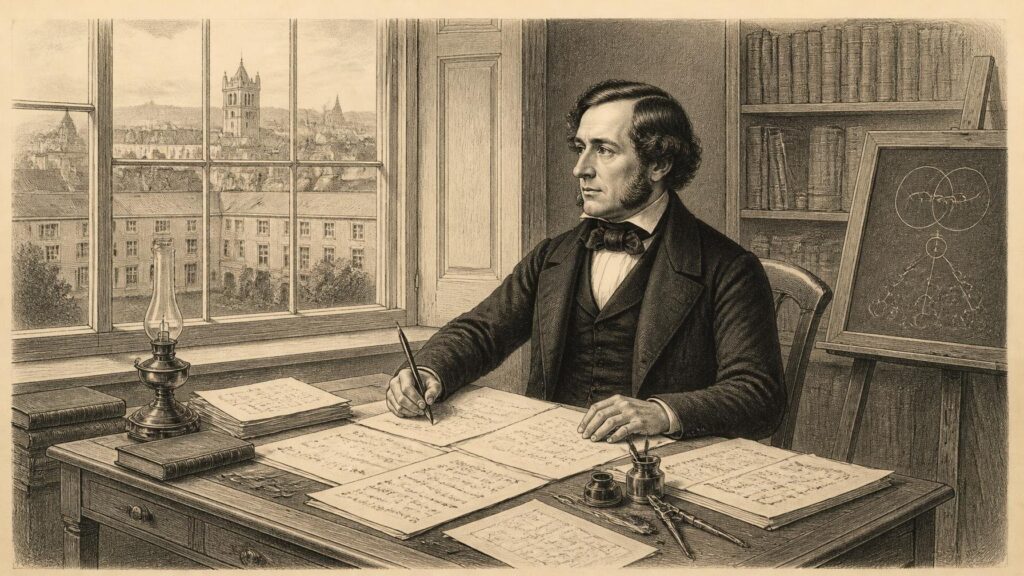
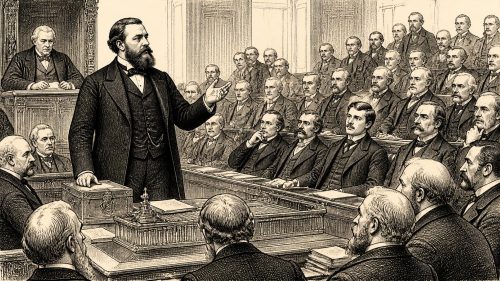
AI generated historical illustration, not a contemporary photograph.
At a Glance
Artificial intelligence is not an Irish invention, and to say otherwise would confuse a valuable connection with a national origin story. Yet Ireland occupies a significant place in the longer prehistory and later development of intelligent machines. That place begins most clearly in Cork, where George Boole turned logic into algebra during the nineteenth century, and continues through Irish universities, research networks, language technologies and public arguments about how computational systems should serve society.
Irish Connection
The phrase “artificial intelligence” belongs to the twentieth century, and the field normally dates its formal beginning to the Dartmouth summer research project of 1956 in the United States. That was where John McCarthy’s name for the subject entered common use and where programmes capable of limited symbolic reasoning helped establish a new scientific ambition: to make machines perform tasks associated with human intelligence. Ireland was not the site of that meeting, nor was it the sole source of the mathematics, engineering, psychology and philosophy from which AI emerged.
There is nevertheless a real Irish history to tell. Its first part is intellectual rather than technological. George Boole, the English-born mathematician who became the first Professor of Mathematics at Queen’s College Cork in 1849, developed an algebraic treatment of logic while living and teaching in Cork. His work did not create artificial intelligence in the modern sense. He had no electronic computer, no programme, no stored data, no neural network and no theory of machine learning. What he supplied was something more basic: a way of representing logical relations in mathematical form.
That distinction matters. Popular accounts often call Boole the “father of the information age” and draw a straight line from his classroom in Cork to every modern digital device. Such language is understandable as commemoration, but it compresses a long and difficult history. Between Boole’s nineteenth-century logic and contemporary AI lay developments in formal logic, electrical switching, communication theory, computer architecture, programming, statistics, hardware manufacture and data collection. Many were made elsewhere, by many people. Ireland’s connection is substantial precisely because it can withstand this qualification.
The historical question is not whether Cork somehow invented modern AI before its time. It is how an idea forged in a nineteenth-century Irish college became useful to later engineers and computer scientists, and how Ireland subsequently built institutions capable of participating in the new field. That question links local academic history to a worldwide transformation in the meaning of reasoning, information and intelligence.
Boolean Foundations
George Boole arrived in Cork at a remarkable moment. Queen’s College Cork opened in 1849, in the aftermath of the Great Famine, as one of the Queen’s Colleges established for higher education in Ireland. The college’s founding ambitions combined practical improvement with intellectual cultivation. Its first intake was small, its circumstances were far from easy, and debates about education, religion and public authority surrounded it. Within this new institution, Boole held the chair of mathematics from 1849 until his death in 1864.
Boole had not followed the conventional route of an English university mathematician. Born in Lincoln in 1815, he was largely self-taught and supported himself through teaching before gaining wider recognition. His appointment in Cork gave him reliable employment, students and the time in which to pursue original research. University College Cork’s archival account preserves the basic chronology: he was first Professor of Mathematics at Queen’s College Cork, published An Investigation of the Laws of Thought in 1854, and remained in Cork for the rest of his life.
The title of that book can mislead modern readers. Boole was not proposing a mechanical replica of the human brain. He was investigating the logical structure of propositions and classes: statements concerning things included, excluded or combined with one another. He treated such relations with symbols and operations analogous to those of algebra. In a simplified later form, the values true and false, or one and zero, can be combined through operations commonly rendered as AND, OR and NOT. A statement may be true only when two conditions hold; a class may include one group or another; a category may be negated.
This was a striking change in the treatment of logic. Traditional logic had often been taught through verbal forms and syllogisms. Boole sought a calculus in which logical relations could be manipulated with a rigour resembling mathematics. His project was philosophical as well as technical. He believed that reasoning had discoverable laws. Yet the historical importance of his work was not confined to his own account of the mind. Subsequent logicians altered, corrected and extended his system. The modern notion of Boolean algebra is therefore related to, but not identical with, every detail of Boole’s original work.
This is an important point of evidence rather than pedantry. Later generations adapted Boole’s ideas for purposes he could not have anticipated. The mathematical language developed around binary states proved exceptionally suitable for circuits that could be open or closed, energised or unenergised. From that fit came one of the crucial bridges from symbolic logic to digital engineering. The bridge was constructed decades after Boole’s death, and it was built by an international succession of mathematicians and engineers.
Cork Context
Boole’s Irish years were neither a brief honorary association nor an incidental residence. He taught at Cork for fifteen years, participated in the life of the college and the city, and produced major work there. University College Cork records his involvement with the Cuvierian Society and notes that he lectured across Arts and Engineering in his final academic year. The surviving associations are tangible: the Boole Library holds editions of his works and archival materials, while the university’s Aula Maxima includes a commemorative window.
Cork also shaped the human circumstances of his work. Boole met Mary Everest in the city; they married in 1855 and raised a family. Their daughter Alicia later became an important contributor to geometry. The family story is sometimes invoked because Geoffrey Hinton, a major figure in modern neural-network research, is a descendant of George and Mary Boole. It is an arresting connection, but it ought not to be treated as a hereditary explanation for scientific achievement. It is family history, not an intellectual chain of transmission.
Another well-known story concerns Boole’s death. He walked through severe rain to lecture at the college, fell ill and died in December 1864, aged forty-nine. The bare outline is documented, though later retellings have sometimes turned it into a parable of the absent-minded scholar sacrificing himself to duty. The historical record supports the rain, illness and early death; it does not require embellishment. Such stories reveal the affection in which Boole came to be held, but they should not replace the less romantic work of reading what he wrote.
It is also necessary to resist retrospective nationalism. Boole was born in England, educated outside Irish universities and worked within a college created under British rule in Ireland. To describe him simply as an Irish mathematician would obscure that history. To remove Ireland from the story would be equally misleading. His mature academic career, his professorship, his household and the publication of his best-known book were closely bound to Cork. His legacy is properly part of Irish intellectual history, while also being part of British, European and global history.
This layered identity is a useful model for the history of technology. Ideas rarely belong to one nation alone. They travel through books, universities, correspondence, professional societies, companies and migration. Ireland’s role in AI has likewise been shaped by international circulation: overseas theories and equipment, multinational firms, European research programmes and Irish scholars working across borders. The Cork connection is strongest when understood as a place where global knowledge was made, not as an isolated national miracle.
Logical Ambitions
Boole’s work offered later thinkers a powerful lesson: reasoning could be formalised. If logical statements could be given a symbolic structure, then some aspects of inference might be checked, transformed or calculated without relying entirely on intuition. This possibility became central to several later traditions, including mathematical logic, the theory of computation and what would eventually be called symbolic AI.
Formalisation, however, is not the same as intelligence. A calculation can follow rules perfectly while understanding nothing in the human sense. Boole’s algebra concerned relations that could be represented precisely; it did not solve perception, learning, language, emotion, judgement or consciousness. The distinction has remained at the heart of AI debates. Some researchers have pursued systems built from explicit representations and rules. Others have concentrated on statistical pattern recognition and learning from data. Most practical systems combine carefully designed structures with empirical methods to varying degrees.
For historians, the temptation is to make every earlier theory of reasoning a direct ancestor of AI. The temptation should be resisted. Aristotle’s logic, medieval scholastic argument, calculating machines and nineteenth-century algebra all form part of a long prehistory of mechanised reasoning, but none is identical with a contemporary computer system. The proper word is influence. Boole supplied an influential formal language that later became technically useful. That is more accurate, and more impressive, than claiming he foresaw every consequence.
The modern field also contains contrasting intellectual traditions. Logic-based AI sought to represent knowledge and draw conclusions by formal inference. Its advocates hoped that commonsense reasoning, planning and action might be rendered explicit enough for machines to use. Other approaches, especially those now described as machine learning, have placed less emphasis on hand-written logical rules and more on models trained from examples. The prominence of one approach over another has shifted repeatedly as available data, computing power and mathematical techniques have changed.
Boole belongs most obviously to the first of these histories: the history of logic. Yet even this must be stated carefully. His original algebra was not simply the modern binary notation taught in introductory computing. Later logicians refined the concepts, changed conventions and separated Boolean algebra from elements of Boole’s own interpretation. Historical accuracy does not diminish the Cork achievement. It shows why the achievement endured: it opened questions that others could develop in unexpected directions.
Mechanical Precedents
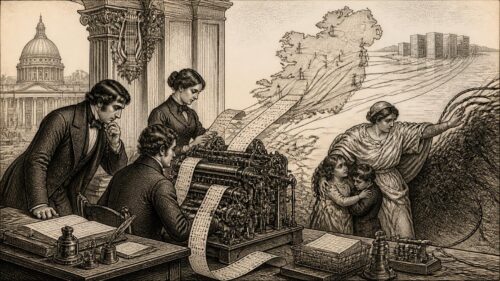
Before electronic computers, machines had already transformed calculation. Tables, slide rules, mechanical calculators and punched-card systems made numerical work faster and more regular. In the nineteenth century, Charles Babbage imagined engines capable of carrying out complex sequences of operations, while Ada Lovelace reflected on the possibility that a machine might manipulate symbols according to rules. These projects did not yield a working general-purpose computer in their own time, but they broadened the imaginative horizon of what machinery might do.
Ireland participated in this wider culture of calculation through education, surveying, astronomy, commerce, administration and engineering, though it did not possess a separate, self-contained industrial computer revolution. State records, railways, shipping, banks, insurance offices and universities all depended increasingly on standardised information and numerical methods. The historical significance of such practices lies not in calling them AI, which they were not, but in recognising the administrative conditions from which later computing would grow.
The difference between calculation and reasoning was often blurred in popular expectation. Mechanical devices could add, subtract and tabulate; enthusiasts sometimes imagined that they would eventually think. Such hopes were not wholly foolish, but they were speculative. A machine can perform a formal operation without possessing judgement, intention or experience. Nineteenth-century debates therefore anticipated, in a loose way, later disputes about whether intelligence means correct performance, internal understanding, human resemblance or something else altogether.
In Irish public memory, the figure of Boole provides a convenient anchor for this larger story because logic has a more obvious relationship to reasoning than a ledger machine does. Yet the historical pathway was indirect. The key change came when symbols could be physically embodied in electrical states and when machines could carry out long sequences of operations at speed. Only then did the formal possibilities of logic acquire a material infrastructure commensurate with the dream of automated reasoning.
That material history cautions against a purely heroic account. No individual mathematician “invented” the digital world. Logic needed engineers; engineers needed components, manufacturing, standards and capital; computers needed programmers, operators and institutions. The story of AI has always been social as well as intellectual. Ireland’s later experience reflects this truth, for its AI capacity has depended not solely upon famous names but upon education, public funding, telecommunications, research collaboration and access to international technical communities.
Electronic Reckoning
The decisive connection between Boolean reasoning and electronic design emerged in the twentieth century. Engineers working with switching circuits recognised that propositions and logical operations could be represented by arrangements of relays and, later, electronic components. Claude Shannon’s celebrated work on relay and switching circuits demonstrated the practical value of algebraic logic for circuit analysis. It was one of the major steps through which logic became an engineering language.
The significance of this development is often rendered as a neat equation: Boole invented binary logic, Shannon made it electrical, and computers followed. The sequence captures something real but remains too simple. Binary representation had older histories, electrical engineering had many parallel lines of development, and digital computers emerged through wartime needs, theoretical advances and institutional investment. Still, Boolean methods became indispensable to the design of digital systems. At the level of basic circuitry, they offered a disciplined way to describe conditions and transformations.
Electronic computing changed the scale of what machines could do. Rather than executing one isolated calculation, a programmable machine could undertake a sequence of stored instructions. It could sort records, calculate trajectories, process symbols, search possibilities and, in due course, respond to text, images and speech. The hardware was initially costly, large and restricted to governments, universities and major firms. Over time, declining costs and increased power brought computing into offices, homes, schools and pockets.
The phrase “thinking machine” became common in public discussion because electronic computers appeared to perform tasks previously reserved for trained people. They could play games, prove limited theorems, translate fragments of language and recognise patterns. Yet such demonstrations also provoked philosophical questions. Was a machine genuinely thinking, or only simulating the outward signs of thought? Did success at a defined task amount to intelligence? Could a system reason without consciousness? These questions have never been settled merely by technical progress.
For Ireland, the electronic era created a new kind of connection to Boole. His name moved from historical mathematics into the vocabulary of computer science: Boolean values, Boolean expressions, Boolean operators and Boolean search. Students encountered “true” and “false” in programming languages without necessarily knowing that the name referred to a nineteenth-century professor in Cork. The local memorial and the everyday technical term thus came to reinforce one another, although the original intellectual context had become distant.
Computing Arrival
The arrival of modern computing in Ireland did not occur in a single dramatic moment. It was a gradual process involving universities, public administration, commercial users and international firms. Early computers were expensive assets requiring specialist staff, purpose-built accommodation and carefully managed access. Their first uses were commonly numerical, administrative or scientific rather than recognisably artificial intelligence. This was normal internationally: general computing infrastructure had to exist before specialised AI research could flourish.
Irish higher education was important in this transition. Mathematics departments, engineering schools and emerging computer-science courses trained people able to work with programming, systems design and formal methods. University research created space for work that had no immediate commercial application, while companies and public bodies supplied practical problems, equipment and employment. The relationship was reciprocal. A small country could not reproduce every global centre of computing, but it could cultivate areas of expertise and connect them to wider networks.
This history should not be romanticised as uninterrupted progress. Computing resources were unevenly distributed, and institutional priorities changed with economic conditions. Researchers faced the familiar constraints of small systems: limited budgets, difficulty retaining staff and dependence on external technology suppliers. At the same time, Ireland’s later economic development, international business links and English-language educational environment made it an attractive location for technology activity. The result was an ecosystem in which locally trained researchers could collaborate with multinational industry and overseas universities.
AI appeared within that ecosystem as a cluster of methods rather than one machine or profession. Expert systems, natural-language processing, pattern recognition, robotics, optimisation, data mining and machine learning each had somewhat different histories. A person working on a database, a speech system or a medical decision tool might not have used the same label for their work at every period. Retrospective accounts should therefore avoid treating AI as a fixed object moving unchanged through time.
What did persist was the desire to automate difficult informational tasks. In Ireland, as elsewhere, the most durable applications were often modest and specific: finding relevant documents, detecting patterns in data, translating defined kinds of text, helping professionals make decisions or tailoring digital services. Such systems could be valuable without possessing general intelligence. The history of AI is filled with grand claims, but its social effects frequently arrive through narrow tools embedded in ordinary institutions.
Research Networks
A more distinctly national AI research infrastructure became visible in the early twenty-first century. Public research funding increasingly treated data, digital media and intelligent systems as strategic areas. This did not mean that all relevant work was centrally directed. Rather, it linked university groups that had developed expertise in different places and disciplines. The result was a networked model suited to Ireland’s scale.
Insight, established by Science Foundation Ireland in 2013, brought together research capacity in data analytics across Dublin City University, University College Dublin, University College Cork and the University of Galway, with further partner institutions. Its formation represented an effort to coordinate work that had previously been distributed among separate university centres. Its remit has included data science, machine learning, sensing, decision-making, governance and trustworthy AI.
The importance of such a centre is historical as well as administrative. It shows a shift from isolated computing projects towards organised national capacity. AI requires more than individual brilliance. It needs sustained training, shared equipment, research management, ethical review, access to data, partnerships with public and private bodies, and channels through which discoveries can be tested. Networked institutions make these conditions more durable than short-lived projects or single appointments.
ADAPT, led from Trinity College Dublin and involving a wider group of Irish institutions, developed another major strand: AI-driven digital content technology. Its work has included language technology, text and speech processing, personalisation, human-computer interaction, data management and the study of responsible digital systems. Here Ireland’s historical strengths in education, publishing, cultural production and multilingual life met the computational problems of a digital public sphere.
These centres should not be described as proof that Ireland has solved AI or secured a permanent advantage. Research organisations are contingent creations, dependent on funding, policy and people. Their value lies in the capacity they make possible: the ability to ask long-term questions, train researchers, collaborate internationally and subject applications to scrutiny. In this respect, they are heirs to the university culture that once gave Boole room to develop ideas in Cork, though the scale and context are vastly different.
Language Technology
The Irish language gives the country a particularly distinctive stake in AI. Technologies trained mainly on large, commercially valuable languages can leave smaller languages poorly served. Speech recognition may misunderstand them; translation systems may have little reliable material from which to learn; digital assistants may not support them; search and educational tools may reproduce uneven access. These are not merely technical inconveniences. They affect whether a language can be used naturally in contemporary public and private life.
Irish-language technology therefore connects AI to cultural continuity. Machine translation, terminology resources, speech systems and text-processing tools can make it easier to write, learn, search and communicate in Irish. Their success depends on high-quality language data, careful linguistic knowledge and continuous evaluation. A system that produces plausible but inaccurate Irish can be more damaging than one that openly admits its limits, particularly in education, public information or legal and administrative contexts.
There is a historical irony here. Boole sought to make logical form amenable to symbolic treatment; modern language technology must confront the fact that human language exceeds simple formalisation. Meaning depends on context, idiom, history, speaker intention and social convention. Irish, like every language, contains variation across regions and communities. It has a literary inheritance, a changing spoken life and relationships with English that cannot be reduced to a tidy database.
This does not make computational work futile. It makes it a matter of stewardship. Researchers can build tools that support speakers, learners, translators and public services, while recognising that a language belongs to its users rather than to a model. The strongest applications are developed with linguistic communities and subject specialists, not imposed upon them as technological solutions from outside.
Language technology also demonstrates why the category “AI” can obscure as much as it reveals. A translation model, an automatic speech recogniser and a recommender system share computational techniques, but they create different risks. Translation may flatten cultural nuance; speech systems may privilege certain accents; recommendation may direct attention in commercially advantageous ways. Historical understanding begins by asking what a system does, whose material it relies upon and who bears the cost when it fails.
Data Politics
The modern AI revival has depended heavily on data. Earlier symbolic systems often relied on rules explicitly supplied by programmers or experts. Contemporary machine learning commonly identifies statistical regularities from large collections of examples. The performance of a model may improve with better data, more computing power and a suitable training method, but these ingredients also raise difficult questions about consent, ownership, representation and power.
Ireland’s history in this respect is shaped by its position within a global digital economy. International technology companies have established major operations in the country, while Irish users, workers, public bodies and cultural institutions generate and manage large volumes of information. This has made Ireland an important place in wider arguments about data protection, platform governance and the regulation of digital technology. The issue is not simply whether the state can attract technical investment, but whether the social rules governing information are adequate.
AI systems inherit the limitations of their sources. If historical records underrepresent particular groups, languages, regions or experiences, a model trained on them may reproduce that imbalance. If labels are applied carelessly, the output can appear authoritative while encoding earlier prejudice. If a system is deployed in a consequential setting, such as welfare, employment, education, policing, health or credit, an error may affect real opportunities and rights.
Such concerns are not an argument against research. They are an argument against treating technical accuracy as the only form of accountability. A system may perform well on an aggregate test yet work poorly for people whose data were sparse or misclassified. It may save time for an institution while transferring burdens to the public. It may be difficult to challenge because the logic of a decision is hidden behind proprietary software or complex statistical methods.
Irish research programmes have increasingly used terms such as trustworthy, human-centred and responsible AI. These words should be judged by institutional practice rather than accepted as slogans. They imply questions about transparency, oversight, accessibility, environmental cost, bias, security and redress. The historical significance of this language is that it marks a change from earlier eras in which technical capability was often discussed separately from public legitimacy.
Public Governance
Government interest in AI reflects both opportunity and unease. Ireland’s national strategy, published in 2021 under the title AI Here for Good, presented AI as a technology that could support public services, enterprise, research and social benefit. It also acknowledged the need for trust, skills and appropriate governance. That balance is characteristic of the period. States seek economic advantage from AI while attempting to prevent discrimination, insecurity and misuse.
Strategies are not historical achievements in themselves. They are statements of intention, shaped by the assumptions of their time. Their language often promises innovation, competitiveness and inclusion together, even when these goals can conflict. A policy that encourages rapid adoption may leave too little time for public consultation. A system designed to improve efficiency may make individual judgement harder to access. A national ambition to become a leading AI location may depend on global firms whose priorities are not determined locally.
For that reason, the best historical reading of AI policy is neither celebratory nor cynical. It asks which problems a policy identifies, which institutions it empowers, which kinds of evidence it values and whose voices are missing. In Ireland, the presence of universities, regulators, language communities, civil-society organisations, workers and public-service users means that AI cannot be understood simply as an industry matter. It is also a question of democratic capacity.
The European context is especially important. Ireland is not regulating AI in isolation. European rules, cross-border data flows, shared research programmes and multinational platforms make national policy part of a larger legal and economic environment. This reduces the plausibility of a purely sovereign technological narrative, but it can also give Irish institutions leverage through common standards and collective action.
There is a further continuity with Boole’s world. Logic has always carried an aspiration to clarity: to make the structure of an argument visible and testable. Contemporary AI governance seeks, imperfectly, an analogous clarity about systems that can be opaque to those affected by them. The comparison should not be overstated. A modern model is not an algebraic proof. Yet both histories involve a desire to expose hidden operations to reasoned examination.
Historical Limits
Claims about AI often outrun evidence. This has happened repeatedly, from early predictions of imminent machine intelligence to later promises that data-driven systems would transform every sector without cost. Some applications have indeed changed daily life. Others have failed, proved too expensive, worked only under narrow conditions or created new forms of dependency. A historical article should preserve that unevenness.
One common error is to treat AI as a single agent. It is not. The label encompasses search tools, classifiers, predictive models, image generators, robots, language models, decision aids and many other systems. Their methods and consequences differ. An archive-search tool may be useful because it helps a historian discover material, while a model used to rank job applicants may require much stronger safeguards. General language about “AI” can conceal these differences.
A second error is technological determinism: the belief that machines arrive with fixed social consequences. In practice, outcomes depend on design choices, laws, institutions, workplaces and habits. The same predictive tool can be used to assist a professional or to replace judgement with an unchallengeable score. The same language technology can increase access or spread confident inaccuracies. History shows that technical capability does not decide these questions alone.
A third error concerns origins. Ireland’s connection to AI does not justify the claim that AI is fundamentally Irish. Boole’s work in Cork is a documented and important part of the intellectual ancestry of digital computing. It is not a substitute for the later histories of American, British, European, Soviet, Japanese, Canadian, Chinese and many other centres of research and manufacture. Nor can it account by itself for the rise of modern machine learning.
Folklore has a place in public memory, provided it is named as such. The image of Boole as the solitary genius whose logic directly made the smartphone, or the notion that a bloodline runs from him to present-day AI, offers an appealing narrative. It is not the most useful one. The documented story is better: a gifted scholar worked in Cork, produced a profound account of logical form, and left ideas that later communities transformed into tools and theories beyond his imagining.
Living Legacy
Boole’s continuing presence in Cork is more than ceremonial. Buildings, collections, teaching and commemorations keep his work visible in the place where much of his mature career unfolded. Such remembrance can serve an educational purpose when it encourages people to look beyond the simplified legend. The surviving books and papers invite readers to see him not as a modern computer scientist in nineteenth-century clothing, but as a mathematician and philosopher confronting the problems of his own age.
That historical distance is precisely what makes the legacy meaningful. It reminds present-day researchers that concepts can outlive their original uses. Boole could not have predicted semiconductor fabrication, global networks, large-scale datasets or machine translation. Yet his attempt to articulate the structure of logical relations proved adaptable. The lesson is not that every abstract idea will become a technology. It is that fundamental scholarship can acquire unforeseen public importance when later conditions make its insights usable.
Ireland’s contemporary AI landscape has developed through a comparable mixture of inheritance and adaptation. Universities have built specialist knowledge; national research centres have brought dispersed expertise together; language researchers have addressed the needs of Irish and other less-resourced languages; public policy has tried to connect innovation with accountability. None of these developments guarantees an equitable technological future. They do, however, give Ireland institutions through which that future can be debated and shaped.
The most enduring Irish contribution may therefore be neither a claim to have invented artificial intelligence nor a promise to dominate it. It is a tradition of asking how symbols, reasoning and communication can be made more intelligible. In Boole’s Cork this took the form of algebraic logic. In present-day research it appears in algorithms, language resources, human-computer interaction and governance. The forms have changed, but the underlying challenge remains: to use formal systems without losing sight of the human world they are meant to describe.
Thinking machines are never merely machines. They embody choices about what counts as knowledge, which patterns matter, whose language is recognised, how decisions are explained and who may contest them. Ireland’s documented connection to AI begins with a mathematician’s search for the laws of thought. Its continuing significance lies in ensuring that the systems built from logic, data and code remain answerable to the people among whom they operate.
The article’s careful separation of George Boole’s Cork work from modern artificial intelligence highlights how easily intellectual heritage can become a simplified national story. Boolean logic was foundational for later digital systems, yet Ireland’s contemporary AI capacity also depended on universities, public investment, international networks and language technologies. This makes the relationship between symbolic legacy and institutional development especially interesting. When considering Ireland’s future AI policy and research priorities, how should its history of Boolean logic inform decisions alongside evidence about education, infrastructure, multilingual technology and global collaboration in shaping responsible, socially useful artificial intelligence for diverse communities within Ireland?