

Wicklow’s New Shire1606 CE
Dateline
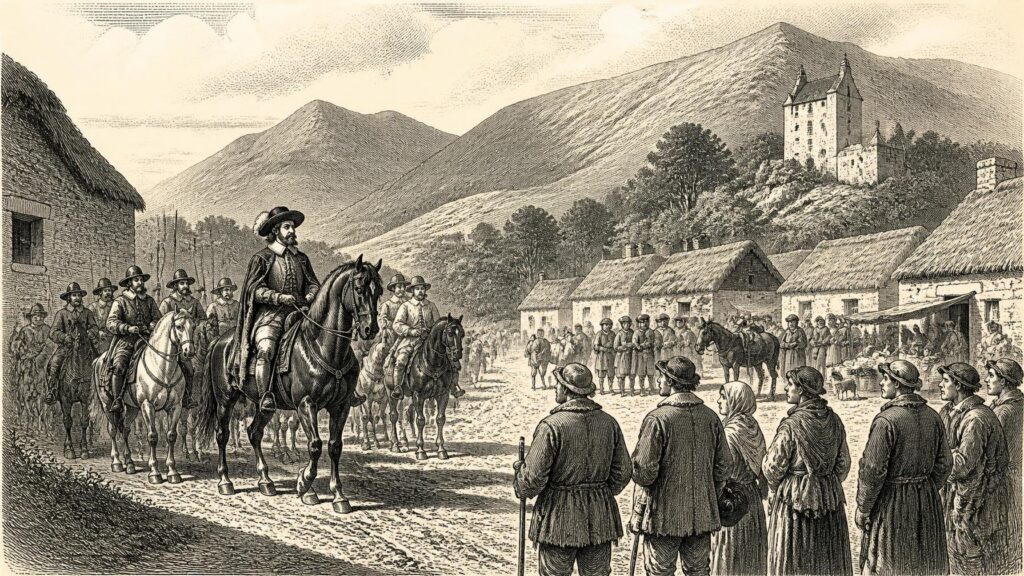
In 1606, the Irish kingdom was being remade less by one spectacular battle than by a series of administrative, legal and social interventions. Three years had passed since the end of the Nine Years’ War, but the settlement that followed remained insecure. Sir Arthur Chichester’s Dublin administration sought to make royal authority visible in places where it had been thin, contested or dependent on military force. A new county was set out in the Wicklow uplands; Scots began arriving in north Down under private landlords; courts travelled through Munster; Catholic townspeople met new pressure to attend Protestant worship; and Gaelic lords faced their lands being translated into Crown-defined property. These were not separate stories. Together they reveal how the government hoped peace would become permanent: through shires, surveys, rents, assizes, churches, fortified houses and obedient landholders.
A County Made in the Mountains
The most definite constitutional development of the year came in January, when an Order in Council provided for the erection of County Wicklow. The new shire gathered territories that had previously been divided between older jurisdictions, notably lands associated with Dublin, Carlow and the borderlands of the Pale. Part of the barony of Rathdown south of the River Bray, including Fercullen, Glencap and the Archbooles country, was explicitly to be joined to the new county.
This was not the creation of an empty space on a map. The Wicklow mountains and adjoining lowlands were home to powerful communities, especially branches of the O’Byrnes and O’Tooles, whose authority, kinship networks and knowledge of the terrain had long complicated government from Dublin. Roads, valleys and wooded uplands offered refuge to armed bands and made the distinction between local lordship, cattle-raiding, protection and rebellion difficult for Crown officials to control. Earlier schemes to organise the district had existed, but 1606 gave the project firmer administrative form. Wicklow became the last of Ireland’s traditional counties to be shired.
Shiring promised more than a new name. It meant sheriffs, juries, gaols, sessions and the extension of common-law procedure. In practice, it also meant that inhabitants could be assessed, summoned and punished through institutions intended to bypass or contain older local power. The change should not be mistaken for instant transformation. A county boundary did not abolish mountain routes, family allegiances or local armed capacity. Yet it made a powerful claim: the Crown now treated this difficult frontier beside Dublin as a place to be governed through routine civil offices rather than exceptional expedients alone.
North Down’s Sea Crossing
In north Down, a different but related experiment began in May. James Hamilton and Hugh Montgomery, Scots with access to the court of James I, commenced the settlement of their estates in Upper Clandeboye and the Ards. Their opportunity had emerged from the predicament of Con O’Neill, whose lands were divided after his pardon and a complicated series of grants and exchanges. The legal arrangements had taken shape during 1605 and continued into 1606; what mattered in this year was the practical arrival of settlers.
Families and workers crossed the North Channel from Scotland. Later accounts describe farmers alongside masons, carpenters, textile workers, merchants and clergy. Such lists should not be treated as a complete census of a single voyage, but they capture the character of the undertaking. The scheme required hands to clear and cultivate land, restore or construct dwellings, revive coastal communications, furnish markets and establish Protestant congregations. Donaghadee, Newtownards and the surrounding countryside were therefore becoming sites not merely of migration but of a planned alteration in settlement, production and landlordship.
Chichester’s letter of 14 June 1606 to the earl of Salisbury gives the official reasoning with unusual clarity. He supported Hamilton’s effort to ‘plant and settle’ lands he depicted as largely waste, arguing that settlement by ‘civil people’ would serve the king, secure dependable rents and require castles to be built. His language was interested rather than neutral. It diminished the claims of existing inhabitants and interpreted ground scarred by war through the government’s preferred vocabulary of improvement. Nevertheless, the letter shows that construction, revenue and security were inseparable in official thinking. A stone house or castle was to be a landlord’s residence, a military strongpoint and a sign that land had entered a new fiscal order.
This Down settlement was not the later Crown-directed plantation of much of Ulster, and it should not be retrospectively merged with it. It was a privately driven, royally favoured venture that demonstrated methods later familiar elsewhere: land titles recast through English law, a landlord’s obligation to build, settlement encouraged from Britain, and an expectation that people, rents and defence would be organised together. Its immediate human consequence was a reshaping of local society in an area where Gaelic communities had not disappeared and where Con O’Neill retained a portion of the former lordship.
Ulster’s Uneasy Peace
The same June brought a revealing appeal from Hugh O’Neill, earl of Tyrone. Writing from Dungannon to King James, he complained that investigations into his patent and the status of lands described as monastic or abbey property threatened to undo his estate. He asked the king to restrain those claims, particularly where the bishops of Clogher and Derry sought more than the customary rents they had formerly received. This was not an open rebellion. It was an argument in the language of patent, inheritance, rent and royal interpretation. Yet it exposed the fragility of the post-war accommodation: the earl’s position depended upon documents and definitions controlled by the very state with which he was negotiating.
Government personnel also changed. By June, Sir Henry Docwra had departed Derry, where he had been soldier, governor and promoter of the recently incorporated town since the final phase of the war. In July he was replaced as governor by Sir George Paulet. The handover mattered because Derry and the Lough Foyle region remained strategically sensitive, with overlapping military, ecclesiastical and Gaelic interests. A change of governor could alter access to patronage, justice and land as surely as it altered the command of a garrison.
Chichester’s June letter ranged beyond Down to the Route and Glens of Antrim, where he criticised Randal MacDonnell’s position and contemplated creating freeholders directly dependent on the king. His proposal was not simply about confiscation. It envisaged weakening concentrated lordship by giving some established inhabitants a more direct legal relationship with the Crown. That was a recurring imperial technique: turn tenants or dependants into freeholders, make rents answerable to the state, and make local authority divisible. Whether such designs could be implemented without generating fresh resentment was another question.
Courts, Churches and Town Life
Sir John Davies, attorney-general for Ireland, travelled through Munster during the Lent vacation of 1606 with the chief justice of common pleas. His report is valuable precisely because it is partisan. Davies repeatedly contrasted a supposedly ordered, cultivated Munster with a supposedly wild Ulster and treated English law as the measure of improvement. Those judgments reveal an administrator’s assumptions, not an impartial description of Irish society. They do, however, record the practical business of a travelling judiciary: crowded sessions, gaol deliveries, jury selection, contested titles, petitions and the pressure placed on towns.
At Waterford, Davies found the difficulty of drawing jurors from a society in which large kin groups overlapped with prisoners and witnesses. At Cork, the commissioners dealt with nearly a hundred citizens and burgesses who had been indicted for absence from church. They accepted the statutory penalties; the total, more than £60, was assigned towards a proposed hospital for the town’s poor and infirm. The decision joined religious discipline to civic welfare. It did not mean that Cork had become Protestant. Rather, a Catholic-majority urban population was being made to finance a charitable institution through fines imposed for nonconformity.
The pattern continued elsewhere. At Limerick, more than two hundred burgesses stood indicted for recusancy, and anticipated penalties were earmarked for repairing the damaged cathedral. Davies noted ruined parish churches, a shortage of re-established ministry and the incomplete preparation of Irish-language religious books. Enforcement was consequently uneven and highly local. Mayors, aldermen and wealthier merchants could seek time for religious disputation, while poorer inhabitants faced the smaller but cumulative twelve-pence penalty for every missed Sunday or holy day.
Davies’s circuit also offers a glimpse of economic burdens beneath the language of reform. At Cork, tenants complained that lords continued the exactions known as coshering and related customary demands, despite proclamations against them. Some who had lost parts of their freeholds because they could not meet wartime cess and contributions were restored. Further west and south, Munster plantation undertakers sought recovery of lands lost during the wars, but Davies criticised many for arrears of Crown rent, failure to inhabit or improve substantial acreage, and neglect of their obligations to settle English tenants. Thus the government’s own model colonists could be portrayed as inadequate landlords, while older local customs remained costly to tenants.
Land, Language and Allegiance
In Carbery, south-west Munster, Donal na bPíopaí MacCarthy Reagh surrendered his lordship to the Crown in 1606 and received it back in English legal form. The transaction did not erase the MacCarthy family’s local standing or income overnight. Its significance lay in translation: a Gaelic territorial lordship was being redefined as a Crown-recognised estate held under English tenure. In a period when patents, inquisitions and surveys could determine who possessed land, that shift was politically consequential.
Language formed part of the same contest for allegiance. It is sometimes said that William Bedell translated the Book of Common Prayer into Irish in 1606, but that cannot responsibly be presented as an achieved event of this year. Bedell was still in England and left for Venice in 1607. The relevant translation had been authorised late in 1605 for William Daniel, an Irish-speaking Protestant cleric. Davies reported in 1606 that the Irish New Testament and prayer book were not yet fully prepared; Daniel’s work was completed only later. The important fact for this year is therefore one of work in progress: the administration recognised that an English-only reformation could not readily reach Irish-speaking communities.
Wicklow’s new shire, the settlers arriving in Down, O’Neill’s petition from Dungannon, the courts of Munster and the unfinished Irish prayer book all belonged to a single unsettled peace. In 1606 the Crown was not simply restoring what had existed before war. It was advancing a new framework in which territorial power would be registered, land would yield secure rent, religion would be monitored, and authority would be carried by sheriffs, judges, clergy and settlers. The framework was ambitious; its human costs, local resistances and incomplete results were already visible.
Primary Sources
- Observations made by Sir John Davys, Attorney of Ireland
- Letter of Francis Bacon to Sir John Davies, Attorney-General of Ireland, 26 December 1606
- Calendar of the State Papers Relating to Ireland, of the Reign of James I: 1606–1608
- Hamilton, James
- Chichester, Arthur
- O’Neill, Hugh
- Daniel (Ó Domhnuill, O’Donnell), William
- Bedell, William
- Docwra (Dowkra, Dockwra, Dockwraye, Dockquerye, Docura), Sir Henry
- O’Doherty (Ó Dochartaigh), Cahir
- King, Murtagh (Ó Cionga, Muircheartach)
- Annals of the Four Masters, Volume 6 English Translation
- The Montgomery Manuscripts: 1603–1706
- Timeline: Hamilton & Montgomery Settlement
- Maps of the Settlement
- The Plantation of Ulster
- State Papers Ireland 1509–1782: Government Papers on Irish Affairs
- The Civil Survey AD 1654–56, Volume VII: County of Dublin, Introduction
- Wicklow History Book: The Last County
- The Irish Language in Co. Wicklow
- MacCarthy Reagh, Florence (Finian, Finghín)
- Our Story: MacCarthy Reagh Clan
- Ireland Under the Stuarts, Vol. I