

Rural Reform
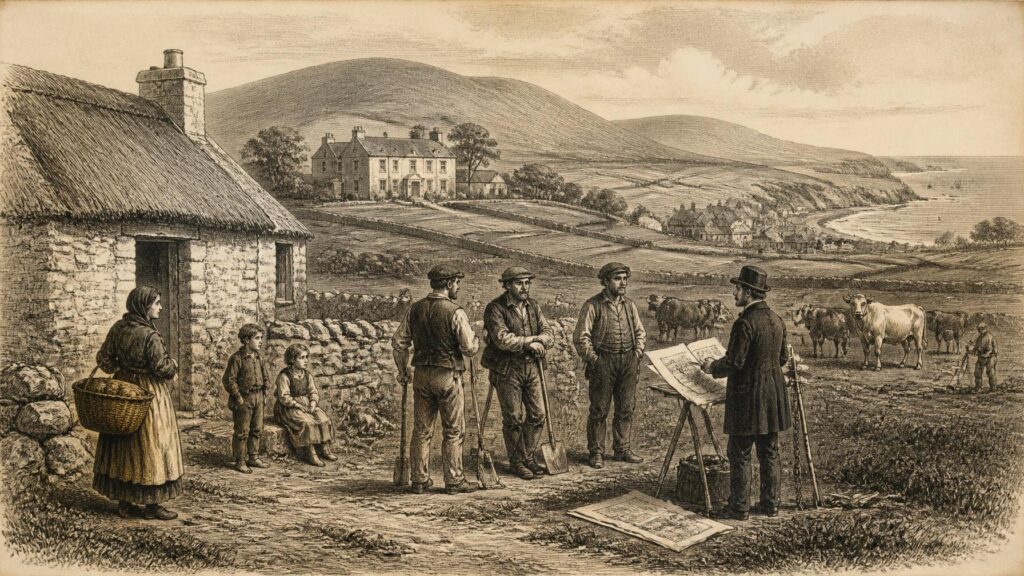
AI generated historical illustration, not a contemporary photograph.
At a Glance
Irish rural policy has never been merely a matter of farming. It has concerned ownership and inheritance, poverty and emigration, roads and schools, fisheries and co-operatives, environmental management and the uneven ability of communities to remain populated. Its history is therefore not a straight story of state improvement. It is a record of repeated attempts to make country life viable, usually under pressure from economic change, political conflict and the enduring disparity between better land and poorer land.
Policy Defined
“Rural policy” is a modern administrative expression, but the problems it describes are much older. In Ireland, governments and public bodies have long tried to influence the social and economic life of the countryside. They have altered land tenure, financed purchase, promoted agricultural instruction, subsidised drainage and roads, regulated fisheries, encouraged co-operation, distributed income support and, more recently, funded village renewal, broadband and environmental schemes.
Such intervention cannot be reduced to a benevolent tale of progress. Policy frequently served several objectives at once. British governments in the nineteenth century hoped to lessen rural disorder and make agriculture more productive. Nationalist reformers sought economic self-reliance and a countryside capable of sustaining an Irish nation. The Irish Free State sought stability, export earnings and social peace after revolution and civil war. Later governments wanted to modernise farming while limiting depopulation. European programmes combined market regulation with regional and environmental aims. Each purpose affected what was funded, who qualified and which districts received priority.
The term also needs geographical care. Before 1922, many important measures applied across Ireland. After partition, rural policy developed under two different political systems: the Irish Free State, later Ireland, and Northern Ireland within the United Kingdom. This account concentrates principally on the twenty-six counties while noting the all-island institutions and conditions that preceded partition. It does not assume that policies south of the border were automatically shared in the six counties.
Nor should “rural” be imagined as a timeless world outside modernity. Rural Ireland included commercial graziers, dairy farmers, labourers, fishermen, shopkeepers, teachers, seasonal workers and households combining small plots with wages, migration or remittances. A policy that aided one kind of household might do little for another. The history of rural reform is consequently a history of competing claims about what the countryside was for, and whom it ought to sustain.
Land Foundations
The central nineteenth-century issue was land. Much agricultural land was held under landlordism, with occupiers paying rent and possessing varying degrees of security. The arrangement was not uniform: farm size, quality, lease terms and local custom differed widely. Yet the insecurity and unequal power inherent in the system gave land an exceptional political importance. A bad harvest, low prices or a disputed eviction could become not simply a private misfortune but evidence of a wider social order thought to be unjust.
The catastrophe of the Great Famine transformed the context in which rural questions were discussed. It did not create every weakness in the rural economy, but it exposed the consequences of extreme dependence on small holdings, the potato and insecure access to land. Death, eviction, emigration and the restructuring of estates altered the population permanently. Later policy makers inherited a countryside in which population was far lower than before the Famine, while attachment to land remained intense and opportunities outside agriculture were limited in many districts.
Land legislation from the later nineteenth century progressively restricted landlord power and strengthened tenants’ claims. The reforms associated with the Land Acts recognised, in varying forms, fair rent, security of tenure and saleability of tenant interest. These measures did not abolish conflict. Indeed, they gave legal shape to demands that had been advanced through agitation, electoral mobilisation and, in some places, intimidation. But they changed the terms on which the countryside was governed.
The Land War of the late 1870s and early 1880s made clear that land was a national as well as local question. Relief, rent and political allegiance became entangled. Historical evidence shows that state agencies, landlords, clergy, charitable bodies and political organisations all distributed or influenced assistance during the crisis. It is too simple to portray rural people as passive recipients of rescue, or to regard every action as centrally directed. Tenants, labourers and local activists pursued their own strategies, often using the pressure created by hardship to pursue changes in tenure.
In this setting, rural policy was already broader than agriculture in the narrow sense. It involved the prevention of destitution, the management of disorder, the capacity of local institutions and the terms on which people could form households. Land reform promised greater security, but it could not by itself make poor soil fertile, create industries or end migration.
Ownership Transfer
The Irish Land Act of 1903 was a major landmark in the transition from landlord ownership towards occupying ownership. Its provisions encouraged voluntary sale by making state-backed purchase more attractive to landlords and tenants. The Act was not the first purchase measure, nor did it instantaneously transfer every holding. Nonetheless, it accelerated a profound redistribution of property that gave many tenant farmers a prospect of owning the land they worked.
The importance of ownership was both material and symbolic. Ownership could replace an uncertain rent with annuity payments, allow improvements to be made with greater confidence and confer a measure of independence upon the household. It also reshaped political language. The small proprietor became an ideal figure in nationalist and governmental thought: industrious, locally rooted and presumed to possess a stake in order and national stability.
That ideal concealed complications. The purchase system was more readily suited to viable holdings than to every claimant on the land. Agricultural labourers, cottiers and people with very small plots did not automatically become secure farmers. In congested districts, fragmentation and poor land made the issue particularly difficult. A transfer of title could be valuable, but it could not overcome inadequate acreage, weak access to markets or the shortage of paid employment.
The policy also depended on public credit and administrative machinery. Land transfer was not simply a transaction between two private parties. It required valuation, inspection, financing, conveyance and dispute resolution. In this sense the land programme helped expand the practical reach of government into rural life. The resulting records, maintained by bodies such as the Land Commission and related agencies, are an important source for historians, though they must be read alongside local experience rather than treated as a complete account of social reality.
Later memory often simplifies this process into a single liberation: landlords departed and farmers became owners. There is a documented foundation for the broad transformation, but the neatness of the popular version can mislead. Change occurred over time, involved numerous statutes and institutions, and left unresolved questions of landlessness, congestion, inheritance and farm scale. Ownership was decisive, but it was not a complete rural policy.
Western Poverty
The west of Ireland presented a particularly persistent policy problem. Parts of Connacht, Donegal, Kerry, Clare and west Cork contained many small, scattered holdings, difficult terrain and limited non-farm employment. Coastal communities might depend on a precarious combination of farming, fishing, seasonal work and remittances. The language of “congestion” came to describe not merely crowding but a perceived mismatch between population, land quality and available resources.
The Congested Districts Board for Ireland, established in 1891, was one of the most distinctive responses. Its remit extended beyond straightforward land purchase. It could support improvements, encourage fisheries and rural industries, aid migration or resettlement, and assist forms of local development. The Board represented an acknowledgement that the problems of poorer regions could not be resolved solely through general land legislation.
Its work deserves neither dismissal nor uncritical celebration. Documentary evidence shows sustained activity in land acquisition, the enlargement of holdings, fisheries and infrastructural efforts. In some places it made practical differences to farms, harbours and settlement patterns. It also generated considerable paperwork, surveys and official reporting. Yet the Board’s resources and authority had limits. It could not produce an industrial economy across the western seaboard, reverse every pattern of emigration or make all small holdings viable.
Contemporary critics often argued that the Board moved too slowly, retained too much land in preparation, or failed to confront the deeper distribution of land. Such criticism is historically useful because it shows that the Board was judged against high expectations. It should not, however, be mistaken for neutral measurement. Nationalist newspapers, local campaigners and political figures wrote from particular positions and frequently used rural suffering to make wider arguments about British government.
Folklore and family tradition in the west often preserve strong memories of poverty, migration and small farms. They can reveal how policy was experienced emotionally and socially, especially where official files are silent about domestic decisions. But they should not be used as statistical proof. A remembered story of a family leaving for America, or of land gained through a scheme, is evidence of memory and experience; it requires corroboration before it can establish the typical fate of an entire parish.
Cooperative Vision
The co-operative movement offered a different answer to rural difficulty. Rather than looking only to legislation or state subsidy, its advocates encouraged farmers to organise collectively for creameries, purchasing, credit, marketing and education. Sir Horace Plunkett and the Irish Agricultural Organisation Society were especially influential in advancing this programme from the 1890s.
Co-operation appealed because individual small farmers often lacked the capital and scale to process produce, buy inputs cheaply or bargain effectively in markets. A creamery, run as a collective enterprise, could make dairying more commercial and create a local institution with economic as well as social significance. Co-operative societies also expressed a moral argument: that rural improvement depended upon association, discipline and practical self-help rather than upon political rhetoric alone.
That language was never politically neutral. Plunkett’s approach could sit uneasily with more confrontational nationalist traditions, and co-operation sometimes competed with private traders and existing interests. Not every proposed society prospered. Management, access to capital, local trust and market conditions mattered. A co-operative was not automatically democratic merely because it used the name. It required participation, rules, competent administration and sufficient business.
Still, the movement changed the institutional landscape of rural Ireland. It created durable local structures and demonstrated that public policy could work through voluntary associations rather than only through direct state control. This hybrid model would later reappear in discussions of local development, partnership and community-led programmes.
Co-operative history also challenges a common opposition between tradition and innovation. The creamery was rooted in a rural society of farms and kinship, yet it involved new technologies, accounting methods, standards of production and connections to wider markets. Rural reform was not an effort to preserve an untouched past. It was an attempt, often contested, to alter how rural households could participate in a changing economy.
Technical Instruction
The Agriculture and Technical Instruction (Ireland) Act of 1899 established a Department of Agriculture and Technical Instruction, commonly known as DATI, which began operating in 1900. This was a significant institutional development. It brought agricultural improvement, certain rural industries and technical education within a more systematic public framework, while involving county-level structures in delivery.
The Department’s programme rested on the belief that knowledge could improve rural production. It supported instruction, demonstrations, experimental work and training. Its advocates did not suppose that every farmer would become a scientific specialist. Rather, they sought to make practical methods, improved breeding, better dairying and elementary scientific understanding more accessible. Itinerant instructors and local classes carried policy beyond Dublin offices into counties and districts.
Plunkett’s account of the Department’s early work is an important contemporary source, but it is also advocacy. He presented agricultural education as a carefully considered response to Irish conditions and stressed the partnership of state and people. Historians can accept that the Department expanded instruction while also recognising that its leaders had an interest in portraying their system as coherent and successful.
Technical instruction reached beyond farming. County committees supported teaching connected with trades, domestic economy and rural crafts. This reflected an awareness that rural households required more than improved grassland or livestock. Skills could assist employment, household management and local enterprise. Yet educational provision was uneven, and attendance depended on time, transport, income and local priorities. The very people most in need of opportunity could find it hardest to spare labour or travel to classes.
The Department’s significance lay partly in its administrative inheritance. When the Irish Free State was established, much of the pre-existing agricultural and instructional machinery remained useful. The new state did not begin rural policy from nothing. It adapted institutions created under the Union, placing them in a new constitutional and national setting.
National Transition
The revolutionary years and the foundation of the Irish Free State brought land, agriculture and rural order into sharp focus. The new state faced limited finances, political violence, unresolved land claims and dependence on agricultural exports. It also inherited a society in which a large proportion of people still relied directly or indirectly upon the land.
Early Free State policy combined continuity with change. The agricultural department and much of its expertise survived, though its role was reframed within an independent administration. Governments sought to develop agriculture, contain costs and preserve access to overseas markets. They also continued the transfer of land that had not been completed before independence. The land question was therefore not closed by the Treaty; it remained an urgent issue for tenants, labourers, former evicted families and people seeking viable holdings.
Patrick Hogan, Minister for Agriculture in the first Free State governments, is often associated with an emphasis on orderly development, self-help and fiscal restraint. This approach reflected the state’s precarious circumstances as much as ideology. Ministers could not simply promise extensive grants when revenues were constrained and public authority itself was being consolidated. The government’s preference for low expenditure could, however, appear remote from the immediate needs of poorer rural households.
Agrarian violence during and after the revolutionary period demonstrates why rural policy cannot be separated from security. Cattle driving, seizures, intimidation and disputes over land allocation were not isolated economic incidents. They tested the authority of the new state and its claim to administer justice impartially. Land settlement therefore had a political purpose: it was intended to satisfy legitimate claims where possible, but also to channel conflict into official procedures.
Interpretation is important here. It would be wrong to describe the Free State simply as a farmers’ republic or simply as a conservative defender of property. Its policies aimed to create a stable proprietor class, but they operated amid sharp class differences and did not meet every demand. The rural order it consolidated gave many families security, while leaving others outside the favoured category of viable owner-occupier.
Economic Conflict
The 1930s brought further upheaval. International depression weakened agricultural prices, while the Economic War between Ireland and Britain placed particular pressure on livestock exporters. For a country heavily dependent on agricultural trade with Britain, the dispute over land annuities was not an abstract constitutional matter. Tariffs and countermeasures affected cattle sales, farm income and rural employment.
Fianna Fáil governments sought a more interventionist economic course, including protection for domestic industry and measures intended to increase tillage and national self-sufficiency. The programme appealed to aspirations for economic independence, but its effects were uneven. Farmers producing for export could suffer from restricted trade, while others might benefit from protected markets or state encouragement of particular forms of production.
Rural policy during this era cannot be judged merely by asking whether it raised aggregate output. Governments also considered employment, national sovereignty, food supply and the political support of farmers. These aims could conflict. A policy favouring tillage might be defended as reducing dependence on imports, while farmers accustomed to cattle production might see it as impractical or unprofitable. The countryside was not politically homogeneous.
Farm organisations became important participants in these disputes. Their history demonstrates that farmers were not only objects of policy. They formed unions, leagues and parties, lobbied ministers and resisted taxes or annuities. Their priorities varied by farm type, region and economic position. A large commercial farmer and a smallholder in a marginal district did not necessarily want the same policy, even when both spoke in the name of agriculture.
The Second World War, known in Ireland as the Emergency, reinforced the state’s concern with food production and supply. Tillage expanded under wartime necessity. This experience revealed both the capacity of government to direct agriculture in exceptional circumstances and the practical constraints imposed by labour, machinery, fuel and weather. It also confirmed that Irish rural policy was deeply connected to international conditions, even when official language stressed self-sufficiency.
Rural Departure
Post-war Ireland was marked by persistent rural out-migration. The scale and causes varied from place to place, but many younger people left farms and villages for British cities, North America, Dublin or other centres of work. Mechanisation reduced demand for agricultural labour; small farms could not always support a new household; education expanded aspirations; and industrial employment was concentrated unevenly.
Emigration should not be explained as proof that every policy had failed. Migration can be a household strategy, providing remittances, skills and alternatives to poverty. Yet sustained departure changed the age structure and services of many communities. Schools, shops, transport routes and voluntary organisations depended upon population. The loss of young adults could make farm succession and local social life more difficult.
State policy often responded indirectly. Agricultural advisory services, drainage, electrification, roads, housing and vocational education all had rural effects even when they were not collected under a single “rural policy” label. Rural electrification, in particular, altered domestic life and the possibilities of small enterprise, though its arrival differed by locality. It should be understood as infrastructure with social consequences, not merely as a technical utility.
Land consolidation became another concern. Holdings fragmented by inheritance or divided into scattered plots could impede efficient farming. Policies encouraged enlargement, drainage and improvement, but the historical attachment to ownership complicated mobility. Later research on land markets has stressed that land in Ireland carries emotional, familial and cultural value as well as monetary value. That observation helps explain why economic arguments for sale or long leases do not always determine behaviour.
Popular nostalgia sometimes presents the mid-century countryside as socially unified and self-sufficient. There was certainly mutual aid, strong local identity and rich cultural life. But the record also shows hardship, poor housing, limited services and constrained choices, especially for women and labourers. Historical interpretation should hold these realities together rather than substitute either romantic village life or unrelieved misery for the complexity of lived experience.
European Entry
Ireland joined the European Economic Community on 1 January 1973. For agriculture, entry was transformative. The Common Agricultural Policy, created by the original member states during the 1960s, offered Irish producers access to a wider European market and to a system of price support and intervention. This reduced the country’s former dependence on the British market, although Britain remained commercially important.
The attraction of the CAP was readily understood in a predominantly agricultural country. Higher and more predictable prices promised to improve farm incomes. For many family farms, European membership brought a material uplift and encouraged investment in livestock, buildings and machinery. It also linked Irish agriculture more closely to continental regulations, market conditions and negotiations beyond national control.
Benefits were not distributed evenly. Farmers with marketable output and capacity to expand could gain most directly from price support. Smaller holdings, especially in difficult areas, remained vulnerable. Policy therefore continued to confront the old tension between increasing efficiency and sustaining population across marginal regions. The Disadvantaged Areas Scheme, introduced at European level in the mid-1970s, reflected recognition that farming conditions were not equal across the Community.
European policy also changed the language of rural development. It was no longer enough to speak only of agricultural production. Structural measures addressed farm modernisation, training, infrastructure and regional imbalance. In the west of Ireland, programmes sought to respond to poorer land, dispersed settlement and limited employment. Oireachtas reports from the period show that Irish representatives were keenly aware that national resources alone could not meet every structural need.
It would be misleading, however, to depict Europe as a simple external benefactor. CAP rules shaped domestic choices and sometimes rewarded production patterns that later became difficult to sustain. Irish governments and farm organisations negotiated within the system, seeking favourable terms. Rural policy became multi-level: decided partly in Brussels, interpreted in Dublin and experienced on individual farms and in particular communities.
Market Revision
By the 1980s, the original CAP faced serious problems of surplus production and rising expenditure. Guaranteed prices had stimulated output across the Community, creating the well-known difficulty of storing or subsidising surplus butter, beef and other products. Reforms therefore sought to limit production and restrain costs.
Milk quotas, introduced in 1984, were especially consequential for Ireland. Dairying had become a major and expanding sector, but quotas fixed a ceiling on output linked to historical production. For some farmers the system brought certainty and preserved the value of quota. For others, particularly those who had hoped to expand, it was restrictive. The policy illustrates a recurring difficulty: measures designed to solve a Europe-wide market problem could have very different local consequences.
The reforms associated with Commissioner Ray MacSharry in the early 1990s shifted further away from price support towards direct payments. This was a major change in the relationship between farmer, market and state. Income support became more visible and, in many cases, increasingly important to farm viability. Critics questioned whether payment patterns reinforced historic inequalities, because support could be related to prior output or entitlements rather than contemporary need.
At the same time, environmental concerns became more central. Intensive production had consequences for water, habitats, soil and biodiversity. The policy question was no longer simply how to produce more food or maintain incomes. It was how to reconcile farming with public environmental obligations. This did not mean that older economic concerns vanished. Rather, farmers were asked to meet a wider set of expectations while remaining commercially viable.
The change is sometimes interpreted as the decline of the farmer-producer and the rise of the farmer-custodian. That phrase captures part of the shift, but it can overstate the break. Irish farmers had always managed landscapes as well as commodities, while policy makers had long worried about drainage, reclamation and land use. What changed was the scale of formal environmental regulation and the growing link between public payments and specified practices.
Community Renewal
From the late twentieth century, rural development increasingly meant diversification rather than solely farm restructuring. The European LEADER approach, introduced in 1991 after pilot initiatives, supported local action groups and projects shaped at community level. It encouraged tourism, small enterprise, heritage initiatives, training and social infrastructure, as well as agricultural diversification.
This approach was attractive in Ireland because it appeared to counter the limitations of a purely top-down system. Local people were expected to identify needs and devise projects through partnerships involving community organisations, businesses and public agencies. The model echoed older co-operative ideas, though it operated through different funding rules and professional structures.
Its achievements should be assessed carefully. LEADER and associated programmes supported many visible projects, from enterprise facilities to tourism ventures and community amenities. They also developed local administrative capacity and brought groups into contact with funding processes previously dominated by departments. In areas with energetic organisations and experienced staff, they could create momentum that exceeded the value of any single grant.
Yet localism did not abolish power differences. Applying for funds required literacy in forms, regulations and project management. Better connected groups could sometimes navigate systems more easily than isolated households. Questions also arose about representation: who spoke for a community, who sat on partnership boards and how accountable were local development bodies? These were not incidental concerns. They went to the heart of the claim that policy was genuinely bottom-up.
The 1999 Oireachtas report on the future of Irish agriculture identified an important conceptual shift. It described rural development as broader than agricultural policy, encompassing economic, social, cultural and environmental conditions. That formulation remains historically significant because it expressed what earlier experience had repeatedly demonstrated: farming mattered greatly, but it could not carry the whole burden of rural survival.
Spatial Balance
The years of rapid economic growth before the financial crisis brought a new paradox. Ireland became wealthier, but development remained unevenly distributed. Some rural areas benefited from commuting, construction, tourism and new services. Others continued to lose young people and struggled to retain shops, post offices, transport links and public services. The category “rural Ireland” concealed major differences between accessible hinterlands, coastal communities, islands, border areas and remote uplands.
The National Spatial Strategy of 2002 attempted to address regional imbalance by identifying gateways and hubs intended to support wider hinterlands. Its historical importance lies less in the complete achievement of its ambitions than in its recognition that settlement patterns, infrastructure and employment policy affected rural life. A village cannot be understood in isolation from nearby towns, roads, schools and labour markets.
The financial crash after 2008 exposed vulnerabilities in development based heavily on construction and property. Some villages experienced unfinished estates, reduced employment and renewed uncertainty. Nonetheless, the crisis did not restore an older, agriculture-centred countryside. Many rural households now depended on mixed incomes: farming, commuting, self-employment, pensions, tourism and public-sector work. Policy consequently had to address connectivity and services as well as farm output.
Broadband became an increasingly prominent issue. In historical terms, this was a successor to earlier questions about roads, railways, electricity and telephones. Every generation has debated whether rural areas could participate fully in economic life without essential infrastructure. Digital connection does not erase distance, but inadequate connection can intensify it by limiting access to work, education, trade and public services.
Interpretation should avoid technological determinism. Infrastructure can create opportunities, but it cannot by itself guarantee local employment, affordable housing or demographic stability. Its value depends upon wider conditions: skills, transport, investment, childcare, health services and the capacity of people to remain in or return to an area. Rural policy works, when it works at all, through combinations rather than single remedies.
Environmental Claims
In the twenty-first century, climate action, biodiversity loss and water quality have made the environmental dimension of rural policy more explicit. Agriculture is asked to reduce emissions, protect habitats and improve water management, while rural communities seek secure incomes and viable services. These objectives are sometimes presented as opposites, but the historical record suggests that the conflict is more complicated. Poorer land and low incomes have long shaped farming choices, while environmental constraints can impose particular burdens on already marginal areas.
The CAP now includes environmental conditions, agri-environment measures, organic support and rural-development funding. Ireland’s current CAP framework combines income support with schemes intended to encourage environmental improvement and locally led development. The language is new in places, but the underlying question has deep roots: how should public money balance productivity, social equity and the long-term condition of land?
There is no single rural interest. Some farmers favour stronger incentives for environmental work; others fear additional bureaucracy or reduced productive capacity. Conservation groups may emphasise habitat protection, while residents may prioritise housing, roads or jobs. These disagreements are not evidence that rural policy has failed to find a simple answer. They show why simple answers have rarely existed.
Island and coastal communities make this especially clear. Their concerns include transport, fishing, housing, seasonal tourism, language and service provision as well as farming. A policy designed around the average mainland farm may not fit their circumstances. The same is true of upland commonages, commuter settlements and villages with ageing populations. Effective policy requires attention to place without assuming that every locality needs the same solution.
Folklore can contribute to this discussion by recording customary knowledge of weather, land, shore and seasonal practice. Such material should be respected as cultural evidence and, where independently supported, may illuminate local environmental history. It should not be treated as a substitute for scientific measurement or legal evidence. The most useful historical approach allows different kinds of knowledge to speak without confusing their authority.
Enduring Questions
The long history of Irish rural policy reveals several enduring questions. Who should own and control land? Should support favour the most productive farms, the most vulnerable communities or environmental public goods? Can agricultural policy maintain dispersed settlement, or must other forms of employment and service provision carry that task? How much should be decided by central government, local bodies or European institutions?
There have been real transformations. The landlord-dominated system of the nineteenth century was substantially dismantled. Agricultural education, advisory services, co-operatives and public infrastructure altered the resources available to rural households. European membership changed markets, incomes and regulatory structures. Community programmes widened the conception of rural development beyond the farm gate.
But continuity is equally striking. Regional inequality remains important. Marginal land, farm succession, access to services and the departure of younger people still shape public debate. So does the question of whether policy treats the countryside as a productive landscape, a residential hinterland, a cultural inheritance, an ecological resource or all of these at once.
The historical lesson is not that one programme finally solved the rural problem. It is that policies work within inherited landscapes, property relations and social expectations. Land purchase mattered because ownership mattered. Technical instruction mattered because knowledge and institutions mattered. European payments mattered because markets and income mattered. Community action mattered because local organisation mattered. None was sufficient alone.
Rural Ireland has repeatedly been represented as either a place left behind or a repository of national authenticity. Both images obscure the evidence. The countryside has been dynamic, politically organised and connected to international markets and migration networks for generations. Its history is best understood not as an escape from modern change, but as a continuing argument over how change should be governed.
The article complicates the familiar idea that land ownership alone secured rural prosperity. Purchase schemes gave many tenants stability and independence, yet labourers, cottiers and households on fragmented or poor land often remained outside the benefits of reform. Its discussion of the Congested Districts Board, co-operatives and technical instruction suggests that viable communities depended on credit, skills, infrastructure and collective organisation as well as title deeds. This raises an important question about how success should be measured: by ownership, income, population retention, or local resilience. How far did these approaches historically narrow gaps between prosperous districts and poorer western regions?