

Pacific Bridges
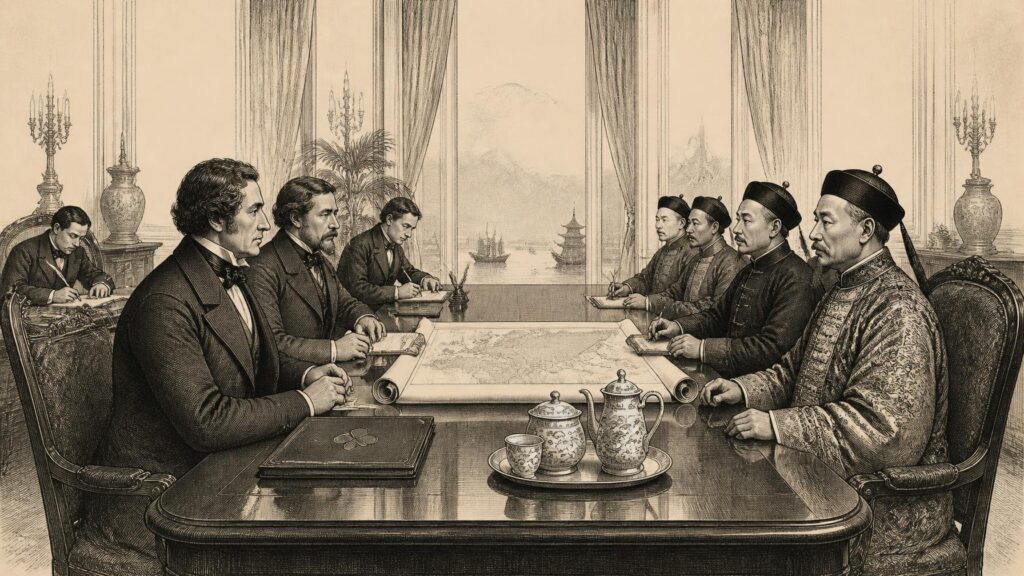
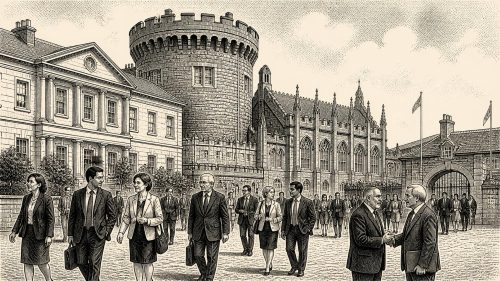
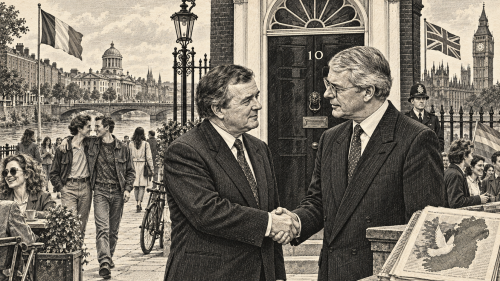
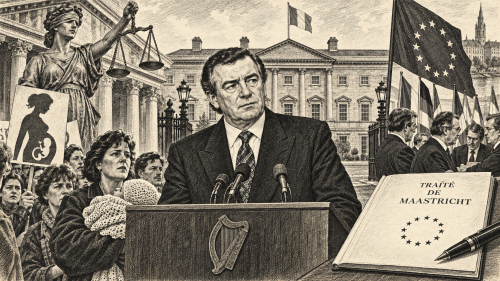
AI generated historical illustration, not a contemporary photograph.
At a Glance
Ireland’s relationship with the People’s Republic of China is a comparatively young strand of Irish diplomatic history, yet it has grown from a formal exchange of recognition in 1979 into a dense, sometimes difficult, network of political contact, trade, education, culture and multilateral negotiation. Its history is not a simple story of friendship between distant countries. It is also a record of how a small European state sought opportunity in Asia while retaining its constitutional traditions, European commitments and stated attachment to international law.
Historical Setting
For most of the twentieth century, China lay beyond the practical horizon of Irish foreign policy. The Irish Free State and, after 1937, Ireland had limited diplomatic resources. Its external relations were shaped principally by the legacy of partition, relations with Britain, neutrality, the United Nations and, increasingly after 1973, membership of the European Communities. China was important in world affairs, but it was not initially a country in which Dublin possessed a resident mission or a large commercial stake. Distance, the absence of regular air links, modest trade and the priorities of a small diplomatic service all mattered.
That did not mean that China was wholly absent from Irish consciousness. Irish missionaries had travelled to China from the nineteenth century onwards, while news of revolution, war, famine and Communist victory reached Ireland through church networks, newspapers and international organisations. These earlier human connections belong to a broader history of Irish encounters with China, but they were not themselves state diplomacy. They should not be confused with a continuous official relationship between Dublin and Beijing. The modern bilateral relationship rests on decisions made in the late Cold War, not on an unbroken line from missionary activity or anecdotal friendship.
The international setting changed substantially during the 1970s. The People’s Republic of China had obtained China’s seat at the United Nations in 1971, and the diplomatic recognition of Beijing gathered pace across western Europe. The United States and China moved towards normalisation, while the European Community established formal relations with China in 1975. Ireland, a member of the European Communities from 1973, was therefore making decisions in an environment in which European and global diplomatic arrangements were being recast.
The timing is revealing. Ireland established diplomatic relations with the People’s Republic on 22 June 1979, during its second presidency of the Council of the European Communities. The decision placed Ireland within a wider western European movement towards normal relations with Beijing, but it was an Irish decision reached through Irish constitutional and diplomatic channels. It demonstrated that neutrality did not mean isolation, and that a state with constrained resources could still extend its diplomatic reach where it judged that national and international interests justified doing so.
Recognition carried consequences beyond ceremonial protocol. It required Ireland to define its position on representation of China. Ireland recognised the government in Beijing as the legal representative of China and did not establish diplomatic relations with Taiwan. That position, usually described as the one China policy, has remained an important framework for Irish policy. It has not prevented trade, educational contacts or other non-diplomatic links with Taiwan, but it has shaped the formal architecture through which Ireland conducts relations with Beijing.
The vocabulary of later decades can make 1979 appear inevitable. It was not. China’s economic reform programme was only beginning; Ireland’s own economy was still far from the export-led, highly internationalised economy of the Celtic Tiger years; and neither country could foresee the scale of Chinese industrial growth, Irish pharmaceutical exports or digital services. The establishment of relations created a channel. The scale and character of what would later travel through that channel remained uncertain.
Formal Recognition
The joint communiqué of June 1979 was the foundational public instrument. China and Ireland agreed to establish diplomatic relations, and ambassadors were exchanged in 1980. The document itself was brief, as such instruments often are. Its historical importance lay less in elaborate language than in the fact of mutual recognition and the opening of official representation. It made routine contact possible: political reporting, consular work, commercial advocacy, cultural arrangements and communication in times of international difficulty.
The decision also needs to be placed against Ireland’s developing conception of foreign policy. The state had become more active internationally after joining the United Nations in 1955. Participation in peacekeeping, the work of international organisations and European integration enlarged the range of issues on which Irish governments had to take positions. Opening relations with China was consistent with this gradual broadening. It signalled that Irish diplomacy was no longer concerned only with near neighbours and Atlantic partners, even though those relationships remained central.
China’s perspective was necessarily different. Beijing was building relations with a widening circle of states at a moment when it sought greater international presence and access to economic, technological and political exchange. Ireland was small in population and territory, but it was a European Community member, an English-speaking economy and a country with particular experience of development, overseas trade and multilateral diplomacy. The two governments approached one another with unequal power and different strategic weight, but each could identify practical value in regular contact.
It is tempting to describe the relationship as being free of historical baggage. In a narrow bilateral sense, Ireland and China had no record comparable to the colonial conflicts or wars that burdened China’s dealings with several larger European powers. That observation has appeared often in official and diplomatic language. Yet it should not be exaggerated into a claim of automatic affinity. Ireland’s history, political culture and European location were distinct from China’s; absence of a bilateral quarrel did not erase differences over political institutions, rights, security or international order.
The early years were therefore modest rather than dramatic. Resident representation developed gradually, and official contact had to compete with other foreign-policy demands. There was no immediate transformation in commerce or public awareness. Diplomatic recognition is sometimes remembered as a decisive moment because it supplies a convenient anniversary. In practice, it was the beginning of patient institutional work: securing representation, identifying sectors of interest, learning administrative systems and building trust through repeated encounters.
That patient quality matters in assessing the record. Relations between states do not normally advance through goodwill alone. They depend on embassies that can interpret policy, officials who know one another’s systems, translators, visa arrangements, business contacts and agreed procedures. The subsequent history of Ireland and China was built as much through these ordinary mechanisms as through summit meetings. The later prominence of trade missions and high-level visits rested on a diplomatic infrastructure first made possible by the 1979 decision.
Economic Opening
China’s reform and opening period gave the relationship an economic rationale that became clearer with time. Irish officials and business figures watched China’s economic transformation with interest, while Chinese visitors examined models of export development. One frequently repeated element of this history is the visit to the Shannon Free Zone by a Chinese delegation led by Jiang Zemin in 1980. Chinese diplomatic accounts have presented Shannon as an example studied during the formative period of China’s special economic zones. The episode is documented as a visit and an exchange of experience; the stronger claim that Shannon directly created China’s zones is an interpretation too simple for a vast policy development shaped by Chinese domestic choices and many international influences.
Nevertheless, Shannon had an intelligible appeal. The free zone represented an Irish experiment in attracting industry and employment through infrastructure, incentives and an outward-looking commercial environment. China, then seeking ways to draw foreign capital and technology into designated areas, had reason to study examples beyond its borders. For Ireland, the connection later acquired symbolic power. It suggested that a country often presented as peripheral to global affairs could provide ideas of interest to a much larger state entering a new economic era.
Trade did not grow in a straight line. Statistics varied according to whether Hong Kong and Macau were included, whether goods or services were counted, and whether figures were reported in euros, dollars or national statistical categories. Such differences caution against using single headline totals as if they were fully comparable across decades. The larger pattern, however, is clear: commercial exchange became vastly more significant than it had been at the establishment of diplomatic relations.
Irish exports to China came increasingly to include pharmaceuticals, medical technology, food and drink, dairy products, spirits, educational services, financial services and computer-related activity. China also became a source of manufactured imports and an increasingly relevant market for firms supported by Irish state agencies. The relationship was never reducible to merchandise trade. Services and investment mattered greatly to a modern Irish economy, while Chinese investment in Ireland became part of the wider landscape of inward investment.
Economic engagement brought opportunities but also exposure. Ireland’s economic model relies heavily on external trade, foreign direct investment and access to international markets. The attraction of a large Chinese market was therefore evident, particularly after the financial crisis that began in 2008, when Irish governments looked urgently for export growth. At the same time, dependence on distant markets could create vulnerability: regulatory changes, animal-health restrictions, geopolitical tension, shipping disruption or wider European policy shifts could quickly affect commercial expectations.
Food provides an especially useful illustration. Irish agri-food exporters sought market access in China, where official approval, sanitary standards and consumer confidence are central. The trade in pork, dairy and beef involved not merely private sales but sustained work by diplomats, agricultural officials, Bord Bia and regulators. Market access is diplomatic history in practical form: a veterinary protocol, inspection regime or import suspension can carry consequences for farmers and processors far from the embassy district in Beijing.
By the middle of the 2020s, official Irish statements described China as Ireland’s largest trading partner in Asia and among its most important global partners. Those descriptions convey scale but should not conceal complexity. Trade figures can be affected by multinational corporate structures, product routing and the distinction between final markets and recorded destinations. They nonetheless explain why Irish governments have repeatedly sought a stable and predictable relationship with China even when other issues produce disagreement.
European Context
Ireland’s China policy has always been both bilateral and European. Membership of the European Communities and later the European Union supplied Ireland with a larger economic and diplomatic setting, but it also limited any suggestion that Dublin could pursue a wholly separate great-power policy. Trade policy, sanctions, many regulatory issues and broad strategic debates are substantially European matters. Irish ministers meet Chinese counterparts as representatives of Ireland, yet they do so as members of a Union with shared competences and common positions.
This dual position can be advantageous. European membership gives Ireland weight and access that it could not command alone. It also offers a framework for addressing subjects that are difficult for a small state to manage bilaterally, including market access, industrial policy, supply-chain resilience, climate action and international security. Conversely, European consensus can be hard to form, and Irish economic interests do not always coincide exactly with those of larger member states or with the political tone of debate in Brussels.
The period after the Cold War made the European dimension more visible. China’s economic rise coincided with the deepening of European integration and with Ireland’s own rapid growth. Dublin could present itself as a bridge into the European market, a location for internationally trading firms and a country familiar with adapting to global economic change. Beijing, meanwhile, became a more consequential partner and competitor for the European Union. The terms of engagement grew more sophisticated and more contested.
Ireland’s official approach has generally rejected a false choice between engagement and principle. Government statements have presented China as an important economic and political partner while emphasising the rules-based international system, the United Nations Charter, effective multilateral institutions and open dialogue. This is diplomacy rather than detachment. It recognises that Ireland has interests in trade and contact, while also acknowledging that those interests exist alongside differences in values, policy and international outlook.
European debates over economic security sharpened in the 2020s. Concerns about critical technologies, strategic infrastructure, coercive trade measures and dependence on particular suppliers became more prominent across the Union. For Ireland, whose prosperity depends on openness, the policy challenge was acute. A turn towards indiscriminate protectionism could damage Irish interests; an assumption that commerce alone removed strategic risk was equally implausible. The emerging language of de-risking, rather than complete disengagement, reflected an attempt to manage this tension.
Irish diplomacy must also work with the fact that China has a permanent seat on the United Nations Security Council. For a country that has invested heavily in the United Nations and peacekeeping, Chinese influence in multilateral institutions cannot be ignored. China’s role in climate negotiations, development finance, global health and conflict diplomacy affects matters on which Ireland has stated interests. Engagement is therefore not solely a commercial calculation, even when trade receives the most public attention.
The European context was particularly significant as Ireland prepared to hold the rotating presidency of the Council of the European Union in the second half of 2026. The Taoiseach’s January visit to China took place with that future responsibility in view. It reinforced an old feature of Irish policy: bilateral discussions with Beijing are never entirely separable from the wider European conversation.
Political Exchanges
High-level visits gave public form to the gradual growth of the relationship. Such visits should not be treated as mere pageantry. They provide occasions to signal political recognition, settle priorities, advance commercial cases and establish direct contact between leaders. Yet they are also carefully managed events, and the public record rarely reveals every point of disagreement. The historian should distinguish the formal communiqués, which document official commitments, from the broader claims that sometimes surround them.
Irish presidential visits to China in 2003 and 2014 demonstrated the importance attached to the relationship. The 2014 state visit by President Michael D. Higgins, in particular, connected diplomatic representation with cultural and educational exchange. In parliamentary democracies, the presidency does not direct foreign policy in the manner of an executive presidency, but a state visit can represent the country at a level that is symbolically and diplomatically valuable. It allows Ireland to project cultural confidence alongside commercial interest.
A major turning point came in 2012. Xi Jinping, then China’s vice-president, visited Ireland, and Taoiseach Enda Kenny travelled to China later that year. During Kenny’s visit, the two governments announced a strategic partnership for mutually beneficial cooperation. The formal title was ambitious, covering political, economic, trade, investment, agriculture, culture, science, technology, education, tourism and services. It should be read as an agreed programme for deeper relations rather than as proof of a military alliance or identity of world view.
The language of “strategic partnership” can be misleading when detached from context. In Chinese diplomacy, such partnerships are used with many states and often describe a framework for broad cooperation. In the Irish setting, the 2012 declaration marked recognition that China had become too important to be handled solely as a distant export market. It also reflected China’s view that Ireland offered commercial, educational and European connections of value. The word strategic did not remove the asymmetry of power between the two countries.
Subsequent exchanges continued across ministerial, parliamentary and official levels. In 2015 Premier Li Keqiang made a transit visit to Ireland. In 2018, visits by Tánaiste Simon Coveney and Ceann Comhairle Seán Ó Fearghaíl maintained political and parliamentary contact. Micheál Martin visited China as Tánaiste and Minister for Foreign Affairs in November 2023. Such contacts expanded the relationship beyond heads of government and helped keep channels open even as international controversy around China intensified.
Premier Li Qiang’s official visit to Ireland on 17 January 2024 had particular symbolic value. It came during the forty-fifth anniversary year of formal diplomatic relations and brought Chinese premier-level engagement to Dublin. Irish statements anticipated discussion of global issues, bilateral questions and European Union–China relations. This phrasing was important: it affirmed openness to engagement while making clear that Ireland would not present the relationship as insulated from wider international concerns.
The January 2026 visit by Taoiseach Micheál Martin was the first official visit to China by a Taoiseach since 2012. In Beijing, he met President Xi Jinping, Premier Li Qiang and Zhao Leji, chairman of the National People’s Congress. His programme also included Shanghai and engagement with business, tourism and educational representatives. The stated agenda joined political relations, trade, European Union–China relations and shared global challenges. The visit thus belonged to a longer history of calculated engagement rather than a sudden diplomatic departure.
Institutional Growth
Diplomacy depends on institutions that are easily overlooked by accounts centred on leaders. Ireland developed resident representation in China through its embassy in Beijing and consular presence in Shanghai, with state agencies working alongside diplomatic staff in support of trade, tourism, investment and education. China maintains an embassy in Dublin. These missions deal with matters ranging from political reporting to passport assistance, visas, cultural events and business introductions. They also carry responsibility when relations become sensitive.
Formal agreements supplied an additional framework. China and Ireland signed a cultural exchange agreement in 1985, followed by later understandings on cultural cooperation. Education agreements, including recognition arrangements for higher-education qualifications, helped create conditions for student mobility and institutional collaboration. Scientific and technological arrangements opened channels for researchers and innovation agencies. Memoranda of understanding, however, should be understood correctly: they can signal intent and structure dialogue, but they do not guarantee outcomes.
Parliamentary records show the expansion of practical agreements in the first decades of the twenty-first century. They included cooperation in trade and internationally traded services, investment promotion, science and innovation, education, cultural exchange, banking supervision and tourism. The range suggests that the bilateral relationship was becoming normalised across administrative fields. It also reflects the increasing complexity of a globalised Irish economy, in which regulators, universities, cultural bodies and sectoral departments may have as much direct relevance as foreign ministries.
The role of state agencies has been particularly important. Enterprise Ireland, IDA Ireland, Bord Bia and Tourism Ireland have all been part of the wider Irish presence in China, though their mandates differ. They translate diplomatic access into commercial, investment, food-export or visitor-economy work. Their activity shows why it is inadequate to describe modern diplomacy as conversations between politicians alone. A trade mission can involve food-safety officials, entrepreneurs, university representatives, journalists, investors and local government as well as ambassadors.
Institutional growth also took place within China. As Chinese outward investment and overseas study expanded, Ireland became more visible as a location for technology, education, English-language study and European business. This did not make Ireland a principal global destination on the scale of the United States or Britain, but it created a recognisable niche. Irish higher-education institutions cultivated Chinese partnerships, while Chinese students and researchers contributed to academic links that were often more durable than individual political visits.
These institutional ties should not be romanticised. Partnerships can be uneven, commercial expectations can disappoint and academic cooperation raises questions about intellectual property, academic freedom, data and research security. The historical point is that Ireland–China relations became multi-layered. That density can make the relationship more resilient, but it can also make disagreements harder to manage because more interests are involved.
Cultural Currents
Cultural exchange has been a recurring feature of official accounts, but its significance lies beyond diplomatic ornament. It creates habits of contact and frames how societies imagine one another. Ireland’s cultural reputation in China has drawn on literature, music, dance, film, heritage and the international recognition of Irish universities. Chinese culture in Ireland has been represented through festivals, language teaching, exhibitions, community activity and the work of cultural institutions. These exchanges have broadened public contact beyond government and business.
Language education is one measurable part of this process. Mandarin became available within elements of the Irish post-primary curriculum and was later incorporated into the Leaving Certificate. This development did not mean that Mandarin became widely studied across Ireland, nor that language learning alone transformed bilateral understanding. It did indicate that Irish educational policy saw some value in equipping pupils for a world in which China mattered economically and culturally.
Higher education provided a deeper channel. Agreements on recognition of qualifications and university partnerships helped students move between systems that differ in language, governance and academic tradition. Irish institutions sought Chinese students, research links and international standing; Chinese students sought education in an English-speaking European Union member state. Such exchanges produce genuine personal connections, but they are also part of a competitive international education market. Sentiment and revenue can coexist.
Tourism has played a similar role. Ireland introduced a five-year multi-entry visa option for Chinese visitors in 2019, marking the fortieth anniversary of diplomatic relations. The policy was practical and promotional: it aimed to make travel easier and to support visitor numbers. Tourism depends on connectivity, visa rules, disposable income and public confidence, and it was severely disrupted by the COVID-19 pandemic. The pandemic demonstrated the fragility of people-to-people exchange when borders close and air travel contracts.
It is important to separate documented exchange from folklore. Stories about ancient Irish–Chinese affinities, shared symbols or supposed deep civilisational connections can be attractive, especially at cultural events. Some may express a sincere desire for friendship. They are not, however, a substitute for evidence. The documented relationship rests on modern diplomatic agreements, migration, travel, education, trade and institutional cooperation. A historically responsible account does not need to invent antique links to explain why contact has grown.
Cultural diplomacy has also acquired a political dimension. States often promote culture as a comparatively safe field for cooperation when strategic questions are difficult. That can be useful, but culture is not politically empty. Questions of representation, institutional independence, academic freedom and the treatment of minority cultures may arise. The value of cultural engagement lies not in pretending that such questions do not exist, but in sustaining informed contact without collapsing difference into propaganda.
Policy Tensions
The maturation of relations brought tensions into clearer view. Ireland’s official position seeks engagement with China while retaining commitments to human rights, democracy, the rule of law, multilateralism and the European Union. These commitments can generate disagreement with Beijing on subjects including human rights, Hong Kong, the treatment of ethnic and religious minorities, cyber security, the South China Sea, Russia’s war against Ukraine and Taiwan. The existence of trade does not dissolve such differences.
Irish ministers have stated that Ireland recognises the People’s Republic of China as the legal representative of China and does not have diplomatic relations with Taiwan. At the same time, Ireland has expressed concern about tensions in the Taiwan Strait and stressed the importance of maintaining peace, stability and the status quo. This position illustrates the careful language of diplomacy. It adheres to the formal framework of recognition while seeking to discourage escalation in a region whose instability would have grave global economic and security effects.
Human-rights questions require similar precision. Ireland has a long-standing record of raising human-rights issues through bilateral and European Union channels, but official statements generally do not claim that dialogue eliminates disagreement. Diplomatic engagement can provide opportunities to raise concerns directly; critics may argue that commercial priorities blunt the force of such concerns. Both observations can be true. The archive often reveals the existence of meetings and agreed language more readily than the private exchanges that determine how forcefully difficult questions were pressed.
Security has become more prominent with technological change. Ireland is not a military power and maintains a policy of military neutrality, but it is not outside questions of cyber resilience, telecommunications, research security, data, investment screening and critical infrastructure. As Chinese technology and investment became more significant internationally, Irish and European policymakers had to consider how openness could coexist with safeguards. This is not uniquely a China problem; it is part of the wider governance of an interconnected economy. China’s scale makes it especially consequential.
The term “economic security” can obscure as much as it clarifies. If used too broadly, it can turn ordinary commerce into a source of suspicion and invite protectionism. If ignored, it can leave small states exposed to concentrated dependencies or coercive pressure. Ireland’s interest lies in a rules-based trading system, diverse supply chains and open markets governed by transparent standards. That interest explains why Irish policy has generally favoured dialogue and diversification rather than either naïve dependence or wholesale severance.
There is also a domestic political dimension. Irish public discussion of China has become more attentive to rights, technology, university links and foreign influence. This is a sign of democratic scrutiny, not necessarily hostility. A relationship that once received limited public attention is now debated in parliament, the media, universities and business organisations. Greater scrutiny may complicate diplomacy, but it also makes policy more accountable and discourages simplistic narratives of either inevitable partnership or inevitable conflict.
Recent Engagement
The years from 2023 to 2026 show both continuity and change. Micheál Martin’s November 2023 visit to China as Tánaiste and Minister for Foreign Affairs restored high-level contact after the disruption of the pandemic years. In January 2024, Premier Li Qiang visited Ireland and met Taoiseach Leo Varadkar at Farmleigh. The official agenda encompassed bilateral relations, global questions and European Union–China relations, a formula that captured the three levels on which modern Irish policy operates.
In official Irish language, China was described as an important economic partner and as a state with a major role in questions of peace, security and climate change. The same language acknowledged the likelihood of differing perspectives. That balance is revealing. It avoids characterising relations as an uncomplicated strategic convergence, yet it rejects the idea that disagreement should end communication. Such formulation can sound cautious, but caution is often the substance of small-state diplomacy.
The Taoiseach’s official visit from 4 to 8 January 2026 built on this pattern. The programme combined meetings with China’s senior political leadership in Beijing with engagements in Shanghai focused on business, investment, tourism, food and education. Twelve Irish colleges and their Chinese higher-education partners featured in the Beijing programme. The visit’s design therefore conveyed a familiar Irish understanding of diplomacy: political dialogue, commercial opportunity and people-to-people connections reinforce one another, even though each has its own purposes.
A prominent immediate outcome concerned beef. China had temporarily suspended access for Irish beef in September 2024. Following the January 2026 visit, the Irish government announced that the Chinese market would reopen to Irish beef. The episode is important because it demonstrates how bilateral relations are experienced beyond the capital. For Irish farmers and processors, the issue was not an abstract diplomatic phrase but the restoration of a market. For officials, it represented the value of regulatory credibility, veterinary systems and persistent engagement.
It would be too strong to attribute the reopening solely to one visit. The Irish government itself described the decision as the culmination of intensive political, diplomatic and official engagement, including technical work and agricultural contacts. This is a better historical explanation. Senior meetings can help create political momentum, but market access normally depends on evidence, inspection, standards and administrative decisions as well as leadership-level advocacy.
At the same time, the visit occurred amid a more unsettled international environment than that of 2012. Competition between China and the United States, conflict in Europe and the Middle East, strains in global trade and European debate about competitiveness all formed part of the background. Irish statements stressed robust multilateral institutions, fair trading conditions and a strong European Union–China relationship. These priorities indicate that Dublin regarded the bilateral relationship as valuable, but not detachable from the international system in which Ireland’s interests are embedded.
Future Questions
As of 2026, the central historical lesson is neither that Ireland and China are natural partners nor that their relationship is destined for confrontation. The record shows a relationship created deliberately in 1979, enlarged through economic change, and tested by the return of sharper geopolitical divisions. Ireland has sought to gain from China’s growth while preserving room to articulate European, multilateral and national positions. The success of that approach will depend on conditions that no bilateral agreement can fully control.
Trade will remain important, but the composition of trade may matter more than its headline size. Pharmaceutical and technology exports, food standards, services, research links and investment flows expose Ireland to different forms of risk and opportunity. Policy will need to distinguish between ordinary commercial interdependence and genuinely strategic dependence. It will also need to recognise that Chinese demand, regulation and domestic economic conditions can change rapidly, just as European rules and global supply chains can reshape the environment for Irish firms.
Education will remain a valuable but sensitive field. Student exchange and collaborative research can deepen knowledge and create long-term links. They also require robust protections for academic integrity, data, intellectual property and freedom of inquiry. Ireland’s universities are international institutions; their China connections should be assessed by the same standards of transparency and institutional autonomy applied to all overseas partnerships. Openness is strengthened, not weakened, by clear rules.
The European Union will continue to frame much of the relationship. Ireland’s forthcoming Council presidency in the latter half of 2026 gives it a particular responsibility to encourage coherent European discussion. That does not mean Ireland can dictate Union policy, nor that an EU position will always match every Irish commercial preference. It means that Irish diplomacy must connect national experience with collective European interests, including resilience, fair competition, climate cooperation and adherence to international law.
The one China policy will also remain a defining formal element. The policy does not resolve every question surrounding the Taiwan Strait, but it establishes the diplomatic basis on which Ireland engages Beijing. In an era of heightened tension, careful wording and consistent support for peaceful dialogue matter. For Ireland, which has repeatedly emphasised international law and peaceful settlement, the avoidance of escalation is both a principled and a practical concern.
Finally, historians should resist the urge to write the conclusion in advance. Forty-seven years of diplomatic relations have created substantial connections, but they do not guarantee a fixed future. The relationship may deepen through trade, climate work, education and multilateral cooperation; it may also encounter sharper disagreements over security, rights or economic policy. What the evidence supports is a more modest judgement: Ireland and China have built durable channels of communication since 1979, and those channels are likely to remain necessary precisely because the world around them has become more uncertain.


Pacific Bridges demonstrates that Ireland’s relationship with China has been built through patient institutions, not simply trade missions or summit visits. The article particularly illuminates the tension between Ireland’s desire for commercial opportunity and its obligations within the European Union, including de-risking, multilateralism and principled dialogue. Shannon’s symbolic place in China’s economic opening also complicates assumptions about influence between states of very different scale. As Ireland prepares for its EU Council presidency, how should it balance bilateral economic engagement with China against collective European efforts to reduce strategic dependencies while sustaining meaningful cooperation on global issues such as climate action?