

Women’s Christmas
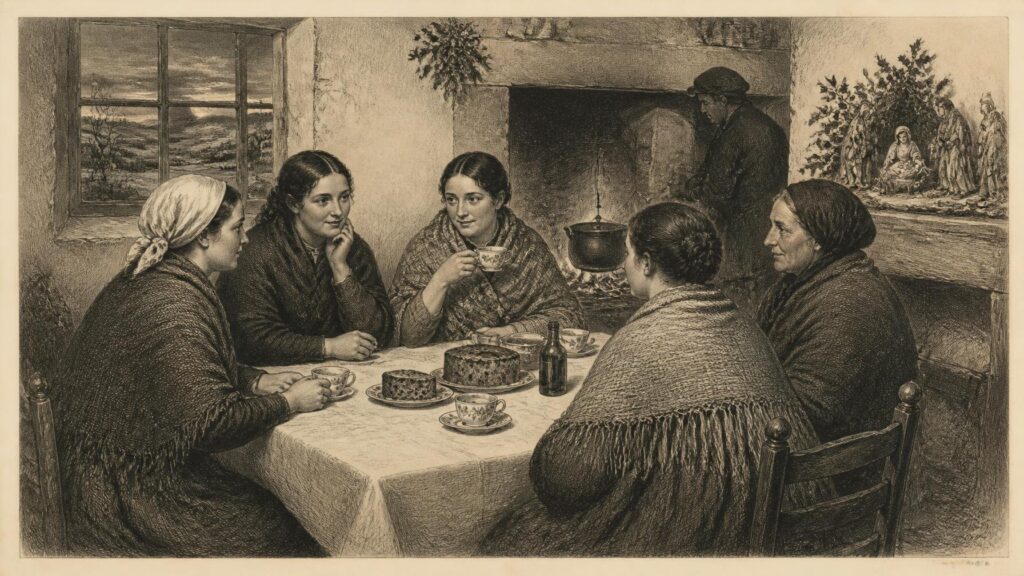
AI generated historical illustration, not a contemporary photograph.
At a Glance
Nollaig na mBan, usually translated as Women’s Christmas, is observed on 6 January, the Feast of the Epiphany and the traditional end of the Christmas season. Its most familiar form is deceptively simple: after the heavy domestic labour of Christmas, women were meant to rest, visit female friends or relatives, and enjoy food, tea, drink, conversation and, in some places, music. Men, at least in the ideal version of the custom, assumed the household work. Yet this small reversal of routine opens a larger history of women’s work, sociability, religion, food and memory in Ireland. It should be approached as a regional and changing folk practice, not as a timeless national institution or a surviving prehistoric rite.
Calendar Setting
Nollaig na mBan belongs first to the Christian calendar. The sixth of January is Epiphany, the feast associated in western Christianity with the visit of the Magi to the infant Christ. In much of Ireland it was also known as Little Christmas, Old Christmas, Twelfth Day or Twelfth Night. These names overlap but are not always interchangeable in local usage. “Nollaig na mBan” literally means “Christmas of the women”, and its English forms include Women’s Christmas and, occasionally, Little Women’s Christmas. The name makes the gendered feature of the day unusually explicit, but it remained part of the wider closing sequence of Christmas observance.
The traditional twelve days ran from Christmas Day to Epiphany, though popular counting could vary by beginning on Christmas Eve. This was a period when sacred observance, hospitality, entertainment and household obligations were closely entangled. In rural homes especially, Christmas was not merely a day of presents and dinner. It involved cleaning, preparing special food, receiving visitors, attending Mass, tending children, accommodating returning family members and maintaining the ordinary demands of animals, fuel, water and cooking. Such work was not distributed evenly. The ideal of Women’s Christmas makes sense only against that background of unequal responsibility.
Irish folklife records place 6 January within a dense field of customs. Decorations were traditionally left up until the end of the season; removing them prematurely could be considered unlucky. Cribs, candles, holly, prayers, visiting and particular foods all belonged to the period. In some districts, the day was chiefly remembered as the moment when Christmas ended. In others, especially in the south-west, its association with women’s leisure gave it a more distinct social character. A history of Nollaig na mBan must therefore hold two truths together: it was an Epiphany observance, and it could also be an occasion shaped specifically by women.
That distinction matters because modern accounts sometimes flatten the practice into a single national ritual: men cleaned while women went to the pub. The evidence does not justify such certainty. Customs differ from parish to parish, household to household and generation to generation. Some women may have enjoyed a genuine day away from routine work; others probably did their usual morning tasks before an afternoon visit. Some celebrations were domestic and modest, while others became meals or nights out. The old custom was real, but it was neither universal nor fixed.
Irish Language
The Irish name is itself historically revealing. In Irish grammar, na mBan means “of the women”; the initial change in ban is part of the language’s grammar. The phrase locates women not as incidental participants in a general holiday, but as the possessors of a day within the Christmas cycle. Such wording does not prove that women held authority over the household or that the day overturned ordinary gender relations. It does show that the custom could be expressed through a clear popular recognition of women’s distinctive labour and their claim to respite.
Irish-language terminology also cautions against easy translation. “Women’s Christmas” sounds, in modern English, like a formal parallel festival to Christmas Day. In practice, Nollaig na mBan could be much humbler. It might mean tea with neighbours, a visit to a sister, the last Christmas cake, a glass of porter or sherry, or a rare opportunity to gather without serving a mixed household. “Little Christmas” likewise need not mean an inferior celebration. It may refer to the smaller scale of the final feast, the end of the twelve days, or a date associated with older calendar habits. Local meanings should not be forced into a single explanation.
There were regional names for the day and for its eve. Folklore from Galway, for example, records Twelfth Night customs centred on candles, the Rosary and the close of Christmas. Those accounts do not necessarily describe a women-only celebration. They remind us that the same date carried different emphases around the country. Where one locality foregrounded women’s visiting, another remembered candle divination, prayers, decorations or the final clearing away of the season. Ireland’s folk calendar was local before it was national.
The linguistic survival of Nollaig na mBan has had an important effect on its modern appeal. A compact Irish phrase can appear ancient even when the surviving evidence is comparatively recent. It has become a resonant label for gatherings, meals, concerts, charitable events and celebrations of women’s friendship. That continuing use is meaningful, but it should not be used to manufacture an unbroken, uniform custom reaching indefinitely backwards. Names travel, revive and acquire fresh purposes. Folklore is not diminished by change; change is one of the ways folklore survives.
Household Labour
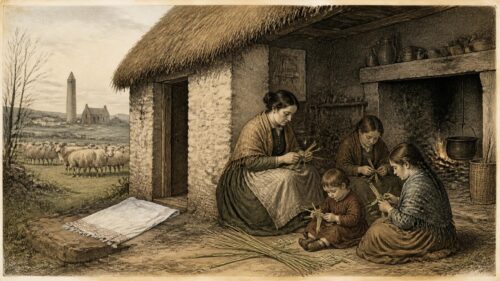
The central historical fact behind Women’s Christmas is work. Christmas celebrations depended upon a great deal of labour that was often expected of women: baking and cooking, cleaning, washing, managing fuel and fires, caring for children, preparing beds, serving visitors and restoring the house afterwards. This labour was routinely treated as ordinary duty rather than public achievement. A day of rest did not abolish that inequality. It acknowledged it, however briefly and imperfectly.
The National Museum of Ireland’s account of older Christmas customs describes a familiar division: after religious services, men might take part in sport while women prepared the special meal. Such summaries should not be mistaken for a complete record of every household. Class, occupation, age, family size, migration and local circumstance all affected who worked and who rested. Nonetheless, the pattern is important. In a society where the home was a principal site of women’s productive labour, a custom that named women’s rest could carry social weight even when its practical benefits were limited.
The usual description of Nollaig na mBan says that men cooked and did the chores. It is best read as an ideal and a social expectation, not as a guarantee. Folklore frequently records what people believed should happen, what they remembered fondly, or what made a good story. A husband or son taking over the kitchen for one day may have been practical help in one home, comic role reversal in another and merely an aspiration in a third. The formula nevertheless exposes the usual arrangement. A reversal only makes sense where there is an established norm to reverse.
There is also a risk in celebrating the custom too warmly. The phrase “a day off” can hide the scale of the other 364 days. Women’s Christmas was not a primitive form of equality, nor should it be presented as compensation sufficient for structural inequality. Rather, it offers evidence that women’s contribution was recognised within popular custom, even if that recognition was confined to a short interval and couched in domestic terms. Its historical interest lies partly in that tension: it was both an acknowledgment of labour and a reminder of how much labour remained gendered.
Social Visiting
At the heart of many recollections is female sociability. Women called on neighbours, sisters, mothers, cousins and friends. They sat together, exchanged news, drank tea, ate cake and talked. Such activities can look slight in formal histories, but they were important means by which information, sympathy, practical advice and local memory circulated. The kitchen table and the neighbour’s parlour were places of social knowledge. They offered a setting in which women could speak outside the immediate demands of children, husbands, employers or farm work.
The form of visiting depended on place. In a rural district, houses might be reached on foot along roads made difficult by winter weather. In a town, visits could take place between nearby streets, shops or public houses. Women who lived at a distance from kin, or who had limited money for entertainment, may have valued an occasion that required little ceremony beyond hospitality. The custom did not need expensive gifts, tickets or elaborate costumes. Its modesty was part of its strength.
Accounts from Kerry, particularly the Dingle Peninsula and Corca Dhuibhne, have helped preserve the public memory of Nollaig na mBan. Broadcast recordings made late in the twentieth century include women describing gatherings, drink, conversation and, in some households, the exclusion of men and children so that women could have the house to themselves. These testimonies are valuable because they give voice to participants rather than merely repeating a general definition. They also reveal variation: for some, the day was rooted in childhood home life; for others, it had already become a changing adult social occasion.
The word “gossip” sometimes appears in descriptions of these meetings. Used carelessly, it can trivialise women’s talk. Conversation was not simply idle chatter. It could include news of births, illness, employment, marriages, emigration, prices, neighbourhood disputes and local events. It could preserve songs, prayers, recipes, sayings and stories. It could provide emotional support. A tradition of women meeting together was not necessarily radical in outward form, but it created a social space that official records rarely capture well.
Food Memories
Food marks the difference between Christmas Day and Women’s Christmas. The earlier feast was generally associated with the best and heaviest fare that a household could afford. By 6 January, the cupboard and cake tin were being emptied. Folklorists and later writers have described the food of Nollaig na mBan as “dainties”: tea, cake, biscuits, sweets and perhaps wine or sherry. In some memories this made the day seem lesser than Christmas Day; in others, it suited the occasion perfectly, providing a lighter and more sociable conclusion to the season.
That apparent smallness should not be dismissed. Tea, currant cake, bread, butter and alcohol had social meanings beyond their price. Tea was associated with visiting and with hospitality; cake represented special provision; a bottle opened for callers marked occasion. In rural households where cash was tight and food was planned carefully, the remains of festive supplies could still be a treat. The final portions of Christmas were not merely leftovers in a modern sense. They were part of the ritual finishing of the season.
A recurring male joke, remembered in several accounts, held that Women’s Christmas was “no good” because the best food and drink had already been consumed. Such sayings should be treated as evidence of humour and hierarchy, not as neutral reports. Their point was precisely to belittle a day associated with women. Women could answer with their own approving version of the phrase. The exchange suggests that the day’s status was negotiated playfully, sometimes sharply, within the household and community.
Food history also complicates romantic pictures. Not every home had an abundance of meat, alcohol, fruit cake or confectionery. Rural poverty, seasonal scarcity and unequal access to cash shaped Christmas sharply. A celebration based on tea and baking may have been pleasurable, but it was not proof of plenty. Nor should one assume that women themselves controlled the household stores. The most convincing interpretation is practical: Nollaig na mBan often made use of what remained while turning that final hospitality into a women-centred occasion.
Folklore Evidence
The documentary record for Nollaig na mBan is uneven. It becomes clearer in the late nineteenth and twentieth centuries, but much of what historians know comes from recollection rather than administrative paperwork. That is unsurprising. A neighbourly gathering, a domestic division of chores or a customary plate of cake rarely generated official documents. Folklore collections, local newspapers, memoirs, recordings and later interviews are therefore indispensable. They require careful handling, but they are not inferior simply because they concern ordinary life.
The National Folklore Collection at University College Dublin is especially important. Its Schools’ Collection was assembled principally between 1937 and 1939, when schoolchildren recorded local tradition from parents, grandparents and other informants. The material is immense and geographically broad, although it covers the twenty-six counties of the Irish Free State rather than the whole island. The collection preserves customs, stories, beliefs, songs, local history and everyday observations that would otherwise often be lost. Entries concerning Christmas and Epiphany provide a valuable snapshot of what people said was remembered or practised in the 1930s.
Yet the Schools’ Collection is not a transparent window onto an ancient past. Children wrote down material selected by teachers, prompts and informants. Memories could compress time, conflate custom with belief or report a practice that was already fading. A manuscript entry is evidence that someone in a locality told a child something in the late 1930s; it is not automatic proof that every family had followed the custom for centuries. Its greatest value comes from reading numerous entries comparatively and from distinguishing a precise locality from a broad national claim.
One Kerry entry on Dúchas records beliefs for Little Christmas Night, including a warning about going to a well at midnight. It is not a straightforward account of women resting or men cooking, but it demonstrates the rich cluster of ideas attached to the date. Galway material collected in the same broad period records the lighting of twelve candles and beliefs about their burning. Such evidence is a corrective to the assumption that 6 January had only one meaning. Women’s Christmas existed within a larger, varied world of Epiphany folklore.
Regional Patterns
The strongest and most consistent association of Nollaig na mBan is with Munster, particularly Counties Cork and Kerry. Modern scholarship and folklore commentary repeatedly identify the south-west as the region where the custom was most conspicuous and longest remembered. This does not mean it was unknown elsewhere. References from Wicklow, Galway and other places demonstrate that names and practices travelled beyond Munster. But the evidence does not support describing it as equally established in every Irish county.
Regional concentration is historically significant. Customs do not spread evenly across a country merely because they share a language or religion. They develop through kinship networks, local economies, patterns of work, parish culture and the circulation of stories. In Irish-speaking and bilingual districts, the Irish name may have had particular resilience; elsewhere, English names such as Little Christmas or Twelfth Day may have eclipsed it. In some places, the day’s women-centred element may have been present without the Irish title. In others, the title may have survived after the domestic practice weakened.
Kerry’s prominence may also reflect preservation. The county has a strong tradition of Irish-language cultural documentation, local memory and broadcast representation. A custom that remained active there was more likely to be recorded, discussed and later revived. Visibility does not necessarily mean exclusivity. It does, however, mean that Kerry’s testimony should not automatically be projected onto the whole island. A carefully written history should say “in parts of Kerry” when that is what the record supports, rather than turning a local practice into a national rule.
The same principle applies to urban Ireland. It is tempting to imagine Women’s Christmas as a purely rural survival, but women in towns also maintained neighbourhood networks and festive visiting. Urban life could alter the venue from kitchen to café, hotel, club or public house. It could also make the celebration more visible commercially. Still, recent city events should not be assumed to reproduce nineteenth-century domestic arrangements. They are best understood as adaptations, drawing authority from an older tradition while serving present-day social needs.
Religious Meanings
Nollaig na mBan was not separate from religion. Its date was fixed by Epiphany, and in many households Mass, prayer and the Nativity remained central to the season. The cultural setting was overwhelmingly Catholic in much of the Republic, but regional and denominational diversity should be remembered. The phrase Women’s Christmas describes a folk observance attached to a Christian feast day; it does not name a separate church festival or an alternative theology.
Folk practice often extended formal religion through domestic acts. Candles in windows, places at table, prayers for the dead and stories of the Holy Family’s passing were part of Irish Christmas observance in many recorded accounts. These acts can be read as forms of popular devotion, hospitality and protective custom. They were not necessarily inherited unchanged from remote antiquity, and it is misleading to label every candle or threshold practice “pagan”. Christian ritual, household symbolism and older patterns of seasonal belief can coexist without allowing historians to identify a single origin with confidence.
The Three Kings were important to the visual and devotional imagination of Epiphany. In some south-western accounts, figures of the Magi were placed in the crib on 6 January, completing the Nativity scene. Such details give the day a narrative shape: Christmas was not fully over until the visitors from the East had arrived. The women’s gathering therefore took place not outside the sacred calendar but at its final domestic threshold, when the household turned from feast back towards ordinary time.
There is no sound basis for claiming that Nollaig na mBan was originally a pre-Christian women’s festival. The claim is attractive because the custom involves female gathering, winter, candles and a reversal of roles. But attraction is not evidence. The date’s secure framework is Epiphany. Folklore may contain elements older than the records that preserve them, but historians cannot establish exact prehistoric origins from resemblance alone. Respecting uncertainty produces a richer account than inventing a deep past.
Ritual Reversal
The temporary transfer of domestic work to men can be understood as ritual reversal: a short, marked departure from ordinary roles that makes those roles visible. Similar reversals appear in festive cultures elsewhere, where age, rank, dress or gender may be playfully inverted. Nollaig na mBan did not have to transform the social order in order to matter. By allowing women a recognised interval of leisure, it made ordinary expectations open to comment.
Humour was part of that process. Men’s disparaging sayings, women’s replies, joking incompetence in the kitchen and the claimed exclusion of males all belong to the custom’s social texture. Laughter could soften the challenge of role reversal, but it could also contain it. If a woman’s day of rest was treated as a comic exception, the normal burden remained unquestioned. The tradition therefore resists simple political labels. It was neither a modern feminist campaign nor merely a harmless joke; it could be a space in which women’s labour was acknowledged through celebration, irony and negotiation.
Interpretation should not erase women’s agency. Women were not only recipients of a day granted by men. They organised visits, chose companions, made hospitality, sustained memories and passed on the name of the occasion. The tradition survived because women valued and repeated it. Even where the work of preparing tea or hosting fell partly on women, gathering could still provide pleasure, authority and connection. Historical agency is not confined to formal organisations or public protest. It can be exercised through customs that shape time, company and conversation.
At the same time, it would be wrong to assume that every woman welcomed or could participate in the same way. Older women, unmarried women, widows, domestic servants, women in isolated houses, mothers with infants and women facing poverty had different opportunities. Household hierarchy mattered as well. A daughter-in-law in a crowded home may have experienced the day differently from a woman hosting her own sisters. The phrase “women” conceals these differences. Good history notices the shared custom without pretending that experience was uniform.
Modern Change
During the twentieth century, the social conditions that had sustained Nollaig na mBan changed greatly. Electrification, piped water, packaged food, changing patterns of farm work, wage labour, migration, cars and new forms of entertainment altered domestic life. Women’s paid employment expanded, though unevenly; men’s participation in household work also changed, again unevenly. The old contrast between a man’s public labour and a woman’s domestic labour cannot simply be carried into the present without adjustment.
Some observers have described the custom as declining in the later twentieth century, surviving most visibly in parts of Kerry and Cork. Decline, however, is not the same as disappearance. A tradition can become less formal while remaining recognisable in family habits: a yearly call, a meal with sisters, an arranged night out, an annual phone call to a mother or aunt. Such practices may not leave archival traces, but they are part of cultural continuity. Conversely, a public event using the name may be new even when it is sincerely inspired by the past.
Broadcast archives are particularly useful for tracing this transition. Programmes from the 1990s and 2020s show participants comparing remembered childhood customs with current practice. In one generation, a group of women might gather in a house with porter heated at the fire; in another, the day might involve a restaurant meal, music session or online gathering. These are not necessarily signs of loss. They show a custom adapting to changing homes, transport, work schedules and expectations of public social life.
Commercialisation brings another change. Restaurants, hotels and pubs now market special gatherings around 6 January. Such events can broaden access and help popularise the tradition, but they also risk reducing it to themed consumption. The historical core was not luxury. It was relief from routine work and time in female company. A modern dinner can honour that spirit, but only if it does not obscure the domestic and social history that gave the day its meaning.
Memory Politics
The present revival of Nollaig na mBan is linked to wider efforts to recover women’s histories. It is now common for cultural organisations, local groups and individuals to use 6 January to celebrate women artists, workers, organisers, relatives and community figures. That expansion is understandable. A day once associated with rest after domestic labour offers a suitable occasion to ask whose work has been overlooked and whose stories have been preserved only in family memory.
This contemporary use is an interpretation, not a falsification. Traditions endure by being re-read. Yet it is important to distinguish what archival testimony directly records from what people now wish the day to represent. The older evidence commonly describes domestic rest, visiting and female fellowship. It does not show a nationwide annual commemoration of women’s political achievement. Modern events may honour that achievement powerfully, but their relationship to the past is one of creative inheritance rather than exact repetition.
The same caution applies to claims of ancient matriarchy, goddess worship or a hidden women’s holy day. Such stories can be emotionally appealing, particularly where women’s historical contribution has been undervalued. But they are not required to make Nollaig na mBan important. The documented custom is sufficiently compelling on its own terms. It offers a rare named occasion in the Irish calendar when the labour of women was publicly recognised within everyday culture.
Memory politics can also sharpen questions about whose traditions get called national. When a south-western or Irish-language custom becomes fashionable across Ireland, this may be welcomed as cultural renewal. It should also invite care about attribution. The communities that kept the custom alive, the women who remembered it, and the collectors who recorded it deserve recognition. A national celebration is strongest when it preserves local texture rather than consuming it as picturesque background.
Historical Limits
Several limits should guide any account of Women’s Christmas. First, the available record is much stronger for the twentieth century than for earlier periods. It is reasonable to say that the custom was known by the late nineteenth century and well documented in twentieth-century folklore and oral testimony. It is not reasonable to assign it a precise medieval or prehistoric beginning. Absence of earlier evidence does not prove the practice did not exist, but it prevents confident claims about origin.
Second, the sources are weighted towards what was collected and remembered. Folklore archives preserve rich testimony but not a statistically complete survey of Irish households. Broadcast programmes preserve individual voices, not a representative sample. Museum summaries make broad traditions accessible but necessarily condense local variation. The best approach is cumulative: compare archive entries, oral accounts, scholarly interpretation and material context, while retaining the limits of each source.
Third, the term itself can conceal differences between ritual, custom and folklore. A family meal on 6 January may be a personal tradition; a parish pattern of women visiting may be a local custom; candle beliefs attached to Twelfth Night are folklore; a modern ticketed event may be a revival. These categories overlap, but they should not be collapsed. Nollaig na mBan is best understood as a flexible cluster of practices centred on a date, a gendered idea of respite and a remembered social opportunity.
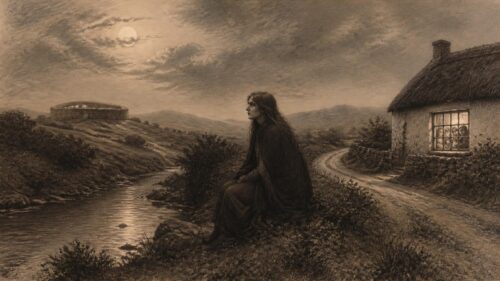
Finally, historical caution is not a refusal of feeling. The power of the tradition lies partly in its intimacy: a woman putting down her work, a sister arriving at the door, a kettle boiling, a table set with the last of the cake, a group talking after the noise of Christmas has passed. Such scenes cannot be universalised, but neither should they be dismissed because they are domestic. They reveal how people made time for care, companionship and recognition within the constraints of ordinary life.
Living Legacy
Nollaig na mBan remains valuable because it gives a name to something easily overlooked: rest is social, and leisure is shaped by who normally carries the work. Its historical setting was not one of complete emancipation. It emerged from homes in which women’s labour was expected and frequently undervalued. The day’s small reversal therefore had a double meaning. It brought pleasure and recognition, while also revealing the imbalance that made such recognition necessary.
For modern observers, the custom need not dictate how women or men should behave. It need not exclude anyone, nor must it preserve old stereotypes about cooking, cleaning or drinking. Its durable inheritance is the principle of deliberate appreciation. Friends may gather in a house, a café, a hall, a restaurant, on a walk or through a call across emigrant distances. Families may use the date to share work more fairly. Communities may use it to recover local women’s stories. These uses extend the tradition rather than imprisoning it in the past.
The most historically responsible celebration is one that remembers both continuity and change. It recognises Epiphany and the close of Christmas; it acknowledges the distinctive strength of Cork and Kerry memory without denying other local forms; it values folklore without mistaking it for proof of remote origins; and it honours women’s sociability without pretending that one festive day solved unequal labour. Such a celebration is richer than a slogan because it understands what has been inherited.
Women’s Christmas is, ultimately, a history of ordinary people making a little room for themselves at winter’s end. Its record survives in manuscripts, museums, broadcasts and family recollection because the occasion mattered. Not because it was grand, but because it was modest, repeatable and humane: a day when women could be guests as well as hosts, listeners as well as workers, and companions to one another before the year resumed its ordinary demands.
Women’s Christmas is especially intriguing because it can be read both as a welcome recognition of women’s extensive festive labour and as a brief, limited reversal that left wider household inequalities intact. The article also stresses how later celebrations, from cafés to organised gatherings, adapt a custom most securely associated with Cork and Kerry, rather than simply preserving a uniform national practice. This raises questions about what continuity means in folklore: is it the date, the women-centred sociability, the redistribution of work, or the regional memories attached to them? How should communities honour Nollaig na mBan while acknowledging gendered labour?