

Motor Arrival
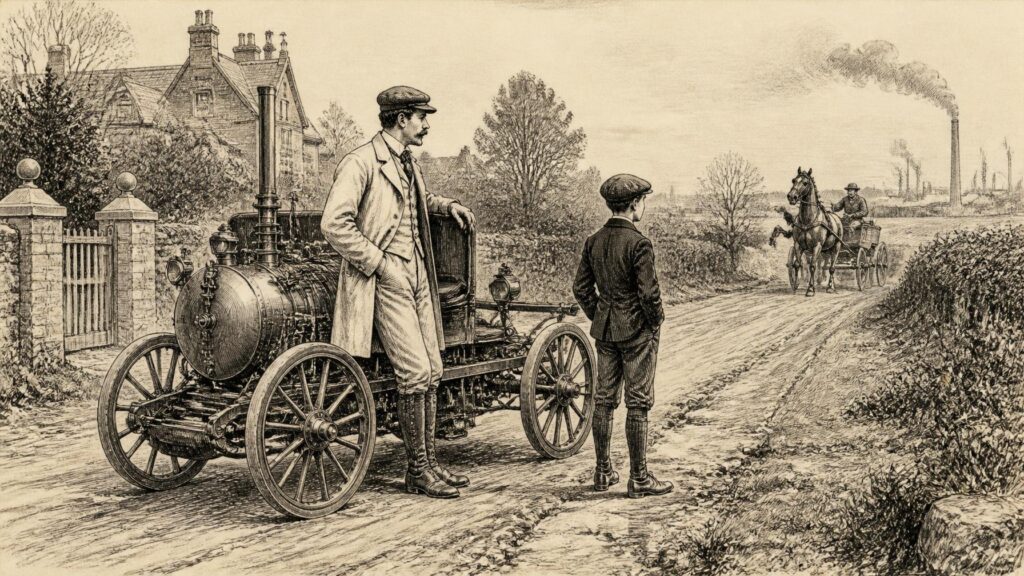
AI generated historical illustration, not a contemporary photograph.
At a Glance
The best documented answer is that the first motor car brought into Ireland arrived on 6 March 1896: a French-built Serpollet steam car imported by John Brown of Dunmurry, near Belfast. Yet the question deserves more than a date. “First car” can mean the first machine exhibited, the first owned in Ireland, the first driven on an Irish road, or the first petrol-powered vehicle. The surviving evidence supports Brown’s claim most strongly in the sense that matters most: his Serpollet was the first motor car known to have been imported and kept in Ireland. It was the beginning of motoring on the island, but neither the beginning of Irish people’s acquaintance with motor vehicles nor an instant transformation of Irish travel.
Evidence Question
Historical firsts are often deceptively tidy. They invite a single name, date and object, then conceal the distinctions upon which the answer rests. The first motor vehicle imagined by an Irish inventor is not necessarily the first vehicle completed. The first car seen by an Irish audience is not necessarily the first to remain in the country. The first Irish person to drive one abroad is not automatically the first driver on an Irish road. Nor did contemporaries use the words “motor car”, “automobile”, “horseless carriage”, “light locomotive” and “steam carriage” with the exactness expected today. In the late nineteenth century these were new machines, and their language was new as well.
For that reason, the strongest conclusion must be expressed carefully. John Brown’s steam-powered Serpollet reached his home, Longhurst, at Dunmurry on 6 March 1896. The Northern Ireland historic buildings record identifies Brown as Ireland’s first motorist and notes that no contradictory evidence for an earlier imported car has come to light. The Royal Irish Automobile Club’s motoring archive likewise dates the import to March 1896. These are not casual retrospective claims: they draw upon a tradition of specialist motoring research, surviving photographs, contemporary public activity and the unusually well-recorded life of Brown himself.
The qualifying words remain necessary. A demonstration of a Benz vehicle by the English importer Harry Hewetson is reported to have taken place in Ireland in 1895, though the evidence indicates that the demonstrator was not imported as a resident Irish vehicle. Dr John Fallon Colohan, a Dubliner who had encountered motoring on the Continent, became an important early owner and driver after Brown. He is widely associated with the first petrol-engined car in Ireland, but accounts disagree over the priority between Colohan and another early importer, Mr Gillies of the Freeman’s Journal. Such uncertainty is a historical fact, not a defect to be hidden.
Brown’s Serpollet therefore answers the general question, while the later disputes explain why an apparently elementary question acquired layers. Ireland’s motor age began not with a mass-market product, a factory or a national transport policy, but with an affluent and scientifically minded individual importing an experimental French steam vehicle into an island whose roads, laws and habits had been made for feet, horses, carts, cycles and railways.
Continental Prelude
Motor transport did not emerge in a single place or by a single fuel. By the 1890s, inventors and firms in France, Germany, Britain and the United States were testing competing arrangements of steam, electricity and internal combustion. Steam had a familiar industrial pedigree. It could produce formidable power, but boilers, fuel, water and firing arrangements made it difficult to adapt to small road vehicles. Electric vehicles were quiet and mechanically attractive, though limited by battery capacity and charging. Petrol engines were noisy, temperamental and dependent on an immature supply system, yet their range and convenience eventually made them dominant.
France was especially important to the opening Irish story. It was one of the most energetic centres of early automobile manufacture and experimentation, a place where wealthy travellers could see vehicles in use rather than merely read about them. John Brown travelled there during 1895. There he became acquainted with a Serpollet car owned by M. Dozan of Saint-Omer, travelled extensively in it, and then persuaded its owner to sell. The machine was not ordered from a showroom in the modern sense. It was acquired through personal encounter, technical curiosity and the international networks of a small, privileged motoring world.
Léon Serpollet’s name represented a distinctive branch of early motoring. His steam systems aimed to make steam propulsion more responsive and compact than the large boilers associated with railway locomotives and traction engines. Brown’s vehicle used a coke-fired steam generator and had steel tyres. It was a far cry from later enclosed motor cars: exposed, loud, mechanically conspicuous and demanding in operation. It was nevertheless recognisably a self-propelled road carriage, capable of travelling without horse, rail or fixed cable.
That French connection illuminates an important point about Ireland in 1896. The country was not isolated from technological change, but access to it was uneven. Irish scientists, doctors, engineers, industrialists and travellers encountered new developments through continental journeys, professional contacts, journals and exhibitions. The car arrived through such channels before it was supported by dealerships, trained mechanics, filling stations, standardised registration or dependable road surfaces. Brown did not enter a ready-made motoring culture. He helped create one.
Brown Arrival
John Brown lived at Longhurst, Dunmurry, then a semi-rural district outside Belfast. He was known in scientific circles for work relating to electricity and possessed both the means and the technical confidence that early motoring required. The Serpollet was delivered there on 6 March 1896. A surviving photograph of Brown with his son William in the vehicle, taken in the grounds of Longhurst, gives the claim a physical anchor. The photograph matters because so much early motoring history rests on later recollection, advertisement or uncorroborated family tradition. Here, place, person and machine are unusually closely connected.
Brown did not keep the car as a private curiosity concealed behind a gate. A few weeks after its arrival he delivered a lecture, “Automobiles or Horseless Carriages”, in the Ulster Hall Annexe, where the machine itself was exhibited with its engine operating. This public presentation is revealing. The car was a novelty requiring explanation. Audiences did not simply need to be persuaded that a new brand was desirable; they needed to understand what sort of thing a car was, how it moved, and what consequences its use might bring.
Descriptions of the Serpollet underline its transitional character. Its driving gear resembled that of a tricycle, its engine was beneath the seat, and its steam generator sat at the rear. Such a machine did not fit later assumptions about an automobile’s form. It belonged to a period when engineers were still deciding whether the ideal road vehicle would descend from the bicycle, the carriage, the steam engine or some combination of all three. The driver was less a consumer than an operator. Starting, firing, maintaining and steering it demanded active competence.
Brown’s interest extended beyond ownership. Dissatisfied with aspects of the Serpollet, he designed an electric vehicle of his own between 1897 and 1900, submitting patents relating to chassis and wheels. He compared the result to a sleigh or an electric street boat. It had a stated range of about twenty miles and a top speed of around six miles an hour. That experiment is significant not because it launched an Irish electric-car industry, which it did not, but because it demonstrates that Ireland’s earliest motor story included technical adaptation rather than mere importation.
It also complicates the familiar narrative in which petrol was always obviously destined to win. At Longhurst, steam came first and electricity followed. Petrol became dominant later through a combination of engineering advances, production scale, fuel distribution, price and practicality. In 1896 the outcome was not settled. Brown’s choices show a technically informed observer testing more than one possible future.
Road Conditions
The arrival of a car did not mean that Ireland possessed an environment suited to cars. Roads had evolved to accommodate walking, animal traffic, agricultural carts, coaches and, increasingly, bicycles. Their surfaces were often rough, rutted, muddy in wet weather and dusty in dry conditions. Bridges raised anxieties about weight. Narrow roads left little room for fast passing. Animals could be startled, and drivers could not expect other road users to recognise the sound or behaviour of a mechanically propelled carriage.
Early motoring was consequently a practical test of road infrastructure. Steel tyres, such as those on Brown’s Serpollet, were harsh on uneven surfaces and offered none of the comfort later associated with pneumatic tyres. A steam car required fuel and water as well as a route. A mechanical failure could leave travellers stranded far from specialist assistance. Even a successful journey was an expedition, with tools, spare parts, maps, weather and road gradients all carrying greater importance than they would for a twentieth-century driver.
The old road order also shaped public reaction. Horse traffic did not merely share space with cars; it embodied a transport economy in which road travel depended upon animals, stables, harness, farriers, coachmen and agricultural labour. The motor car challenged parts of that system while initially remaining too expensive to replace it. A farmer, carter or pedestrian had good reason to regard an approaching self-propelled machine with caution. Its speed, sound, fumes and unfamiliarity made it potentially dangerous even when it travelled slowly by later standards.
Brown’s response was institutional as well as personal. He became associated with the Irish Roads Improvement Association, an organisation that pressed for better road conditions. Its work should not be reduced to a narrow motorist’s campaign. Better drainage, surfacing and maintenance could benefit cyclists, carts, rural communities and public services as well as cars. Still, motoring supplied a new urgency. The car revealed how poorly a road designed for older traffic performed when subjected to mechanical speed and weight.
This is one reason the first car is historically important beyond novelty. It exposed a relationship between technology and public works. A machine imported by one wealthy man could not itself alter travel across Ireland. But it helped make roads a subject of new argument: who maintained them, who paid, what they were for, and whether the future belonged to rail, horse, cycle or motor vehicle.
Legal Framework
Law was as important as machinery. Before cars became commonplace, mechanically propelled vehicles were governed through legislation drafted with locomotives and traction engines in mind. The older legal environment was restrictive because heavy self-propelled vehicles could damage roads and frighten horses. Motoring advocates later remembered such rules under the convenient label “Red Flag Act”, although the phrase can oversimplify a complicated body of nineteenth-century legislation.
The key change was the Locomotives on Highways Act 1896, passed on 14 August 1896. It created exemptions for qualifying “light locomotives”, generally mechanically propelled vehicles under three tons unladen, and set a maximum speed of fourteen miles an hour. Crucially, the Act expressly applied to Ireland, substituting the Local Government Board for Ireland and the relevant Irish road authorities for their English counterparts. It came into operation three months after passage. The frequently repeated notion that Ireland was simply excluded from the measure is incorrect; confusion can arise because another Act printed nearby in the statute book did not extend to Ireland.
Brown’s Serpollet had arrived months before the Act. Its importation was therefore not the product of the new legislation, although the reform helped make wider motoring more practicable. The timing matters. The car’s presence in March 1896 demonstrated that enthusiastic individuals could acquire and use such machines despite legal uncertainty and practical obstacles. The legislation later gave a more coherent framework to a phenomenon already visible on Irish roads.
The language of “light locomotive” also reveals how the state initially understood the car. It was not yet a routine private vehicle with its own familiar legal category. It was a special kind of engine on the highway, regulated in relation to road damage, speed, warning signals and public safety. The law did not assume that every household might one day possess a motor car. It addressed an exceptional device whose users required regulation.
By 1903 that position had changed enough to demand more specific administration. The Motor Car Act 1903 introduced the framework within which motor vehicles were registered and licensed, and the Motor Car Registration and Licensing Ireland Order of that year applied the system in Ireland. Local authorities became central to the process. Registers recorded owners, addresses, descriptions, weights and dates. These bureaucratic traces are now invaluable historical evidence: they move the subject beyond celebrated pioneers and show the spread of vehicles through towns and counties.
The 1903 legislation also sat alongside the Light Locomotives Ireland Act, which made it possible for county councils to authorise road races under regulated conditions. This apparently specialised provision would give Ireland an outsized role in early international motor racing. It also indicates how quickly the car had moved from private experiment to public spectacle, commercial opportunity and administrative concern.
Petrol Debate
If Brown’s Serpollet was the first documented imported car, who brought the first petrol car? The answer is less secure. Dr John Fallon Colohan is the strongest contender. A Dublin-born doctor with engineering interests, he had been introduced to motoring while abroad, visited continental manufacturers and returned to Ireland determined to own a car. He later imported a Benz, generally dated to late 1896 or 1897 in different accounts. Specialist motoring histories describe him as one of the first three importers and possibly the first or second Irish importer of a petrol-powered vehicle.
Colohan’s importance is not diminished by the uncertainty over priority. His career illustrates the profile of the earliest motorists: professional, prosperous, technically curious, mobile across national borders and willing to accept considerable inconvenience. For a doctor, a car could be more than a fashionable toy. It promised rapid independent travel across distances that otherwise required horses, rail timetables or hired transport. Yet the promise was conditional upon mechanical reliability and passable roads.
Claims that Colohan was the “first Irish motorist” require the same caution as every other first. He had driven on the Continent early in the 1890s, before Brown’s import. In that sense he may indeed have been among the first Irish people to operate a motor vehicle. But Brown’s Serpollet arrived earlier as a car physically imported into Ireland. These propositions are compatible rather than contradictory. They describe distinct milestones.
Contemporary and later accounts also name Mr Gillies, editor of the Freeman’s Journal, as a competitor for the petrol-car distinction. The lack of a universally decisive surviving record means that no responsible historian should declare the matter finally settled. It is better to say that Brown’s steam car has the clearer claim to national first arrival, while the priority of the first petrol import remains contested between very early motorists.
Such distinctions may appear pedantic, but fuel type mattered enormously. Steam, petrol and electricity demanded different skills, infrastructures and routines. Steam relied on heat, water and pressure; petrol required ignition, fuel storage and increasingly a supply network; electric propulsion relied on batteries and charging. When people in 1896 spoke of the motor car’s future, they were not discussing a settled technology. They were observing a competition among systems.
Public Curiosity
The first Irish cars were spectacles. Brown’s Ulster Hall presentation demonstrates that the earliest encounter was often educational and theatrical. A working engine indoors, however carefully controlled, dramatised a new power source. Observers could see that the vehicle did not require a horse, but they also saw and heard mechanisms that made it strange. The car was an object of wonder precisely because it did not yet disappear into everyday life.
Newspaper notices, club records and photographs suggest a growing public appetite for motoring news. Accounts of continental races, speed records and new designs reached Irish readers at a time when cycling had already accustomed many people to individual road mobility and mechanical innovation. The bicycle was an important cultural predecessor. It created clubs, touring habits, repair trades, road-improvement campaigns and arguments over road rights. Cars did not arrive in a road culture untouched by technology; they entered one already reshaped by cycling.
Nevertheless, the social distance between cycle and car was considerable. A bicycle was relatively accessible, though not universally affordable. A motor car in the late 1890s was expensive to buy, difficult to maintain and dependent on leisure, servants or mechanical ability. Its owners were disproportionately members of professional, commercial and landed elites. That class character influenced public perception. The car could appear as an exciting emblem of progress, but also as an intrusive privilege exercised on common roads.
Folklore later attached dramatic reactions to the earliest cars: frightened horses, villagers crossing themselves, children running after machines, and drivers wrapped in goggles and veils against dust. Such stories are plausible in broad terms, because the roads were shared and the technology startling. But particular anecdotes should not be treated as proven simply because they are vivid. The documented evidence better supports a general conclusion: motorists encountered curiosity, concern and occasional hostility, while communities learned gradually how to share road space with them.
That learning process involved motorists too. Early drivers had to understand that speed, noise and dust affected others. The social legitimacy of the car was never automatic. It had to be negotiated through law, etiquette, road engineering, policing and, eventually, mass use.
Commercial Beginnings
From the first imported vehicle to a motor trade was a short chronological step but a large practical one. A solitary owner could rely on personal ingenuity and imported parts. A growing number of owners required sellers, repairers, storage, tyres, lubricants, fuel, drivers and information. Belfast and Dublin, as major urban and commercial centres, were natural early hubs, but motor services spread through provincial towns as ownership widened.
The Northern Motor Company, established in Belfast in 1899, is commonly identified as the first motor company in Ireland. In Waterford, W. F. Peare established an early purpose-built garage around the turn of the century and built a motor tricycle for Captain Hercules Langrishe. These ventures should not be mistaken for an instant domestic manufacturing revolution. They were small-scale responses to a new market. But they demonstrate that the car quickly created local technical work and commercial opportunity.
Tyres were central to that transformation. Pneumatic tyres improved comfort, grip and the feasibility of road travel, while creating a consumable product requiring specialist supply. Dublin’s association with the Dunlop name forms an important part of the wider story. The tyre industry linked Irish industrial knowledge to a global motor economy, even though most complete cars used in Ireland were imported. Roads, tyres and vehicles developed together: smoother surfaces made pneumatic tyres more useful, while better tyres made longer and faster travel more attractive.
The first Irish motor show at the Royal Dublin Society in Ballsbridge in January 1907 marked another stage. By then the car could be displayed not simply as a miraculous object but as a consumer product with makes, models, agencies and a prospective clientele. R. W. Archer’s sale of the first Ford in Ireland that year pointed towards a future in which American mass production would alter the economics of ownership. Yet 1907 remained far from mass motoring. The early Ford was an important sign, not an immediate social revolution.
The trade also made motoring more legible. Dealers could explain models; garages could undertake repairs; advertisements could standardise expectations; and clubs could circulate advice. The private experiment of 1896 gradually acquired the supporting institutions necessary for a transport system. These institutions mattered at least as much as the vehicle itself.
Racing Ambitions
Ireland gained remarkable prominence in international motoring only seven years after Brown’s Serpollet arrived. The 1903 Gordon Bennett Cup race was held on public roads in County Kildare, after British racing interests selected Ireland because racing on public roads was prohibited in Great Britain. The race required legal permission, road preparation, policing, crowds and an enormous degree of local organisation. It was not an everyday expression of Irish motoring; it was an exceptional international event imposed upon ordinary roads.
The Light Locomotives Ireland Act 1903 was pivotal. It empowered county councils, subject to conditions, to authorise specified public roads for races on limited days. The law illustrates the relationship between motoring and the state: enthusiasts sought not merely tolerance but special temporary control of public space. Roads that normally belonged to farmers, traders, walkers and local traffic could be transformed into a course for high-speed machines.
Surviving National Library of Ireland material captures both the visual and cultural presence of the event. Its Gordon Bennett postcard collection preserves contemporary ephemera, while photographs show cars taking part in speed trials at Phoenix Park on 4 July 1903. Sir Horace Plunkett’s diary recorded his own disapproving reaction to the race, describing a disturbing display of danger and folly. That response is valuable precisely because it resists the assumption that all educated observers greeted speed as progress.
The race amplified Ireland’s motoring reputation, drew visitors and displayed technical performance at a scale unimaginable when Brown lectured about his Serpollet in 1896. It also made visible the tension inherent in racing. Supporters saw daring, skill, engineering and publicity. Critics saw danger, disruption and an elite spectacle whose claims upon public roads were questionable. Both interpretations belonged to the motor age from its beginning.
Racing influenced ordinary motoring indirectly. It generated publicity, encouraged road improvements, fostered clubs and exposed people to new makes and speeds. But it should not be used as evidence that the average Irish family owned a car. The Gordon Bennett was memorable because motor cars were still unusual. Its very novelty gave it power.
Administrative Change
Registration after 1903 allows the historian to observe a transition from rarity to measurable presence. Limerick City Council’s surviving motor-vehicle registers begin in 1904 and list registration number, owner, postal address, description, type, weight and registration date. Such records show the practical state interest behind number plates and licences. Authorities needed to identify vehicles and drivers, enforce standards and address incidents on increasingly mixed roads.
The county-based marking system also left a durable cultural legacy. Initial registration series attached vehicles to local administrative areas. They were not merely identifiers: they recorded the moment when motoring became part of ordinary municipal business. A car was no longer only a marvel possessed by an innovator. It was an object that paid fees, had an owner of record, occupied road space and fell within the jurisdiction of local government.
By 1914 the scale had increased substantially. A Local Government Board return recorded 20,211 motor vehicles registered in Ireland, including 10,923 cars and 9,288 cycles. The provincial totals were uneven: Leinster had 8,751, Ulster 6,262, Munster 3,066 and Connacht 1,475. These numbers should be read with care. They include motorcycles as well as cars, and registration does not reveal every pattern of use. Yet they establish beyond doubt that the motor vehicle had moved from isolated novelty to a visible feature of Irish life within less than two decades.
The figures also expose geography and inequality. Leinster’s lead reflected Dublin’s population, wealth and administration; Ulster’s strong total reflected Belfast’s industrial and commercial environment. Connacht’s much smaller number reminds us that national arrival did not mean uniform access. Roads, incomes, population density and local commerce all shaped the pace of adoption.
Administrative evidence corrects a common tendency to tell motoring history through famous individuals alone. Brown, Colohan, racers and industrialists matter, but registration books reveal a wider population of owners. They include doctors, merchants, farmers, companies, public bodies and private residents. The car’s history became a history of records because it became a matter of public regulation.
Social Consequences
In its first Irish decades, the motor car altered possibilities before it altered everyone’s daily life. It offered doctors, commercial travellers, landowners and affluent families a degree of mobility independent of train schedules and horse management. It made some rural journeys quicker, expanded touring and changed the effective distance between town and countryside. For those who could afford it, it promised command over time.
That promise had limits. Early cars were costly, unreliable and often uncomfortable. Their operating demands could be substantial, especially before fuel distribution, good tyres, skilled mechanics and improved roads became widespread. A journey could still be thwarted by weather, punctures, poor surfaces or breakdown. Motoring was liberating partly because it was difficult: the successful motorist acquired a reputation for competence, endurance and nerve.
The car also changed the status of drivers. Chauffeurs became skilled employees in wealthy households and businesses. Their work combined mechanical knowledge with navigation, maintenance and service. Some women motorists claimed new forms of independence, though access remained shaped by class and resources. During the First World War, women’s visibility as drivers increased in several contexts, challenging the assumption that motoring was inherently male. The machine did not by itself create social equality, but it became a site in which gender roles could be negotiated.
Motor vehicles had political and military consequences as well. By 1916, cars, taxis, lorries and charabancs could be used to carry people, messages, weapons and supplies. Their presence in the Easter Rising and later revolutionary years demonstrates that the motor car had become more than a leisure possession. It was a tool of communication and movement. At the same time, its uneven ownership meant that control of motor transport could confer strategic advantage.
There were darker consequences. Greater speed and mass created new forms of injury and death. Mary Ward’s fatal fall from the Earl of Rosse’s steam carriage in 1869 predated Brown’s car and is often described as Ireland’s first motoring fatality, though it involved an earlier experimental steam vehicle rather than a conventional motor car. The distinction is important, but so is the broader warning: self-propelled road travel brought risks before 1896, and the risks grew as motor traffic expanded.
Historical Verdict
When did the first cars arrive in Ireland? In the most defensible sense, the answer is Friday, 6 March 1896, when John Brown’s Serpollet steam car arrived at Dunmurry near Belfast. The date is supported by specialist motoring research, heritage documentation and the surviving record of Brown’s subsequent public demonstration. It should be stated plainly, because excessive caution can obscure a well-supported conclusion.
But the fuller verdict is necessarily more nuanced. Irish people had encountered motor vehicles abroad before that date. A reported Benz demonstration in Ireland may have occurred in 1895. Brown’s first documented imported car was steam-powered, not petrol-powered. Dr John Fallon Colohan was among the earliest Irish motorists and has a serious claim to priority for a petrol car, but the exact sequence among early petrol importers remains uncertain. Meanwhile, earlier steam-carriage experiments complicate any claim that 1896 marked the first self-propelled vehicle ever seen in Ireland.
What changed in March 1896 was that a motor car became a resident Irish fact. Brown’s machine existed not as an account from Paris, an engineering possibility or a passing exhibition, but as a vehicle at an Irish home, driven and displayed by an Irish owner. From that point, a chain of consequences followed: road-improvement advocacy, technical experiments, new clubs, commercial services, legislation, registration, racing and eventually a motorised society.
The story is therefore neither a simple tale of invention arriving late nor a myth of instantaneous modernity. It is a story of transfer, adaptation and negotiation. The first car came from France, but its Irish significance was made at Dunmurry, on difficult roads, within Irish administrative structures and among communities learning to live with machines that moved without horses. Brown’s Serpollet was only one vehicle. Historically, it was enough to start a transformation.
Brown’s 1896 Serpollet is compelling not merely as Ireland’s first imported car, but because it reveals how unsettled motoring’s future remained. Steam, electricity and petrol represented competing systems, while rough roads, horse traffic and emerging legislation made every journey an argument about infrastructure and public safety. Brown’s later electric experiment challenges the assumption that petrol’s dominance was inevitable from the outset. The article suggests that technological change depended on social institutions as inventive machines. How might Ireland’s transport history have differed if road investment, regulation and networks had developed widely enough to sustain steam or electric motoring rather than petrol?