

Labour Firebrand
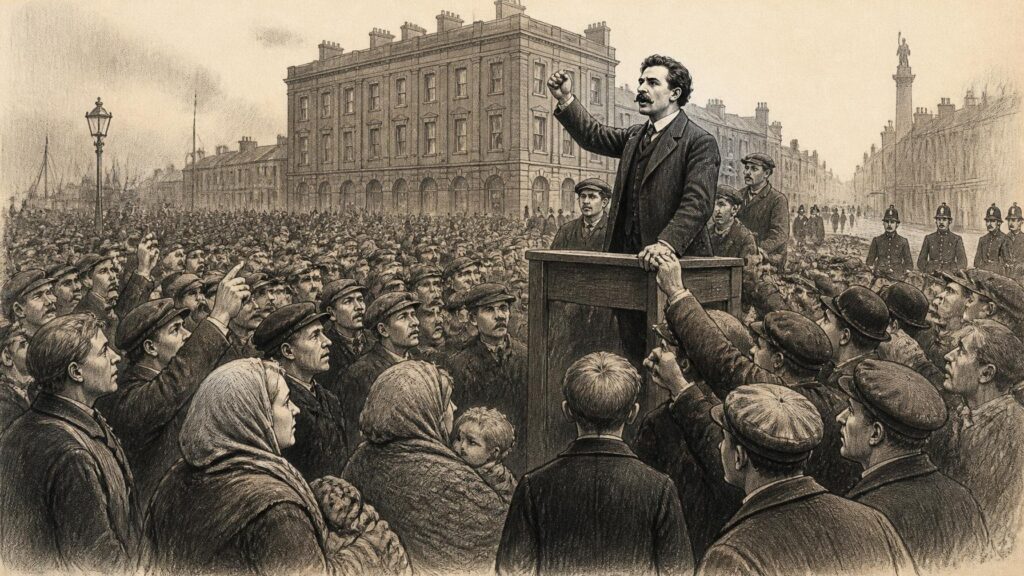
AI generated historical illustration, not a contemporary photograph.
At a Glance
James Larkin was among the most consequential and divisive figures in modern Irish history. His name is inseparable from the Dublin Lockout of 1913, yet the larger significance of his life lies in the way he made unskilled and casually employed workers a political force in their own right. A commanding organiser and electrifying speaker, he helped create institutions, symbols and expectations that outlasted his own turbulent career. He was also erratic, quarrelsome and frequently isolated from allies. To understand Larkin is therefore to understand both the liberation and the strain within Irish labour politics in an age of empire, nationalism, revolution and state formation.
Irish Beginnings
James Larkin was born on 28 January 1874 at Combermere Street, Toxteth, Liverpool. He was English-born, but this should not obscure the depth of his Irish family background or his subsequent place in Irish history. His father, also James Larkin, came from Lower Killeavy in south Armagh; his mother, Mary Ann McNulty, was from Burren in south Down. Both belonged to the immense nineteenth-century migration from Ireland to Britain, in which families displaced by poverty, limited rural opportunity and the long aftermath of the Great Famine found work in industrial cities while retaining strong kinship, religious and national connections across the Irish Sea.
Larkin later claimed an Ulster birth at his mother’s home district. The documentary record instead supports Liverpool as his birthplace. That discrepancy is revealing rather than trivial. It indicates the strength with which he came to identify himself with Ireland, especially Ulster, and the political usefulness of an Irish origin within the nationalist atmosphere in which he later worked. He was neither simply a Liverpool labourer transplanted to Dublin nor an uncomplicated native son. His life belonged to the dense world of Irish migration, where identities were made between cities, docks, churches, families and political movements on both islands.
His childhood was poor. Formal education was brief, and he worked from a young age under the half-time system that combined schooling with employment. Such an upbringing did not make him representative of every worker, but it gave him direct knowledge of insecurity, casual labour and the humiliations of dependence upon employers. He held a succession of jobs, including work connected with shops, furnishings, engineering and the sea, before becoming a dock worker around 1890. Liverpool’s docks were an unforgiving school. Work could be intermittent, hiring was often arbitrary, and families depended upon the uncertain daily sale of male labour.
The death of his father while Larkin was still young intensified this insecurity. Yet the surviving evidence also shows a young man with unusual self-confidence, curiosity and energy. He travelled or attempted to travel widely, at one stage stowing away for America. He read, attended political meetings and joined the Independent Labour Party. His socialism grew less from abstract theory than from moral anger at poverty and from the practical question of how people with little property or education could defend themselves. This moral emphasis remained a constant in his public speech. He saw industrial conflict not merely as a dispute over wages but as a contest between human dignity and social degradation.
Dockside Education
Larkin’s political formation occurred within the British labour movement, whose organisations and ideas crossed readily to Ireland. In Liverpool he encountered independent labour politics, radical journalism and trade unionism. At first he shared a common socialist suspicion that unions might simply temper capitalism rather than overcome it. Experience altered that view. Dock labour taught him that collective organisation could immediately change the balance between a worker seeking a job and an employer controlling access to one.
He joined the National Union of Dock Labourers after taking part in industrial action in 1905. The conflict cost him his job but brought his abilities to the attention of the union. He became an organiser and, in 1906, a general organiser. This transition was decisive. Larkin was not an intellectual writing from outside labour life; he became a professional advocate for workers, travelling, recruiting, negotiating and addressing meetings. His greatest gifts were personal presence and a capacity to translate complicated grievances into an urgent moral drama. His weaknesses were closely connected: impatience with procedure, mistrust of compromise and a tendency to treat disagreement as betrayal.
His union work took him through northern England and Scotland before he was sent to Belfast in January 1907. Belfast was then one of the leading industrial cities of Ireland, its economy built around shipbuilding, engineering, linen, ports and associated trades. It was also deeply shaped by sectarian division, political unionism and a labour market in which employers could benefit from workers’ religious and communal rivalries. Larkin did not abolish those divisions. No organiser could have done so by oratory alone. But he demonstrated that dock workers, carters and other transport workers could act together on grounds of shared material interest.
The Belfast dock strike of 1907 gave him a national reputation. Initially he pursued the moderate policy expected by the National Union of Dock Labourers. Employer resistance, the use of replacement labour and pressure from below drove the dispute towards wider action. His speeches attracted large crowds and his attacks on employers and cautious union officials made him a compelling public figure. The strike was marked by violence, police intervention and serious tension between labour solidarity and sectarian politics. It did not produce a simple triumph. Its importance lay partly in showing the potential power of generalised transport disruption, and partly in demonstrating how quickly a militant organiser could come into conflict with the cautious leadership of a British-based union.
Larkin’s Belfast experience also established a pattern that would recur repeatedly. He could make workers feel visible and formidable; he could also alarm allies, provoke opponents and make durable organisation harder by insisting on personal command. The legend of “Big Jim” was already beginning to form, but legend should not conceal his practical achievement. He had helped workers whose occupations were insecure and poorly regarded to believe that they were capable of acting collectively.
Union Creation
The breach with the National Union of Dock Labourers pushed Larkin towards a more independent Irish organisation. In Dublin, after a period of suspension and dispute with the British union leadership, he founded the Irish Transport and General Workers’ Union in 1909. The title mattered. It announced an ambition to organise workers across transport and beyond it, including labourers who had often been excluded from craft unions or treated as too transient, poor or unskilled to organise effectively.
The new union’s emergence must be placed against the social conditions of Edwardian Dublin. The city contained great wealth, commerce and cultural activity, but it was also notorious for overcrowded tenements, low-paid casual employment and high levels of sickness and infant mortality. Workers did not form one uniform class. There were skilled tradesmen, domestic servants, carters, dockers, women employed in factories and laundries, casual labourers and many others. Their experiences varied by gender, occupation, religion and neighbourhood. Larkin’s distinctive contribution was to insist that the least secure workers were neither marginal to the labour movement nor beyond organisation.
The Irish Transport and General Workers’ Union, usually known by its initials ITGWU, built branches, collected dues, supported disputes and cultivated an identity larger than any particular workshop. It sought industrial unionism: workers in related industries acting together rather than being divided into narrow craft bodies. It also encouraged sympathetic action, under which workers might assist others whose dispute was with a different employer. Such methods could be potent in transport and distribution, where a stoppage by drivers, dockers or carters could affect an entire city.
Larkin’s organisational achievement should not be reduced to the work of one man. The union relied on office staff, local activists, women supporters, organisers, committee members and the families who bore the hardship of strikes. James Connolly, who became an important colleague, was among those who helped give labour politics intellectual and organisational depth. Figures such as William O’Brien, Rosie Hackett and many less celebrated workers were indispensable to the movement’s development. Nevertheless, Larkin was its most recognisable public voice. His persona recruited people, drew donations and made the union visible in a city where employers and newspapers could otherwise dismiss workers individually.
The union also created a social world. Liberty Hall became more than an office. It was a meeting place, a site of newspapers and education, and a symbol of workers’ independent organisation. The ITGWU promoted music, drama, recreation and political discussion. Such activity was not merely ornamental. It expressed the conviction that labour should produce a culture of its own rather than accept a subordinate place within institutions controlled by employers, churches or nationalist elites. In this sense Larkin’s movement combined practical wage struggles with an assertion of working-class citizenship.
Public Voice
The weekly Irish Worker, first issued in 1911, extended Larkin’s influence far beyond any hall in which he could speak. Edited under his direction, it was combative, visual and deliberately provocative. It attacked exploitation, criticised employers, publicised disputes and promoted a broad labour culture. It also gave Larkin an instrument through which to shape his own image. He understood the political value of publicity unusually well. A speech could stir an audience; a newspaper could sustain the argument, rally supporters and carry labour news into homes, workplaces and public houses.
His journalism was not restrained. Personal attacks, accusations and inflammatory language frequently brought threats of legal action and increased antagonism with opponents. Admirers saw fearless candour; critics saw recklessness and egotism. Both perceptions had some basis. Larkin’s language was designed to force choices. It rejected the polite assumption that social peace was more valuable than justice for the poor. Yet his readiness to personalise political conflict narrowed his room for manoeuvre and damaged relationships with people who broadly shared his objectives.
His place in public life grew rapidly. He was elected to Dublin Corporation as a labour councillor in 1912 and became president of the Irish Trade Union Congress in 1913. These offices demonstrated that he was not merely a street agitator. He operated within civic and trade-union institutions even while denouncing their inadequacies. But institutional office never fully suited him. He preferred mass meetings, direct appeals and dramatic confrontation. His authority came not from patient committee-building alone but from the emotional bond he made with workers who felt ignored by official Ireland.
The popular image of Larkin as an entirely spontaneous orator needs qualification. His performances were undoubtedly theatrical, but they were also political work. He used gesture, rhythm, biblical language and moral contrast to construct an audience as a collective body. When he spoke of workers as a people with honour, he offered more than consolation. He was asking them to accept sacrifice, discipline and solidarity. This could be empowering, but it also placed immense importance on his own ability to sustain morale and interpret events.
By 1913, the ITGWU had grown to roughly 20,000 members. The achievement was remarkable, especially given the union’s youth and the precarious positions of many recruits. Its success frightened employers who believed that industrial unionism threatened managerial authority and commercial stability. The collision that followed was not inevitable in every detail, but a major confrontation had become increasingly likely. Dublin’s employers were not facing a minor demand from a single workplace. They faced a movement that challenged their right to dictate the terms on which labour could organise.
City Conflict
The Dublin Lockout began with a dispute centred upon William Martin Murphy’s business interests, especially the Dublin United Tramways Company and the Irish Independent newspaper group. Murphy was a formidable capitalist, nationalist and civic figure. He regarded Larkin’s union as a dangerous force, and Larkin regarded Murphy as the emblem of an employer class determined to preserve low wages and arbitrary power. Their personal antagonism became prominent, but the Lockout was never simply a duel between two men. It involved hundreds of employers, tens of thousands of workers and families, the police, churches, newspapers, British unions and the state.
When the ITGWU sought to recruit tramway workers, Murphy dismissed union members or demanded assurances that employees would not join the union. The union answered with a strike on 26 August 1913, the opening day of the Dublin Horse Show. Employers then widened their response. In September, about 400 employers combined to lock out workers who would not repudiate the ITGWU. More than 20,000 workers were directly involved, while the number of dependants affected was vastly larger. The word “lockout” is important: the struggle was not only a strike initiated by labour but an employers’ campaign to deny work to those associated with an independent union.
The conflict made visible the ordinary misery of Dublin’s working poor. Families already living close to subsistence faced hunger, eviction and mounting debt. Relief came from union funds, charitable effort and solidarity from Britain, but it could not remove the daily pressure upon households. Women carried a great share of this burden. They managed scarce food, collected relief, maintained homes and participated in meetings and demonstrations. Historical accounts that focus only on male leaders can make the struggle appear narrower than it was. The Lockout was lived in tenement rooms, queues, kitchens and streets as well as in union offices and employer boardrooms.
On 31 August, later remembered as Bloody Sunday, police baton-charged crowds gathered around Sackville Street, now O’Connell Street, where Larkin appeared despite a ban on his public speaking. The violence was widely reported and hardened opinion. Contemporary and later accounts differ in emphasis, but there is no serious doubt that police force against crowds became one of the defining images of the dispute. The digitised Dublin Metropolitan Police prisoner records also complicate hostile contemporary portrayals of those arrested: they indicate that many arrested during the Lockout were workers, not merely the supposed criminal fringe invoked by anti-union newspapers.
Larkin’s arrest and imprisonment for seditious utterances made him still more famous. His release, after a public campaign, was celebrated by supporters as proof that the authorities sought to silence working-class representation. Yet his imprisonment also exposed a problem. The movement depended heavily on a leader who could be removed by the state or exhausted by constant crisis. The Lockout demonstrated both the power of Larkinism and the vulnerability of a campaign centred so strongly on Larkin himself.
Family Hardship
The Lockout has often been remembered through great speeches, crowded streets and the image of Larkin addressing workers. Those images are powerful, but they can obscure the private cost. The dispute continued into the winter of 1913–14. Families faced hunger and cold, while the possibility of returning to work could divide neighbours and even households. Employers hoped that prolonged deprivation would break union loyalty. Workers had to decide repeatedly whether solidarity could be maintained when children needed food and rent arrears threatened the home.
British trade unionists and socialist organisations sent substantial aid. Support crossed the Irish Sea in money, food and political campaigning. This assistance was real and important, yet it could not substitute for decisive industrial action in Britain. Larkin believed that sympathetic strikes by British workers were essential, because Dublin employers depended upon commercial and transport links beyond Ireland. He travelled in Britain during the dispute, appealing to enormous audiences in what was called the Fiery Cross campaign. He could generate enthusiasm, but he could not compel established British unions to adopt a strategy they considered too risky.
In December 1913, a special Trades Union Congress conference rejected direct action on the scale Larkin wanted. British union leaders feared the consequences of a general sympathy campaign and were wary of syndicalist tactics. Larkin’s contemptuous attacks upon cautious officials did not help his case. The decision was a strategic defeat of immense consequence. It showed that international solidarity had limits, even between workers facing related employers within the United Kingdom.
One of the most controversial aspects of the Lockout involved efforts to send children of strikers temporarily to sympathetic homes in Britain. Catholic clergy and nationalist critics opposed the scheme, frequently presenting it as a threat to children’s faith and family ties. The resulting confrontations were emotionally charged and sometimes violent. It is too simple to describe one side as caring for children and the other as indifferent. Supporters saw evacuation as practical relief from hunger; opponents feared religious influence, separation and loss of parental authority. The episode exposed the power of Catholic institutions and the limits of labour’s authority in a predominantly Catholic working-class city.
By January 1914, the workers returned to employment where they could, usually without the decisive victory Larkin had sought. The Lockout was therefore a defeat in its immediate industrial objectives. Employers had not destroyed the ITGWU, however, and workers had demonstrated a capacity for organisation that could not be erased. The struggle left behind bitterness, pride, damaged health, strengthened networks and an enduring language of solidarity. Its historical importance does not depend upon calling it a victory. In some respects it was a devastating defeat; in others, it was the making of a permanent labour tradition.
Citizen Defence
The violence of the Lockout prompted the formation of the Irish Citizen Army. It began as a workers’ defence body associated with Larkin and Connolly, intended to protect meetings and pickets from police attack. Sources differ slightly on its exact founding date and early sequence, a reminder that organisations often emerge through several meetings and decisions rather than one uncomplicated moment of birth. What is clear is that it developed at Liberty Hall during the crisis of late 1913 and drew much of its early membership from the union movement.
The original purpose was defensive. It reflected the belief that ordinary workers had not received equal protection from public authorities and needed a disciplined means of safeguarding their meetings. In time the organisation acquired uniforms, training and political ambitions larger than the Lockout. Under Connolly, particularly after Larkin left Ireland, it became connected to the revolutionary politics that culminated in the Easter Rising of 1916. Around 200 members of the Citizen Army took part in that Rising.
Larkin’s relationship to this development requires care. He helped establish the organisation and served as its commandant during its early period. He was not in Dublin during Easter Week, having gone to the United States in late 1914. It is therefore inaccurate to place him among the active leaders of the Rising. Nor should his role in creating the Citizen Army be ignored simply because Connolly later became its most influential military and political leader. The Army’s history belongs to both men, as well as to Michael Mallin, Constance Markievicz, Seán O’Casey, Helena Molony and many others.
The connection between Larkin and the revolutionary decade is consequently indirect but substantial. He changed the political vocabulary of Dublin by making social justice central to discussions of national freedom. The National Library of Ireland has rightly described his contribution to the Rising as both indirect, through his exposure of social injustice, and direct, through his part in establishing the Citizen Army. This does not mean that labour and nationalism were naturally identical. They frequently diverged. It does mean that the social question could no longer be treated as secondary to constitutional or national questions.
American Exile
Larkin left Dublin for New York in October 1914, ostensibly for a speaking tour and period of recovery. Whether he intended a short absence or contemplated a more prolonged departure remains uncertain. His relations with colleagues in the ITGWU had deteriorated, and the emotional toll of the Lockout had been severe. The timing was momentous. Europe was at war, Irish nationalism was entering a more radical phase, and the organisation he had helped create would soon be led by Connolly into a revolutionary current from which Larkin was physically absent.
In America he moved through a complicated world of Irish nationalism, socialism, anti-war agitation and emerging communism. He worked at different times with socialist activists, Irish-American networks and labour radicals. During the First World War he received financial support connected with German agents for anti-war propaganda. This is a documented aspect of his American years, but it must be understood in context. Germany sought to exploit opposition to Britain; Irish nationalists and anti-imperialists sought support for their own causes; socialist and labour activists opposed the war for varied reasons. Larkin’s involvement does not fit neatly into later patriotic or ideological narratives.
He became increasingly interested in the Russian Revolution and in the American socialist left. In 1919 he was involved in the formation of the Communist Labor Party of America. His enthusiasm for revolutionary change was genuine, but his dealings with organised communism repeated familiar patterns. He could attract followers, speak powerfully and make bold initiatives; he could also quarrel, distrust colleagues and resist collective discipline when it limited his own authority.
American authorities arrested him during the Red Scare. He was convicted of criminal anarchy and imprisoned at Sing Sing. The prosecution took place amid a fierce national campaign against radicals, immigrants and labour militants. Larkin’s case cannot be separated from that atmosphere. His imprisonment made him a cause among supporters but did not restore the position he had lost in Irish labour. He was pardoned and deported in 1923, returning to Ireland after nearly nine years away.
Exile enlarged Larkin’s international experience but also deepened his separation from the Irish organisations he had founded. While he travelled and agitated abroad, Ireland underwent the Easter Rising, the War of Independence, partition, the Treaty and Civil War. He returned not to the city of 1914 but to the capital of a new Free State, where labour, nationalism and revolutionary politics had all been transformed.
Revolutionary Return
Larkin’s return to Dublin in 1923 was dramatic. He remained a famous figure, and crowds still responded to his presence. Yet fame could not automatically restore leadership. The ITGWU had survived the Lockout and the revolutionary years under other leaders, especially William O’Brien. Larkin expected recognition as its founder; many within the union saw him as a disruptive force whose long absence and revolutionary commitments made cooperation difficult. The resulting conflict was bitter and personal, but it also concerned genuine questions: should labour be organised through pragmatic union negotiation, revolutionary industrial action, parliamentary representation, or some combination of all three?
He founded the Workers’ Union of Ireland in 1924, creating a rival to the ITGWU. The split weakened labour unity in Dublin and endured for decades. It is tempting to blame Larkin alone, particularly because of his combative temperament. That would be inadequate. Post-revolutionary Ireland was a fractured political environment, and labour organisations faced difficult choices about state institutions, employers, communism, religion and electoral politics. Nonetheless, Larkin’s inability to share leadership or accept organisational limits was a major factor in the division.
His political activity included the Irish Worker League, which represented a communist current. In the general election of September 1927 he won a seat for Dublin North, becoming the only openly communist candidate ever elected to Dáil Éireann. He could not take his seat because he was an undischarged bankrupt. The Oireachtas record of the Committee on Procedure and Privileges preserves the institutional trace of this episode. It is a sharp illustration of the gap between electoral victory and effective political power. Larkin’s election demonstrated his continuing appeal; his exclusion demonstrated the practical and legal constraints that limited it.
Relations with the Communist International were also difficult. Larkin had welcomed Soviet revolution and hoped for international support, but he resisted being directed by party structures beyond Ireland. By 1929 he had broken with Moscow. He remained interested in the Soviet experiment while becoming wary of its authoritarian character. His political evolution was neither a clean conversion from communism nor a simple betrayal of it. Rather, it reflected the tension between his revolutionary rhetoric and his profound personal independence.
In the early 1930s, amid intense hostility to communism from Catholic and conservative forces, Larkin retreated from formal revolutionary politics. The Irish Worker League declined. The Workers’ Union of Ireland adopted a more reformist direction, and Larkin increasingly returned to the familiar ground of municipal politics, industrial representation and campaigns around housing and poverty.
Political Reinvention
Larkin’s later career was quieter than his years of greatest fame, but it should not be dismissed as mere decline. He was elected again to Dublin Corporation in 1930 and remained an eloquent critic of poor housing, unemployment and inequality. He had always understood that industrial conflict could not be detached from the conditions in which workers lived. The tenements, health crises and housing shortages of Dublin were not background scenery to labour history; they were central to the vulnerability of workers and their families.
His public politics now combined old militancy with a more practical engagement in local government and parliamentary life. He stood unsuccessfully in several general elections before winning election to Dáil Éireann in 1943 as an Independent Labour candidate for Dublin North-East. He was re-elected in 1944. The achievement was striking, given the divisions that had marked his earlier career and the decades since the Lockout. It showed that his name still carried immense meaning for many Dublin voters.
He did not become a conventional parliamentarian. His significance in the Dáil lay partly in his symbolic presence: the old agitator of 1913 had entered the legislature of the state that had emerged from the revolutionary period. Yet he also used the chamber to raise labour and social questions. His later years demonstrate that Irish political life could not simply absorb Larkin without being altered by him. He brought into formal politics memories of hunger, police batons, locked-out families and workers’ self-organisation.
There was a gradual rehabilitation in the wider labour movement. The antagonism between the ITGWU and the Workers’ Union of Ireland did not disappear, and Larkin never recovered the undisputed authority he had enjoyed before 1914. But age, electoral success and the enduring prestige of 1913 made it increasingly difficult to exclude him from the story of Irish labour. Those who had once regarded him as irresponsible could acknowledge his foundational role without accepting every decision he had made.
This later acceptance was incomplete and sometimes ceremonial. That should not be mistaken for irrelevance. The movement he helped shape had become larger than the man, and in one sense that was his most lasting success. Unskilled workers had institutions, traditions and political languages that did not depend entirely on his voice. In another sense, his inability to secure unity remained a warning about the cost of leadership driven by charisma and personal conflict.
Final Years
By the 1940s, Larkin was an elder statesman of Irish labour, though never a universally comfortable one. He remained capable of forceful public intervention and retained a strong following. The contrast between the poor dock worker of Liverpool, the central figure of the Lockout, the American prisoner and the Dáil deputy was extraordinary. It also makes simple character judgements difficult. His life contained dramatic reversals, but his underlying concern with the powerlessness of ordinary workers endured.
He died in Dublin on 30 January 1947. He was attended by Archbishop John Charles McQuaid and reconciled with the Catholic Church. This final episode has sometimes been used to impose a neat interpretation upon a life that resists neatness. Larkin had been a Catholic throughout, even while his politics had repeatedly challenged clerical authority and attracted fierce religious condemnation. Reconciliation at death did not erase earlier tensions between labour radicalism and Catholic power, nor did it convert his career into a conventional religious story.
His modest estate at death is a poignant fact. Despite a lifetime at the centre of great disputes, he did not accumulate wealth. That detail should not be sentimentalised: poverty does not prove political virtue. But it does underline the distance between the public mythology of a mighty labour leader and the material circumstances in which he ended his life.
Funeral commemoration quickly reinforced his symbolic stature. Labour activists and many ordinary Dubliners recognised in him a man who had given voice to people accustomed to being treated as expendable. His name became attached to streets, halls, banners, songs and arguments. He entered the civic memory of Dublin not as a neutral historical subject but as a contested emblem of working-class pride.
Contested Memory
Larkin’s afterlife has been exceptionally powerful. Oisín Kelly’s statue on O’Connell Street, derived from the familiar image of Larkin speaking with raised arms, has made him an unavoidable presence in Dublin’s public landscape. Art, literature, theatre, songs and trade-union banners have often been more influential in sustaining his image than detailed historical scholarship. The public Larkin is therefore frequently larger, simpler and more heroic than the contradictory person revealed by the record.
Folklore and political memory have naturally magnified his role. He is sometimes represented as the sole creator of Irish labour, the commander of the Lockout, or the direct author of the Easter Rising’s social vision. Each formulation contains a fragment of truth but fails as history. Labour organisation in Ireland existed before Larkin; the Lockout was sustained by thousands of workers and families; Connolly and many others shaped the Citizen Army and revolutionary labour politics. Larkin’s importance is not diminished by recognising collective action. On the contrary, his achievement was to help make such collective action imaginable and organised.
Interpretations of his character remain divided. Admirers stress courage, compassion, exceptional communication and his refusal to accept that poor workers should be grateful for insecurity. Critics point to personal vanity, unstable alliances, intolerance of criticism and decisions that damaged labour unity. The evidence supports both admiration and criticism. He had a remarkable ability to awaken self-respect among the marginalised. He also repeatedly turned organisational disagreement into personal enmity, with consequences that outlasted the immediate quarrel.
His nationalism was similarly complex. He was a lifelong Irish nationalist, opposed partition and British imperial power, yet his political education was rooted in Liverpool and his strategy repeatedly depended upon connections with British labour. His internationalism brought him into contact with American radicals, Irish-American nationalism and Soviet communism. Larkin’s life therefore challenges a narrow national narrative. Irish labour history was never confined to the island. It was formed through migration, empire, ports, newspapers, international finance and the movement of ideas across borders.
His greatest historical legacy may be the change in political imagination he effected. Before Larkin, unskilled workers could be treated as an incoherent mass: necessary for labour but absent from public authority. After Larkin, their organisation had to be reckoned with. Employers, political parties, civic institutions and nationalist movements could oppose them, patronise them or attempt to lead them, but could no longer plausibly ignore them.
Enduring Legacy
James Larkin did not achieve all that he promised. The Lockout ended without victory; the labour movement was later divided; his revolutionary ventures faltered; and many of the social injustices he denounced survived him. A historical assessment that measures him only by immediate outcomes would therefore be severe. But historical influence also lies in creating capacities and expectations that later generations use in altered circumstances.
The ITGWU became one of the principal foundations of organised labour in independent Ireland. The Workers’ Union of Ireland, despite originating in division, also became a significant force. Their eventual successors carried forward traditions of collective bargaining, workplace organisation and social advocacy that owe much to the world Larkin helped create. Modern trade unionism in Ireland did not reproduce Larkinism unchanged. It professionalised, negotiated and adapted to a different economy and state. Even so, it inherited the conviction that workers excluded from wealth and power could organise across occupations and demand recognition.
His legacy is also cultural. The phrase “Big Jim” conveys affection, scale and public drama, but it can conceal the more valuable lesson of his career: movements require both inspiration and institutions. Larkin supplied inspiration in abundance. His best work involved institution-building, newspapers, branches, funds, meetings and common purpose. His failures often followed when personal leadership outran collective discipline. That tension makes him a useful subject not only for commemoration but for critical reflection.
In Irish history, he belongs beside the great nationalist and revolutionary figures of his era, though he cannot be fitted comfortably into any one tradition. He was not simply a nationalist, socialist, communist, trade unionist or parliamentarian. He was all of these at different moments, and never wholly reducible to any of them. His story joins social history to political history: the history of wages, housing, hunger and work to the history of elections, national independence and armed mobilisation.
Labour Firebrand remains an appropriate description because the fire was real, but it was neither pure nor uniformly destructive. Larkin illuminated injustices that respectable society preferred to overlook. He gave workers words for their anger and structures through which to act. He also scorched alliances and sometimes mistook his own authority for the cause itself. The durable historical fact is that Irish public life after Larkin had to acknowledge the worker not merely as a voter, client or recipient of charity, but as a citizen entitled to organisation, dignity and power.
The article presents Larkin’s achievement as inseparable from a tension: his dramatic, morally charged leadership mobilised precarious workers and gave the ITGWU a powerful public identity, yet it also made campaigns vulnerable when his alliances frayed or he was removed from action. The Lockout particularly suggests that solidarity depended not only on speeches and strikes, but on women’s unpaid labour, household endurance and support from Britain. This broader social infrastructure complicates the familiar focus on Larkin and Murphy. How should historians weigh charismatic leadership against the quieter collective labour that sustained Irish trade unionism during and after the 1913 Lockout?