

Fuel Burdens
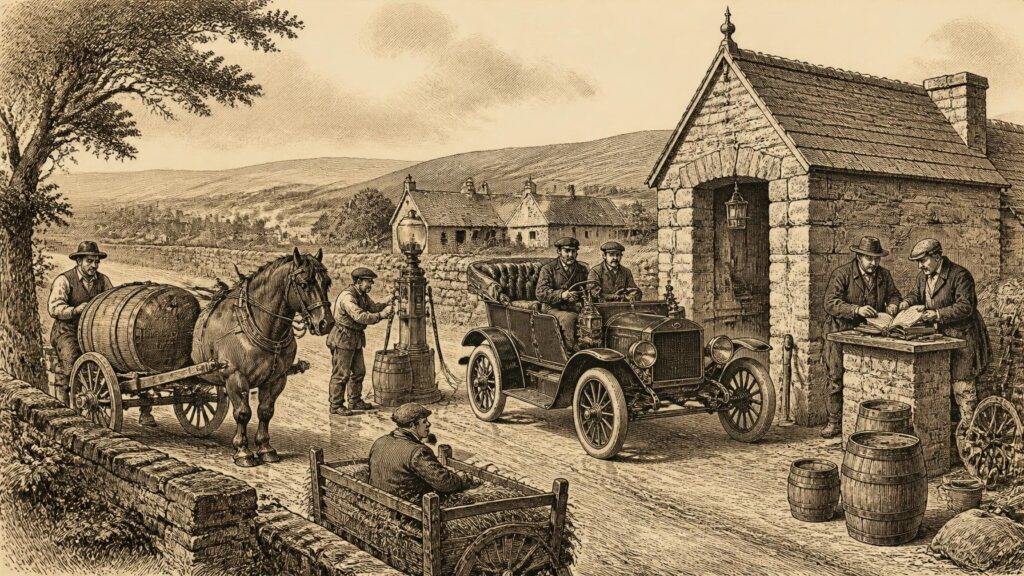
AI generated historical illustration, not a contemporary photograph.
At a Glance
Taxes on petrol, diesel and heating fuel have repeatedly made the Irish state visible in everyday life: at the pump, beside the oil tank, on the farm, and in the household budget. Their history is not simply one of governments raising revenue. It is a record of dependence on imported energy, changing forms of mobility, rural and urban inequality, international crises, environmental policy, and recurring disputes over who should bear unavoidable costs.
Fiscal Origins
Imperial Inheritance
Fuel excise in Ireland did not begin with the independent state. It emerged under the United Kingdom of Great Britain and Ireland, when the motor car and the internal-combustion engine were still relatively novel technologies. The Finance Act of 1909–10 placed a customs duty on motor spirit, while making provision for allowances or repayment where spirit was used for purposes other than propelling motor cars. The arrangement is revealing. From the outset, the tax was not merely a general levy upon a commodity. It sought to distinguish between fuel consumed on the road and fuel used in agriculture, industry, fishing or other activities. That distinction would survive, in altered administrative forms, long after independence.
The British fiscal system also connected motoring to the financing and regulation of roads. Motor licences, duties on vehicles and duties on fuel developed together, though not always in a simple or transparent relationship. Those who drove tended to understand these payments as contributions towards roads. Governments, however, treated them as part of the wider public revenue. That tension—between a user-pays expectation and the Exchequer’s need for flexible income—became a durable feature of Irish arguments about fuel.
It is important not to exaggerate the social reach of the earliest petrol taxes. Private motoring before the First World War was limited, and ownership of a car marked considerable means. Petrol duty could therefore be understood as a tax on a relatively narrow activity. Yet fuel was already important beyond private cars. It powered commercial transport, agricultural machinery, boats and small engines. The practical problem of identifying the eventual use of a liquid fuel, and preventing a lower-taxed product from being diverted into road vehicles, was embedded in excise administration from an early date.
The constitutional upheavals after 1921 did not produce an immediate clean break in fiscal practice. The new Irish administration inherited an economy damaged by war and political conflict, a thin revenue base, and much of the tax machinery previously operated through British institutions. Revenue’s own historical account emphasises that the legal effect of existing fiscal laws was preserved where they were compatible with the Free State’s constitutional order. Customs and excise, including duties connected with hydrocarbon oils, were among the revenue heads on which the state depended from its earliest years.
State Survival
This inheritance mattered because the Irish Free State required dependable receipts. A young state needed to fund administration, public services, policing, debt obligations and infrastructure, while its capacity to levy broad progressive taxation was constrained by low incomes, emigration and the political sensitivity of direct taxes. Customs and excise were administratively familiar and comparatively efficient to collect at ports, depots and warehouses. Fuel, like alcohol and tobacco, was especially suitable for such collection because imports and distribution passed through identifiable commercial channels.
In that setting, an excise charged on fuel was part of a wider reliance on indirect taxation. Such taxes were paid in fragments rather than as a conspicuous annual bill. Their incidence could nevertheless be sharply felt, especially where a household or enterprise could not avoid the purchase. The apparent ease of collection did not mean political invisibility. The price displayed by a petrol pump condensed several elements: the cost of imported oil, wholesale and retail margins, transport, taxation and, later, value-added tax. When the total rose, motorists frequently attributed the increase to government, whether or not the immediate cause lay in world oil markets.
The early state also inherited an unequal geography of transport. Railways remained important, but motor transport was gradually becoming essential for commerce and local travel. The meaning of a fuel tax consequently varied. In a city with trams, buses and shorter journeys, petrol might be viewed as a discretionary motoring expense. In scattered rural districts, the same fuel could be connected to getting to a market, hospital, school, parish town or workplace. This was not a simple urban-rural division—many rural households did not own cars, while many urban workers relied on them—but it created the political language through which later objections were often expressed.
Contemporary evidence from the interwar period shows both the limited scale of private motoring and its cost. A 1926 study presented to the Statistical and Social Inquiry Society of Ireland estimated just under 20,000 private cars in the Free State. It treated annual car tax, insurance and petrol as significant elements in the expense of ownership. The figures should not be read as precise measures of every household’s experience, but they demonstrate that motoring had already become a recognisable item in the social accounting of the state.
Motor Expansion
Road Claims
As motor traffic expanded through the middle decades of the twentieth century, fuel taxation acquired a broader constituency and a more forceful political vocabulary. The driver was no longer necessarily a wealthy enthusiast. Cars, lorries, buses, taxis and tractors were increasingly woven into ordinary economic life. A levy on petrol could therefore be presented in two competing ways: as a reasonable charge for using roads and consuming an imported resource, or as a penalty imposed on work and mobility.
The former argument had institutional force. Roads required resurfacing, bridges, drainage, policing and traffic management. Heavy vehicles imposed wear; accidents and congestion imposed costs not reflected in the purchase price of a vehicle. A tax related to fuel consumption had an intuitive logic because those who travelled further generally bought more fuel. It was imperfect, however. A fuel duty did not neatly correspond to a particular motorist’s use of a particular road, and it could not by itself distinguish between a commuter trapped by poor alternatives and a leisure driver making optional journeys.
The latter argument was often expressed through the complaint that the motorist paid repeatedly: through vehicle taxes, licences, fuel duty, repairs, insurance and indirect tax on many of those costs. The complaint carried particular weight when road conditions were poor. If motorists associated their payments with a promise of better roads, potholes and inadequate local routes appeared to be evidence of breach. Governments did not necessarily accept that a hypothecated bargain existed, but public debate repeatedly treated one as morally persuasive.
Fuel policy also became tied to industrial and agricultural development. For a peripheral island economy, imported oil was not merely a household commodity. It was essential to haulage, exports, fishing, tourism and farming. This made the tax base attractive to the Exchequer and politically vulnerable at the same time. Raising duty could produce revenue from a widespread consumption item. It could also increase the operating costs of sectors whose competitiveness depended on transport.
Marked Fuels
The long-standing distinction between fuels used on roads and fuels used elsewhere developed into a central feature of Irish excise. Marked gas oil, commonly called green diesel, illustrates the point. It is chemically identified by markers and dyes so that it can be sold at a lower duty for authorised uses, principally in agriculture, construction machinery, certain commercial activities and other non-road purposes. The aim is not to grant an indiscriminate cheap-fuel privilege. It is to apply a different tax treatment where the fuel is not being used as ordinary road propellant.
This system reflects a practical political judgement. Agriculture and other productive sectors use diesel in equipment that does not consume public roads in the same way as a private car. A reduced rate can be defended as avoiding an input cost that might be passed into food and other prices. Yet it also creates a compliance problem. The price difference provides an incentive to use rebated fuel unlawfully in road vehicles. Enforcement, sampling and penalties therefore form a less visible but important part of fuel-tax history.
The existence of marked fuel also complicates sweeping claims that all fossil fuels are taxed alike. They are not. Successive governments have used differentiated rates to recognise road use, heating, commercial production, aviation, shipping, farming and environmental objectives. A headline argument about “the tax on fuel” can conceal a much more elaborate structure of rates, refunds, exemptions and reliefs. This complexity helps explain why political debate often focuses on petrol and ordinary diesel: they are the most visible retail purchases, and they are the products on which motorists see the price change immediately.
It is also a reminder that tax policy can distribute support indirectly. Rather than paying a grant to a farmer or a haulier, government may lower a duty on an input. Such assistance is less conspicuous in the annual budget of a household, but it still has distributional consequences. It can lower business costs, protect production, or preserve the viability of activities in places with few alternatives. Equally, it may favour larger consumers in cash terms, because they buy more fuel.
Oil Shocks
Imported Crisis
The oil crises of the 1970s turned these underlying tensions into an acute political issue. Ireland’s reliance on imported oil exposed it to decisions and conflicts far beyond the state’s control. When world prices rose after the 1973–74 crisis and again at the end of the decade, the cost reached households through petrol, diesel, heating oil, electricity generation and the prices of transported goods. A fuel-price increase was therefore not isolated. It could become a general cost-of-living event.
Dáil debates from the period capture the mixture of economic anxiety and political accusation. In 1977, speakers noted the sustained rise in petrol prices since 1973 and argued over how much of the increase came from oil producers and how much had been added by the Irish Exchequer. The specific assertions made in parliamentary debate should be treated as political claims rather than neutral calculations. Their historical importance lies in what they reveal: fuel had become an index of inflation, and excise was a convenient target because it was a domestic decision even when the underlying oil price was international.
The political difficulty was intensified by Ireland’s spatial pattern. Rural households and businesses often faced longer journeys and weaker public transport. Haulage costs were relevant to small towns, exporters and retailers. Farmers used energy in machinery, transport and production. The price at the forecourt could thus be represented as a burden carried through the entire local economy. This was not simply rhetoric. Higher transport costs can feed into consumer prices. But the distribution of that burden varied greatly: a household without a car did not gain directly from a cut in petrol duty, even if it might gain indirectly if some transport costs fell.
The state’s response to oil shocks could not be confined to taxation. Conservation, diversification of energy supplies, public transport, domestic energy resources and social supports all mattered. Nonetheless, excise was unusually tempting as a political instrument because it could be adjusted quickly and communicated in pence per gallon or, later, cent per litre. A government could cut it to demonstrate intervention; an opposition could demand that it be cut further. Neither action altered the fact that Ireland remained exposed to the international oil market.
Inflation Politics
The 1970s also made a wider lesson unmistakable: an indirect tax can be fiscally useful precisely when it is economically painful. Fuel duty reaches a broad base and is collected before retail sale, but it can amplify visible inflation. Governments facing budget deficits may be drawn to duties on heavily consumed goods. The same governments may then face public anger when taxes contribute to prices during a period of falling real incomes.
There is no single answer to whether an excise increase is inflationary in the deeper sense. It raises the price of the taxed item immediately. Its broader effect depends on wage bargaining, business pricing, monetary conditions, international energy costs and the scale of transport within the economy. But politically, consumers did not need a macroeconomic model to experience the rise. A delivery driver filling a tank, a family arranging home heating, or a farmer buying diesel could see the cost before they saw any eventual fiscal benefit.
Arguments about affordability were therefore intertwined with arguments about trust. If taxation was believed to be paying for roads, services or social protection, it could be defended as collective provision. If it was believed merely to be exploiting a captive consumer, it became a symbol of remote administration. The distinction was often moral rather than technical. It concerned whether government had acknowledged the lack of alternatives available to particular groups.
That moral language outlasted the specific crises of the decade. It helped shape the political afterlife of fuel taxation, particularly when Ireland’s economic circumstances changed. During the later twentieth century, rising car ownership made fuel duty relevant to a much larger portion of the electorate. By the 1990s and 2000s, a dispute once associated with motorists and commercial transport could readily be framed as a dispute about the living standards of ordinary households.
Protest Years
Public Mobilisation
The fuel protests of 2000 were a defining episode in the modern political history of Irish excise. Rising world oil prices created the immediate pressure, but the protests focused public attention on the tax component of prices. Hauliers, farmers, taxi drivers and other groups demonstrated, blockaded and pressed the government for relief. Their actions made fuel a highly visible national issue, disrupting transport and forcing discussion of the relationship between international prices and domestic taxation.
It would be too simple to describe the episode as a spontaneous revolt against a single tax. Different groups had different interests. Hauliers were concerned with operating margins and competition. Farmers were attentive to diesel costs and the treatment of agricultural fuel. Taxi drivers depended directly on petrol or diesel for their livelihoods. Private motorists faced rising household expenditure. Their coalition was united by fuel costs, but not necessarily by a common view of tax policy or public spending.
The protests also showed how fuel can become politically potent when a price rise is understood as externally caused but domestically aggravated. A government cannot control the global price of crude oil. It can, however, control some duties and taxes. That distinction makes excise a pressure valve. Cutting it may not restore an earlier price, but it allows ministers to say that they have acted on the portion within national control. Conversely, refusing to cut it can be presented by opponents as a deliberate choice to leave a domestic charge in place during hardship.
The Finance Resolution of December 2000 recorded reductions in excise on unleaded petrol and auto diesel. The measure was modest in the scale of the wider oil market, but its political significance was larger than the amount per litre alone suggests. It established a clear precedent for temporary or responsive adjustment of fuel duty during a cost crisis. It also reinforced public expectation that governments should intervene when pump prices become politically intolerable.
Uneven Relief
Fuel-duty reductions, however, are blunt instruments. Their principal cash benefit goes to those who buy the most taxable fuel. A large car owner, a frequent long-distance commuter and a household with several vehicles may receive more in euro terms than a low-income household with no car. Businesses may pass some savings to consumers, retain them, or see them outweighed by other costs. The result is that a policy can be popular, rapid and easy to understand while still being poorly targeted at poverty.
This was already evident in the logic of the 2000 debate, even where it was not always stated plainly. The groups best able to organise and make disruption visible were often those with large direct fuel purchases. People who experienced hardship through higher food prices, heating bills or reduced disposable income were less easily represented by a forecourt protest. Political visibility and social need did not necessarily coincide.
Yet it would be unfair to dismiss all demands for fuel relief as special pleading. In a country where many workers had limited transport alternatives, fuel was a necessary input into employment. In rural areas, the ability to travel could determine access to work, education, health care and family support. The crucial historical point is that necessity was unevenly distributed. The same litre of diesel could be a business expense, a commuting necessity, a farm input, or a discretionary purchase. Tax policy treated the product; politics argued over the person using it.
The early twenty-first-century fuel controversy also revealed the limitations of looking at the pump price in isolation. A duty cut reduces revenue. That foregone revenue must be financed by borrowing, spending restraint, other taxes or a lower level of public service. There is no costless tax reduction, even where the immediate price relief is real. The policy choice is therefore distributive twice over: first through who buys fuel, and then through what public expenditure or revenue is changed to accommodate the cut.
Carbon Turning
New Rationale
The introduction of Ireland’s carbon tax marked a significant change in the stated rationale for taxing fuel. Traditional excise could be defended through revenue, road use, import dependence or administrative convenience. Carbon taxation introduced a further principle: the price of fossil fuel should reflect at least some of the environmental damage associated with carbon dioxide emissions. It was a tax designed not only to raise money but also to influence behaviour and encourage a transition away from fossil fuels.
In Budget 2010, the state applied a new carbon tax to petrol and auto diesel from 10 December 2009, initially calculated at €15 per tonne of carbon dioxide. It was subsequently extended to other mineral oils and natural gas, and later to solid fuels. The phased design recognised the different uses of energy, although it did not eliminate controversy. Heating a home and travelling to work were not readily substitutable for every household. The environmental rationale could be strong while the capacity to respond to the price signal remained unequal.
The policy was introduced during a period of severe economic crisis. That timing gave opponents a powerful fairness argument. When unemployment, mortgage stress and falling incomes dominated public life, an additional charge on fuel could be portrayed as punitive. Supporters replied that climate policy could not be indefinitely postponed and that taxation produced revenue capable of funding compensatory measures, energy efficiency and social supports. The dispute was therefore never solely about the scientific basis for climate action. It was about the sequence, pace and distribution of costs.
Carbon tax also altered the meaning of a receipt or rate table. A motor-fuel levy could now comprise a non-carbon excise element and a carbon element, alongside value-added tax. Revenue’s Mineral Oil Tax system makes this composition explicit. The distinction is useful for administration but not always persuasive to a consumer facing one final price. For many households, a tax labelled environmental still looks like a cost-of-living increase unless its purpose, use and compensating measures are credible.
Justice Questions
Research by the Economic and Social Research Institute has given substance to the fairness questions that dominate public argument. Its work indicates that energy and carbon-pricing burdens differ substantially between households according to income, home-heating fuel, dwelling condition, location, transport needs and patterns of consumption. Lower-income households tend to devote a larger share of income to essential energy. Rural households may face heavier exposure because of greater reliance on heating fuels and private transport. But the evidence does not support an overly simple picture in which every high-income household has a lower carbon burden in every respect. Higher-income households can consume more energy in absolute terms, while the burden relative to income can fall more heavily on poorer households.
This distinction between cash amounts and shares of income is fundamental. A flat reduction in fuel duty may give more money to a high-consuming household, yet a smaller saving may be more significant to a low-income household whose budget is already stretched. Similarly, a carbon-tax increase may raise more revenue from a higher-consuming household while still taking a more damaging proportion of income from a poorer one. Political slogans generally compress these differences; historical interpretation should preserve them.
The most important issue is what happens to the revenue. Carbon taxation differs from an uncontrollable oil-price increase because the state receives the proceeds. That creates the possibility of recycling funds through social welfare, retrofitting, public transport, rural mobility, fuel-poverty measures or broader tax changes. It does not guarantee that the outcome will be fair. A retrofit grant requiring substantial upfront payment may be least accessible to those in the coldest homes. A tax reduction may assist those with sufficient taxable income rather than pensioners or people out of work. A universal payment may be quick but may also transfer public money to households that can readily absorb the price rise.
For this reason, the history of carbon tax belongs within the longer history of cost-of-living politics rather than outside it. Carbon policy did not replace the older questions of revenue and mobility. It intensified them. It asked government to make energy more expensive for environmental reasons while simultaneously protecting people who had few realistic means of using less energy.
Energy Emergency
War Prices
The energy-price crisis following Russia’s full-scale invasion of Ukraine in February 2022 brought these themes together with exceptional force. Oil and gas markets were already volatile after the pandemic. The war and its consequences heightened uncertainty and helped drive steep increases in energy costs across Europe. In Ireland, households confronted higher petrol, diesel, gas, electricity and home-heating bills at the same time. The resulting political problem was broader than motoring: energy had become central to the cost of living.
On 9 March 2022, the Government announced a temporary reduction in excise duty on fuels, effective from midnight. The stated reductions were 20 cent per litre of petrol, 15 cent per litre of diesel and 2 cent per litre of marked gas oil. In April, the marked-gas-oil relief was increased further and the temporary measures were extended. The government also used other tools, including changes to VAT on gas and electricity, energy credits and welfare supports. This package reflected an important lesson of earlier crises: fuel duty alone could not answer a general household-energy shock.
The terminology around the measure requires care. Announcements and political discussion often expressed the final saving at the pump in VAT-inclusive terms, whereas the statutory excise change and its tax interaction can be described differently. What matters historically is that the measure was deliberately framed in terms motorists could recognise: cents per litre and the estimated cost of filling a tank. That language was not accidental. It transformed a complicated fiscal adjustment into a direct claim of relief.
The cut was temporary from the beginning. This mattered because emergency tax reductions can generate a political problem when they are withdrawn. If world prices remain high, restoring the duty feels like a fresh increase, even though it is the end of relief. The Irish government delayed and phased restoration. Parliamentary answers in 2024 described the cumulative temporary reductions, extensions and staged reversals. The episode demonstrates how difficult it is to remove a tax concession once households have incorporated it into their expectations and budgets.
Return Pressure
The 2022 measures renewed the old dispute between speed and targeting. Cutting fuel duties is fast. It lowers a visible price, requires little application process and reaches businesses as well as households. But it is not tightly focused on those most in need. Someone who buys little or no road fuel receives little direct benefit; a person driving many kilometres receives more. Broad relief can therefore be politically defensible as an emergency response while remaining economically inefficient as a long-term anti-poverty measure.
Evidence from later ESRI research reinforces this caution. Energy-price shocks tend to weigh more heavily on lower-income households as a proportion of income. Measures such as fuel-duty reductions cushion the shock, but broad tax cuts distribute assistance according to consumption rather than need. Targeted cash supports can direct more help towards households facing poverty, while investments in insulation and efficient heating can reduce exposure to future price movements. Each option has drawbacks: targeted systems can miss people, grants take time, and infrastructure cannot be transformed overnight.
In historical perspective, the 2022 intervention was not a departure from Irish practice but a concentrated expression of it. As in 1973, 1979 and 2000, an international oil shock was translated into domestic conflict over tax. As with carbon taxation, the crisis raised questions about whether a price signal should be softened or allowed to encourage reduced consumption. As in the Free State, the Exchequer faced the basic problem that a valuable revenue source could simultaneously be a burden on economic life.
The episode also revealed a changed energy landscape. Earlier fuel politics centred heavily on petrol and diesel. By 2022, household electricity and gas bills were equally prominent, while climate commitments made permanent fossil-fuel subsidies increasingly difficult to reconcile with stated policy. The state was asked to reduce the immediate price of fossil energy while also leading a transition away from it. That apparent contradiction is the central dilemma of modern fuel politics.
Political Lessons
Visible Taxes
Fuel excise remains politically distinctive because it is unusually visible. Income tax may be deducted before wages reach a bank account; many indirect taxes are buried in the price of ordinary goods. Fuel is different. Drivers see a large illuminated number at the roadside, watch the litres accumulate, and can compare prices between stations. The transaction repeats frequently, making each price movement legible. When governments alter duty, consumers can readily convert the decision into a cost per fill.
Visibility encourages simplification. The pump price can become shorthand for a government’s competence, concern or alleged indifference. Yet no single actor determines it. Crude-oil prices, refining, currency movements, transport, retailer competition, regulation, VAT, excise and carbon charges all matter. A historically responsible account must resist the claim that government either wholly controls prices or is wholly powerless. It controls an important component and decides how tax revenue is used; it does not command the global market.
The same qualification applies to claims about tax cuts. A cut can lower the tax-inclusive price relative to what it otherwise would have been, but it cannot guarantee that a retailer will absorb no other cost change or that international prices will not rise simultaneously. The political demand for a precise and immediate pass-through is understandable, but the commercial chain between duty point and forecourt complicates the outcome. This is one reason official announcements often state the intended tax effect rather than promise a permanently lower advertised price.
Rural Dependence
Rural Ireland has occupied a special place in these arguments, sometimes with justification and sometimes as a convenient political symbol. The documented basis is clear enough: dispersed settlement, longer travel distances and less frequent public transport can make private vehicles more necessary. Agricultural and small-business uses of diesel add further exposure. A uniform fuel price therefore does not create uniform hardship.
But rurality should not be treated as a complete explanation of need. Some rural households are affluent and consume substantial fuel; some urban households depend on cars because of shift work, disability, childcare or weak orbital transport. Conversely, many low-income urban households experience energy hardship through poor-quality housing and heating bills rather than petrol. Good policy requires more detail than a simple map of town against country.
The historical persistence of the rural argument nevertheless points to a basic state obligation. If government taxes a necessity in areas where alternatives are scarce, it must consider whether public transport, local services, energy retrofit and income supports make the burden manageable. In that sense, the strongest response to fuel-tax controversy may not be a permanent reduction in duty. It may be reducing the extent to which livelihoods depend on expensive and volatile fossil fuel in the first place.
Lasting Dilemma
The history of fuel excise in Ireland does not yield an uncomplicated rule that taxes should always be raised, or always be cut. High taxes can finance services, price environmental damage and discourage consumption. They can also deepen hardship where people lack money, efficient homes or transport alternatives. Low taxes can offer immediate relief and protect some businesses, but they consume public revenue, reward higher use in cash terms and may preserve dependence on fuels whose prices and climate costs remain unstable.
What the record does show is that fairness cannot be judged from the nominal rate alone. The crucial questions are who pays, what choices they have, what revenue funds, how quickly prices change, and whether the state provides credible alternatives. A fuel duty imposed without attention to housing, rural mobility and low incomes will be experienced as punitive. A duty cut offered without attention to targeting, public revenue and long-term energy dependence may be popular but incomplete.
Irish fuel politics has repeatedly returned to this point because it sits at the junction of the private and public economy. A litre of petrol is a personal purchase, yet it embodies international supply, national taxation, transport planning and environmental risk. The controversy is therefore likely to endure. Its terms will change as electric vehicles, renewable heat and new forms of mobility expand, but the older questions will remain: what should essential energy cost, who can avoid that cost, and what does a state owe citizens when the price of keeping life moving suddenly rises?
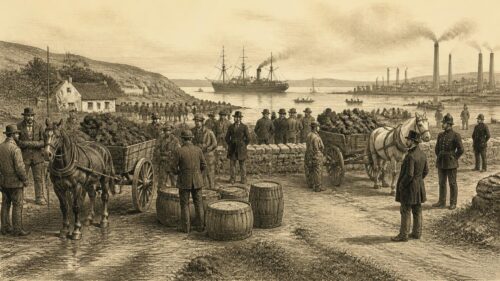
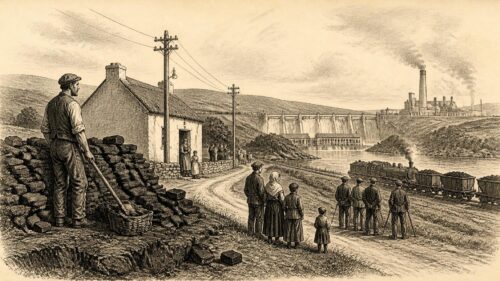
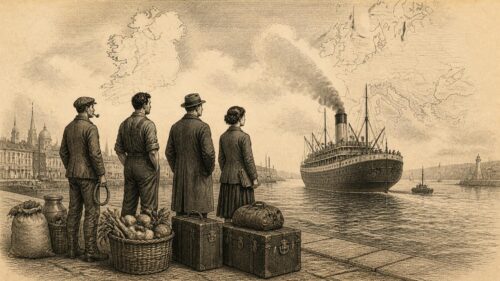
Fuel Burdens shows that Irish fuel taxation has consistently balanced revenue needs, mobility, and competing ideas of fairness. The most striking issue is whether rapid, visible excise cuts during oil-price crises are fairer than more targeted support. They can ease pressure for drivers, farmers, and hauliers, yet their largest cash benefits may go to those using most fuel, while car-free or heating-dependent households face different burdens. This tension also complicates carbon policy: environmental pricing may encourage change, but alternatives remain unevenly available across Ireland. How should Irish governments combine emergency fuel relief, rural needs, and climate objectives without deepening inequality?