

Power Politics
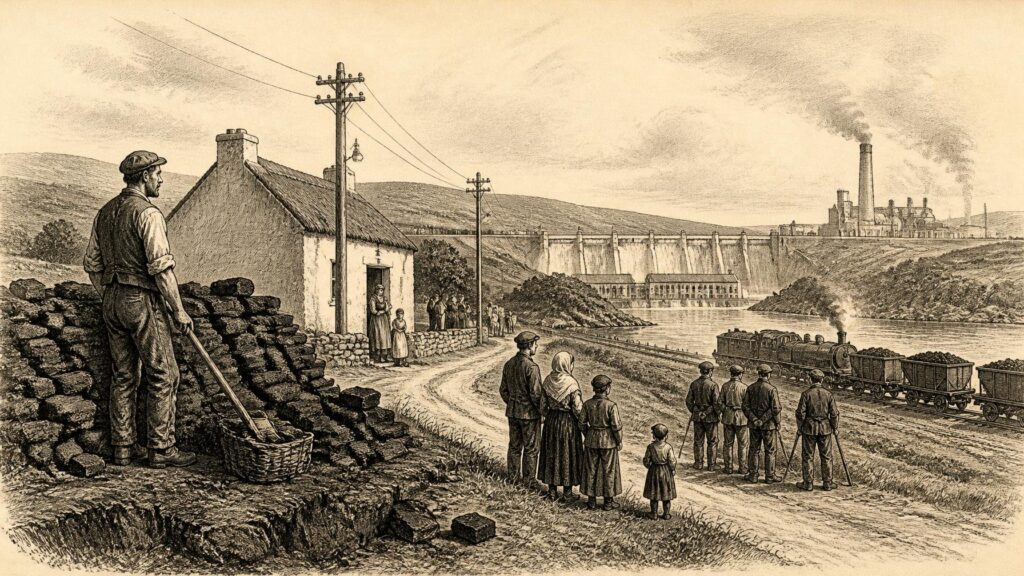
AI generated historical illustration, not a contemporary photograph.
At a Glance
In Ireland, the price of energy has rarely been only a commercial matter. The cost of coal, turf, electricity, gas, petrol and home heating has repeatedly exposed larger arguments about independence, poverty, regional inequality, industrial development, public ownership and the limits of the State. Energy bills entered kitchens and farmyards, but their causes often lay in international markets, inherited infrastructure and political decisions made years earlier. The history of Irish energy prices is therefore also a history of how a small, comparatively isolated country tried to make modern life affordable while remaining vulnerable to imported fuel.
Fuel Before
Before large electricity networks and gas pipelines, energy was conspicuously local. People heated rooms, cooked food and powered small enterprises with whatever fuel could be bought, gathered or cut within reach. In urban Ireland, imported coal was essential. In many rural districts, turf was a household necessity rather than a picturesque survival. Wood, where available, mattered too, but it was not the dominant commercial fuel. The division between coal and turf was never absolute: town and country overlapped, and poorer urban households also used turf where it could be obtained cheaply. Yet the broad contrast was politically significant. Coal tied the country to external supply routes and prices; turf appeared to offer a domestic alternative, though one limited by labour, weather, transport and the quality of particular bogs.
That distinction made fuel a question of social class as well as geography. A household able to buy coal could obtain a concentrated, convenient fuel, but its price was exposed to freight charges, foreign supply and merchants’ margins. Turf demanded arduous labour, storage and a degree of access to land or a reliable seller. Its apparent cheapness could conceal the value of unpaid family work. For politicians, the political meaning of fuel prices was immediate: an increase was not an abstraction but a colder house, a smaller household budget or a higher cost for a workshop, bakery, public institution or farm.
There is a temptation to describe turf as an uncomplicated emblem of national self-sufficiency. The documentary record supports a more qualified view. Turf was undeniably important in domestic life and later became central to State policy, but it was neither uniformly cheap nor universally available in convenient form. Its extraction and drying depended on seasons. Large scale mechanical production involved capital, drainage, rail transport and organised labour. Its calorific value and suitability varied. The political appeal of turf rested partly on its Irish origin, but the practical problems of producing, moving and burning it never disappeared.
The formation of the Free State did not erase these constraints. Independence gave the new administration greater authority over domestic development, but it did not furnish abundant coal, oil or hydrocarbon reserves. Ireland remained on Europe’s western edge, with a dispersed population, a modest industrial base and an energy system shaped by import dependence. The question was not whether the State could eliminate that dependence outright. It was how far it could reduce exposure to outside prices without imposing excessive costs on consumers or public finances.
Shannon Ambitions
The Shannon hydroelectric scheme became the most dramatic early answer. Its construction at Ardnacrusha in the late 1920s was an engineering project of exceptional scale for the new State and a statement of confidence in electricity as an instrument of national development. Hydro power offered something coal could not: generation based on a domestic natural resource. It also gave the State an opportunity to organise electricity supply on a national rather than a merely municipal or private basis.
The Electricity Supply Board, established in 1927, emerged from this project with a public mandate that was broader than producing units of power. Electricity was presented as a means of modernising homes, agriculture and industry. The political calculation was long term. Major generating works and national wires required substantial capital before many consumers could be connected. They could not be judged simply by the immediate price charged to the first customer. The system had to balance present tariffs against the expense of extending supply, maintaining plant and creating demand for electricity in a country where many households had never used it.
That balance was politically delicate from the beginning. Electricity prices could be criticised as burdens on householders or industry, while low prices could be criticised if they weakened the utility’s capacity to invest. Public ownership did not make costs disappear. Instead, it placed decisions about investment, borrowing, tariff structure and regional service within a political framework. The State, as owner and guarantor, bore ultimate responsibility when the utility’s commercial accounts and national-development role pointed in different directions.
Ardnacrusha also had physical limits. Hydroelectric output depended on water conditions, while growing demand required more capacity than one great scheme could permanently provide. The interwar system therefore did not free Ireland from every imported fuel. It did, however, establish a durable political idea: electricity should be organised as a national service and its benefits should not be confined to the places where private providers found immediate profit.
Rural Promise
The Rural Electrification Scheme made that idea tangible. Launched in 1946, it extended supply through 792 rural areas during its first principal phase. ESB Archives records that more than 50,000 miles of line had been strung and over one million poles erected by 1964. Such figures convey the physical scale of the undertaking, but not fully its political character. The scheme asked whether a small farm, a remote cottage or a scattered parish should receive an electricity service even where the direct commercial return looked poor.
Rural electrification was not a gift without charge. Connection fees, fixed charges, wiring costs and the price of appliances could deter households. The ESB’s own historical material shows that organisers and demonstrators travelled to communities to explain the benefits of supply and to encourage sufficient local take-up. In some areas, local clergy, voluntary groups and residents assisted canvassing. Electricity arrived through a combination of central planning, local persuasion and private household expenditure.
The pricing problem was fundamental. If each locality had paid a tariff reflecting only its own distribution costs, remote consumers could have faced particularly high prices. The historical record of planning for the scheme shows concern that highly differentiated charges would provoke political opposition on grounds of discrimination. A national or broadly uniform tariff structure implied cross-subsidy: denser or cheaper-to-serve areas helped sustain the wider network. This was not an accidental feature of the scheme. It was part of the political settlement that made universal service conceivable.
For many households, the first value of electricity was lighting. Yet the public case made for it was much broader. It promised pumps, milking equipment, refrigeration, cooking, hot water and labour-saving domestic appliances. These promises were sometimes promotional, and their fulfilment depended on household income as much as on the presence of wires. Still, the scheme altered what citizens could reasonably expect from modern government. Energy was increasingly understood not simply as a commodity but as infrastructure necessary for social participation.
The Emergency of the Second World War reinforced that perception. Restricted imports of coal and oil, together with difficult generating conditions, exposed the fragility of supply. ESB archival material recalls rationing, conservation campaigns and disconnections for consumers exceeding their allocations. The hardship of those years left a political lesson: neither import dependence nor a national grid guaranteed abundance. It also gave added force to the post-war argument that rural Ireland should not remain outside the electrified society being built in towns.
Peat Strategy
Post-war governments sought another domestic pillar in peat. Bord na Móna, created under the Turf Development Act 1946, was charged with developing peat resources on an industrial scale. Its work combined employment policy, regional development, household fuel supply and electricity generation. The bogs were expected to provide briquettes and turf for homes and industry, as well as milled peat for ESB stations. In political language, peat could appear to reconcile economic nationalism with practical necessity.
The reconciliation was never complete. The cost of peat involved more than cutting it. Industrial extraction required drainage, machinery, rail lines, processing, storage and management of uncertain harvests. Wet weather could damage output. The power stations designed for peat had particular technical requirements. Moreover, the apparent security of a home-produced fuel had to be weighed against its combustion characteristics, environmental consequences and the opportunity cost of State capital.
For a time, the political system accepted that peat should receive support not justified by narrow commercial comparison. The Oireachtas committee report on Bord na Móna in 1980 stated plainly that, until the mid-1970s, half of its output had been sold into an “artificially” created market: turf for electricity generation. In effect, electricity consumers were helping sustain the peat industry. This was not hidden from public institutions. It reflected a policy choice to value indigenous production, employment and security of supply alongside the immediate fuel cost of generating electricity.
That arrangement helps explain why arguments over power prices could not be reduced to management efficiency. A domestic electricity bill could incorporate the cost of a broader regional policy. Consumers in cities and suburbs, many with little direct connection to the boglands, contributed to a system that supported jobs and production in the Midlands. Supporters regarded this as national development; critics could regard it as a levy that obscured the true cost of electricity. Both views had an evidential basis because the system deliberately pursued objectives beyond the cheapest available unit of power.
Peat also mattered to household politics. Briquettes and turf were familiar fuels, bought in small quantities by families unable to absorb large periodic bills. Their prices therefore carried special political sensitivity. When supplies were short or prices rose, the effects could be immediate. The 1980 Oireachtas report recorded that Bord na Móna had been unable to meet briquette demand from 1976 and had used rationing. Such episodes show the difference between having a domestic resource and being able to deliver affordable quantities where and when people needed them.
Later environmental debate transformed the moral standing of peat. What had once been defended as indigenous security and regional employment came to be criticised for carbon emissions, habitat loss and the depletion of raised bogs. This was not merely a modern change of taste. It revealed a conflict that had always existed beneath the policy: a resource can be local, politically useful and economically supported while still imposing costs not fully reflected in the price at the grate or meter.
Cheap Oil
During the 1950s, 1960s and early 1970s, oil altered the economics of Irish energy. Imported fuel oil was convenient for modern generating stations and, while international prices remained relatively stable, it could appear cheaper than the domestic alternatives promoted for strategic reasons. ESB’s 1986 report later observed that demand for electricity grew at roughly 8 to 10 per cent through the 1960s and early 1970s. By 1973, nearly two thirds of Irish electricity was generated in oil-fired stations, while the real price of electricity had declined markedly over the preceding period.
In retrospect, cheap oil can seem like a policy failure waiting to happen. That judgement needs care. Governments and utilities were responding to the price signals and technologies of their own time. Oil-fired generation provided flexible, scalable capacity. It accompanied wider economic change: more electrical appliances, industrial expansion, rising expectations and a population increasingly accustomed to modern energy services. The problem was not that oil had no advantages. It was that Ireland’s exposure became exceptionally concentrated.
Oil’s apparent cheapness also placed peat under pressure. The Oireachtas record makes clear that machine turf was being sold at a loss by the mid-1960s in some circumstances. The State could either accept decline in peat production, with implications for employment and domestic fuel, or maintain support in the name of national resources and regional development. This was one of the recurrent Irish energy dilemmas: market prices supplied a useful warning about costs, but they did not measure every political consequence of allowing an industry to contract.
Natural gas offered a prospective escape from some of this dependency. The discovery of the Kinsale gas field in 1971 generated optimism, and gas began to be landed in 1976. Bord Gáis Éireann was established under the Gas Act 1976 to purchase, transmit and distribute natural gas. The arrival of indigenous gas was important, but it did not amount to limitless national energy abundance. Its reserves were finite, its infrastructure had to be built, and decisions had to be made about priority users. Gas became part of the answer, not a complete answer.
The political significance of Kinsale lay partly in timing. It reached the system at a moment when the assumptions of cheap imported oil were breaking down. This coincidence made gas more than a new fuel. It became evidence that strategic planning, exploration and public infrastructure could change the country’s bargaining position. Yet the same history also warns against exaggerated hopes attached to any single discovery. Irish energy policy repeatedly moved between confidence in a new resource and recognition that diversity, rather than dependence on one fuel, offered the more durable form of security.
Oil Shock
The oil crisis of 1973–74 made energy prices a national political emergency. International developments sharply raised the cost of imported oil, and Ireland’s economy was especially exposed because oil supplied so much electricity as well as transport and heating demand. ESB’s 1986 review quantified the scale of the immediate change: its average oil price rose from £6.70 a tonne in 1973–74 to £32.90 in 1975–76. Electricity demand growth, previously strong, stalled over the following three years.
The shock reached households through several channels. Higher oil prices increased the cost of generating electricity, heating homes and moving goods. Inflation amplified the pressure. Public debate concerned not only the level of bills but the fairness of passing increased costs to consumers. A State utility could smooth increases for a time, but it could not indefinitely make imported fuel cheaper. Delaying price rises could shift the burden into borrowing, public subsidy or underinvestment. Raising them, meanwhile, could deepen hardship and worsen the competitiveness of industry.
The crisis therefore changed the language of policy. Energy conservation acquired political seriousness. Diversification became a central objective. Indigenous fuels regained value even when they were not the cheapest immediate option. The 1975 Oireachtas report on energy policy considered imported oil dependence a threat to economic and social progress and discussed peat, coal, gas and nuclear power within a wider European context. Ireland’s entry into the European Economic Community added another dimension: domestic energy decisions were now increasingly linked to shared European concerns about imports, security and industrial policy.
It would be misleading to suggest that politicians discovered energy insecurity only in 1973. Earlier governments had long known the difficulties of imports and the importance of turf and hydroelectricity. What changed was the severity and visibility of price risk. Oil had become sufficiently central that a movement in distant international markets could quickly affect electricity tariffs, inflation and household living standards. Energy was no longer a specialist concern of engineers and departmental officials. It was a matter of electoral politics.
The second oil crisis at the end of the decade reinforced the lesson. By then, arguments about nuclear generation, coal, gas, peat and interconnection were inseparable from the question of price. Each option promised some combination of security, diversification and future stability, yet each involved capital costs, environmental effects or dependence of another kind. The policy challenge was not to find a fuel without disadvantages. It was to choose which disadvantages the public should bear.
Nuclear Debate
Nuclear power became one of the most contentious answers proposed during the 1970s. The State had established a Nuclear Energy Board, and a station at Carnsore Point in County Wexford was seriously considered. Supporters connected the proposal to energy security and the need to reduce reliance on imported oil. They argued that a large nuclear station could provide a powerful new source of baseload electricity and protect consumers from the volatility exposed by the oil shocks.
Opposition was wide-ranging. Environmentalists questioned safety, waste and the suitability of nuclear power for a small island. Others doubted whether a plant of the scale then contemplated fitted the Irish system, which had a comparatively modest peak demand. Campaigners at Carnsore Point turned technical questions into a vivid public controversy. The episode is important because it showed that an argument for lower or more stable future energy costs could not settle political debate by itself. Citizens asked who would carry the risks, who would control the technology and whether the claimed benefits were sufficiently certain.
There is a distinction to make between documented political outcomes and retrospective folklore. It is often said that protest alone stopped Irish nuclear power. Protest was unquestionably important in making nuclear development politically difficult and publicly controversial. But the historical record points also to system size, cost, changing policy priorities and alternative investments. The abandonment of the Carnsore project was not the product of one cause. It emerged from the interaction of technical, financial, political and social considerations.
The nuclear debate had a lasting effect even though no nuclear station was built. It widened public discussion of expertise and State planning. It made the environmental consequences of energy choices a national issue. And it helped establish a pattern that would recur with large generating stations, transmission lines, gas projects and wind farms: people might accept the need for energy, while resisting a specific technology, location or distribution of cost.
Coal Insurance
The alternative eventually chosen was Moneypoint, the large coal-fired station in County Clare. Construction began in 1979 and the station was commissioned in the 1980s. ESB Archives describes it as a response to the need, made plain by the oil crises, to reduce oil dependence. Coal was also imported, so Moneypoint did not represent energy independence in the simple sense claimed for peat or hydro. Its value lay in diversification, storability and the ability to avoid an electricity system overwhelmingly dependent on oil.
Moneypoint was therefore a form of insurance. Coal could be stockpiled more readily than oil in the political conditions then feared. A large new station also promised modern, substantial capacity. But insurance had a price. The plant required enormous capital expenditure, and the electricity system had to recover that expense over time. If fuel prices or demand forecasts changed, consumers could still face higher tariffs shaped by commitments made years before.
The Oireachtas report on the ESB in 1986 captures the ambiguity. It recorded high industrial electricity costs relative to European competitors and examined the changing comparative costs of oil, gas, coal and peat. By May 1986, after the fall in oil prices, fuel oil had become cheaper for the ESB than estimates associated with Moneypoint. The political difficulty was obvious: an investment chosen to protect the country from one set of price conditions could look expensive under another. Long-lived infrastructure cannot be judged only by the market price of a single month, but neither can its cost be ignored.
This was a formative lesson in Irish energy politics. The cheapest fuel at a particular instant is not always the most secure option; the most secure option may become costly if world conditions reverse. Policymakers must make choices before they know future prices. Their decisions are later assessed by consumers who encounter the results on bills, and by industries comparing Irish costs with those abroad. Political controversy follows because both perspectives are legitimate and neither has access to certainty.
Tariff Conflicts
By the mid-1980s, electricity tariffs had become a conspicuous issue in debates about industrial development. Ireland sought investment and employment while confronting high unemployment, debt and fiscal pressure. Businesses argued that expensive power weakened competitiveness, especially for energy-intensive manufacturing. The 1986 Oireachtas review recorded the widespread assessment that industrial electricity prices were above those in many European countries, although the ESB cautioned that international comparisons could be distorted by exchange rates, taxes, subsidies and special bulk contracts elsewhere.
This qualification matters. International price comparisons are politically potent because they appear simple: one country pays more than another. In practice, the figures may cover different tariff classes, consumption patterns, taxes, network costs, generation mixes and public supports. The comparison nevertheless had political force. If a factory believed it faced an avoidable disadvantage, the State had to answer whether the cause was inefficient management, a small system, expensive investment, fuel choices, public-service obligations or simply an unavoidable consequence of geography.
Domestic and industrial users did not always share the same interest. A tariff system designed to assist industry might shift more cost towards households or public finances. A system that maintained lower domestic charges might be criticised for restraining economic growth. Rural customers retained a particular claim because universal supply had been built through cross-subsidy and national development policy. Thus tariff arguments became arguments about who electricity was for: the family, the farm, the factory, the region or the economy as a whole.
State ownership did not abolish these conflicts. It gave elected government a closer relationship with the utility and a clearer responsibility for its consequences. Ministers could be pressed to intervene over price rises, fuel contracts or investment plans. Yet intervention could make it harder for the ESB to operate on consistent commercial terms. The 1980 and 1986 Oireachtas reports repeatedly reveal this tension between public policy direction and the financial requirements of a major utility.
Market Reform
From the 1990s onward, European integration and changing economic ideas reshaped the framework. Competition, regulation and consumer choice became prominent objectives. The old model in which a vertically integrated State company dominated generation, networks and supply was gradually modified. Ireland completed full electricity market opening in 2005, according to Eurostat’s contemporary account of liberalisation. This did not mean that the State withdrew from energy. Networks remained regulated monopolies, ESB remained a major public enterprise, and government continued to determine taxation, public-service obligations and the rules under which markets operated.
The political promise of liberalisation was that competition would improve efficiency, attract investment and place downward pressure on prices. Its critics feared that a service built through public investment would be reoriented towards profit and that the complexity of the market would obscure accountability. Both arguments contained elements of truth. Competitive supply allowed customers to switch provider and separated some activities previously combined in one organisation. But generation costs, network charges, taxes, levies, fuel prices and international market conditions still shaped what households paid.
The creation of the all-island Single Electricity Market on 1 November 2007 was another major institutional change. It joined the wholesale electricity arrangements of Ireland and Northern Ireland under joint regulation. The stated aims included more efficient competition and greater market integration. The arrangement also reflected a practical reality: electricity systems ignore political borders less easily than many other public services. Shared operation could improve scale and coordination, though it added institutional complexity and did not abolish the island’s limited interconnection with larger neighbouring systems.
Market reform changed the manner in which price politics was conducted. Under the older model, public attention focused heavily on a State utility’s tariffs and costs. Under the newer model, citizens encountered multiple suppliers, standing charges, promotional rates, wholesale markets, network tariffs and regulators. This could offer choice, but it also made responsibility harder to locate. A household facing a high bill might reasonably ask whether the cause was a supplier’s commercial decision, wholesale gas, network investment, taxes, a public-service levy or regulatory design. Often the honest answer was that several causes were operating together.
The Oireachtas debate on energy prices in 2009 illustrates this new language. Government spokespeople could point to lower fuel costs being reflected in a regulatory tariff decision and to the arrival of competition. Opposition voices and consumer advocates could still argue that bills were unaffordable or that reductions were not passing through rapidly enough. The political question persisted, but it had moved from direct control of a single public tariff to supervision of a regulated, partly competitive system.
Climate Costs
Environmental policy increasingly altered the terms of the debate. Earlier energy strategies had largely treated peat, coal and gas as questions of supply, cost and security. By the late twentieth and early twenty-first centuries, climate change made the carbon content of fuel a central political consideration. This did not replace affordability; it made affordability more complicated. Policies intended to reduce emissions could increase the immediate price of carbon-intensive heating and transport unless accompanied by grants, income supports, improved housing and viable alternatives.
Carbon taxation became a particularly clear example. The Government’s Budget 2009 statement committed to introducing a carbon levy on a revenue-neutral basis and explicitly acknowledged the need to protect vulnerable people. The subsequent political principle was important: environmental pricing could be defended only if its social consequences were addressed. A tax may encourage efficiency and fund wider measures, but it is felt first by people buying fuel, particularly those living in poorly insulated homes, using oil or solid fuel, or dependent on cars in areas with limited public transport.
The debate cannot be understood as a simple choice between climate action and compassion. Poor energy efficiency itself is a social injustice because it forces households to buy more heat for the same level of comfort. Retrofitting, insulation, efficient heating systems and better public transport can reduce exposure to price volatility as well as emissions. Yet these investments require up-front resources, skilled labour and administrative capacity. The families most exposed to high running costs may be least able to finance improvements without public assistance.
Peat’s decline demonstrates the change most vividly. The same fuel once supported as an indigenous resource and employment policy became increasingly difficult to justify in climate and conservation terms. This transition brought real anxieties in communities linked to bog work and peat-fired generation. It also provoked arguments that environmental policy was abandoning domestic security in favour of imported energy. The historical evidence suggests a more complex position. A transition away from peat can reduce emissions and ecological damage, but unless replacement supply, employment measures and household supports are credible, the political costs are concentrated in particular places.
Gas Dependence
Natural gas became increasingly important to Irish electricity generation in the late twentieth and early twenty-first centuries. Gas-fired plant could be efficient, comparatively flexible and compatible with an expanding system that also accommodated growing wind generation. But gas reliance revived the older problem of import exposure. Domestic gas discoveries had helped diversify supply, yet indigenous production declined over time and imported gas again became central.
The political consequences became unmistakable when international gas prices rose sharply after 2021 and especially following Russia’s full-scale invasion of Ukraine in February 2022. The resulting household crisis was not an entirely new phenomenon. It echoed the oil shocks of the 1970s: a globally traded fuel, a country with limited control over its price, pressure on electricity and heating bills, demands for public intervention and arguments about national vulnerability. What differed was the market structure, the greater role of climate policy and the speed with which complex wholesale movements were discussed in everyday politics.
The Dáil debate of February 2023 recorded the scale of public concern, including claims of rapidly rising residential electricity unit prices and annual household energy costs. Parliamentary debate is evidence of political contention rather than a neutral statistical series, so such claims should be treated as statements made in a particular argument. But their significance is unmistakable: energy had returned to the centre of parliamentary and household politics with exceptional intensity.
Government responses included electricity credits and other cost-of-living measures. These interventions revived a longstanding dilemma. Broad credits can be delivered quickly and offer visible relief, but they also assist some households less in need and do not necessarily reduce underlying dependence on volatile fuel. More targeted supports may be fairer in principle but slower and more difficult to administer. Investment in renewables, networks, storage and retrofits promises structural relief, but it cannot fully solve an immediate winter bill.
In 2024, the Government told the Dáil that Irish retail energy prices were not regulated and that suppliers’ hedging practices could make price movements slower to reach customers in either direction. This is a useful reminder that retail bills do not track wholesale spot prices mechanically. Suppliers buy energy in advance; network charges, taxes and other components matter; and regulatory decisions affect the final total. Yet the explanation does not remove the political question. When wholesale prices fall, consumers expect to see a fair and timely benefit. When they do not, the legitimacy of the market itself is questioned.
Public Accountability
The history of energy prices in Ireland is, above all, a history of accountability. Every era has had its preferred institutional answer. The early State relied on public ownership and national construction. The post-war decades added regional development and cross-subsidy. The oil crises promoted diversification and strategic planning. Liberalisation emphasised competition and regulation. Climate policy brought carbon pricing, renewable deployment and energy efficiency. None of these removed the central difficulty that reliable energy systems require costly long-lived infrastructure while households experience the result as a monthly or seasonal bill.
There is no evidence for a lost golden age in which Irish energy was simply cheap, secure, clean and nationally controlled. The historical record instead shows changing compromises. Hydro power offered domestic generation but limited scale. Peat provided local fuel and employment but required support and carried environmental costs. Oil was cheap until it was not. Coal diversified supply but remained imported and became environmentally untenable. Gas enabled efficient generation but exposed the system to international markets. Competition widened consumer choice but did not abolish structural costs.
Interpretation is necessary here. The recurring political attraction of an indigenous resource reflects more than economics. It speaks to the experience of a State conscious of peripheral geography and external dependence. But independence in energy has always been relative. Electricity networks require imported equipment; fuels travel across borders; European rules shape markets; and climate obligations are international by nature. The more realistic historical aim has been resilience: a system diversified enough that no single failure or price shock can dictate the country’s future.
That resilience must also be social. A policy can improve average national security while imposing severe hardship on particular households, regions or workers. The Rural Electrification Scheme remains instructive because it accepted that a purely local calculation of profitability would not create equal access. Modern policy faces a comparable task. Decarbonisation and security investments will command durable support only if their costs and benefits are distributed fairly, especially for those in inefficient homes, rural areas, low-income households and communities affected by industrial transition.
The historical lesson is not that governments should fix every price or that markets should determine every outcome. It is that energy prices are political because energy is foundational. Light, heat, mobility and productive work depend on it. Irish governments have repeatedly been forced to decide which risks to socialise, which costs to reveal, which industries to support and how quickly consumers should bear the consequences of external shocks. Those choices will remain contentious. They are also unavoidable.
The article highlights how broadly uniform electricity tariffs during rural electrification embedded cross-subsidy: consumers in cheaper-to-serve areas helped make energy available to remote households. This suggests that price policy was an instrument of regional citizenship, rather than simply a reflection of supply costs. Similar tensions reappear in support for peat, where bills helped sustain Midlands employment and indigenous fuel despite higher costs and later environmental concerns. As Ireland pursues decarbonisation, these histories complicate claims that affordability and fairness can be judged by unit prices alone. How should energy policy balance universal affordability, regional transition, security of supply and environmental responsibility?