

Unequal Access
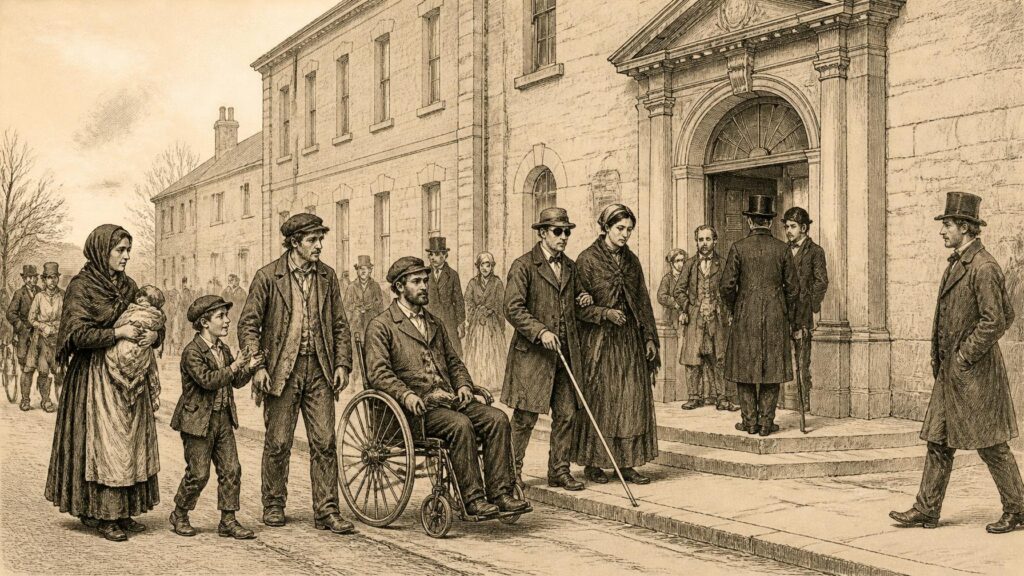
AI generated historical illustration, not a contemporary photograph.
At a Glance
The history of disability rights in Ireland is inseparable from the history of public services: from the workhouse and county home to the school, clinic, bus, council office and courtroom. It is a story of care and exclusion existing together, of voluntary endeavour filling gaps left by the State, and of disabled people gradually asserting a right not merely to assistance but to equal citizenship, voice and control.
Public Boundaries
“Disability rights and public services” can sound like a modern subject, formed by international conventions, equality legislation and the vocabulary of accessibility. In Ireland, however, the question has a much longer history. It concerns who was counted as a citizen, who was treated as a patient or dependent, who could enter public buildings, travel, attend school, obtain work or make decisions, and who was expected to remain within family, charitable or institutional care. The answers changed over time, but not in a simple line from exclusion to inclusion.
For much of the nineteenth and twentieth centuries, disability was approached primarily through relief, medicine, education, charity and social control. The categories used by officials were often harsh and reductive. Historical records employed terms now rightly rejected, and they frequently grouped people with very different impairments, circumstances and wishes under one administrative heading. Such language should not be repeated casually, but it cannot be ignored: it reveals the assumptions through which public authorities allocated money, beds, schooling and supervision.
Public services were never provided by the State alone. Religious congregations, charitable associations, mutual aid, families and local communities all did work that governments did not undertake, could not undertake, or chose to leave to others. Institutions for blind and deaf people, schools, homes, hospitals and organisations supporting people with intellectual disabilities commonly depended on this mixed system. The pattern gave many services a durable presence, yet it also made access uneven. A person’s prospects could depend on county, denomination, family resources, the availability of a voluntary body, or a local official’s judgement.
The historical evidence therefore requires care. Laws, official reports and departmental strategies show what authorities promised or intended. They do not by themselves demonstrate that a ramp was installed, a classroom support arrived, an assessment was timely, or a person was enabled to live independently. Personal testimony and the work of disabled people’s organisations are essential for recovering experience, though surviving records are uneven. Where this article describes broad change, it distinguishes documented policy from interpretation. It does not treat later rights language as though it had governed earlier lives.
Poor Law
Nineteenth-century Irish public provision was shaped above all by the Poor Law. The Irish Poor Law Act of 1838 created a network of unions and workhouses, supervised through central administration but operated locally. Its principal object was relief of destitution, not the recognition of disability rights. Yet people with impairments were among those drawn into its system, especially where poverty, age, illness, lack of family support or unemployment made life precarious. The workhouse was not designed as a disability service, but it became part of the environment in which disabled people lived.
That fact matters because the workhouse combined aid with discipline. Admission could mean food, shelter and medical attention, but also the loss of domestic independence, separation from family, institutional routine and stigma. A person whose mobility, communication or mental health needs could not be met in ordinary employment or household life might be classified first as poor, infirm, sick or disorderly rather than as a holder of rights. The public response was organised around dependency and scarcity. It was not organised around participation in community life.
Specialist institutions also emerged during the nineteenth century, including educational and residential provision for blind and deaf people. These developments were important and often founded by committed individuals. They could offer learning, training and companionship unavailable elsewhere. Nevertheless, they were usually separate establishments, created because ordinary schools and public life were not adapted to include disabled people. Their existence should not be represented simply as benevolence or simply as oppression. They provided real support, while also reflecting a society that commonly placed disability outside the mainstream.
Medical and psychiatric provision operated in a related manner. District asylums, infirmaries and later hospitals were created within changing legal and professional frameworks. They were not identical to workhouses, and the experiences of people within them differed greatly. Yet the underlying tendency was frequently to define difficulty as something to be managed by experts and institutions. This was particularly consequential for people with mental health conditions and people then described through categories of “mental deficiency”. Decisions about residence, work, family contact and liberty could be made with little meaningful participation by the person affected.
It would be misleading to impose a uniform story on every locality. Families often cared for relatives at home; neighbours offered help; religious and voluntary agencies sometimes developed services before public authorities did. But family care was not automatically a free choice, particularly for women whose unpaid labour sustained it. Nor should local support be romanticised. The historical record demonstrates a patchwork of assistance, not an assured entitlement. In that patchwork, disability could intensify the danger of poverty, isolation and institutionalisation.
Institutional Lives
After independence, the Irish Free State inherited a fragmented welfare landscape. Poor-law institutions did not disappear overnight. The Local Government (Temporary Provisions) Act 1923 brought public-assistance administration formally into the new State, while county homes succeeded many workhouses. These establishments accommodated diverse groups of people: older people, people without housing, unmarried mothers and children, people with physical impairments, and people whom official language classified as intellectually disabled or mentally ill. Such mixing was itself revealing. Need was managed through institutional capacity rather than through services designed around individual rights.
County homes and related institutions cannot be understood merely as buildings. They were systems of authority. Admission, discipline, work, visiting, discharge and access to medical care were governed by rules and by the practical power of managers, local authorities, doctors and religious personnel. Some residents found security in a setting that supplied food and shelter. Others experienced confinement, neglect or the absence of alternatives. Archival and investigative material has made it increasingly difficult to sustain older comforting assumptions that institutional care was necessarily protective because it was called care.
The institutional model also survived in specialist settings. Large congregated residential services for people with intellectual disabilities or autism, and residential arrangements for people with physical or sensory impairments, expanded in parts of the twentieth century. Their growth was connected to changing medical ideas, the work of voluntary organisations, religious provision, parental anxieties and the limited development of home-based supports. Many staff and families acted with commitment in circumstances of limited resources. That acknowledgement is compatible with a clear historical conclusion: segregated services restricted ordinary opportunities to choose where and with whom to live.
The distinction between public and private responsibility was blurred. The State funded, regulated or relied upon bodies that were not State agencies, while families were expected to shoulder much of the daily work. This arrangement could obscure accountability. When services were inadequate, responsibility might be shifted between departments, local authorities, health boards, voluntary providers and families. People using services had little leverage where no clear enforceable entitlement existed. A place in an institution was more easily counted and funded than a package of flexible support in an ordinary home.
Later policy language of deinstitutionalisation should therefore be read against this history. It was not only a question of closing large settings. It involved a different idea of public duty: that a person should receive support enabling life in the community, rather than be required to enter a segregated setting in order to receive support. That principle developed gradually and has remained incomplete. The persistence of congregated arrangements, waiting lists and uneven local provision has repeatedly shown the distance between a policy aspiration and daily reality.
Voluntary Foundations
Voluntary organisations occupy a central place in Irish disability history. They developed education, training, residential services, advocacy, family support and social opportunities long before the modern disability strategy. Their work emerged partly from philanthropy and religious mission, partly from self-help, and partly from families responding to the lack of public provision. To write them out of the history would be inaccurate. To treat voluntary action as an adequate substitute for public responsibility would be equally inaccurate.
The voluntary sector was not a single voice. Organisations differed in constituency, outlook and method. Some centred medical rehabilitation, some charity, some parental support, some service delivery, and some the collective self-representation of disabled people. These distinctions became increasingly significant as disability politics changed. A service provider may speak from professional knowledge and long experience; a disabled persons’ organisation claims a different authority, grounded in lived experience and in the political principle that people affected by policy should shape it.
For much of the twentieth century, voluntary provision was commonly associated with a charitable model. Donations, fundraising and public sympathy could deliver valuable practical assistance, but they also risked representing disabled people principally as recipients of pity. The public image of disability was often made through appeals for generosity rather than arguments for equal access, income security, accessible transport or control over personal support. The charitable model did not necessarily deny dignity, but it could make rights appear conditional on benevolence.
Religious congregations were especially influential in health, education and social care. Their role cannot be summarised in one moral judgement. They created and staffed services in periods when the Irish State’s direct capacity was limited; they also exercised extensive authority over institutional lives. The historical lesson is structural rather than partisan. When public systems depend heavily on non-state bodies, the lines of accountability, inspection and individual redress must be especially clear. In earlier decades they were often not.
By the later twentieth century, disability advocacy increasingly questioned arrangements in which professionals, charities or families spoke for people without ensuring their direct participation. This challenge was part of a wider international movement but had a specifically Irish setting. It arose from the practical difficulties of inaccessible streets and services, segregated education, lack of personal assistance, dependence on institutions and exclusion from employment. The demand was not that assistance disappear. It was that assistance be controlled, accessible and directed towards citizenship rather than dependency.
Changing Language
Changes in language did not by themselves transform services, but they indicate important shifts in public understanding. Earlier policy often located disability in an individual body or mind that required cure, training, supervision or special treatment. This is usually described as a medical model. It can be too crude if used to dismiss all medical support, which many people need and value. Its historical limitation was that it made the person’s impairment seem the main explanation for exclusion, while leaving inaccessible institutions and social prejudice comparatively unexamined.
The social model, developed through disability activism and scholarship, redirected attention towards barriers. A wheelchair user excluded from a public office by steps, a deaf person unable to use a service without communication support, or a person with an intellectual disability denied understandable information is not excluded solely because of an impairment. Exclusion is produced through the interaction between a person and an environment organised without them in mind. This way of thinking helped recast accessibility as a matter of design and public responsibility.
Irish policy development from the 1980s and especially the 1990s shows this transition. The National Disability Authority’s account of the period identifies a move away from an approach located chiefly in health policy and heavily dependent on voluntary provision, towards equality and participation. This did not mean that health and social care ceased to matter. Rather, disability came to be recognised as relevant to every department and every public service: transport, housing, education, communications, employment, culture, justice and local government.
The establishment in 1993 of a Government department with responsibility for equality and law reform was an institutional marker of this change. In November that year, the Minister established the Commission on the Status of People with Disabilities. The Commission conducted a major consultative process and reported in 1996 under the title A Strategy for Equality. Its significance lay partly in its breadth. It did not reduce disability to one service system. It considered the conditions required for disabled people to participate as equal members of society.
This was a turning point, not a finishing line. Reports can create a public language, identify failures and recommend reforms, but they require political decisions, funding and administrative follow-through. Nor did the equality perspective erase disagreements. There were and remain difficult questions about scarce resources, the relation between universal services and specialist supports, and who should decide what support is appropriate. The contribution of rights thinking was to insist that these questions must be addressed with disabled people as citizens, not merely as objects of professional assessment.
Equality Measures
The late 1990s and early 2000s brought a more explicit legislative framework. The Equal Status Act 2000 prohibited discrimination in the provision of goods and services, accommodation, education and certain other fields. Its disability provisions were especially important for public life. The Act treated discrimination as including a service provider’s refusal or failure to do what was reasonable to accommodate a disabled person’s needs, where otherwise use of the service would be impossible or unduly difficult.
This was a notable legal departure from older assumptions. Access was no longer framed only as a discretionary improvement or a charitable concession. A service provider could have a duty to alter arrangements. Yet the legal formula also contained limits. The Act’s treatment of reasonable accommodation included a cost threshold, and rights in practice depended on individuals knowing the law, bringing complaints and obtaining remedies. A statutory protection is powerful, but it is not self-executing. It does not automatically remove a step, produce an interpreter or end a waiting list.
The Disability Act 2005 placed particular duties on public bodies. It addressed access to public buildings, public services, information and heritage sites; provided for access officers; required sectoral plans from specified government departments; and included provisions relating to public-service employment. It also established arrangements for independent assessments of need and service statements, initially phased by age. The Act represented the State’s acceptance that disability must be considered within mainstream administration rather than left solely to specialist agencies.
The wording of the Act is historically revealing. Public bodies were required to ensure, so far as practicable, that their public buildings were accessible. The phrase recognised practical constraints, but it also left room for argument about what was practicable and how quickly change must occur. In this respect, the Act combined aspiration, administrative machinery and qualification. Its importance should not be diminished; equally, it should not be treated as an unconditional guarantee that every need identified would be met.
Sectoral planning expressed the policy of mainstreaming. Mainstreaming meant that ordinary departments and services should incorporate disabled people rather than assume another body would deal with them. The idea had considerable democratic force. It implied that a person should not have to enter a separate system to access transport, public information, employment services or civic participation. Its weakness, where implementation was poor, was that responsibility could become diffuse. If everyone is responsible in principle, clear leadership and measurable duties remain necessary in practice.
Service Reform
Health and personal social services remained central to disability policy even as policy broadened beyond health. The Health Service Executive, established in 2005, inherited a complex service landscape shaped by former health boards, voluntary agencies and local arrangements. Assessment, therapy, respite, residential support, personal assistance and family services could be experienced very differently across the country. The existence of a national structure did not instantly produce uniform provision.
The assessment-of-need provisions of the Disability Act are an instructive example. An assessment was intended to identify health and education needs without regard to the cost or capacity to provide a service. That separation was significant: it allowed need to be recognised independently of the resources currently available. However, recognition and delivery were not identical. A service statement could set out services that would be provided, but the wider statutory framework did not create an unlimited individually enforceable right to every support identified as appropriate. This gap has been a persistent subject of criticism.
The 2012 Value for Money and Policy Review of Disability Services became another important landmark. It promoted person-centred supports, greater individualisation, and movement away from segregated service models. The Transforming Lives programme was established to implement its recommendations. In historical terms, the review belongs to a wider shift from funding places in services towards supporting people in ordinary communities. That shift is conceptually profound, because it changes the question from “Which institution can accommodate this person?” to “What support does this person require to live the life they choose?”
Such reform is difficult. Large organisations, established funding arrangements and workforce patterns cannot be remade by policy language alone. Community living requires housing, transport, accessible healthcare, personal assistance, appropriate communication, local social networks and safeguards against isolation. Closing an institution without creating these supports can simply transfer risk. Conversely, retaining institutional placements because community supports are incomplete can perpetuate segregation. Historical judgement must acknowledge this tension rather than assume that one administrative act resolves it.
Independent living has been particularly important to activists and disabled people’s organisations. It does not mean doing everything without assistance. In its rights-based meaning, it concerns control over one’s life, the ability to make choices and access to support on terms that do not require surrendering ordinary citizenship. Personal-assistance services, accessible housing and decision-making supports are therefore not peripheral benefits. They are among the practical foundations on which equal participation rests.
Learning Access
Education offers a clear view of the changing relationship between segregation and inclusion. For much of Irish history, many children with disabilities had limited access to formal education, or were directed towards separate schools and classes. Specialised provision could offer expertise and tailored teaching, particularly where ordinary schools offered none. But separation also reflected low expectations and restricted social contact. Whether a setting was experienced as enabling or excluding depended on its quality, the wishes of the child and family, and the real alternatives available.
The Special Education Review Committee report of 1993 is widely treated as a watershed in the development of Irish educational policy. It helped advance the case for more systematic provision, while later measures created the National Educational Psychological Service and the National Council for Special Education. The Education for Persons with Special Educational Needs Act 2004 set out a framework concerned with assessment, educational planning and the education of children with special educational needs in inclusive environments where this was in the child’s best interests.
Again, the legislation must be read as an important milestone rather than as proof of complete delivery. Parents and pupils have often encountered difficulties obtaining assessments, school places, therapies, special-needs assistance and suitable transport. Public debate has sometimes presented these as recent administrative problems, but their deeper history lies in a long-standing mismatch between recognised need and available provision. Rights language has made that mismatch more visible because it gives people grounds on which to question official decisions.
Inclusive education is not achieved merely by placing a pupil in a mainstream building. It requires curriculum access, trained staff, communication supports, sensory and physical accessibility, anti-bullying measures and respect for the pupil’s own voice. Nor is inclusion identical for every child. Deaf culture, sign language, specialist knowledge and peer community can all matter profoundly. A historical account should resist false choices between a romantic image of special provision and a simplistic declaration that every mainstream setting is automatically inclusive.
The wider lesson extends beyond schools. Access is relational. It concerns whether institutions adapt their methods, information and environment so that people can participate on equal terms. Educational history shows why consultation matters. Services designed without listening to those who use them may meet an administrative target while failing to meet a person’s life.
Accessible Citizenship
Transport, information and the built environment have increasingly become central to disability rights because they determine whether other services can be used. A health appointment is of limited value if accessible transport is unavailable. A public consultation is not truly open if its documents cannot be read with assistive technology or understood in plain language. A public building cannot be called fully public when steps, poor signage, inaccessible toilets or communication barriers prevent entry.
The Disability Act 2005 addressed several of these matters directly, including access to public buildings, services and information. The requirement for public bodies to appoint access officers provided an identifiable point of contact for people seeking help with services. This was administratively modest but symbolically important. It recognised that access problems should not be treated as private inconveniences to be solved individually. They arose from the manner in which public bodies designed and delivered services.
Universal design became influential in this context. Rather than adapting only after an individual encounters a barrier, universal design seeks to make products, places and services usable by the widest range of people from the outset. In Ireland, the Centre for Excellence in Universal Design was given a statutory basis through the Disability Act. The concept has practical relevance far beyond architecture: websites, forms, public notices, ticketing systems, emergency information and procurement decisions all affect access.
There is an interpretive point here. Accessibility is sometimes discussed as a technical matter, concerned with measurements, signage or digital standards. Those details are indispensable, but they are also political. They express whose presence has been anticipated. A public authority that designs only for an imagined average user places the burden of adjustment on everyone else. Accessible design redistributes that burden towards the institution, where it can be planned, budgeted and reviewed.
Progress should therefore be measured not only by the number of policies adopted but by the ordinary ease with which disabled people can use public services. Can a person obtain clear information, enter a building, communicate with staff, make a complaint, travel independently, vote, study, work and take part in local life? These questions make rights concrete. They also show why disability policy cannot be confined to one ministerial portfolio.
International Rights
Ireland signed the United Nations Convention on the Rights of Persons with Disabilities in 2007 and ratified it in March 2018. Ratification was both a legal and political landmark. The Convention presents disabled people as holders of all human rights and fundamental freedoms, and it addresses equality, accessibility, independent living, education, employment, participation, legal capacity and freedom from exploitation and abuse. It gave Irish policy a further rights-based reference point and connected domestic debates to an international framework.
The time between signature and ratification is historically significant. It reflects the complexity of preparing domestic law and institutions, particularly in relation to decision-making capacity. The Assisted Decision-Making (Capacity) Act 2015 formed part of the wider movement away from substitute decision-making and towards supports that help people exercise their will and preferences. This is an area in which language matters greatly. For generations, disability could lead others to assume that protection required control. Contemporary rights standards challenge that assumption without denying the need for safeguards against abuse and undue influence.
Ratification did not settle every question. International conventions require implementation through domestic law, budgets, policies and administrative practice. Ireland’s reporting obligations, and the scrutiny that accompanies them, are valuable precisely because they expose the difference between commitments and outcomes. The State’s first report to the United Nations Committee on the Rights of Persons with Disabilities was submitted in 2021. Such reporting is not a historical endpoint; it is part of an ongoing process in which civil society, representative organisations and public bodies debate evidence and accountability.
The most important change in this period has been the strengthening of the principle “nothing about us without us”, though the phrase itself has many international roots. Disabled people’s representative organisations have pressed for direct participation in policy design, monitoring and service reform. This is more than consultation etiquette. People who encounter inaccessible systems possess knowledge that cannot be supplied fully by professional reports. Their participation changes what counts as a problem and what counts as a successful service.
There remains a risk that rights language becomes ceremonial. Governments may endorse inclusion while services remain difficult to obtain; organisations may consult while retaining all decisive power; buildings may become more accessible while people cannot secure the supports needed to leave their homes. These are not reasons to dismiss rights. They are reasons to insist that rights require institutions capable of delivering them, remedies when they fail, and disabled people with power to influence the terms of delivery.
Unfinished Duties
The long history of disability and public services in Ireland does not support a triumphal narrative. There has been substantial change: from poor relief and segregated care towards equality law, mainstreaming, accessibility duties, individualised support and international human-rights commitments. Older forms of exclusion have been named and challenged. Public bodies now have responsibilities that would have been difficult to articulate in earlier eras. Disabled people’s voices are more visible in public debate and policy formation.
Yet the older history remains present in institutional habits. Services can still be organised around professional convenience rather than personal choice. Families may still supply support where public provision is inadequate. Funding structures may still favour established institutions over flexible community assistance. Geographic inequalities, inaccessible information, delays, staffing shortages and opaque assessment processes can turn formal entitlement into an exhausting contest. In this sense, the past survives not only in buildings but in administrative assumptions about who must adapt to whom.
Historical evidence also cautions against treating disabled people as one homogeneous group. The experience of a blind person, a deaf sign-language user, a wheelchair user, a person with an intellectual disability, an autistic person, a person with a psychosocial disability, or someone with fluctuating chronic illness may differ sharply. Age, class, gender, rural location, ethnicity and family circumstances alter encounters with services. A rights-based public system must recognise those differences without using them as a reason to fragment responsibility.
The central historical transformation has been a change in the terms of the question. Earlier public systems often asked how a person could be accommodated, supervised, treated or relieved. The rights-based approach asks what barriers public institutions create, what supports are required for equal participation, and how the person concerned can exercise choice and influence. That transformation is documented in Irish legislation, strategies and international commitments. Its full realisation, however, depends on the ordinary work of public services and on the continued political force of disabled people themselves.
Irish disability history is therefore public-service history in the broadest sense. It concerns the distribution of resources, the design of common spaces, the authority to make decisions and the meaning of citizenship. The record contains care, ingenuity and committed advocacy, but also exclusion and avoidable dependence. Remembering both is necessary. It prevents nostalgia for segregated systems and prevents complacency about modern ones. Equal access is not a completed inheritance; it is an unfinished public duty.

The article’s most striking theme is the gap between formal rights and lived access. Ireland’s movement from poor relief, institutional care and charitable provision towards equality law reframed disabled people as citizens entitled to participation, yet responsibility has often remained dispersed among public bodies, voluntary organisations and families. This raises comparison between legal progress and administrative practice: access officers, reasonable accommodation and sectoral planning may signal commitment, but their effect depends on resources, enforcement and disabled people’s influence over decisions. How should Ireland assess whether public services deliver independent living and equal citizenship, rather than recording compliance with rights-based policy?